

Infrared heating in the workshop: calculate the required power
, by Warmteshop, 17 min read
For an enclosed garage, you can calculate the required power for infrared heating as a first guideline at 80-120 watts per m². Infrared heating in a workshop heats people and objects directly, so…
For an enclosed garage, you can calculate the required power for infrared heating as a first guideline at 80-120 watts per m². Infrared heating in a workshop heats people and objects directly, so the heat is primarily directed where you work.
A cold workshop quickly feels uncomfortable, especially if you don't need to constantly heat the entire space. The right infrared heating for your workshop therefore depends not only on the floor area, but also on the insulation, ceiling height, and layout of your work zones. In this article, you will learn how infrared radiation works, how to estimate the required power, and what to look out for during installation. This way, you can better tailor the installation to daily use.
The correct mounting height depends on the ceiling, the type of heater, and your work location. Therefore, match the power to the individual work zones, not just the total floor area.
Start by measuring the ceiling height and mark the fixed workstations. For an enclosed garage with a ceiling up to 2.5 meters, a panel or 1.5-2 kW is often sufficient. For work zones under ceilings of 2.5 to 3.5 meters, 1.5-3 kW per zone serves as a guideline.
A higher ceiling requires a different distribution of radiation. Also take into account objects, machines, and shelving, as these can block heat. Distribute the heaters across areas where you stand or work for extended periods. This way, you direct the heat towards the user and prevent a device from heating an empty zone.
A ceiling panel keeps the floor clear and radiates heat downwards. This is suitable for a fixed work zone, such as a workbench under a high ceiling. A freestanding infrared heater is portable when your workspace changes. Choose this option if you need temporary heat near a vehicle or machine.
Wall mounting works if the radiation falls directly onto the work zone from the side. Ceiling mounting directs the heat from above and is suitable for large industrial workshops. Determine the position based on the ceiling height, workstations, and potential obstacles.
A ceiling panel requires a location with unobstructed radiation space. Before installation, check whether beams, lighting, or stored materials block the heat path. For ceilings of 2.5 to 3.5 meters, you can use the guideline value of 1.5-3 kW per zone as a starting point.
First, map out the work zones on a simple floor plan. Position the heaters so that their radiation fields reach the areas being used. In a large room, multiple ceiling panels can direct the heat downwards. Take into account shelving and machinery, which can block the radiation.
For even distribution, the distance between the units is just as important as their power. Do not aim a heater solely at the center of the floor when you primarily work along a workbench. Infrared heating for targeted heat can be selected based on this layout.
What does infrared heating for a workshop cost, including installation? The total cost depends on the number of heaters, the chosen power output, and the required installation. Mounting to the wall or ceiling and any modifications to the electrical connection also determine the installation costs.
Is infrared heating suitable for high ceilings, drafty rooms, and poor insulation? Infrared can heat work zones directly, but the mounting height and power must match the room. Drafts and poor insulation affect heat loss. Therefore, direct the radiation towards the areas where people work.
Are there subsidies or tax benefits in the Netherlands for infrared heating in commercial buildings? A potential benefit depends on the scheme, the type of installation, and the company's situation. Therefore, do not include any subsidy or tax benefit as a fixed discount in your calculation.
Infrared heats people and objects directly. Electric panels distribute that radiant heat. Therefore, for a workshop, both the required power and the available electrical connection are important.
First, add up the power of the heaters that are switched on simultaneously. A standard 16-amp circuit supplies approximately 3,680 watts. A 3,000-watt appliance draws about 13 amperes, leaving less headroom on the same circuit for other electrical appliances.
Therefore, check which machines, lighting, and heating operate together on a single circuit. Compare their simultaneous use with the total power consumption of the heaters. A 3,000-watt heater and a bench machine can together approach the available capacity. The required connection depends on that combination.
From approximately 4,500 watts, a 400-volt connection is often required for workshop heaters. This is relevant when multiple powerful units need to supply heat simultaneously. With a lower total power output, a 230-volt connection may be suitable, depending on the total load. Ensure the chosen setup matches the workshop's electrical situation.
Also take the system's usage into account. If not all devices are switched on simultaneously, the peak load differs from a situation where they run continuously together. Note which heater you want to use and when for each work zone. This will give you a practical idea of the required connection.
Infrared heating can serve as primary or supplementary heating. As primary heating, you adjust the system to the room and the desired temperature. The radiation heats people and objects directly, so that the ambient air does not need to reach the desired temperature first.
For primary heating, distribute the panels across the areas requiring heat, such as a fixed workbench and an assembly zone. Position them so that machines, shelving, or stored materials do not block the radiation. The connection capacity determines how much power you can use simultaneously.
For supplementary heating, limit the heat to a specific work zone. This is suitable, for example, if you do not continuously heat the entire workshop. A directional heater then supplements an existing heating system. Adjust the output to the location and the duration of use.
Electric heating converts electricity into heat; the chosen energy source determines how that electricity is generated. If you want to compare models for various applications, take a look at the infrared heating for workspaces. This allows you to tailor your choice of panels to zones, usage, and connection.
Select the capacity based on the space requiring heat, not just the floor area. The heated volume and the application together determine which configuration is suitable.
First, note the dimensions of the workshop and calculate the volume: length × width × height. A space of 9 by 3 meters with a volume of 40 m³ shows why ceiling height matters. Therefore, two workshops with the same floor area can have different heating volumes.
Next, consider the insulation, desired temperature, and duration of use. A room that is often open requires a different approach than an enclosed workshop. Also, determine whether you want to heat the entire room or just a work zone. This way, you match the output to the heat you actually need.
According to the stated guideline, a 600-watt infrared panel can heat approximately 15 to 20 m³. Use this as a reference for the volume, not as a fixed result for every workshop. A high ceiling, poor insulation, or a different desired temperature affects how the heat is perceived.
Compare the calculated volume with the zone you want to heat. If a panel needs to heat a defined area, such as a workbench, the total building volume is less decisive than that work zone. Note the dimensions and desired temperature for each zone. This prevents you from selecting power based solely on floor area.
A practical approach consists of three steps: measure the length, width, and height; calculate the volume; then determine which parts regularly require heat. In a storage area, this may be a different zone than the place where you work daily. The application therefore partly determines where the heat needs to be directed.
For larger areas, infrared panels are available with varying power outputs. The Ecosun IKP series ranges from 300 to 750 watts; an adjustable infrared heater has a power output of 1,000 watts. Such figures help with comparison, but do not indicate in themselves how comfortably a room will become. Also consider volume, placement, and intended use.
A higher output may be suitable for a larger or heavily used zone. Distribute the heat across multiple locations where necessary so that the coverage aligns with the work layout. For temporary use, a portable heater can be convenient; a fixed work zone may require a permanent setup. Base your choice on where people and objects require heat.
Finally, compare the calculated space with the specified heating capacity of the panel. At 600 watts and approximately 15 to 20 m³, you have a concrete starting point. Use this in conjunction with insulation, desired temperature, and zone layout so that the power matches daily use.
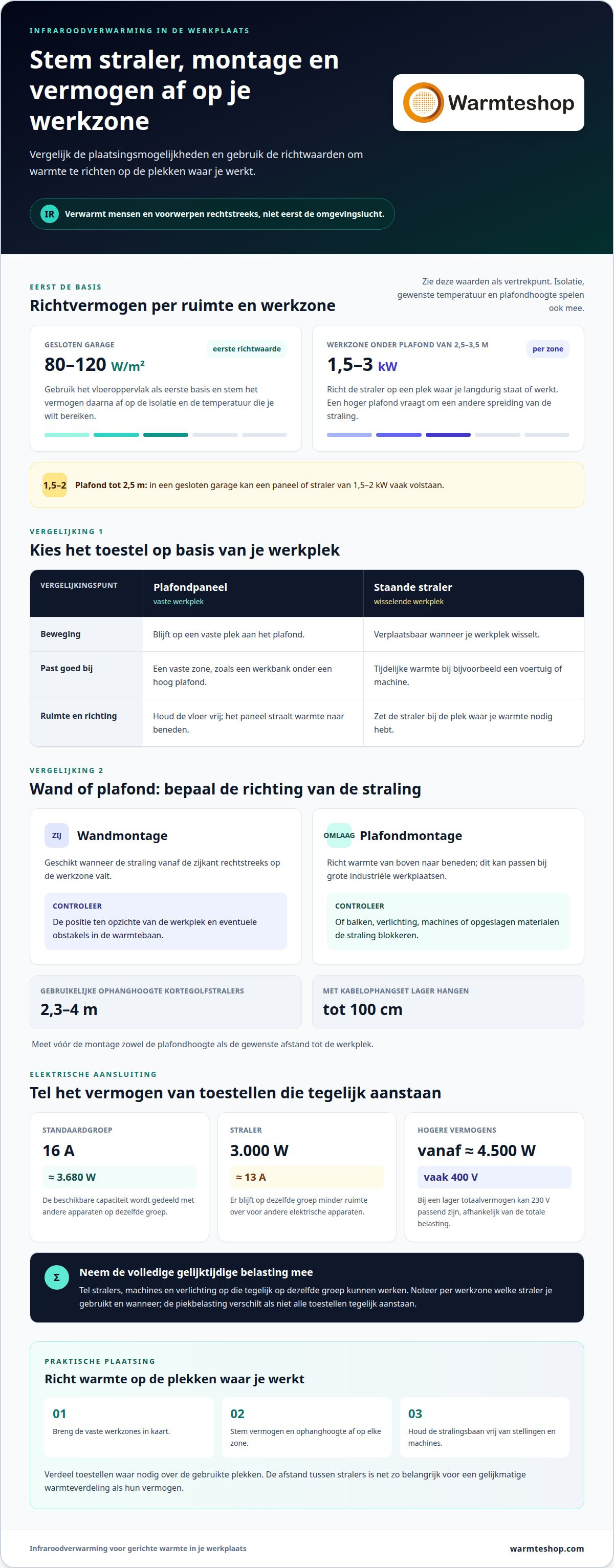
For an enclosed garage, use 80-120 watts per m² as a starting guideline. Multiply the floor area by that range and then adjust the result based on insulation, ceiling height, and desired temperature.
First, measure the length and width of the space. Multiply those measurements for the floor area in square meters. Then, multiply that result by 80 and by 120 watts. This will give you an initial power range for an enclosed garage.
An example from a workshop description is 3.3 m x 4.9 m. Note down those dimensions, calculate the floor area, and only then apply the guideline value per m². This keeps the calculation verifiable. Do not simply round the result to a single appliance capacity; also compare the distribution across the work zones.
The target value is a starting point, not a universal outcome for every workshop. A flat, uninsulated roof and a cavity wall, for example, are characteristics of the described workshop. Such properties influence how much heat the space retains. Therefore, also include the roof, walls, doors, and usage in your assessment.
Next, determine the desired temperature and how long the workspace will be used. A zone that only requires heat during work differs from a room that needs to maintain a constant temperature. Also, check if doors are frequently left open. This prevents the calculation from relying solely on the floor area.
Create a floor plan and mark the workbench, machines, and walkways. Determine for each zone where people need heat and which objects might block the radiation. This way, you can see whether a single heater reaches the desired spot or if multiple devices distribute the heat better.
Note the desired power per zone and add up the values. Compare that sum with the initial calculation based on square meters. A difference may mean that you need to reconsider the zone layout, insulation, or lifespan. Do not choose appliances based solely on their total wattage.
A thermostat switches the heater on and off around the set temperature. As a result, the device does not have to operate continuously at full power as soon as the workspace is warm enough. Place the thermostat in a location where it accurately measures the temperature of the used zone.
A proper calculation therefore involves more than just watts per m². Check the surface area, heat losses, work zones, and controls in succession. Also note where the panels are installed and which areas have a clear view of the radiation. This way, you link the calculated power to the actual use of the workshop.
A workshop does not always need to be heated in its entirety. Targeted infrared radiation can, for example, heat a workbench, vehicle, or fixed assembly station. This ensures the heat is directed to a specific location, even if large doors are frequently opened. The right choice depends on the work layout, duration of use, and desired temperature.
Upon switching on, the heat is immediately noticeable. An infrared heater reaches the desired temperature within 10 minutes. This is suitable for workplaces that are not occupied all day: you heat the zone when needed. In industrial workshops, short-wave infrared heating is often used for rapid, instantly perceptible heat transfer.
In a garage or auto workshop, targeted radiation can heat employees and vehicles without first heating the entire air. This is practical with open doors, as you direct the heater towards an in-use zone. A heater that heats the entire room has a different purpose: a broader and more even temperature distribution.
With infrared panels, heat can be transferred without air circulation distributing it. According to the available product information, this results in less dust being released into the air. This can be relevant for sanding, woodworking, or working on parts where dust is a nuisance. Furthermore, the panels require little maintenance. When installing, take into account machines and shelving that could block the radiation.
You can combine infrared with a conventional system that provides the base heat. The existing system then takes care of the general temperature, while heaters direct extra heat to occupied work zones. This allows you to tailor comfort to the work activities, without constantly keeping unused areas equally warm. This can be suitable for a large workshop with a fixed assembly area.
A thermostat switches the heater on and off around the set temperature. According to the specified guideline, practical consumption amounts to approximately 60 to 75 percent of full power. That percentage is not a fixed value for every workshop: operating time, settings, and heat loss play a role. Therefore, compare not only the specified wattage but also how long and where you need heat.
Infrared heating can run on green energy sources such as solar panels and function emission-free. The combination makes the biggest difference when generation and heating usage are well matched. For industrial applications, correct installation and compliance with safety regulations are important. Choose a setup that suits the work zone, power output, and electrical connection.
Would you like to compare applications for a workspace side by side? Then compare infrared heating for different work zones and tailor your choice to your daily work activities.
Warmteshop helps you choose a suitable solution based on the work zones, the required power, and the installation location. An infrared panel, for example, can radiate heat to a fixed workstation. The correct setup depends on the space and usage. This is how you translate the calculation in this article into a concrete choice.
Check which type of panel suits your workshop and determine whether you want to heat a fixed zone or multiple areas. Warmteshop also offers infrared mirrors and infrared glass heating for spaces where those applications are suitable.
Would you like to discuss your situation or explore the possibilities? Contact Warmteshop or visit warmteshop.com.
As the next step, look at your workday: which areas do you use the most, and where does the layout change regularly? Put those zones on paper in advance. This way, you make a choice that aligns with your work activities and prevent heat from ending up primarily in places where you spend little time. In this way, infrared heating for the workshop becomes part of a well-thought-out layout, not a separate addition.
Warmteshop offers infrared heating and infrared panels for targeted heat. Infrared mirrors are also part of the range, for spaces where this application is suitable. Determine which solution suits your workplace and discuss the possibilities to tailor your choice to your situation.
Contact Warmteshop and take a suitable next step for a more comfortable workplace.
The number depends on the work zones, the desired range, and the power per device. For example, draw a floor plan showing the workbench, machines, and places where you frequently stand. Then check whether a single emitter reaches those spots without shelving or vehicles blocking the radiation. For separate zones, distribution across multiple emitters is sometimes more practical than a single device in the middle of the room.
That depends on energy prices, usage time, and how much heat you need. A diesel heater or hot air blower can easily consume 1 to 2 liters of fuel per hour. Therefore, compare the energy consumption of both options during the same usage, including the parts of the workshop you are heating. Targeted radiation may be suitable if you primarily want to heat a fixed workstation, not the entire room.
Yes, infrared heating is suitable for industrial applications provided the installation is carried out correctly and complies with safety regulations. When setting up, take into account the distance to materials, machines, and workstations. Also ensure that stored goods do not shield the radiation. An unobstructed, targeted placement helps direct the heat to the intended zone.
Yes, a portable panel is suitable for work where you frequently change positions. Portable infrared panels are available with a power output of 350 or 700 watts. During use, position the panel so that the radiation reaches the workspace and does not fall on cabinets or machines. For a fixed workbench, permanent mounting may be more convenient than moving it repeatedly.
No, not if you primarily work in specific areas. A heater, for example, can direct heat onto a workbench, while a storage zone is used less frequently. First, map out where employees actually stand and what tasks they perform there. This way, you can choose between heating the entire space and localized heat, tailored to daily usage.
The mounting height depends on the type of heater and the ceiling height. Short-wave heaters are typically mounted at a height of 2.3 to 4 meters. Then, determine the number of units based on the work zones and the locations with a clear view of the radiation. A cable suspension kit allows a panel or heater to hang up to 100 centimeters lower.
Compare the power output, the type of heater, and the location where you want to mount the device. Also consider the electrical connection and other appliances that will be used simultaneously on the same circuit. A device suitable for a high work zone may be less suitable for a low workbench. Therefore, check whether the range matches the dimensions and layout of your workspace.
An infrared heater emits heat to people and objects, rather than first heating the air. A workbench and tools within the radiation field absorb that heat. This allows you to direct the heater to the area where you are working. This differs from an electric convection heater, which primarily heats the ambient air.


