

4 comfort benefits of infrared heating upon returning home
, by Warmteshop, 16 min read
, by Warmteshop, 16 min read
Coming home to a warm home isn't just about the temperature on the thermostat. Infrared heating directs heat at people and surfaces, so you can experience the comfort of direct warmth when you come home without first having to…
Coming home to a warm place isn't just about the temperature on the thermostat. Infrared heating directs heat at people and surfaces, so you can experience the comfort of direct warmth when you come home without first having to bring the entire room to the same temperature. The radiant heat operates quietly and causes fewer drafts than heating that primarily heats the air.
A cold spot by the sofa or a draft along the windows can significantly reduce your comfort at home. You might be wondering whether infrared heating is pleasant for daily use and exactly how this technology works.
In this article, you will read about four comfort benefits: targeted heat where you need it, reduced air circulation, an even heat experience, and the ability to heat separate zones. You will also discover why the placement and characteristics of your home matter. This will give you a clear picture of what infrared heating can mean for a quiet, pleasant homecoming.
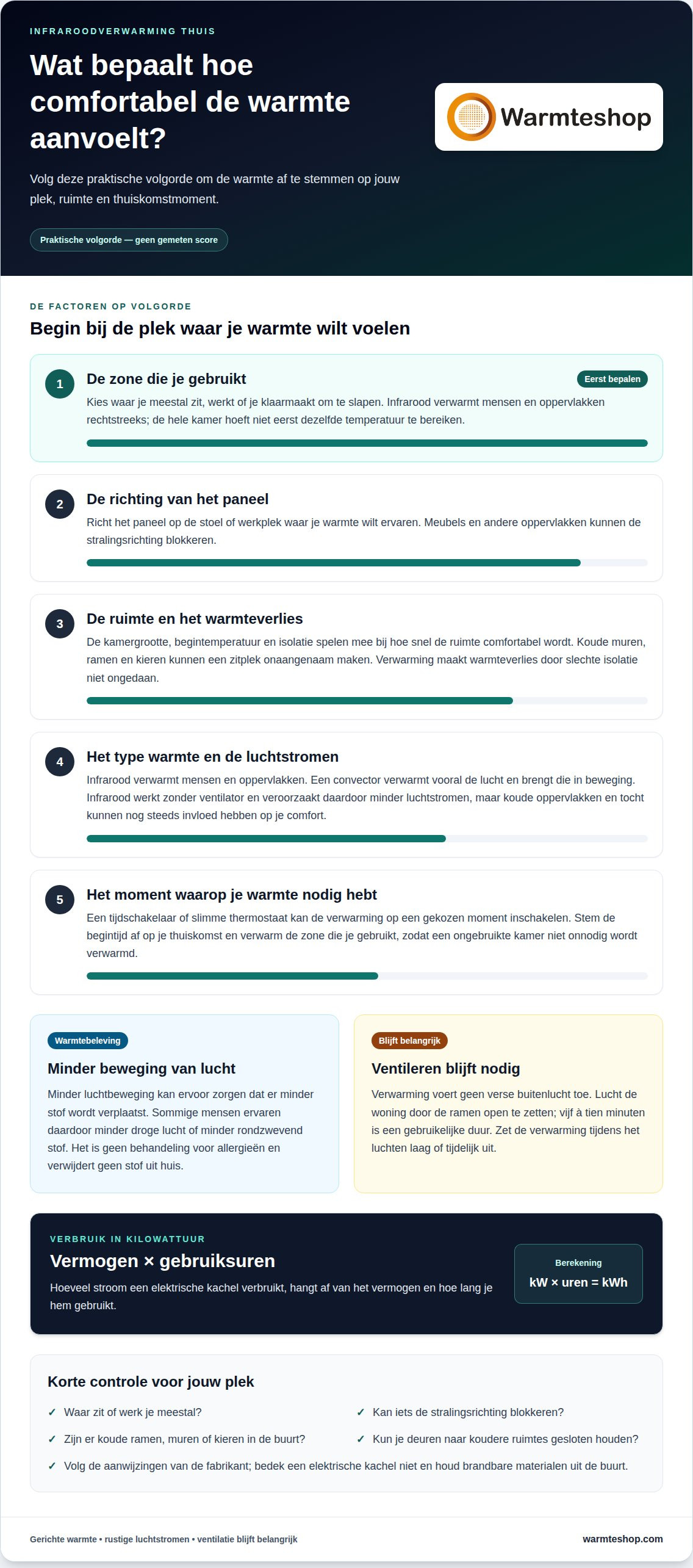
An infrared panel emits radiant heat to people and surfaces in the direction in which it is placed. As a result, a chair or workspace can feel comfortable without the air throughout the entire room first reaching the same temperature. This is especially pleasant when you come home and immediately sit down in a fixed spot. The comfort of direct warmth upon arriving home arises because the heat is directed exactly where you use it.
The placement partly determines how you experience the heat. Consider where you usually sit, work, or get ready to sleep. A panel directed at an open seating area heats a different zone than a panel near a desk. Take into account furniture and surfaces that may block the direction of radiation. Furthermore, a single heat point can feel different in a large room compared to a compact space.
How quickly do infrared panels, electric heaters, and convectors heat a room? Infrared can heat people and surfaces directly, while electric convectors primarily heat the air. How quickly the entire room becomes comfortable depends on, among other things, the power output, room size, starting temperature, and insulation.
In a well-insulated home, heat is generally retained better than in a room with cold walls or windows. Moreover, radiators and other heat sources do not all operate on the same principle and do not heat everywhere in the same way. Therefore, first determine which zone needs to become comfortable and adjust the heating direction accordingly. Heating does not undo heat loss caused by poor insulation.
Which subsidies or rules apply to electric heating in the Netherlands? That depends on the current regulations, the home, and the chosen system. Do not automatically assume that electric heating qualifies for a subsidy. The conditions determine what applies in your situation.
How much power does an electric heater consume during daily use? That depends on the wattage and the duration of use. Calculate the consumption in kilowatt-hours by multiplying the wattage in kilowatts by the number of hours of use.
A timer or smart thermostat can automatically switch on the heating at a chosen time. Align the start time with your arrival home and the zone you want to heat. This prevents an unused room from being heated unnecessarily. The correct setting varies per home and heating system.
How safe are electric heaters and infrared panels in the home? Follow the manufacturer's instructions and use the device as intended. Place a portable electric heater stably according to the manual and do not cover it. Keep flammable materials, such as curtains, away and switch off the device when not in use.
For people who sit still for long periods or have difficulty changing positions, the chosen heating zone is especially important. Direct the heat towards the chair or workspace they use and ensure the controls are within reach. Heat can support comfort, but it is not a treatment for health complaints. Adjust the setting to the individual and prevent the heat from feeling uncomfortable in one spot.
A convector heats the air and sets it in motion throughout the room. Infrared heating works without a fan and therefore causes fewer air currents. You notice this, for example, when you are sitting on the sofa and do not feel warm air blowing past your face. Temperature is not the only thing that determines whether a room feels comfortable.
Less air movement can mean that the heating moves less dust. As a result, some people experience less dry air or less airborne dust. This is not a treatment for allergies and does not remove dust from the house. Regular cleaning remains necessary, even in a bedroom with infrared heating.
Fresh air remains important. Heating does not replace ventilation, as heating does not supply fresh outside air. Open windows while airing out the house and allow it to return to the desired temperature afterwards. Five to ten minutes is a typical duration for airing out a home. Turn the heating down or temporarily off while airing out the house so that it does not emit unnecessary heat.
An open window is not the only possible cause of a draft. Cold windows, exterior walls, and gaps can make a seating area uncomfortable, regardless of the type of heating. For example, if you feel cold air near a window, another heat source will not resolve the underlying heat loss. Therefore, check where you feel a draft and which cold surfaces are nearby.
Doors also play a role. A door left open to the hallway can allow heat to escape from a room and make cold drafts noticeable. A door closer or door spring helps the door close automatically. This is practical in a home office where the door is often left open, or in a room next to a cold hallway.
Upon returning home, many people primarily want a comfortable place, not necessarily the same temperature everywhere. Therefore, combine targeted heating with conscious ventilation: heat the zone in use, keep doors to colder rooms closed, and ventilate at a suitable time. This way, you limit unnecessary air currents without sacrificing fresh air.
Also pay attention to how the room itself feels. A panel can reduce air movement, but cold walls or a drafty door remain comfort issues. Address those causes separately and then assess how the warmth feels at your regular seating spot. This will clarify which part of the discomfort is caused by air currents and which part by cold surfaces.
The impact of reduced air circulation varies from person to person. Some people experience less dry air or less displaced dust as a result. This can be pleasant in a room where you sit for extended periods, but it does not make infrared heating a miracle cure for allergies. View it as a potential difference in comfort, not as a solution to allergy symptoms. Moreover, reduced dust displacement does not mean that air currents or dust disappear completely.
In addition to the sensation of warmth, also pay attention to air circulation: ventilation remains necessary, as heating does not replace fresh air. A door closer or spring can help retain heat in the room by ensuring doors close automatically and reducing drafts. If a spot continues to feel unpleasant, also check for cold windows or walls. These can reduce comfort, just like drafts, regardless of the heating type. Therefore, assess air movement and cold surfaces as separate potential causes of discomfort.
Radiant heat feels different from warm air circulating through a room. You notice the heat, for example , on your skin and on nearby surfaces. This is reminiscent of the sun shining on a chair, without the entire room reaching the same temperature at the same time. An even experience is created when the heat source and the place where you are staying are well matched.
Silence is a practical comfort benefit. An infrared panel does not require a fan to emit heat. As a result, you do not hear a blowing airflow from the heater itself while reading on the sofa or working at the table. In a bedroom, this can be pleasant when you are seeking peace and quiet. Of course, total silence also depends on other appliances in the house, such as a ventilation system.
For a balanced heating experience, the entire room counts. A panel that reaches only one corner makes that spot more comfortable than a dining table located further away. Therefore, consider the layout, the distance to furniture, and the direction in which the heat is emitted. In a wide living room, a second, more gently heated zone can be more pleasant than one strongly heated spot.
Insulation also affects how long heat stays in the home. Cold exterior walls or large windows can make a space feel different from a well-insulated room. For example, after coming home, a seating area next to a cold window may feel less pleasant, even if the thermostat is indicating the desired temperature. The heating does not change that cold surface on its own.
With a smart setting, you tailor the comfort to your daily rhythm. Set the heating so that the room you are using is warm around the time you arrive home. A schedule for workdays can differ from that for a day off. This way, you do not automatically heat every room in the same way, but adjust the heating experience to the places where you actually are.
When considering various solutions, one can pay attention to both the sensation of warmth and the placement. An infrared heating solution may be suitable for a spot where you want to experience targeted radiant heat. Efficient use begins with a clear heating requirement: do you primarily want comfort by the sofa, at a workspace, or in another zone? This choice helps determine where the heat is most effective.
Even distribution does not mean that every spot feels exactly the same. Consider a seating area with a pleasantly warm surface and a cooler passageway to the hallway. By considering placement, insulation, and daily settings together, you make the heating experience calmer and more natural. Comfort is about the right heat in the right place, not just a single temperature number.
With zone heating, you direct heat to the rooms you use. Think of the living room after coming home, while the guest room remains empty. This way, you tailor the heating to your daily routine instead of treating every room the same. First, determine where you usually sit and when that spot needs warmth. Then, consider how to direct the heat source to that zone.
A workspace, for example, requires a different layout than a seating area. If your desk is against an exterior wall, cold surfaces can affect comfort. A heat source directed at the usage area can emit heat there without you having to heat up all the rooms first. When making your choice, also take furniture and the space between it into account.
Which heating system is suitable for a small room or a poorly insulated home? In a small room, you can direct the heat to the area you use, such as a desk or chair. In a poorly insulated home, heating does not compensate for heat loss. Therefore, also consider insulation, drafts, and cold surfaces.
With a thermostat, you time the heating to your presence. For example, set the temperature lower when you are not at home and let the used room warm up around the time you return. A programmable thermostat can schedule heating times. This prevents an unused room from being heated longer than necessary.
Whether you need one or multiple heat sources also depends on the room. In a large living room, a single focused heating area near the sofa might be pleasant, but less suitable for a dining table on the other side. Multiple milder heat sources can distribute the heat more comfortably there. Placement and usage determine how the heat is perceived throughout the room.
Start practically with one room where comfort is lacking. Note where you spend time, when you use the room, and which spots feel cold. Then, direct the heating to that zone and assess how you like it on a daily basis. Do not change all settings at once, so that you can better notice the effect of an adjustment.
With zone heating, ventilation remains necessary, and you must take doors to colder rooms into account. For example, close the door between a heated seating area and an unheated hallway. This limits air exchange, while the thermostat keeps the used zone at the desired temperature. Heating for longer is not automatically more comfortable if the heat ends up in an unused spot.
Infrared heating can feel efficient when you only heat the room in use, but the actual benefit depends on the situation. Therefore, a pleasant warmth experience does not guarantee a lower energy bill. Consider your own usage and assess what works comfortably. In large rooms, multiple milder heat sources can be more pleasant than one strongly heated spot. Take into account where you sit and how you use the room.
In the example home, switching off the heating on the bedroom floor saves approximately €80 annually. That example shows that switching off heating in unused rooms can make a difference, but the outcome is not automatically the same in every home. A sensible way to try out infrared heating is to start in one room where comfort is lacking and evaluate usage. This allows you to determine whether the heat reaches the right times and places.
For heat in a fixed spot, infrared heating works differently than convection heating. An infrared panel emits radiant heat towards people and surfaces in the direction of the panel. A convection heater primarily heats the air. As a result, a spot near a panel can feel comfortable while the entire room has not yet reached the same temperature.
An infrared panel, for example, can be suitable for a seating area where you sit down immediately upon arriving home. The direction and unobstructed line of sight between the panel and the usage area partly determine where the heat is distributed. Therefore, consider the sofa, dining table, or workspace first. A panel in one zone does not automatically heat a separate corner on the other side of the room.
An electric convector is another option when you want to heat the air in a room. This can be suitable for a room where you spend longer periods and desire a wider heat distribution. The experience depends on the room, the insulation, and the placement of the unit. A cold exterior wall or an open door can continue to affect comfort, regardless of the heating.
The shape of the heat source can also suit the room. An infrared mirror combines a mirror surface with focused radiant heat, while infrared glass heating emits heat through a glass panel. Such solutions are particularly useful if the location and function align with your daily use. Therefore, determine not only what type of heat you are looking for, but also where the device fits logically in your home.
With a thermostat or timer, you can time the heating to your arrival home. Set a fixed heating time around your usual arrival time and direct the heating to the room where you will be first. On varying days, you can adjust the schedule according to your presence. This way, an empty room is not heated according to the same rhythm as the living room.
Compare the options based on three questions: do you primarily want to heat a specific spot or the room air, where do you stay after returning home, and how well is the room insulated? A panel can be suitable for targeted heat on the sofa; a convector for heating the room air. In the bathroom, an infrared mirror can combine a function with heating that specific spot.
If you want to time your heating to coincide with your arrival home, take a look at the wireless thermostats and determine which schedule suits your daily routine. The right choice starts with the place where you want to experience warmth. Additionally, take into account the room, the placement, and how you use the heating daily.
Warmteshop helps you tailor the heating solution to the place where you want to experience warmth. Think of an infrared panel for a seating area, an infrared mirror for the bathroom, or infrared glass heating by a window. The right choice depends on your space, daily routine, and desired heat distribution.
Are you hesitating between targeted radiant heat and another form of electric heating? Then discuss where your comfort falls short, how you use the space, and when you need heat. This way, you compare options based on function and placement, without looking solely at the device.
Would you like to discuss together which solution suits your homecoming? Then contact Warmteshop.
The next step is not immediately choosing a device, but clarifying where you lack warmth at home. Think of the place where you sit after a workday, a room you rarely use, or a space where the temperature fluctuates. This way, you discover whether the comfort of instant warmth when you come home aligns with your daily rhythm.
When making your decision, consider the layout of your home, the insulation, and the areas where you spend time. The way you set your heating times also plays a role. With these starting points, you can determine more specifically which solution suits your situation, rather than just looking at the appearance of a heater.
Warmteshop can help you explore the possibilities for your home and desired heating location. Feel free to take the step to submit your question and see together which direction makes sense. Contact Warmteshop and discover how you can make coming home more comfortable.
The hourly power consumption depends on the wattage. Calculate the consumption in kilowatt-hours by multiplying the wattage in kilowatts by the number of usage hours. The costs also depend on the electricity tariff.
Targeted infrared heating can feel efficient if you only heat an in-use zone. The actual benefit depends on your home and usage.


