

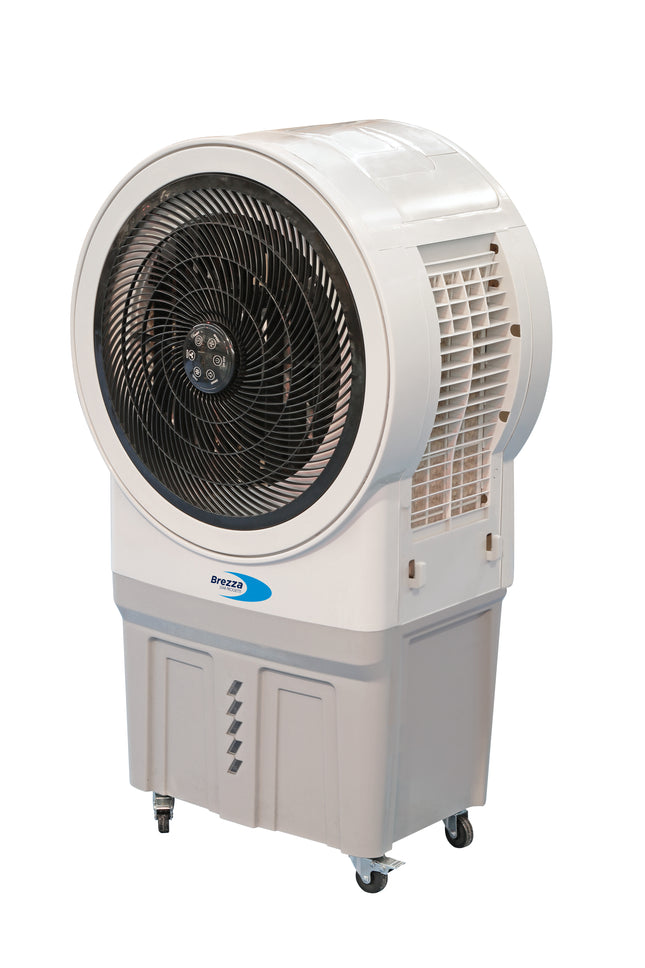
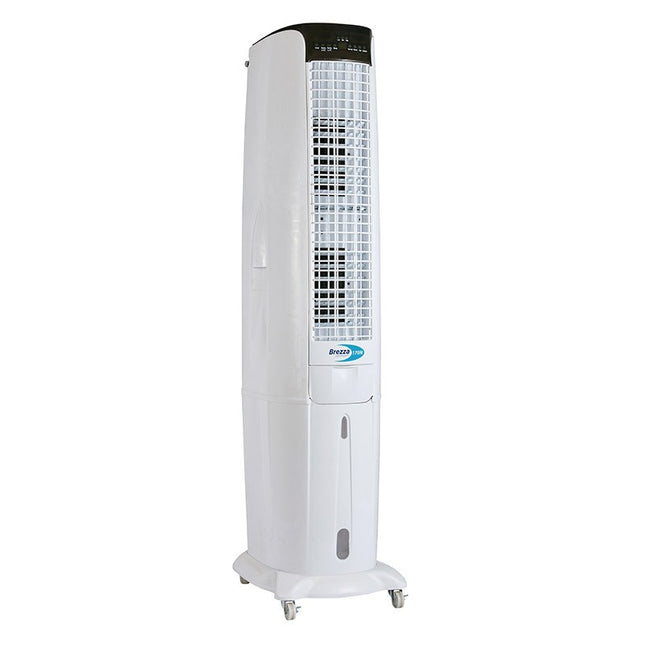
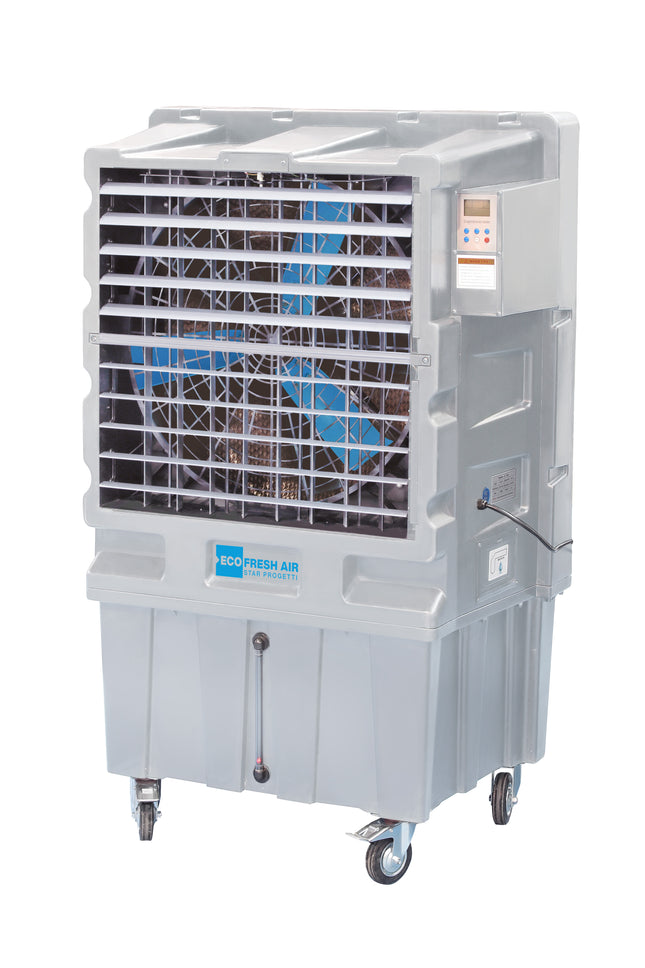


Patio cooling makes a garden, restaurant terrace, veranda, or commercial outdoor space more comfortable during hot days. Cooling outdoors works differently than cooling an enclosed room: cold air dissipates quickly due to wind and open sides. Therefore, a good solution revolves around targeted air circulation, fine water misting, shade, and a suitable setup. Here you can read which technology suits your patio and what to look out for in Belgium and the Netherlands.

How does patio cooling work?
There are two main effects. A fan increases the air speed along the skin, allowing sweat to evaporate faster and making the perceived temperature more comfortable. A misting system disperses small water droplets into the air. When these droplets evaporate, they absorb heat. This is called evaporative cooling or adiabatic cooling.
The result depends heavily on temperature, relative humidity, wind, droplet size, and placement. More water can evaporate in warm, dry air than on a muggy day. Therefore, a fixed promise in degrees is not realistic for every terrace. Choose the technique based on the conditions and the area where people actually sit.
Fan, mist fan, or high-pressure mist?
| Solution | Operation | Suitable for |
|---|---|---|
| Outdoor fan | Moves air without using water. | Targeted cooling where mist is undesirable. |
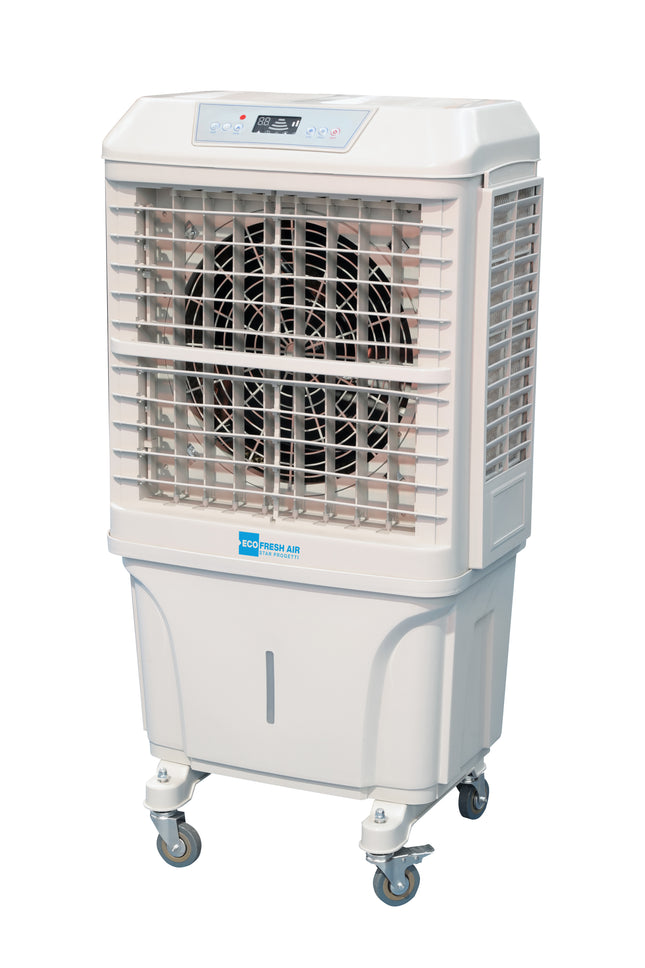
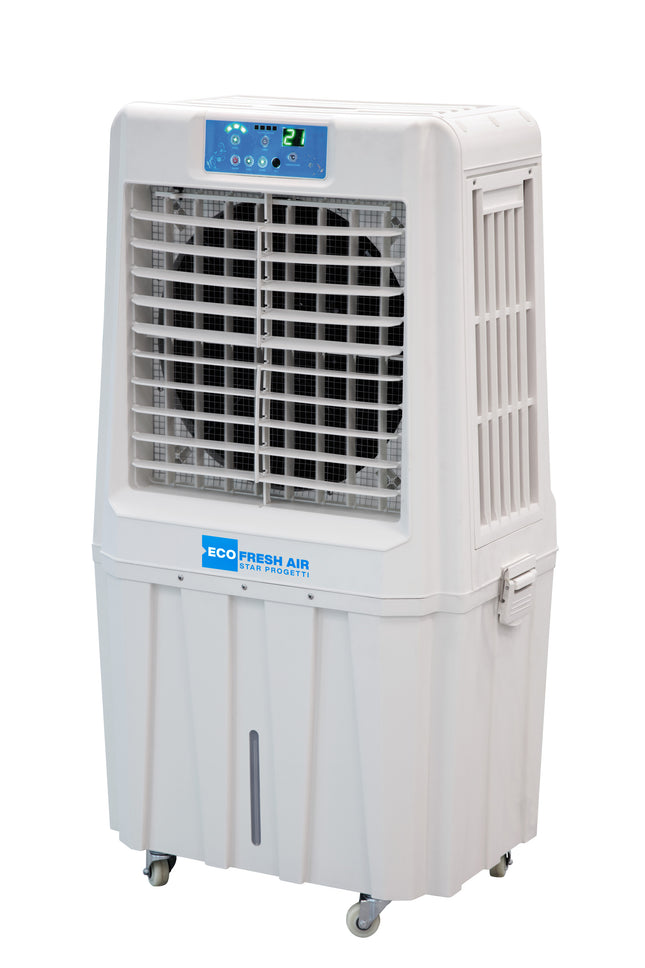
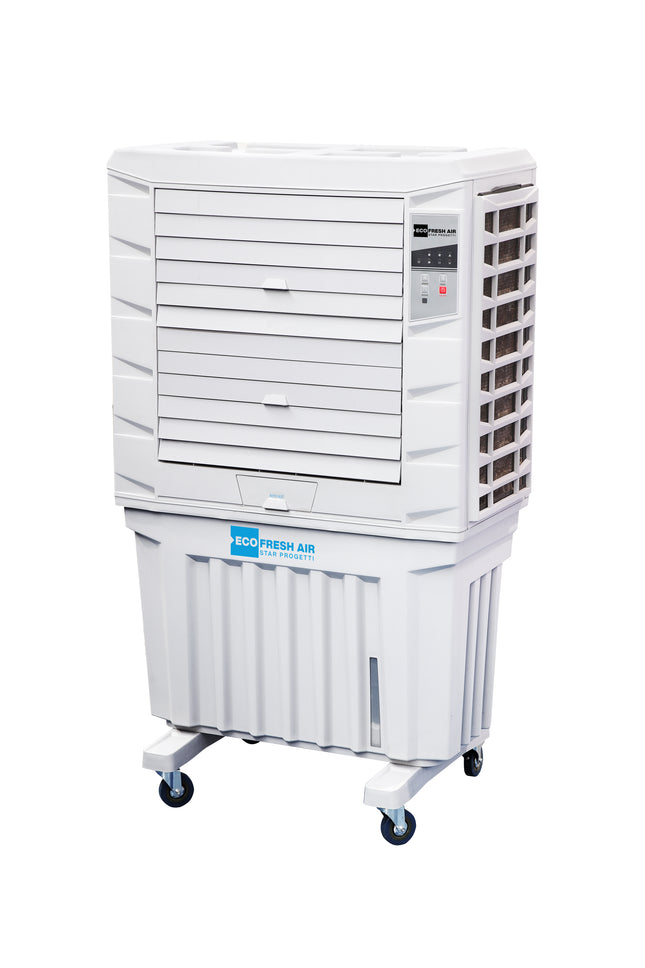
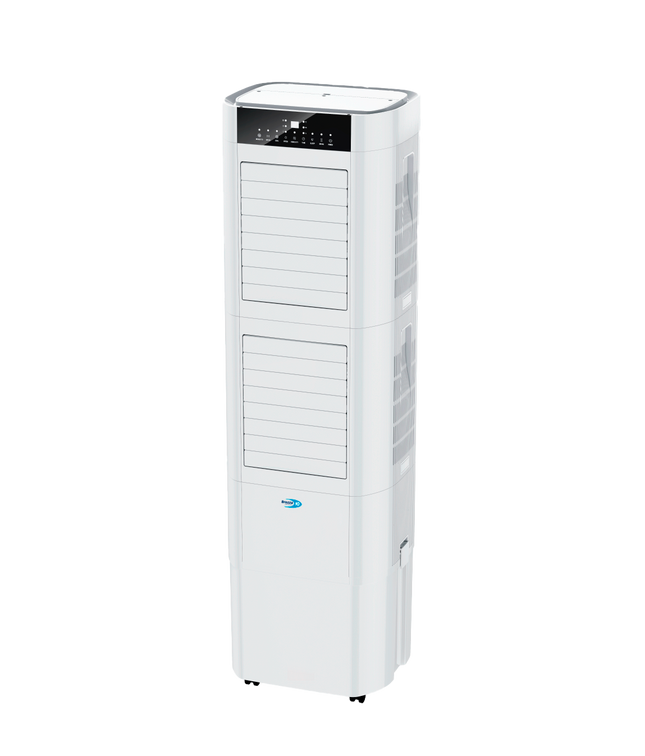
| Mist fan | Combines airflow with a fine water mist. | Flexible zone cooling on a terrace or at an event. |
| Fixed mist pipe | Distributes mist via multiple nozzles along an edge or canopy. | Larger and permanently furnished terraces. |
| Mobile high-pressure unit | Produces a very fine mist with a built-in pump and fan. | Hospitality, seasonal terrace and changing layouts. |
An air conditioner is usually not suitable for cooling a fully open terrace. It must be able to remove heat from a confined space. Air conditioning may only be suitable for a largely enclosed veranda or specific professional application. You can find more information about this under terrace air conditioning.
High-pressure or low-pressure misting?
Pressure affects droplet size. Coarser droplets evaporate more slowly and can wet the floor, guests, or furniture. A high-pressure system can produce a finer mist, causing more water to evaporate into the air before reaching surfaces. However, the final result also depends on nozzle quality, distance, pump pressure, humidity, and wind.
For professional patio cooling, “more water” is therefore not automatically better. A well-tuned system uses sufficient fine mist to cool, without bothersome dampness. Check the recommended pump pressure, the number of nozzles, and the maximum pipe length for each product.
How do you choose capacity and range?
Do not just measure the total terrace surface area. In particular, determine where guests, residents, or employees sit. A targeted cooling zone is often more effective than attempting to treat the entire outside air. Pay attention to the canopy, open sides, prevailing wind direction, mounting height, and heat radiating from facades or paving.
- Dimensions and shape of the seating or work zone
- Fully open, sheltered, or covered terrace
- Sun exposure and existing sun shading
- Wind direction and wind speed on warm days
- Available power and water connection
- Desired mobile or fixed setup
- Duration of use and number of persons present
For a fixed line, you also consider the flow rate per nozzle and the total pump capacity. For a mist fan, air displacement, oscillation, fan speeds, and range are important. Always use the manufacturer's dimensions as a starting point.
Influence of humidity and wind
Evaporative cooling performs best when the air can still absorb moisture. At high relative humidity, droplets evaporate more slowly. As a result, the cooling effect decreases and the risk of a damp floor increases. An adjustable system with a timer, various settings, or individually controllable nozzles provides more control.
Wind can both help and hinder. A gentle airflow supports evaporation, but strong wind blows mist away from the desired zone. Therefore, position nozzles so that the prevailing wind carries the mist through the seating area and not towards the facade, kitchen, neighbors, or walkway.
Patio cooling for the hospitality industry
For patio cooling in the hospitality industry, continuity is key. The installation must therefore be suited to peak hours, table layout, staff routes, and equipment. Additionally, choose controls that allow employees to react quickly to wind or humidity. Zone control also prevents unused sections from running unnecessarily.
Take into account the noise of the pump and fan, the storage of a mobile unit, and maintenance outside opening hours. A fixed installation generally appears quieter, while a mobile mist fan is quicker to deploy and can be moved. For heavier climate control in enclosed workspaces or indoor areas, industrial air conditioning and mobile industrial air conditioning more suitable categories.
Patio cooling for home
At home, compact patio cooling with a mist fan, ventilator, or short mist duct may suffice. Therefore, place the cooling unit near the seating area and combine it with a parasol, awning, or pergola. Shade reduces radiant heat, after which air movement and evaporation provide greater comfort.
Do you have wooden garden furniture, cushions, or a smooth tiled floor? Then first test the mist setting and check if surfaces remain dry. For more specific advice on the application, you can patio cooling .
Water hygiene: an essential point of attention
With patio cooling , water may be inhaled. Therefore, use clean water and carefully follow the manufacturer's maintenance and hygiene instructions. Furthermore, do not allow water to stand in the tank or pipes for extended periods. Flush the system after a period of inactivity, replace filters on time, and clean the tank and nozzles according to instructions.
In addition, local regulations, risk analyses, or management measures may apply to professional installations. Therefore, seek advice regarding filtration, disinfection, piping design, and periodic inspection. After all, a filter alone does not replace a complete maintenance plan.
Outdoor electrical safety
Water and electricity require extra attention. Therefore, only use equipment that, according to the manufacturer, is suitable for outdoor use and the intended location. Additionally, check the IP rating, cables, plugs, and connection points. Keep connections out of puddles and protect them from rain and direct mist.
Next, connect the system to a properly secured installation and follow local regulations in Belgium or the Netherlands. If in doubt, have a qualified installer assess the connection. Finally, switch off the power before servicing filters, nozzles, the fan, or the pump.
Placement of mist fans and nozzles
- Determine the seating or work zone and the prevailing wind direction.
- Place equipment stably and out of walking routes.
- Direct the mist above or along the area, not directly into faces.
- Keep a sufficient distance from electricity, lighting, and fragile materials.
- Test on a low setting first and check the floor and furniture for moisture.
- Adjust the interval or flow rate when humidity or wind changes.
Maintenance for reliable operation
Limescale and dirt can alter the spray pattern. A nozzle that drips instead of mists cools less effectively and wets surfaces. Therefore, check the pattern regularly. Subsequently, clean or replace nozzles and filters according to the maintenance schedule and use only approved products.
Additionally, empty tanks when the system is not used for an extended period. Protect the pump and pipes from frost and store a mobile unit in a dry place. Furthermore, check hoses, couplings, seals, fan, and electrical cables before each season.
Compare water and electricity consumption
The total water consumption of patio cooling is calculated as the flow rate per nozzle × the number of nozzles × the actual operating time. A timer or pulsed control can therefore limit usage when continuous misting is not required. Additionally, for mist fans, compare the electrical power of the fan and the pump.
Don't just look at the purchase price. Also include filters, nozzle maintenance, water, electricity, winter storage, and any installation. Finally, for the hospitality industry, the quick availability of parts and a practical maintenance plan are especially important.
Buying patio cooling: complete checklist
- Choose between fan, mist fan, mobile unit, or fixed ducting.
- Measure the actual cooling zone and assess wind and shelter.
- Check pump pressure, droplet size, flow rate, and number of nozzles.
- View outdoor rating, sound, controls, and oscillation.
- Plan water filtration, hygiene, cleaning, and winter storage.
- Check the required power and water connections.
- Test if guests, floor, and furniture stay dry.
- Compare warranty, parts, and support.
Why patio cooling from Warmteshop?
Warmteshop has been a specialist in climate and heating solutions since 2006. You can compare solutions online or ask for advice on type, coverage, and installation. If you would like to view products first, visit our 30+ showrooms in Belgium and the Netherlands. You can read independent reviews via Trustlocal.
View the range of patio cooling. You can find additional information under patio cooling. If you are specifically looking for a climate solution for a more enclosed outdoor space, view patio air conditioning.
Frequently asked questions about patio cooling
Do you get wet from a mist fan?
With the correct pressure, fine droplets, and proper placement, much of the mist evaporates before reaching surfaces. High humidity, too much water, or incorrect placement can still cause dampness.
Does patio cooling also work in high humidity?
Yes, but evaporative cooling is less effective then. If necessary, reduce the flow rate or switch-on time and combine the mist with sufficient air movement.
Can I use a regular portable air conditioner outside?
A standard air conditioner is intended for an enclosed space and is not automatically suitable for outdoor use. Use only equipment according to the manufacturer's application and outdoor classification.
How often do I need to maintain nozzles and filters?
That depends on water quality, usage time, and system. Follow the maintenance schedule and regularly check the spray pattern for dripping or blockage.
Is a fixed installation better than a mobile mist fan?
A fixed line is well-suited to a permanent terrace and offers a large range. A mobile mist fan offers more flexibility. The best choice depends on the surface area, season, connections, and desired operation.