
Standard electric convectors

7 products


  • Almost sold out Termofol Electric convector with thermostat 1000 Watt

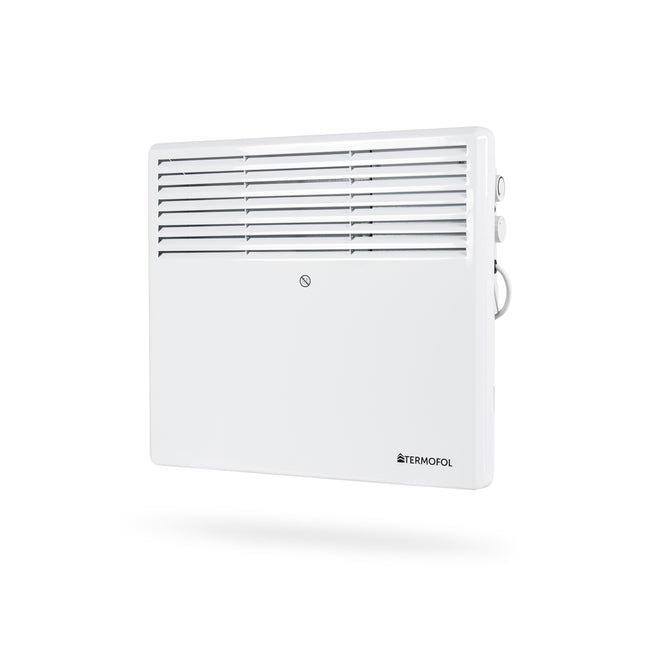
    Termofol Electric convector with thermostat 1000 Watt

    Termofol TF-MH-10: electric convector with two power settings of 500 and 1000 watts. This model heats the room air and features a mechanical thermostat on the unit. It is suitable for those who want simple local control. For primary heating, have it checked whether the power output can meet your room's heat demand. TF-MH-10: power and control Model: Termofol TF-MH-10. Power settings: 500 / 1000 W. Thermostat: mechanical, with controls on the unit. Operation: the thermostat switches the heating element on and off depending on the set setting and room temperature. The two settings are settings of this unit. They are not two separate product variants. Nor is the thermostat knob the same as a digital temperature display or app control. Are you looking for remote control? Then compare the electric convectors for which Wi-Fi is explicitly mentioned. Choosing 1000 watts for your room The TF-MH-10 has the lowest maximum power output of these two entry-level models. This may be suitable for a lower heat demand or supplementary heating. A low wattage is no guarantee that a room will become sufficiently warm. In addition to the floor area, assess ceiling height, insulation, windows, drafts, and desired temperature. Note whether you want to provide short supplementary heating or keep a room warm for an extended period. Select the power based on that heat demand; the number of m² alone is insufficient. What does this mean for power consumption? Calculate the consumption using power in kW × actual active heating hours. With continuous heating at the highest setting, this model consumes 1 kWh in one hour. At the lower setting, this is 0.5 kWh in one hour of continuous heating. These calculation values ​​are not a prediction of daily consumption. The thermostat may switch off intermittently. A lower setting provides less heat per hour and may therefore be required for longer. Multiply the actual kWh used by your own electricity rate for the variable costs. Placement and safe use According to the manufacturer, the TF-MH series can be used on the wall or on the designated mobile support. Before installation, check the supplied parts and follow the installation manual for the exact procedure. Maintain the prescribed clearances, never cover the unit, and keep the air intake and exhaust clear. Use the unit and the electrical connection according to the manual. Do not leave it operating unattended. For a bathroom or damp room, have the suitability and installation conditions assessed first; do not assume general suitability for every room. Compare or ask for advice. Also view the 1,500-watt Termofol TF-MH-15 if the required power has not yet been determined. Only compare after the heat demand has been determined. The convector overview also helps you choose between simple operation, a weekly program, and Wi-Fi. For advice, provide the room dimensions, insulation, glazing, operating hours, and desired placement. Indicate whether you are looking for primary or supplementary heating. Ask for advice on the TF-MH-10

    €79,00

  • Termofol Electric convector with thermostat 1500 Watt

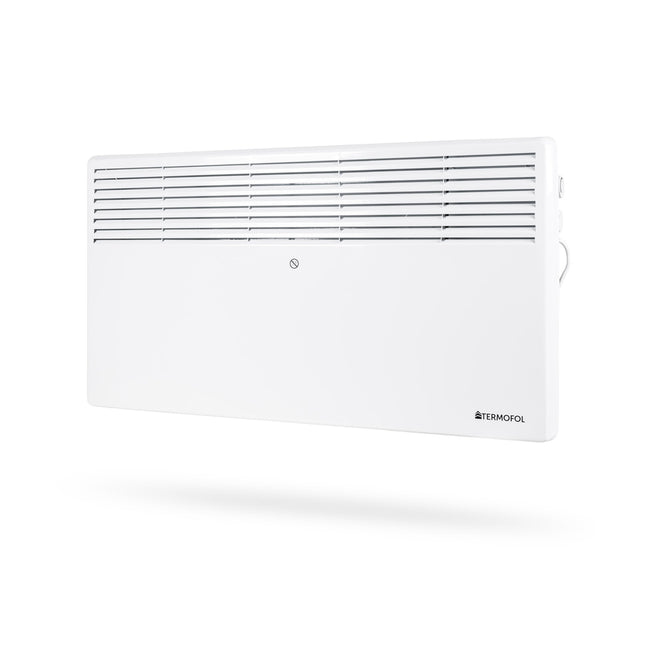
    Termofol Electric convector with thermostat 1500 Watt

    Termofol TF-MH-15: electric convector with two power settings of 750 and 1500 watts. This model heats the room air and features a mechanical thermostat on the unit. It is suitable for those who want simple local control. For primary heating, have it checked whether the power output can meet your room's heat demand. TF-MH-15: power and control Model: Termofol TF-MH-15. Power settings: 750 / 1500 W. Thermostat: mechanical, with controls on the unit. Operation: the thermostat switches the heating element on and off depending on the set setting and room temperature. The two settings are settings of this unit. They are not two separate product variants. Nor is the thermostat knob the same as a digital temperature display or app control. Are you looking for remote control? Then compare the electric convector models for which Wi-Fi is explicitly mentioned. Choosing 1500 watts for your room The TF-MH-15 can output more heat at full power than the 1,000-watt TF-MH-10. This can be useful for higher heat demand. However, it does not automatically make this unit more energy-efficient and does not indicate how many square meters it can heat in your situation. In addition to floor area, consider ceiling height, insulation, windows, drafts, and desired temperature. Note whether you want to provide short supplementary heating or keep a room warm for an extended period. Select the power based on that heat demand; the number of m² alone is insufficient. What does this mean for power consumption? Calculate consumption using power in kW × actual active heating hours. With continuous heating at the highest setting, this model consumes 1.5 kWh per hour. At the lower setting, this is 0.75 kWh per hour of continuous heating. These calculated values ​​are not a prediction of daily consumption. The thermostat may switch off intermittently. A lower setting provides less heat per hour and may therefore be required for longer. Multiply the actual kWh used by your own electricity rate for the variable costs. Placement and safe use According to the manufacturer, the TF-MH series can be used on the wall or on the designated mobile support. Before installation, check the supplied parts and follow the installation manual for the exact execution. Maintain the prescribed clearances, never cover the unit, and keep the air intake and outlet clear. Use the unit and the electrical connection according to the manual. Do not leave it operating unattended. For a bathroom or damp room, have the suitability and installation conditions assessed first; do not assume general suitability for every room. Compare or ask for advice Also view the 1,000-watt Termofol TF-MH-10 if the required power has not yet been determined. Only compare after the heat demand has been determined. The convector overview also helps you choose between simple operation, a weekly program, and Wi-Fi. For advice, provide the room dimensions, insulation, glazing, operating hours, and desired placement. Indicate whether you are looking for primary or supplementary heating. Ask for advice on the TF-MH-15

    €89,00

  • Almost sold out Termofol Electric convector with thermostat 2500 Watt

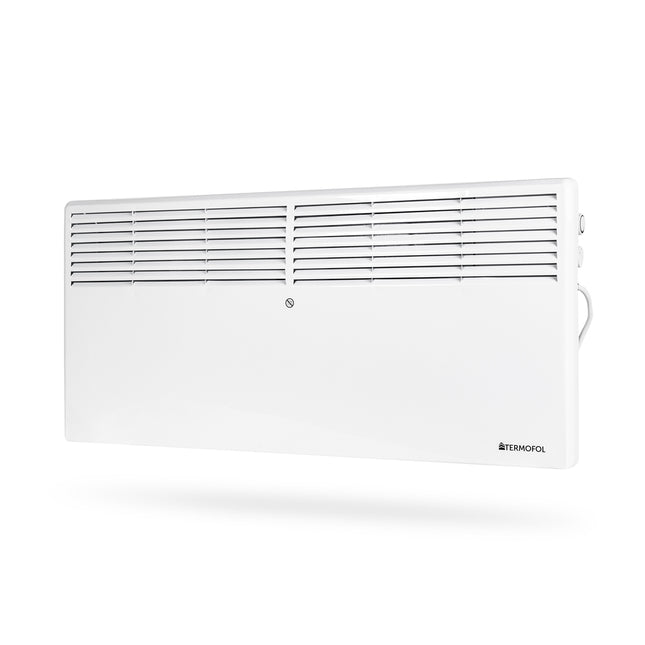
    Termofol Electric convector with thermostat 2500 Watt

    Termofol TF-MH-25: electric convector with 1250 and 2500 watt power settings. The mechanical thermostat regulates the room temperature by switching the heating element on and off. You operate this model on the unit itself. First determine your room's heating requirements and then check if the size and controls suit your needs. Specifications of the TF-MH-25: Power: 1250 / 2500 W. Dimensions (width × height × depth): 90 × 42 × 9 cm. Control: mechanical thermostat on the unit. Heating type: electric convector for heating room air. The power settings belong to this single model; they are not two separate product variants. The thermostat knob offers local control. If you require a weekly program or app control, compare the models described for these features in the electric convector overview. More power also requires more space. The TF-MH-25 is 90 cm wide and has the highest maximum heat output within the TF-MH series. This makes it a candidate for higher heat demand, but not automatically the best choice for every larger room. Check the available wall length and mounting distances; the unit width alone does not determine whether it fits. Measure the length, width, and height of the room and note insulation, glazing, drafts, and operating hours. For primary heating, the total heat output must be able to compensate for heat loss. A different consideration may apply for short-term supplementary heating. A fixed promise for a specific number of m² does not sufficiently take these differences into account. Understanding consumption at both settings. Consumption in kWh = power in kW × actual active heating hours. For one hour of continuous heating at the highest setting, this is 2.5 kWh. At the lower setting, it is 1.25 kWh per hour of continuous heating. The thermostat switches off intermittently when sufficient heat has been reached. Therefore, being switched on for an hour does not always constitute an hour of active heating. A lower output provides less heat per hour and may require longer operation; therefore, it does not represent a fixed saving. For variable costs, use your own electricity rate × the actual kWh used. Check placement and connection beforehand. For wall mounting or use on the designated support, follow the installation manual for the TF-MH series. Check the supplied parts and maintain the prescribed clearance around the unit. The stated dimensions are unit dimensions and do not negate these clearances. Keep the air intake and outlet clear and never cover the convector. Check that the electrical connection is suitable, even if other devices use the same circuit. Have any doubts assessed by a qualified installer. Use the unit according to the manual and do not leave it operating unattended. The application in a damp room must be assessed separately. Compare the two larger TF-MH models. View the 2,000-watt Termofol TF-MH-20 to compare maximum heat output and required space. A higher wattage does not guarantee lower consumption. In the convector overview, you can also compare other control methods. Advice for your room Provide room dimensions, insulation, windows, available space, and hours of use. Indicate whether you are looking for primary or supplementary heating and which other appliances are used on the same connection. This allows us to assess the power output and model selection. Ask for advice on the TF-MH-25

    €109,00

  • Termofol Electric convector with thermostat 2000 Watt

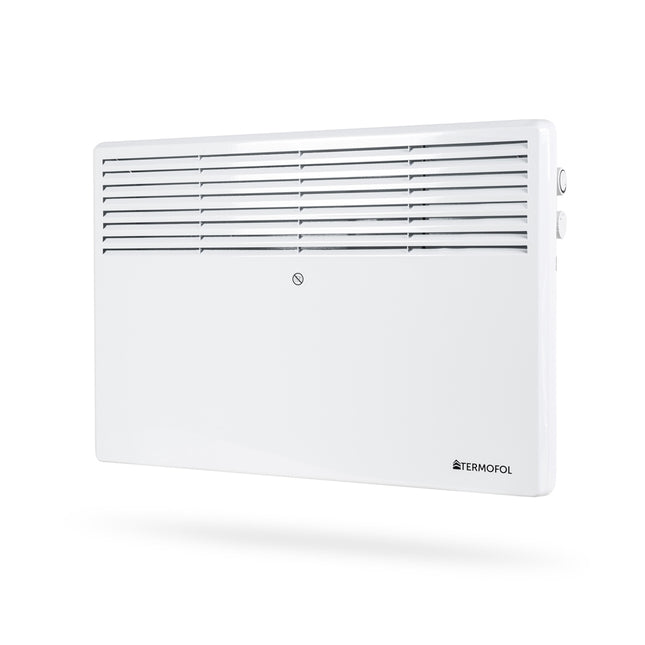
    Termofol Electric convector with thermostat 2000 Watt

    Termofol TF-MH-20: electric convector with 1000 and 2000 watt power settings. The mechanical thermostat regulates the room temperature by switching the heating element on and off. You operate this model on the unit itself. First determine your room's heating requirements and then check if the size and controls suit your needs. Specifications of the TF-MH-20: Power: 1000 / 2000 W. Dimensions (width × height × depth): 71.5 × 42 × 9 cm. Control: mechanical thermostat on the unit. Heating type: electric convector for heating room air. The power settings belong to this single model; they are not two separate product variants. The thermostat knob offers local control. If you require a weekly program or app control, compare the models described for this in the electric convector overview. 2,000 watts or perhaps a different model? The TF-MH-20 is 71.5 cm wide and offers a maximum of 2,000 watts. It is narrower than the 90 cm TF-MH-25 and has a lower maximum output. Choose it when the calculated heat demand and available space match; do not choose based solely on a general surface area claim. Measure the length, width, and height of the room and note insulation, glazing, drafts, and hours of use. For primary heating, the total heat output must be able to compensate for heat loss. A different consideration may apply for short-term supplementary heating. A fixed promise for a specific number of m² does not sufficiently take these differences into account. Understanding consumption at both settings: Consumption in kWh = power in kW × actual active heating hours. For one hour of continuous heating at the highest setting, this is 2 kWh. At the lower setting, it is 1 kWh per hour of continuous heating. The thermostat switches off intermittently when sufficient heat is reached. Therefore, being switched on for an hour does not always equate to one hour of active heating. A lower power output provides less heat per hour and may be required for longer; it is therefore not a fixed saving. For variable costs, use your own electricity rate × the actual kWh used. Check placement and connection beforehand. For wall mounting or use on the designated support, follow the installation manual for the TF-MH series. Check the supplied parts and maintain the prescribed clearance around the unit. The stated dimensions are unit dimensions and do not omit these clearances. Keep the air intake and outlet clear and never cover the convector. Check that the electrical connection is suitable, even if other devices use the same circuit. Have any doubts assessed by a qualified installer. Use the unit according to the manual and do not leave it operating unattended. The application for a damp room must be assessed separately. Compare the two larger TF-MH models. View the 2,500-watt Termofol TF-MH-25 to compare maximum heat output and required space. A higher wattage is no guarantee of lower consumption. In the convector overview, you can also compare other types of operation. Advice for your room: Provide room dimensions, insulation, windows, available space, and operating hours. Please indicate whether you are looking for primary heating or supplementary heat, and which other appliances are used on the same connection. This will allow us to assess the power output and model selection. Ask for advice on the TF-MH-20

    €99,00

  • Almost sold out Termofol TF-1500WIFI convector 1500 Watt

    Termofol TF-1500WIFI convector 1500 Watt

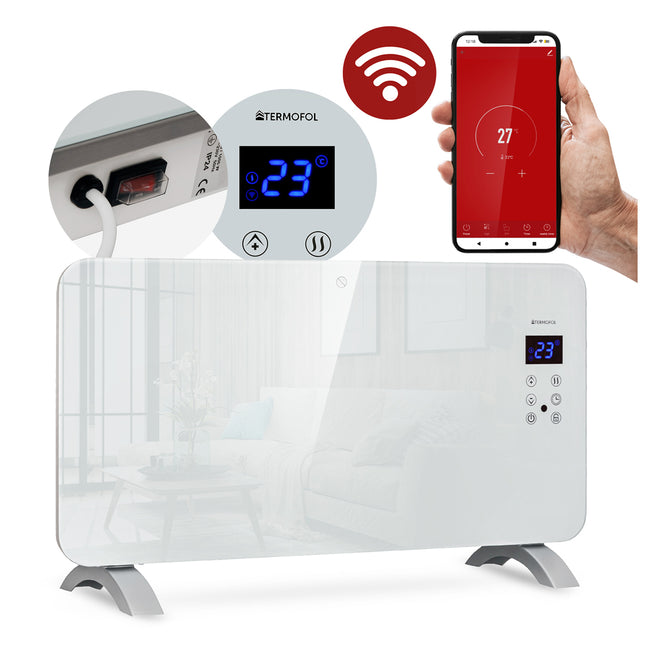
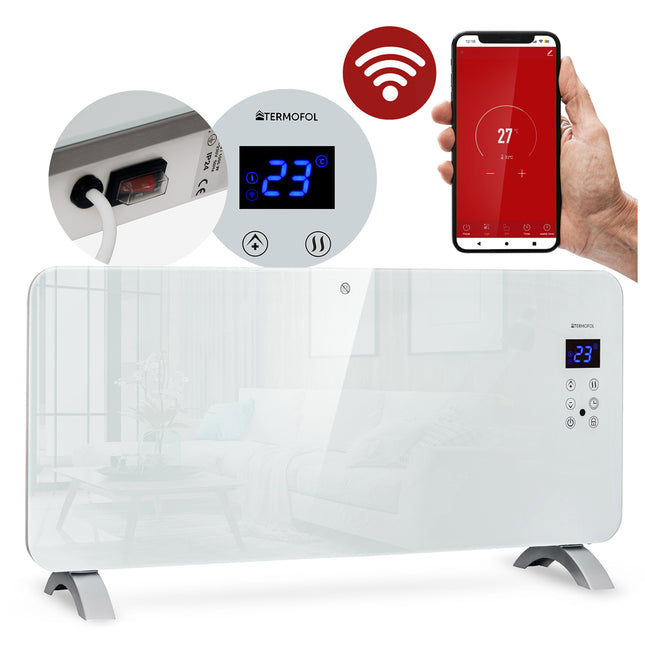
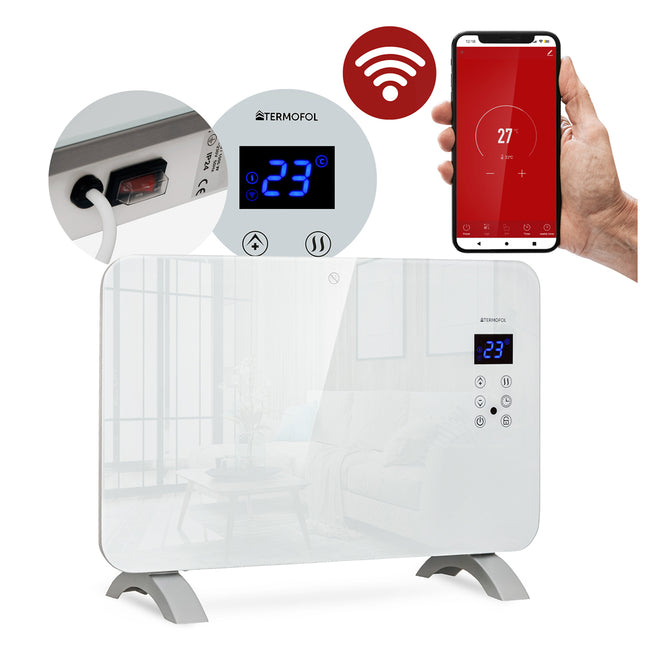
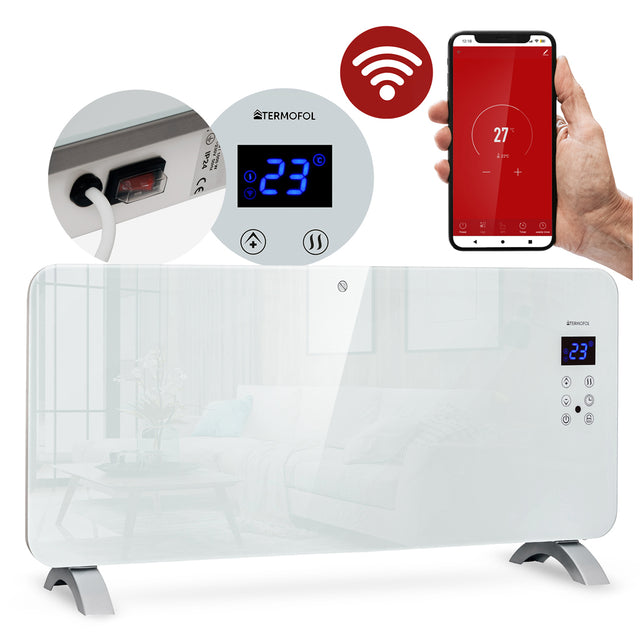
    Product description for "Convection heater with WiFi control" Experience the perfect combination of fast, efficient heating and modern design with our Convection heater with WiFi control. This advanced heating system ensures a pleasant temperature in any room thanks to the innovative X-Shape technology and a modern aluminium low-temperature heater. Key features: Fast and effective heating: The X-Shape technology guarantees fast and even heating of the room, so you can always enjoy a comfortable temperature. Modern design: The front panel is made of tempered glass, which gives an elegant and stylish look that will suit any interior. User-friendly control: Equipped with a digital touch thermostat with LCD display and bright backlight, for simple and intuitive operation. WiFi control: Control the heating remotely via a convenient app on your smartphone or tablet. Adjust the temperature, set weekly programs and manage your heating system from anywhere. Weekly programming: Schedule your heating in advance with flexible weekly programs, so you never come home to a cold house again. Versatile: This convector can be used in both traditional and modern rooms, making it not only functional but also a decorative addition to your interior. Specifications: Width: 75 cm Thickness: 6.5 cm Height: 38 cm Controller: Yes – WiFi Power: 1500W Transform your living space with the Convection heater with WiFi control and enjoy fast, effective and stylish heating. Thanks to the combination of advanced technology, modern design and smart controls, this radiator provides the ultimate solution for comfortable and efficient heating.

    €159,00

  • Termofol TF-2000WIFI convector 2000 Watt

    Termofol TF-2000WIFI convector 2000 Watt

    Product description for "Convection heater with WiFi control" Experience the perfect combination of fast, efficient heating and modern design with our Convection heater with WiFi control. This advanced heating system ensures a pleasant temperature in any room thanks to the innovative X-Shape technology and a modern aluminium low-temperature heater. Key features: Fast and effective heating: The X-Shape technology guarantees fast and even heating of the room, so you can always enjoy a comfortable temperature. Modern design: The front panel is made of tempered glass, which gives an elegant and stylish look that will suit any interior. User-friendly control: Equipped with a digital touch thermostat with LCD display and bright backlight, for simple and intuitive operation. WiFi control: Control the heating remotely via a convenient app on your smartphone or tablet. Adjust the temperature, set weekly programs and manage your heating system from anywhere. Weekly programming: Schedule your heating in advance with flexible weekly programs, so you never come home to a cold house again. Versatile: This convector can be used in both traditional and modern rooms, making it not only functional but also a decorative addition to your interior. Specifications: Width: 92 cm Thickness: 6.5 cm Height: 38 cm Controller: Yes – WiFi Power: 2000W Transform your living space with the Convection heater with WiFi control and enjoy fast, effective and stylish heating. Thanks to the combination of advanced technology, modern design and smart controls, this radiator provides the ultimate solution for comfortable and efficient heating.

    €179,00

  • Almost sold out Termofol TF-1000WIFI convector 1000 Watt

    Termofol TF-1000WIFI convector 1000 Watt

    Product description for "Convection heater with WiFi control" Experience the perfect combination of fast, efficient heating and modern design with our Convection heater with WiFi control. This advanced heating system ensures a pleasant temperature in any room thanks to the innovative X-Shape technology and a modern aluminium low-temperature heater. Key features: Fast and effective heating: The X-Shape technology guarantees fast and even heating of the room, so you can always enjoy a comfortable temperature. Modern design: The front panel is made of tempered glass, which gives an elegant and stylish look that will suit any interior. User-friendly control: Equipped with a digital touch thermostat with LCD display and bright backlight, for simple and intuitive operation. WiFi control: Control the heating remotely via a convenient app on your smartphone or tablet. Adjust the temperature, set weekly programs and manage your heating system from anywhere. Weekly programming: Schedule your heating in advance with flexible weekly programs, so you never come home to a cold house again. Versatile: This convector can be used in both traditional and modern rooms, making it not only functional but also a decorative addition to your interior. Specifications: Width: 60 cm Thickness: 6.5 cm Height: 38 cm Controller: Yes – WiFi Power: 1000W Transform your living space with the Convection heater with WiFi control and enjoy fast, effective and stylish heating. Thanks to the combination of advanced technology, modern design and smart controls, this radiator provides the ultimate solution for comfortable and efficient heating.

    €159,00

Convectors for fast, efficient heating

Standard electric convectors for comfortable warmth

Standard electric convectors heat a room quickly, quietly, and precisely. This makes them a practical choice for a living room, bedroom, home office, or any other room where you want to control the temperature by zone. In this collection, you will find electric convectors with a sleek design and simple operation. This allows you to select the power output and controls that best suit your home in Belgium or the Netherlands.

An electric convector requires no central heating pipes, gas, or chimney. However, you do need a suitable electrical connection and sufficient power. Therefore, we explain below how convection heating works, what wattage to consider, and what to look for when comparing. Furthermore, you will discover how to realistically calculate consumption.

Standard electric convectors for fast, quiet heating

How does a standard electric convector work?

A convector uses natural air circulation. Cooler air enters the unit at the bottom, passes an electric heating element, and rises as warm air. This heat then mixes with the air in the room. Because standard models usually operate without a fan, you hear virtually no airflow during normal use.

The built-in thermostat measures the ambient temperature. As soon as the set temperature is reached, the heating element switches off temporarily. If the temperature drops, the unit heats again. Therefore, the maximum wattage is not automatically the continuous consumption. The actual operating time depends on, among other things, insulation, outside temperature, set temperature, room volume, and heat loss.

When is convector heating a good choice?

Electric convector heating is particularly interesting when you want to quickly heat a separate room. Think, for example, of a guest room that is not used daily, a home office, or a bedroom that only needs warmth around bedtime. Additionally, a convector can serve as local supplementary heating when the central heating does not provide the same level of comfort throughout.

In a well-insulated and correctly calculated room, a suitable appliance can also function as the primary heating source. However, an old, drafty, or very high room requires more power and longer operating times. Therefore, for an entire home, do not compare only the purchase price. Also consider heat loss, your operating hours, the electricity tariff, and alternatives such as a heat pump.

What power does your electric convector need?

The correct power output prevents a device from failing to reach the desired temperature. Even with standard electric convectors, an oversized device does not automatically result in lower energy consumption. Conversely, an undersized device can continue to operate at full power for extended periods. Therefore, first calculate the length, width, and height of the room, and then assess the insulation.

The bandwidths below are often used for a quick orientation. However, these remain indications; a heat loss calculation provides a more reliable result.

  • Well-insulated room: calculate with an indicative estimate of approximately 50 to 70 watts per m².
  • Average insulated room: calculate with an indicative estimate of approximately 70 to 100 watts per m².
  • Moderately insulated or drafty room: 100 watts per m² or more may be required.

Example: a 15 m² room with average insulation requires approximately 1,200 watts according to 80 watts per m². Does the room have a lot of glass, an open staircase, exterior walls, or a ceiling that is significantly higher than average? Then the heat demand increases. Moreover, a bathroom typically requires a higher comfort temperature than a bedroom.

If you want certainty, have the heat loss determined. This takes into account factors such as location, outside temperature, ventilation, glazing, year of construction, and adjacent rooms. This prevents the floor area alone from determining the choice.

Calculate the consumption of standard electric convectors

Electric resistance heating converts the electricity consumed almost entirely into heat at the point of use. However, this does not mean that all standard electric convectors are equally inexpensive to operate. Your costs depend primarily on power output, duty cycle, heat demand, and electricity price.

The simple formula is: power in kilowatts × operating time in hours = consumption in kWh. A 1,500-watt convector consumes a maximum of 1.5 kWh during one hour of continuous heating. At a rate of €0.30 per kWh, that example calculation costs €0.45. In practice, the thermostat regularly switches off as soon as the target temperature is reached. Therefore, actual consumption is usually lower than the theoretical maximum, but in a cold or poorly insulated room, the device may actually remain active for a long time.

Compare over several days for a realistic estimate. Note the set temperature and the number of hours of use. A separate energy meter can provide insight for a plugged-in appliance, provided that the meter is suitable for the power rating and is used in accordance with safety regulations.

Standard convector, fan heater, or infrared panel?

These forms of heating do not feel the same. Therefore, the intended application is more important than just the wattage.

  • Electric convector: primarily heats the room air via natural circulation. As a result, it is quiet and suitable for prolonged comfort in small to medium-sized rooms.
  • Fan heater: blows warm air and provides a noticeable effect quickly. On the other hand, the fan makes noise and can stir up dust.
  • Infrared panel: primarily heats people and surfaces within the radiation range. This can be pleasant for a fixed seating or workspace, but the effect outside the radiation zone is different.
  • Oil-filled radiator: generally reacts more slowly, but retains heat for some time after being switched off. The unit is often heavier and takes up more floor space.

None of these electric resistance heaters structurally generates more heat from the same amount of current. The difference lies primarily in speed, perceived warmth, control, and the way the heat is released into the room.

What to look for in standard electric convectors?

Thermostat and temperature control

Proper control prevents unnecessary overheating. Therefore, when choosing standard electric convectors, to the adjustment range, readability, and the location of the temperature sensor. A simple rotary knob is ready for immediate use. Digital controls often offer more precise settings and additional functions. Always check the specific product specifications, as features vary by model.

Timer, weekly schedule and smart control

A timer or weekly program is useful when your rhythm is predictable. This way, the room does not need to stay warm all day. Some models offer remote control. Furthermore, a frost protection mode can be handy in a storage room, holiday home, or infrequently used room. However, smart features only save energy when you set them appropriately.

Freestanding or wall-mounted

Wall mounting keeps the floor clear and provides a clean appearance. A freestanding unit is more flexible, provided the model is designed for this and the correct feet or wheels are used. Never place a convector on an unstable surface. Also keep the minimum distances specified in the manual clear so that air can flow in and escape unimpeded.

Protection and application in damp areas

Pay attention to overheating protection and, for portable models, any tip-over protection. Do you want to heat a bathroom? Then choose only a device that, according to the manufacturer, is suitable for that room and the intended installation zone. The IP rating, fixed connection, and installation distance are determining factors in this regard. If in doubt, have a certified installer assess what is permitted according to the applicable regulations.

Properly install standard electric convectors

Free airflow is essential for standard electric convectors. Therefore, do not place a sofa, curtain, laundry, or cupboard directly in front of or above the convector. Never cover the unit. A location near a cold exterior wall or under a window can help compensate for cold drafts, but only if the manufacturer permits this placement and the required distances are feasible.

Preferably use a suitable grounded socket and avoid a coiled extension cord or overloaded power strip. A high-power appliance can heavily load a circuit. Therefore, check the connection capacity and do not carelessly combine it with other heavy consumers on the same circuit. For permanent installations, always follow the manual and local electrical regulations.

Standard electric convectors per room

Living room

In a living room, glass surface area, open doors, and ceiling height play a major role. Therefore, do not choose solely based on square meters. As supplementary heating, a convector can support a seating area or living zone without heating the entire home.

Bedroom

A standard electric convector without a fan is attractive when silence is important. Do not set the temperature higher than necessary and use a timer program, if available. Additionally, adequate ventilation remains important; a heater does not replace fresh air.

Home office and study

For a room used only during working hours, fast zone control is practical. Program the heat shortly before use and lower the setting afterwards. This way, you heat specifically rather than continuously.

Holiday home, storage unit or garage

For frost protection, you do not always need the same comfort temperature as in a living room. Choose a model with a suitable frost setting and check whether the environment meets the operating conditions. A damp, dusty, or unattended room may impose additional requirements.

This is how you get more out of your convector

  • Limit drafts and close unused doors so that heat remains in the selected zone.
  • Lower the set temperature when the room is not in use.
  • Keep the air vents dust-free and follow the manufacturer's cleaning instructions.
  • Measure consumption over several days instead of evaluating a single cold start.
  • Compare models based on control, safety, installation, and warranty, not just wattage.

Frequently asked questions about standard electric convectors

Is an electric convector energy-efficient?

The device supplies almost all of the absorbed electrical energy as heat to the room. Nevertheless, insulation, temperature setting, and operating time determine the costs. For short, targeted use, a convector can be practical. For long-term heating of an entire home, an efficient heat pump may be more cost-effective.

Does a standard convector make noise?

A model without a fan generally operates very quietly. You may occasionally hear a slight click from the thermostat or expansion noises. Check the product specifications if absolute silence is important.

Can I use a convector at night?

Use the appliance exclusively according to the manual and keep the air vents clear. Select the correct temperature and use safety functions as prescribed. Never place the appliance too close to bedding, curtains, or other flammable materials.

Can one convector heat a large room?

That depends on the total heat loss and the available power. In a large, high, or open space, a single appliance may be insufficient. Multiple well-distributed heat sources or a different heating system might then be more logical.

What is the difference between watts and kWh?

Watt indicates the electrical power of the appliance. Kilowatt-hour indicates how much energy is used over time. A 1,000-watt appliance that heats continuously for one hour consumes a maximum of 1 kWh.

Compare standard electric convectors

Start with the required power output and then determine which control, mounting, and safety features you need. Check for each product whether functions such as a digital thermostat, timer, frost mode, or smart control are present. Finally, check the dimensions, connection method, and suitability for the chosen space. This way, within our collection of standard electric convectors, a solution that matches both your comfort preferences and usage situation.

Login

Forgot password?

Don't have an account yet?
Create a free account and enjoy many benefits.