

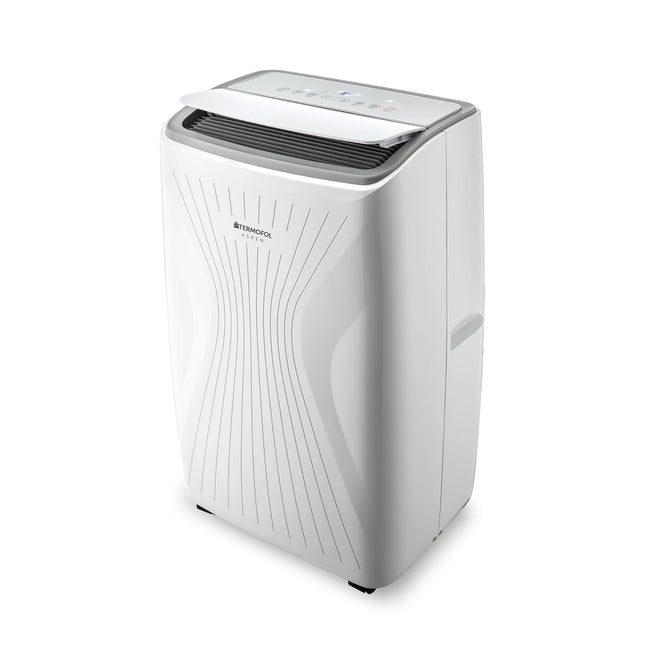
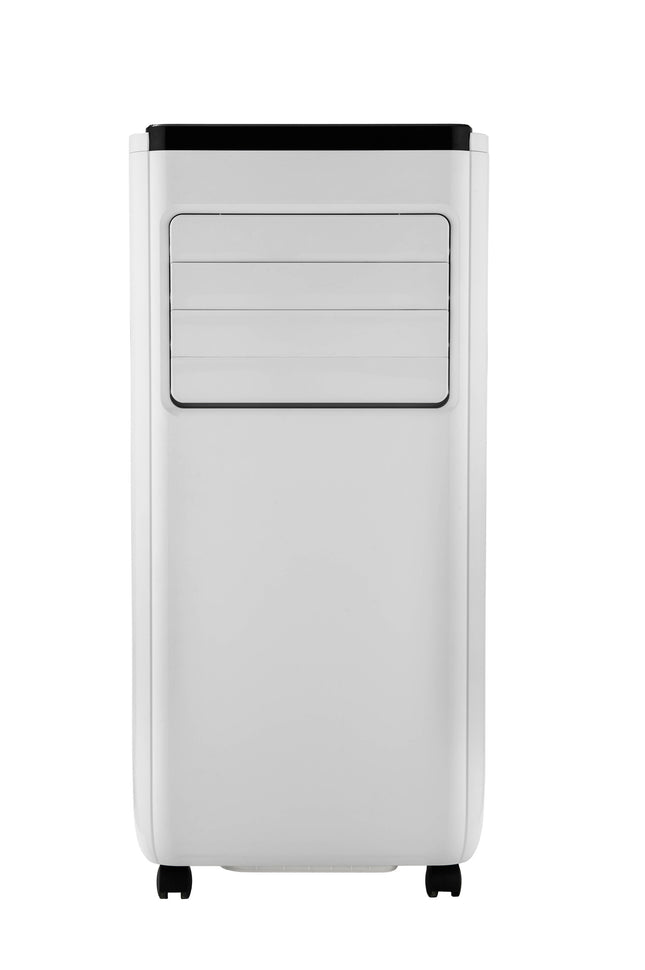
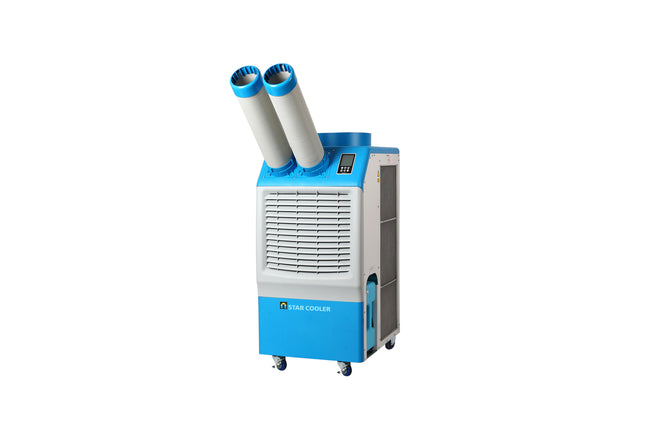
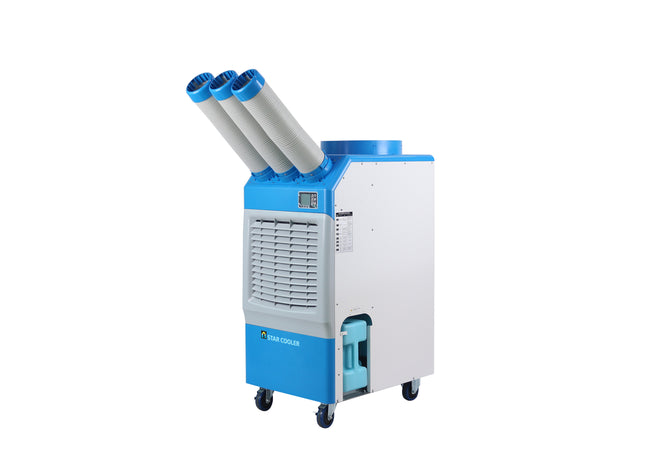

Portable air conditioning provides active cooling without permanently mounted indoor and outdoor units. The unit is placed in the room, extracts heat and moisture from the air, and expels the heat outside via a hose. This makes this solution attractive for rental properties, temporary workspaces, bedrooms, and spaces where permanent installation is not desired. However, achieving good results requires appropriate capacity, proper window sealing, and careful placement.

What is portable air conditioning?
In a monoblock unit, the compressor, condenser, and fan are housed in a single wheeled enclosure. The unit cools the indoor air and blows it back into the room. Simultaneously, the absorbed heat is expelled outside via an exhaust hose. Therefore, the unit must be positioned close to a window, door, or suitable vent during cooling.
The term mobile primarily means that no fixed refrigerant installation is required and that the device has wheels. However, you cannot move it as freely as a regular fan. You must take into account weight, condensate, power cable, drain hose, and a suitable window installation in every room.
Portable air conditioner, air cooler, or fan?
| Device | Operation | Does the room temperature drop? |
|---|---|---|
| Portable air conditioner | Cooling circuit with compressor and heat dissipation | Yes, within the specified capacity |
| Air cooler | Evaporates water in an airflow | Limited; mainly local cooling |
| Fan | Displaces existing room air | No, but it can improve the perceived temperature |
A device without heat dissipation cannot be a proper air conditioner for an enclosed room. Therefore, do not be misled solely by terms like “air cooler,” “mini-air conditioner,” or “no hose.” Check whether the product has a compressor, cooling capacity, and a genuine exhaust to the outside.
Monoblock versus portable split air conditioner
The classic monoblock is easy to install and relatively compact. However, all technical components are located indoors, making the compressor and fan audible. Furthermore, the ducting can release heat into the room, and slight negative pressure develops in many models.
A portable split air conditioner distributes the technology between an indoor and an outdoor unit. As a result, indoor noise can be lower and the system can operate more efficiently. On the other hand, there is a higher purchase price, a connecting pipe, and more requirements regarding the window, balcony, or mounting. Always check whether the chosen setup is safe and permitted.
How much capacity do you need?
Cooling capacity is expressed in BTU per hour and kW. Approximately 3,412 BTU per hour is equivalent to 1 kW of cooling power. However, the number alone does not indicate which room is suitable. The required capacity depends on room volume, insulation, windows, sun exposure, people, and heat from computers or other devices.
First calculate the volume: length × width × height. Then assess the heat load. A well-insulated bedroom on the north side requires less cooling capacity than an attic with a flat roof and afternoon sun. Therefore, compare the range at both low and high heat loads when a manufacturer specifies both.
- Measure the room in m³, not just in m².
- Note the number and size of windows.
- Assess sun, roof, insulation, and floor.
- Include persons and heat-producing equipment.
- Allow sufficient margin for exceptionally hot days.
Underweight portable air conditioners continue to operate at maximum setting for a long time and may fail to reach the desired temperature. A unit that is much too heavy is larger, often louder, and not automatically more efficient. Appropriate sizing provides the best balance between comfort, noise, and consumption.
Why a window seal is essential
The exhaust hose carries heat to the outside. However, an open window allows that heat and fresh outside air to re-enter. As a result, the compressor has to run longer. A suitable window sealant, sliding plate, or custom-made panel seals the opening around the hose as much as possible.
Choose a solution that fits a tilt-and-turn, casement, or sliding window. Keep the hose short and straight and avoid kinks. Only extend it if the manufacturer permits. Extra length and bends increase air resistance and can disrupt operation.
Low pressure and warm air from outside
Many monoblock units blow indoor air outside through the hose. This creates a slight negative pressure, and replacement air is drawn in through cracks. If this air comes from a warm hallway, attic, or outdoor environment, the cooling load increases.
Therefore, close doors to warmer rooms and seal large gaps where practically possible. A double-hose system can better separate supply and exhaust, but is less common. Compare the construction of models if this point is important.
Realistically assess sound
With portable air conditioning, the compressor and fan are located in the room. Therefore, active cooling is not completely silent. Compare both minimum and maximum dB(A) and check for which function the value applies. A low number may only refer to ventilation or sleep mode.
Furthermore, the perception of noise depends on distance, flooring, bare walls, and the switching on and off of the compressor. Do not place the unit next to the headboard or desk. Cool the room beforehand and then use a lower fan setting if that is sufficient.
Power consumption and cooling costs
Cooling capacity is not the same as electrical power consumption. For a simple upper limit, calculate: power consumption in kW × operating hours × your electricity price per kWh. A device that consumes 1.1 kW and runs continuously for three hours uses a maximum of approximately 3.3 kWh during that period.
In reality, the compressor can switch off or reduce output as soon as the temperature is reached. Therefore, the costs depend on insulation, outside temperature, settings, window sealing, and operating time. Sun shading, closed doors, and starting in a timely manner reduce the heat load.
Condensation and dehumidification
In addition to heat, air conditioning also extracts moisture from the air. Depending on the model, this condensate is partially evaporated, collected in a reservoir, or drained through a hose. Therefore, before purchasing, check how the drainage works and what the unit does when the reservoir is full.
More condensation forms during high humidity. Install a permanent drain only as prescribed by the manual and ensure sufficient slope. This prevents leakage and unexpected shutdown.
Portable air conditioner for the bedroom
In a bedroom, sound, airflow, and display light are important choices. Preferably, cool the room a few hours before going to sleep. As soon as walls and furniture retain less heat, the system does not have to work as hard. Do not direct cold air directly at the bed and choose a moderate temperature.
A timer, sleep mode, dimmable display, and multiple fan speeds increase ease of use. Nevertheless, a monoblock remains audible. Those who are very sensitive to noise therefore also compare mobile split and fixed split solutions.
Use in office, studio, or attic
In an office, people, monitors, and computers increase the heat load. Therefore, start the portable air conditioner before the room is fully heated. Position it so that air can flow freely through the room, without obstructing papers, curtains, or cables.
An attic often requires extra capacity due to heat from the roof and limited insulation. Measure the height here as well and ensure a safe route for the exhaust hose. In a studio or practice room, however, noise level and visibility are often the deciding factors.
Cooling, ventilating, dehumidifying and heating
Moreover, many models combine multiple functions. Ventilation moves air without active cooling. Additionally, dehumidification can improve comfort in humid weather. Finally, some versions feature a heating mode via a reversible cooling process or electric element.
Check each function individually. Cooling and heating capacities may vary. The required hose and condensate setup may also change per setting. Therefore, always follow the product-specific manual.
Compare useful features
| Function | When is it useful? |
|---|---|
| Thermostat | Regulates to a set temperature. |
| Timer | Allow to cool beforehand or switch off later. |
| Sleep mode | Typically reduces fan speed and display light. |
| Wi-Fi or app | Enables remote operation and scheduling. |
| Oscillation | Distributes the airflow more widely throughout the room. |
| Heating setting | Increase availability during the off-season. |
Moving and seasonal storage
Therefore, switch off the appliance and empty the condensate reservoir if necessary before moving it. Then drive slowly over thresholds and keep the appliance upright. If it has been tilted, let it rest for as long as the manufacturer prescribes before switching it on again.
Clean the filters and water drain before winter storage. Allow parts to dry and store the hose, window sealant, and remote control together. Store the unit upright in a dry, frost-free environment.
Maintenance for reliable cooling
Therefore, clean the air filter according to the maintenance schedule. A clogged filter reduces airflow, can decrease performance, and may make the fan louder. Additionally, check the hose, couplings, and condensate drain.
Never open the cooling circuit yourself. Have malfunctions, leaks, or work on the refrigerant assessed by a qualified professional. Disconnect the device from the power supply before normal maintenance.
Buying a portable air conditioner: complete checklist
- Calculate the room volume and assess the heat load.
- Compare cooling capacity in BTU and kW.
- Check range under favorable and adverse conditions.
- Choose a suitable window seal and measure the hose route.
- Compare minimum and maximum noise levels.
- View power consumption, energy label, and condensate drain.
- Check dimensions, weight, wheels, and storage space.
- Choose only features that you will actually use.
Why portable air conditioning from Warmteshop?
Warmteshop has been a specialist in climate and heating solutions for Belgium and the Netherlands since 2006. You can compare models based on capacity, noise level, operation, and usage situation. This way, you choose a system that is not only powerful on paper but also practically fits your window and room.
Frequently Asked Questions
Can a portable air conditioner work without an exhaust hose?
Not during actual active cooling. The absorbed heat must be expelled. Devices without a hose are usually fans or air coolers.
How many BTU do I need?
That depends on volume, insulation, sun, windows, people, and equipment. Compare the room advice for a heat load similar to your situation.
Does the window need to be fully open?
An opening is required for the hose, but seal the rest with a suitable window sealant. This limits the inflow of warm outside air.
Can I leave the device running at night?
Follow the manual and keep the air and heat outlets clear. For many people, pre-cooling followed by a moderate setting or timer works better.
Is portable air conditioning suitable as a permanent solution?
For occasional or flexible use, often yes. For daily, prolonged cooling, a fixed split air conditioner can be quieter and more efficient.