

Influence of infrared on your WOZ value around the reference date
, by Warmteshop, 17 min read
, by Warmteshop, 17 min read
Infrared heating does not automatically increase your WOZ value: the influence of infrared on the WOZ value depends on the property characteristics and the valuation date. Municipalities determine the WOZ value annually based on…
Infrared heating does not automatically increase your WOZ value: the influence of infrared on the WOZ value depends on the property characteristics and the valuation date. Municipalities determine the WOZ value annually based on the situation on January 1 of the previous year. For a notice you receive in 2026, the valuation date is therefore January 1, 2025. Energy-efficient heating can play an indirect role, for example through the energy efficiency and attractiveness of your home.
It is logical to wonder whether an investment in infrared heating is reflected in the value of your home. The WOZ value is not the same as the selling price: the municipality values the property on a fixed reference date, while buyers also consider energy costs, comfort, and the current housing market.
In this article, you will read how infrared heating and energy costs can relate to the WOZ valuation, why the timing of a sustainability measure matters, and how the WOZ value relates to the potential selling price. This way, you will see what you can and cannot expect from a heating upgrade.
A more energy-efficient heating system can impact energy costs and comfort, but it does not automatically increase the WOZ value. The municipality assesses various property characteristics; energy efficiency is one of them.
For buyers and renters, it is not only the system present that matters, but also the usage requirements of the home. Infrared heating heats people and surfaces with radiant heat; the effect on the energy bill depends on usage, home insulation, and thermostat control, among other factors. Appropriate heating thermostat control helps to tailor the heat to the rooms you use. This can make a home more attractive, but the energy label remains only one part of the overall picture.
Weigh lower energy costs against potentially higher taxes if the WOZ value increases. The WOZ value partly determines how much property tax an owner pays annually. Therefore, energy savings do not automatically equate to the ultimate financial gain. Compare energy consumption before and after the adjustment and compare the difference with the annual tax assessment. A heat pump or other measure can also affect operating costs; the result depends on the property and usage.
The energy label summarizes characteristics of energy performance and can be taken into account in the WOZ valuation. The Dutch label ranges from A++++ to G and remains valid for ten years. Municipalities may weight valuation factors differently, meaning the same label does not have the same effect everywhere. If you expect a higher WOZ value after an improvement, bear in mind that the label makes energy efficiency visible but is not a fixed calculation for value appreciation.
An energy label is mandatory upon sale. A more favorable label can appeal to buyers because they consider future energy costs; tenants may also attach value to expected housing costs. From 2027, municipalities must include the energy label in the WOZ valuation report. This makes registration more transparent, but does not mean that a label alone explains the full valuation. The municipality also considers property characteristics and sales figures.
After an inspection, you will receive the energy label as soon as the data has been processed and registered. Keep the inspection date and the label with your property documents. Then compare the label with the characteristics in the WOZ valuation report. This way, you check whether the information matches the property, without assuming that a new label automatically leads to a higher WOZ value.
If a registered property identifier or installation is incorrect, file an objection with the municipality within 6 weeks of the date on the WOZ assessment notice. Specify exactly which piece of information you believe is incorrect and attach appropriate evidence, such as invoices, quotations, or warranty certificates. These documents may also come in handy later when selling a home. A clear explanation helps the municipality understand which characteristics need to be reassessed.
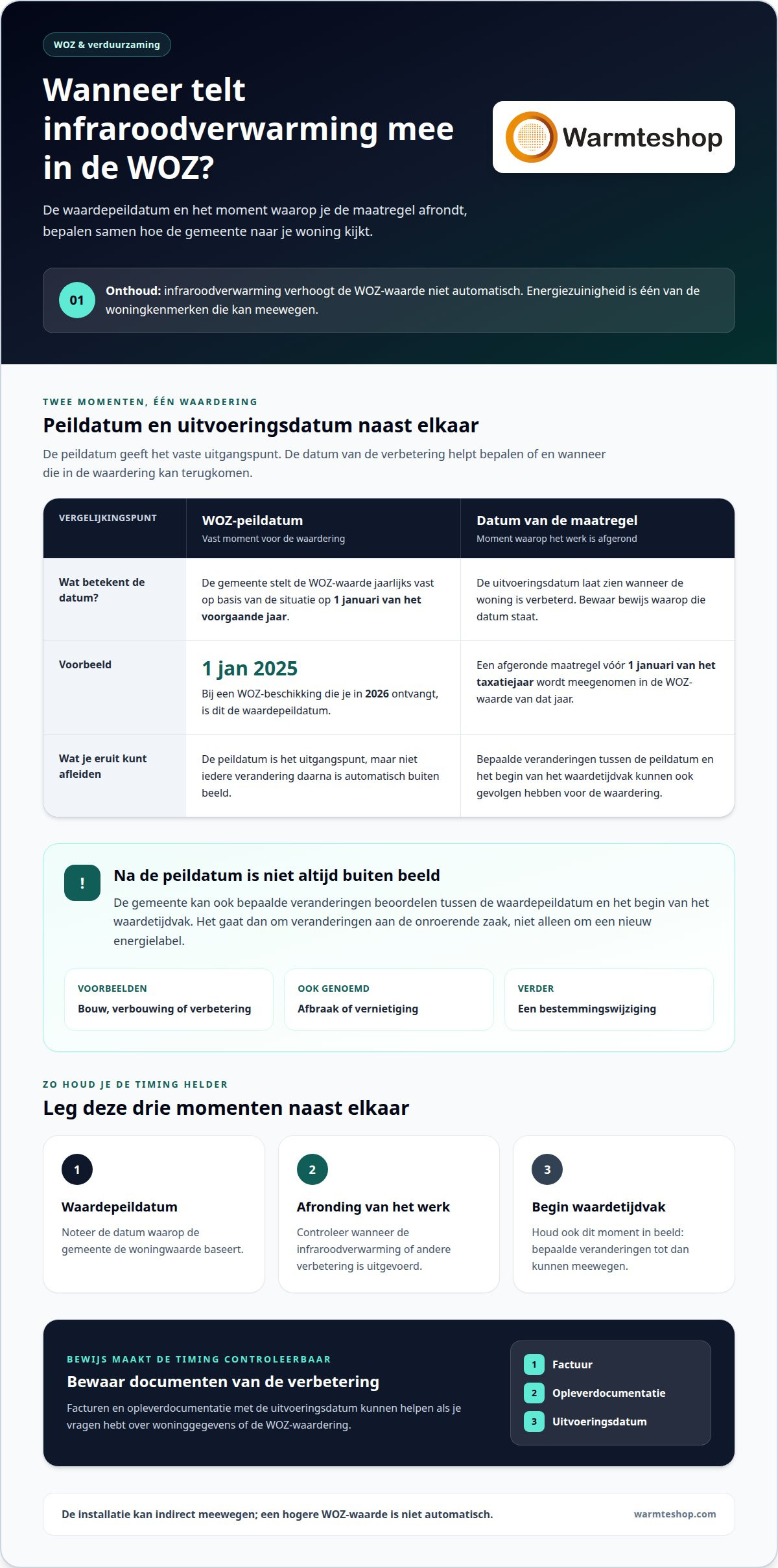
The WOZ value is determined annually based on a fixed reference date. That date determines which market data and housing conditions serve as the starting point. Therefore, a sustainability measure can only be taken into account within the period assessed by the municipality for the valuation. The date on which the work is completed is important in this regard.
The reference date is January 1 of the year preceding receipt of the WOZ assessment notice. As a result, the valuation looks back at a property value that is approximately 14 months old when you receive the notice. This retrospective view does not mean that every change after the reference date is disregarded. The municipality also assesses certain changes between the reference date and the start of the valuation period.
For sustainability purposes, it is particularly important whether the measure was carried out before January 1 of the valuation year. Measures completed before that date are included in the WOZ value for that valuation year. Therefore, keep the invoice or completion documentation showing the execution date. This allows you to substantiate the timing of an improvement if property data or the valuation raise questions.
A measure implemented after the reference date may therefore have an impact at a different time than you expect. The value on the reference date remains the starting point, but changes between that date and the beginning of the valuation period can also have consequences. The municipality may adjust the WOZ value in the event of construction, renovation, improvement, demolition, destruction, or a change of zoning. This concerns the change to the immovable property, not just a new energy label.
Changes in value resulting from mergers can also be taken into account. When a property is incorporated into one or more other properties between the reference date and the start of the valuation period, the municipality includes that change in the valuation. This differs from a standalone heating adjustment, but it demonstrates why the condition is assessed at multiple relevant points in time. Consequently, the WOZ valuation does not follow solely a single snapshot of the property.
Compare three points in time: the valuation date, the date on which the sustainability measure was completed, and the start of the valuation period. This allows you to see whether the improvement occurred before January 1 of the valuation year or within the period thereafter. Also note which points changed, such as an installation, renovation, or zoning. This timeline makes the relationship between the measure, property characteristics, and WOZ value clear.
The WOZ value and market value have different time anchors. The WOZ valuation uses a fixed reference date and municipal valuation data; a selling price reflects the market at the time of sale. As a result, an improvement may already be visible to buyers, while the WOZ value is still based on an earlier situation. The reference date explains why these amounts do not always change simultaneously.
Use the years on your assessment notice and supporting documents as an initial check. Next, verify whether the municipality could have taken the measure into account in the relevant valuation period. An intervention completed before January 1st may fall within that valuation year; a later intervention may only become visible at a subsequent valuation, depending on the relevant changes to the property. This way, you avoid confusing the WOZ value with a direct assessment of the current home.
Infrared heating does not automatically increase the sales value. The WOZ value is primarily intended for tax purposes and is usually not equal to the market value. The influence of infrared heating on the WOZ value depends on how the municipality assesses property characteristics and comparable sales figures. For buyers, the condition of the home, comfort, and expected energy costs also play a role.
That difference is important when estimating a selling price. The WOZ value can provide an indication, but does not independently determine the asking price. A real estate agent also considers the current market situation, the condition of the property, and supply and demand. Therefore, a home with infrared heating can be more attractive to a buyer, even if the WOZ assessment does not show the same increase in value.
The selling price is determined by buyers' considerations at the time of sale. Consider two comparable homes: one has lower measured energy costs and a heating system that matches a buyer's preference, while the other does not. That difference can be a factor in discussions about comfort and monthly costs. It does not result in a fixed price markup, because location, maintenance, and other property characteristics also play a role.
The energy label can also play a role in how buyers compare homes. The NVM cites an average value increase of 7.2% for a better energy label compared to the same home with a lower label. That figure refers to the label, not to infrared heating separately. Therefore, a heating system does not automatically make a home more energy-efficient on paper; the total energy performance and the registered characteristics are relevant.
If you want to assess whether infrared heating can make a home more attractive, look at concrete property information and not just the type of installation. Consider the energy label, available data on energy consumption, and how the heating is used. A home that is heated in a targeted manner can feel different to a buyer than a home with the same installation but different usage. This can influence the choice, but does not guarantee a higher price.
The installation can also be part of your home's presentation. When selling, clearly explain which rooms are heated by it and what other heating features are present. Describe the benefits that you can actually substantiate, such as comfort in a used room. This gives an interested buyer a more concrete picture than simply using the term "infrared heating for homes."
For WOZ valuations, municipalities can use sales figures to analyze how energy efficiency impacts prices paid. This makes the market relevant for the valuation, but does not mean that every installation individually has the same effect. The influence of infrared heating on market value therefore depends on the property as a whole and on what comparable buyers in the area value.
Keep the concepts separate: the WOZ value is a municipal valuation for tax purposes, while the sales price is determined by the market. Use the WOZ value as a single reference point and also assess the property characteristics and local demand. This prevents you from translating a heating upgrade into a fixed sales markup that cannot be determined solely on the basis of the installation.
The WOZ valuation does not have a fixed ranking in which infrared heating, central heating, or a heat pump automatically scores higher. The municipality assesses property characteristics and can use sales figures to analyze their influence on prices paid. Heating is therefore one component of a broader valuation. Insulation, home size, location, and the condition of the house also provide context to the installation.
A central heating system and infrared heating emit heat in different ways. For the valuation, not only the name of the system counts, but also what the property characteristics reveal about energy efficiency. Consider two comparable homes: one has an outdated heating system, the other an upgraded installation. If the insulation or energy label also differ, the valuation cannot assess the effect of the heating system in isolation.
A heat pump calculation example shows how an investment in a system can impact a valuation. In this example, the WOZ value increases by €3,720, because on average 60% of the investment is reflected in the WOZ value. This example concerns a heat pump. Therefore, the percentage and amount are not a fixed calculation for infrared heating, central heating, or other installations.
Therefore, compare heating systems based on the same property characteristics. Note which system is present, when it was installed, and which other sustainability measures have been implemented. Also, review the energy label and insulation data. This prevents you from attributing a difference between homes entirely to the heating system while multiple characteristics change simultaneously.
The usage also makes the comparison more concrete. For example, a home might combine infrared heating in one room with another primary heating system. Another home uses a single system to heat the entire house. These situations are not directly comparable: the heated rooms, installations, and energy performance differ. For buyers, comfort and expected energy costs can also be a factor.
For the WOZ valuation, keep facts about the property separate. An installation certificate substantiates which system has been installed; data on insulation and the energy label describe other characteristics. Sales figures for comparable homes then provide a market reference. The municipality can value these characteristics in conjunction, but a separate installation does not automatically result in a fixed amount on top of the WOZ value.
The practical conclusion: do not compare infrared heating, central heating, and heat pumps solely by system name. Look at the complete home, the registered energy characteristics, and relevant sales data. The example of a heat pump shows how an investment in a different heating solution can be reflected in a valuation calculation, not how the municipality values each installation. This way, you keep system choice and home valuation clearly separated.
Start with the valuation report accompanying your WOZ assessment notice. Compare the registered property characteristics with your home and pay attention to the reference date. Municipalities determine the WOZ value without inspecting the interior of the property. Documents and registered characteristics can therefore help to pinpoint any potential inaccuracies.
First, check whether the municipality has correctly recorded the key data. Consider the location, size, volume, and relevant dwelling characteristics. Next, check whether the information regarding energy efficiency aligns with the situation on the reference date. The presence of infrared heating does not automatically mean that the installation is listed as a separate item in the report. The municipality can take energy characteristics into account without naming each installation separately.
When making your comparison, keep three things separate: what is actually present in the home, when the measure was carried out, and what the report states. For example, an invoice or completion document can demonstrate that an installation was present before the reference date. A document from after that date does not prove that the installation was already there at that time. Also note which rooms are heated so that you can clearly describe the situation.
Next, compare the property data with that of comparable properties and the sales figures used. The municipality may include factors such as location, size, volume, and sales data from the surrounding area. A difference in WOZ value does not in itself prove that infrared heating has been incorrectly assessed. Look for a specific incorrect piece of data, such as an incorrect surface area, a missing renovation, or incorrect information regarding the property characteristics.
If you believe a piece of information is incorrect, file an objection with the municipality within 6 weeks of the date on the WOZ assessment notice. Describe which characteristic is incorrect, what the correct situation is, and why this is relevant to the valuation. Attach relevant documents, such as invoices, quotations, warranty certificates, or information regarding the work performed. A brief timeline including the installation date and the valuation date will make your explanation easier to follow.
Ask the municipality for an explanation if the valuation report does not clarify how a property identifier has been processed. For information regarding the WOZ value, you can also engage a professional appraiser. They can assess the property identifiers and valuation data; the municipality can provide an explanation of its decision. Focus your question on a specific point, such as the registration of an installation or the property data used.
Therefore, do not just check whether the report mentions the word infrared heating. Above all, check whether the relevant characteristics and dates are correct and whether the municipality has assessed the correct situation. If you want to install infrared heating in your home, review the options for infrared heating and keep documentation of the chosen solution with your property documents.
Warmteshop helps you find a heating solution that suits your space and comfort preferences. For homes, you can consider infrared heating as a targeted way to add heat; industrial infrared heaters are intended for heating needs in commercial spaces. An infrared mirror or infrared glass heater may also be suitable for a specific application.
The choice of a system does not automatically determine your WOZ value. The municipality assesses the property characteristics on the relevant reference date. Therefore, keep records of the installation and the execution date with your property documents. This way, you clearly distinguish between your choice of heating and the municipal valuation.
Would you like to discuss which infrared solution suits your situation? Then contact Warmteshop.
The influence of infrared on your WOZ value is no reason to view a system solely as a value increase. For your next step, consider the comfort you seek, the rooms you want to heat, and the property features you can substantiate. This way, you make a choice that suits daily use and maintain a clear record of home modifications.
If you want to explore infrared heating, you can weigh options such as an infrared panel or infrared mirror. The right application starts with your living space and heating needs, not with a promise regarding future valuations. Warmteshop offers these infrared solutions for various applications in the home.
Discuss your heating needs with Warmteshop and discover which solution suits your home. An informed choice can improve your living comfort today and helps you look forward to a more energy-efficient home.
The municipality estimates the home value based on sales data of comparable homes and characteristics such as location, surface area, and volume. The home is not routinely inspected internally for this purpose. Compare your home to a similar house in the same neighborhood: differences in size, maintenance, or insulation can explain why valuations vary. The WOZ value is a municipal valuation for tax purposes, not a personal sales estimate.
Infrared heating can be an indirect factor in the assessment when the installation is linked to home characteristics such as energy efficiency. The presence of a panel does not automatically lead to a higher rating. Consider a home with infrared heating in one room: the municipality assesses the home as a whole, not just that room. Retain information about the installation and the execution date so that the situation is clear at the relevant time.
The valuation may take into account characteristics that indicate energy efficiency, but a separate installation does not automatically receive a fixed value surcharge. Infrared heating, for example, can be part of a heating solution; the insulation and other property characteristics provide context in this regard. From 2027, municipalities must include the energy label in the WOZ valuation report. This makes the label information visible but does not mean that every heating system is listed separately.
A more favorable energy label can make the home more attractive, as buyers consider future energy costs. The Dutch label ranges from A++++ to G and remains valid for ten years. It does not constitute an independent calculation for the WOZ value: property characteristics and municipal valuation methods also play a role. An improved label can therefore be relevant, but it does not automatically mean that the WOZ value changes immediately and proportionally.
Yes, the effect can vary because municipalities do not weight valuation factors in the same way everywhere. The type of dwelling and the installation also play a role. For example, an infrared solution in a single room is not the same as a system that heats the entire home. The municipality incorporates property characteristics and sales data into the valuation. Therefore, the same installation does not automatically have the same effect on the WOZ value of different homes.


