

Maintenance-free heating systems for homes
, by Warmteshop, 18 min read
, by Warmteshop, 18 min read
Less maintenance does not mean that a heating system is completely maintenance-free. Electric infrared heating does not require a central heating boiler or annual gas inspections. This gives you peace of mind with a maintenance-free…
Less maintenance does not mean that a heating system is completely maintenance-free. Electric infrared heating does not require a central heating boiler or annual gas inspections. This gives you peace of mind with a maintenance-free heating system, as long as you know what attention is still required.
It is logical that you want to know in advance how much attention a heating system requires. Installation, energy consumption, and suitability for your home also play a role. A solution that seems simple must, in practice, fit your spaces and daily habits.
In this article, you will read what to expect regarding maintenance and installation, which factors influence energy consumption, and what to look out for during renovation or new construction. You will also discover how thermostat control and operation contribute to comfort. This will help you better assess which system suits your home and how much convenience you can expect from it.
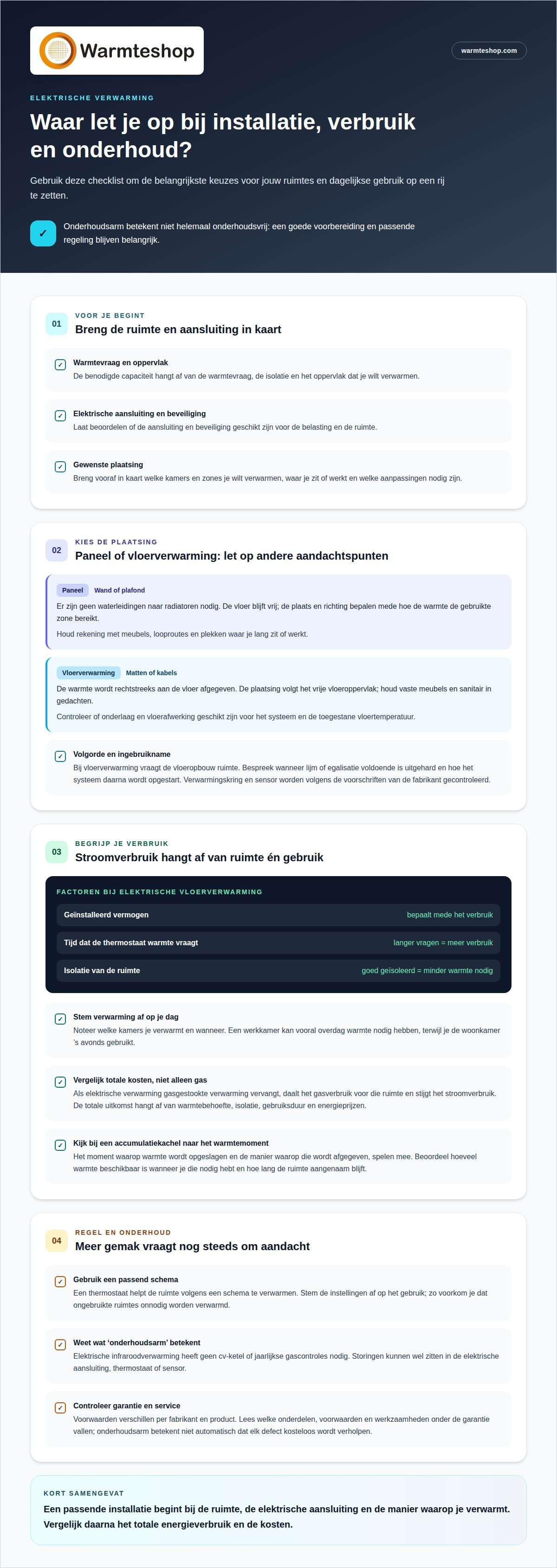
Electric heating can be installed without a piping system and radiators, but the right choice starts with the room. Infrared heating requires little maintenance: a central heating boiler and annual gas inspections are not necessary.
For an electrical installation, a suitable connection and well-considered placement are important. The required capacity depends on the heat demand, the insulation, and the surface area you wish to heat. Therefore, an installer first assesses whether the electrical connection and protection are suitable for the load and the space. This prevents the system from being unsuitable for daily use.
With electric underfloor heating, mats or cables transfer heat directly to the floor. The installation follows the available floor space, taking into account fixed furniture and sanitary fixtures. The subfloor and floor finish must also be suitable for the system and the permissible floor temperature. Around the time the floor finish is installed, the heating circuit and sensor are checked according to the manufacturer's instructions.
A panel on the wall or ceiling heats without water pipes to radiators. This keeps the floor clear and eliminates the need to install a radiator under a window. The position and direction partly determine how the heat reaches the occupied zone. Take into account furniture, walking routes, and areas where you sit or work for long periods. With a thermostat, you adjust the heat to the use of the room.
Underfloor heating requires space in the floor structure. Determine in advance which areas will remain free of fixed furniture and sanitary fixtures. Also discuss when the adhesive or leveling compound has sufficiently cured and how the system will be started up afterwards. The correct sequence protects the floor finish and helps to put the installation into operation in accordance with the manufacturer's instructions.
There is no fixed price for purchase and installation for every home. The total depends on factors such as the heated surface area, the system, the controls, the floor construction, and any necessary electrical modifications. For example, a panel requires different preparation than heating mats under a new floor. First, map out the rooms, desired placement, and required modifications. This allows you to compare quotes better than if you only look at the purchase price.
Subsidies and tax schemes depend on current Dutch conditions and the chosen system. Therefore, do not automatically factor a potential benefit into the investment calculation. The scheme must be suitable for both the measure and your home.
For electric heating, a suitable connection and protection are important installation points. According to the European Union, operators and manufacturers must check equipment for leaks when it contains 5 tonnes or more of CO2 equivalent of the fluorinated greenhouse gases listed in Annex I, or 1 kg or more of the fluorinated greenhouse gases listed in Part 1 of Annex II that are not contained in foams. This requirement applies to equipment containing those gases, not every electric heating system.
Warranties and service contracts vary by manufacturer and product. Therefore, read which parts, conditions, and work are covered under the warranty. A low-maintenance system does not automatically mean that every defect will be repaired free of charge. Potential malfunctions may, for example, lie in the electrical connection, thermostat, or sensor. Correct installation and inspection of the heating circuit help detect problems upon commissioning.
With electric heating, a portion of energy consumption shifts from gas to electricity. How much gas you save depends on the rooms you heat and the system you replace.
The power consumption of electric underfloor heating depends on the installed capacity, the time the thermostat calls for heat, and the insulation of the room. A well-insulated room requires less heat to remain comfortable. It also matters whether you heat the floor at fixed times or leave it on for longer. Therefore, operating costs depend not only on the system but also on your settings and daily usage.
With a storage heater, the timing of heat storage and the way it is released play a role. The heater stores heat and releases it later, so that usage aligns with the times you want to heat. Therefore, compare the overall performance: how much heat does the system provide when you need it, and how long does the room remain comfortable? An economical choice is only possible if the heating system matches the room.
A lower gas bill does not automatically mean lower total energy costs. If electric heating replaces gas-fired heating, gas consumption for that room decreases and electricity consumption increases. The outcome depends on heat demand, insulation, duration of use, and energy prices. Therefore, compare your total consumption and costs, not just a single line on the energy bill.
Make the comparison practical: first, note which rooms you heat and when. Then, check how long the thermostat calls for heat and how well the room is insulated. This gives you a more reliable picture than if you only look at a device's capacity. A schedule can prevent unused rooms from being heated unnecessarily.
For electric underfloor heating, the same relationship between power, thermostat duration, and insulation applies. A thermostat helps heat the room according to a schedule, but the setting must align with usage. Consider a home office that primarily requires heat during the day and a living room that is used in the evening. Adjust the heating times accordingly and assess consumption over a comparable period.
Realistic expectations are also important when switching from gas. If the electric system heats only one room, it does not automatically replace the gas consumption of the entire home. For primary heating, the heat demand and the heated surface area determine how much electricity is required. The energy savings therefore depend on the application and the heat that is no longer generated with gas.
Do you want to compare electric heating for a specific room? Then take a look at the options for infrared heating for homes , paying attention to placement, operating time, and the desired heat.
Whether electric heating is suitable for your home depends primarily on the floor structure, insulation, and heat demand. In a new-build home, you can incorporate heating early in the design. During renovation, existing building components determine how much modification is required.
When renovating, the assessment begins with the room itself. A wall or ceiling solution requires different preparation than underfloor heating. Electric underfloor heating, for example, may be suitable when the floor is being renewed, but the floor structure must accommodate the system and the finish. In an existing home with limited space for remodeling, installation on the wall or ceiling may be more practical. The choice therefore depends on the work that is already planned.
In new construction, you can incorporate the choice of heating into the home design. This allows you to assess insulation, heat demand, and available electrical capacity together. Tailor the system to the rooms you heat and the desired layout. A bathroom, for example, requires a different approach to use than an open-plan living room. This prevents the system from being designed without considering the function of the space.
A practical assessment is also necessary in social housing. The housing association or landlord typically manages the property and determines which modifications are suitable for the building. Discuss the intended heating system and its placement before work begins. For example, if a tenant wishes to supplement an existing radiator with electric heating, the available connection, fixed fixtures, and agreements regarding modifications play a role. The resident's wishes must be compatible with the property and its management.
Insulation partly determines how much heat a home loses. In a well-insulated room, electric heating can function efficiently, whereas a drafty room requires more heat to remain comfortable. Therefore, consider windows, exterior doors, and the building envelope. A system may be installed correctly but still fail to meet the heat demand if heat loss is overlooked. First assess the room and then determine the required heated surface area.
Electric underfloor heating can serve as the primary heating system if the heat loss and available output match. To determine this, you must assess the entire heated space, not just the floor. A small bathroom, for example, presents a different challenge than an open living space with multiple exterior walls. If the output is insufficient for the heat demand, supplementary heating is the more logical choice. The choice depends on insulation, floor construction, and the heat required by the home.
When choosing a flooring solution, you can weigh the options for electric underfloor heating against your renovation plans. Compare the existing floor, desired finish, and function of each room. This ensures the chosen system aligns with the home as it is actually used.
A thermostat links the desired temperature to the times you use a room. With electric underfloor heating, a schedule helps deliver heat at appropriate times. For example, you can set the living room differently from a bedroom. The control system works best when the program aligns with your daily rhythm, rather than using the same setting for every room.
Remote control is convenient when your schedule changes. With a suitable smart control system, you can adjust settings without walking to the thermostat in the room. This can come in handy if the house is unexpectedly empty or you come home later. Remote control does not replace the basic settings: first determine which temperature and heating times suit the room, and use the app for adjustments.
With an app-controlled thermostat, you manage settings in one place. You can use a schedule for each room and see if the heating requires heat at that moment. The benefits depend on the features of the chosen system and its connection to the electric heating. When making your choice, check whether the controls match the heating type and how you want to regulate the temperature.
With electric underfloor heating, the floor sensor has its own function. The thermostat regulates the heat based on the set temperature; the sensor measures the temperature of the floor. This measurement helps keep the floor temperature within the prescribed limits. This is especially important when the floor finish has a maximum temperature. Therefore, have the sensor connected and set up according to the manufacturer's instructions.
When choosing a smart thermostat, do not just look at app control. Also consider the programming options, the measurement method, and the connection to the heating system. Smart control elements are associated with Lot 20 (ErP), a requirement that these controls meet. The right choice further depends on the system: a control system for underfloor heating, for example, must work with the sensor and heating circuit used.
The investment in a thermostat is part of the overall heating decision. First, determine which rooms you want to control individually and whether you need a floor sensor. Then, choose between manual operation, a fixed schedule, or remote adjustment. A wireless thermostat may be suitable if you want to position the controls flexibly; review the options for heating thermostats and match the controls to the installation.
A good control system requires a suitable program. For example, set the heating in a home office for daytime use and give a bathroom its own schedule. Change settings when your routine changes and pay attention to the effect on comfort and energy consumption. This way, the thermostat remains a practical tool, not a complicated system that you have to readjust daily.
Comfort does not depend solely on the temperature on the thermostat. The location where you need heat, the interior design, and the type of heating also play a role. Infrared heating emits radiant heat to people and surfaces in the room. This feels different from heating that primarily warms the air. A seating area and a workspace, for example, require different positioning than an entire floor.
A resident describes infrared heating in an insulated house as comfortable at an air temperature of 16-18 °C. That is a personal experience, not temperature advice for every home. Insulation, activity, and where you sit influence how warm a room feels. Therefore, use your own comfort as a starting point and assess the heating in the room where you need it daily.
In homes with radiators, electric heating can support a specific zone. Think of a bathroom that needs heat quickly or a home office that is not used constantly. This way, you heat the place where you are, without automatically heating all rooms in the same way. The experience depends on the application and control system. With a schedule, the heating aligns with fixed usage times.
The design partly determines how easily a system fits into daily life. A wall or ceiling panel takes up no floor space and leaves room for furniture. An infrared mirror combines heating with a mirror in a place where you use it anyway. Pay attention to the line of sight, the layout, and the location where you want the heat. This prevents a panel from hanging outside the zone where it is used.
Ease of use also means understanding how the controls work. Set the thermostat for times when you use a room and adjust the schedule if your routine changes. With underfloor heating, a floor sensor can help monitor the temperature. Clear controls bring peace of mind closer with a maintenance-free heating system: you tailor the heat to your usage without complicated daily adjustments.
Low-maintenance does not mean you never pay attention to the system. Infrared heating does not require a central heating boiler or annual gas inspections, but visible parts and the controls must remain functional. Keep the area around a heat source clear in accordance with the installation instructions and watch out for changes in operation. In the event of a malfunction, the problem may lie with the control unit, sensor, or electrical connection, for example. This way, you know what to look out for, without equating maintenance-free with complete carefree.
Noise can also affect comfort. A system with a compressor or fans can be audible during operation. Electric infrared heating does not require such components to emit heat. Therefore, consider the placement of the unit in advance, especially in a bedroom or quiet workspace. Those seeking peace of mind with a maintenance-free heating system therefore weigh not only the heat but also placement, operation, and noise.
Warmteshop helps you choose a heating system that suits your home, heating needs, and daily use. If you prioritize lower maintenance, compare not only the controls but also the installation and the rooms you wish to heat. Infrared heating, an infrared mirror, infrared glass heating, and an infrared towel dryer each offer options for targeted comfort.
Discuss which rooms you heat, how well your home is insulated, and whether you are looking for primary or supplementary heating. Warmteshop combines expert personal advice with physical stores and showrooms where you can view the options at your leisure. This way, you choose a system that suits your home and expectations, without equating maintenance-free with maintenance that is completely unnecessary.
Would you like to discuss your situation and heating needs? Then contact Warmteshop.
Make your choice based on what is important to you on a daily basis: a comfortable temperature, simple operation, and low maintenance. This way, you gain peace of mind with a maintenance-free heating system, without expecting every system to require absolutely no attention. A well-considered choice starts with your home and how you use the spaces.
Consider which room you want to tackle first and what level of comfort makes the difference for you there. Perhaps you are looking for a quiet solution for a workspace, or you want the heating to better align with your daily routine. Using these wishes as a starting point makes it easier to evaluate options and choose a suitable next step.
Would you like to discuss your situation and discover which heating options suit it? Discuss your heating needs with Warmteshop and set course for more comfortable living with confidence.
For electric infrared heating, routine maintenance primarily consists of paying attention to the panel and controls. Remove dust with a soft, dry cloth and follow the manufacturer's instructions for cleaning agents. If a thermostat behaves differently than expected, note the setting and the system's behavior. In the event of damage or an electrical problem, have the connection assessed by a qualified installer.
The warm-up time depends on the heating capacity, the size and insulation of the room, and the starting temperature. A small, well-insulated room generally requires something different than a large room with significant heat loss. It also matters whether you are heating the air or primarily heating people and surfaces. Therefore, take the desired temperature and application as the starting point, not a single fixed warm-up time for every home.
Yes, you can control rooms individually if each room has its own thermostat or suitable control system. For example, a home office can request heat only when in use, while the living room follows a different schedule. When making your choice, check whether the thermostat works with the heating system and any sensors. Separate settings prevent unused rooms from automatically receiving the same schedule as rooms you use daily.
That depends on the type of heating, the placement, and the dimensions of the room. Infrared heat reaches people and surfaces within the radiation area, which means the heat can feel stronger there. For an even experience, the position of the panel, furniture, and the desired heated zone are important. A panel behind a cabinet, for example, has less effect on where you are sitting.
Maintenance costs depend on the system and any necessary repairs. Electric infrared heating does not have a central heating boiler that requires periodic maintenance, but a defective thermostat or connection may require investigation. Cleaning is different from a technical inspection or repair. Review the product's maintenance instructions upon purchase and keep the documentation. This allows you to describe exactly what happens in the event of a malfunction.
In practice, maintenance-free usually means that a system requires little periodic technical attention, not that you never look after it. Keep components clean, pay attention to changes in operation, and use the system according to the manufacturer's instructions. With electric heating, work on a central heating boiler is eliminated, but the controls and electrical components remain part of the system. The precise maintenance requirements vary by technology and product.
The total investment varies per home and depends on the chosen system, the number of rooms, the control system, and any necessary installation modifications. For example, a wall panel requires different preparation than underfloor heating. The electrical connection can also affect the work involved. When requesting a quote, ask for a breakdown of equipment, installation, and any necessary modifications so that you can properly compare the components.
Reliability depends on the installation, usage, and components of the chosen system. Electric heating has different components than a system with moving parts, so there is no single lifespan for all technologies. Follow the user manual and watch out for changes, such as failure or abnormal thermostat control. The product documentation describes the warranty and associated conditions; these do not predict how long the system will last.


