

Allergy-friendly home without air circulation: how to keep pollen out and tackle moisture
, by Warmteshop, 17 min read
, by Warmteshop, 17 min read
An allergy-friendly home without air circulation might sound like a good way to keep pollen out, but stagnant air can actually cause moisture, mold spores, and other pollutants to build up. You want all…
An allergy-friendly home without air circulation might sound like a good way to keep pollen out, but stagnant air can actually allow moisture, mold spores, and other pollutants to accumulate. You want to limit allergens *and* keep the indoor air healthy. This requires not less air exchange, but a well-thought-out approach.
It is understandable that you would prefer to keep your windows closed when pollen symptoms flare up. However, a comfortable indoor climate requires balance: moisture must be removed from the bathroom and kitchen while simultaneously limiting the amount of pollen and dust mites. In this article, you will read how ventilation contributes to this, how to tackle moisture and harmful substances, and what signals may indicate polluted indoor air.
You will also discover how heating contributes to a pleasant living climate and why heat alone does not solve problems with dampness or allergens. This allows you to better determine which home adjustments truly contribute to a healthier living environment.
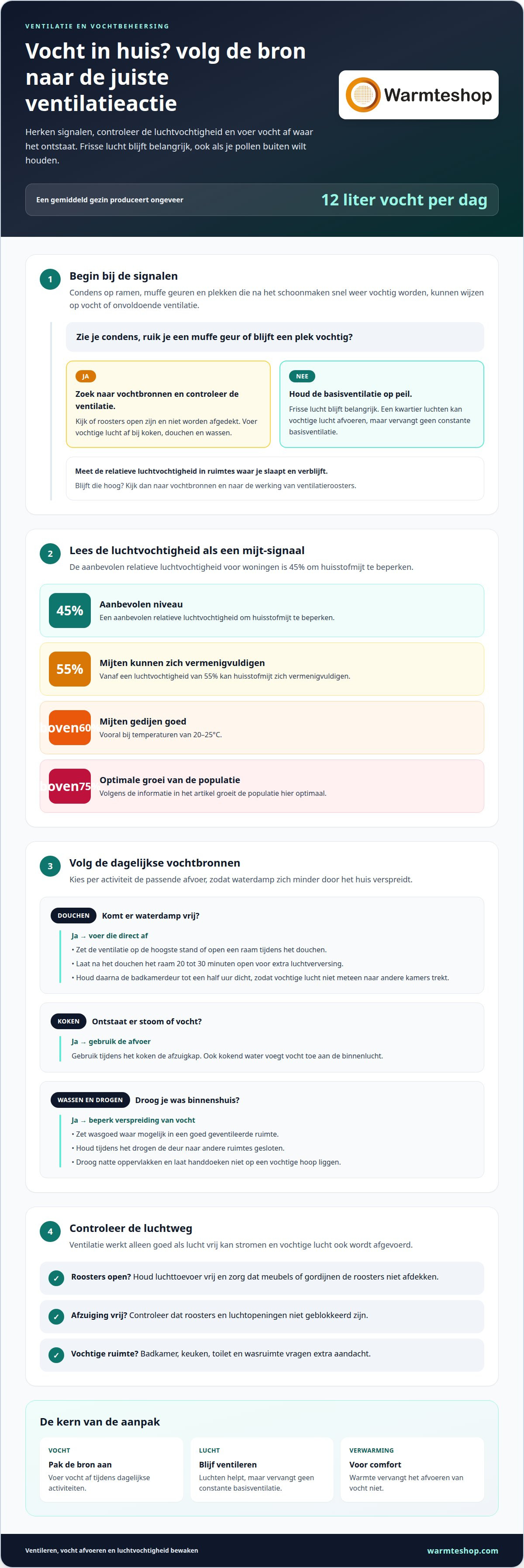
For homes, a relative humidity of 45% is recommended to limit dust mites. The Dutch Building Decree sets requirements for the ventilation capacity of homes; choose furniture and floor coverings that are easy to clean.
Moisture control means removing humid air and keeping humidity within manageable limits. This helps to reduce the chances of dust mites and mold. Dust mites can multiply starting at a humidity of 55%. At a relative humidity above 60%, the mite thrives, especially at temperatures of 20-25°C. According to the table, the population grows optimally above 75%.
Ventilation refreshes the indoor air and helps remove moisture. Without sufficient air circulation, dust mites can continue to multiply, even if you clean regularly. Measure the relative humidity in the rooms where you sleep and spend time. If it remains high, check for sources of moisture and the functioning of ventilation grilles. Airing out for 15 minutes can remove humid air, but it does not replace constant basic ventilation. As of January 1, 2026, a one-time subsidy of €400 is available for an energy-efficient ventilation system that meets the requirements. According to the Netherlands Enterprise Agency, the application must be submitted within 24 months of installation.
The choice of materials also helps to limit dust traps. For example, choose a smooth floor that you can easily mop instead of high-pile carpet. Opt for furniture with smooth surfaces and washable covers. Keep beds, upholstered furniture, and curtains free of visible dust, as textiles can trap dust. These choices do not replace ventilation, but they make cleaning more practical.
Dust mites are microscopic creatures that can trigger allergic symptoms. The allergens are found primarily in the mites' feces and remains and are spread through household dust. A damp, dusty environment provides favorable conditions for mites. Therefore, lower humidity, combined with good ventilation and cleaning, can help limit the amount of allergens in the home.
Symptoms can include sneezing, a stuffy nose, itchy eyes, or shortness of breath; dust mites can also be a cause of asthma and allergies. If you notice symptoms mainly in the bedroom, pay extra attention to bedding, mattresses, and dust accumulation. Wash bedding weekly at 60°C and vacuum at least twice a week with a vacuum cleaner equipped with a HEPA filter. This way, you tackle dust in the areas where you spend a lot of time. With poor ventilation, moisture and dust persist more easily, meaning cleaning alone may be insufficient. A home with fewer dust mites therefore requires a combination of moisture control, air circulation, and targeted cleaning.
Cooking, showering, and cleaning introduce moisture and substances into the indoor air. With targeted ventilation and proper extraction, you prevent these from accumulating in living spaces.
Moisture problems arise when water vapor and dirt accumulate and are not properly removed. This is important because a damp environment can promote mold growth and dust mites. Mold spores and dust mites can cause or worsen allergic symptoms. Therefore, pay attention to condensation, musty odors, and areas that quickly become damp again after cleaning.
With poor ventilation, harmful substances can also linger in the home. Cleaning products, paint, and cigarette smoke are examples of sources. Use these products according to the instructions and ensure fresh air during and after use. A ventilation system refreshes the indoor air, but the air intake must remain unobstructed. Keep vents open and ensure that furniture or curtains do not cover them.
Limiting moisture when washing and showering means removing water vapor immediately before it spreads throughout the house. Turn the ventilation to the highest setting or open a window while showering. After showering, leave the window open for 20 to 30 minutes for extra air circulation. Then keep the bathroom door closed for up to half an hour so that humid air does not immediately spread to other rooms.
An extraction system only works properly if grilles and air vents are not blocked. Dry wet surfaces and do not leave towels lying in a damp pile. Use the extractor hood while cooking, as boiling water also adds moisture. The bathroom, kitchen, toilet, and laundry room require extra attention, as a lot of moisture and dirt accumulate there.
Moisture production in the home is water vapor created by daily activities such as breathing, cooking, washing, and showering. As a result, an average family produces approximately 12 liters of moisture per day. This amount does not disappear on its own: without adequate ventilation, moisture can condense on cold windows, walls, and other surfaces.
Washing indoors also adds moisture. Where possible, place laundry in a well-ventilated room and keep the door to other rooms closed while drying. Gaps and open connections can allow moist air to be drawn into cooler rooms. Fresh air and functioning ventilation remove this air. Heating can provide comfort, but does not replace this removal. As a supplementary heat source, infrared heating fits into a targeted heating plan without rendering ventilation redundant.
By tackling moisture sources and extracting air daily, you limit the conditions in which mold can form. See how infrared heating for targeted heat suits your living space.
Poor ventilation can cause polluted air and moisture to accumulate in the home. This can lead to complaints, irritations, and allergies. In the Netherlands, more than 3 million people suffer from allergy symptoms. Children growing up in a poorly ventilated environment are more susceptible to health problems. Therefore, removing and replenishing fresh air helps maintain indoor air quality.
Allergens can spread via dust, pollen, and mold spores. Keep surfaces and textiles clean: vacuum at least twice a week with a vacuum cleaner equipped with a HEPA filter. Wash bedding weekly at 60°C. This cleaning frequency helps to limit dust and allergens, but does not replace ventilation. With a clogged drain or blocked vents, particles are more likely to linger in living spaces.
A CO₂ meter helps you assess whether there is sufficient ventilation in your home. Take measurements in rooms where you spend a lot of time, such as the bedroom and living room. A hygrometer measures relative humidity. Compare measurements taken at different times and places to see, for example, if moisture lingers in the bathroom after showering. Also look for visible signs, such as condensation on windows or a musty smell.
Air must also be able to flow between rooms. Keep at least 1.5 centimeters of space free under every interior door, or install a ventilation grille in the door. Without this passage, fresh air cannot move properly through the house, even when vents are open. Therefore, check that a rug, draft strip, or threshold does not block the gap. This ensures that airflow between rooms remains possible.
A demand-controlled ventilation system automatically adjusts the ventilation speed when there is more moisture or CO₂ in the air. A mechanical system extracts indoor air and supplies fresh air. This dilutes pollution. However, ventilation grilles, valves, and filters must be maintained: dust accumulation can obstruct supply or extraction. Heating provides warmth but does not remove allergens or moisture.
Also pay attention to symptoms that recur in a specific room or at a particular time. Insufficient ventilation can be associated with symptoms such as headaches, fatigue, and concentration problems. Furthermore, poor ventilation increases the risk of carbon monoxide poisoning. Take such signals seriously: ventilate, keep vents clear, and do not allow harmful substances from cleaning products or cigarette smoke to linger in the house unnecessarily. A healthier indoor climate requires clean surfaces and functioning air circulation.
Good indoor air remains important: poor ventilation can pollute the air and cause moisture problems, resulting in potential complaints, irritations, and allergies.
Condensation forms when humid indoor air cools on a cold surface, such as a window. Recurring condensation can indicate excessive moisture or insufficient ventilation. If the moisture persists for a long time, mold can grow on organic materials, such as wallpaper and wood. Therefore, do not only look at the glass, but also at window frames and exterior walls.
Relative humidity above 65% can promote mold growth on organic surfaces. Therefore, preferably keep the humidity structurally below 60%; good ventilation removes moisture and helps achieve this goal. A hygrometer provides insight into fluctuations per room. Measure, for example, after cooking or showering and compare the value later, when the room has been ventilated again.
Constant basic ventilation helps control moisture better than just short, intensive ventilation moments. Leave ventilation grilles open at least to the basic setting in winter. This ensures air continues to enter, even when windows are closed. Additionally, open windows and doors opposite each other for fifteen minutes daily to air out the home. Use the extractor hood while cooking so that steam does not spread throughout the kitchen.
Insulation can keep cold surfaces warmer and thus help reduce condensation. However, insulation does not replace ventilation: moist air must still be removed. Pay particular attention to corners behind cabinets, window sills, and exterior walls. If a cabinet is placed flush against a cold wall, allow space for airflow along the wall. This way, a hidden damp spot may become noticeable sooner.
Condensation on windows, visible mold, musty odors, and headaches or drowsiness in the morning can indicate insufficient ventilation. Note where and when you see these signs. Condensation only in the bathroom after showering requires a different approach than damp spots that recur daily in a bedroom. Do not remove visible mold without addressing the underlying source of moisture, otherwise the problem may return.
Natural ventilation via a vent or open window depends on the weather. Wind and temperature influence the amount of air exchange, causing the supply to fluctuate. Therefore, keep vents free of dust and do not close them as soon as it gets cold outside. If condensation or damp spots persist, also check that air vents are not blocked. A CO₂ meter and hygrometer can help monitor changes in the room.
When dealing with a moisture problem, inspect both the air supply and the exhaust. Ventilation brings in fresh air and helps lower humidity, while moist air is removed. Ensure that air can enter freely and then flow out. If a vent is covered or an opening is blocked, air circulation may be impaired. Clear the passage and check if the condensation decreases afterwards.
Moisture also enters the kitchen air during food preparation. Use the extractor hood while cooking for extra ventilation, so that air exchange coincides with the moment steam forms. If the kitchen feels damp after use, look for condensation and check if the humidity drops again after ventilating. Combine these observations with hygrometer readings to see if moisture forms primarily during certain activities or at other times as well.
The idea of an allergy-friendly home without air circulation is understandable when pollen causes symptoms. Nevertheless, ventilation remains important for fresh air and removing moisture. More than 1 in 8 people in Europe suffer from hay fever. A mechanical ventilation system D filters fine dust and pollen from the outside air before it enters the home. Suitable filters can reduce allergenic particles by 80-95%.
The filter type makes a difference. According to the displayed filter table, an F7 filter blocks 95-99% of pollen. An F9 or ePM1 filter blocks 99%+ of pollen. A G4 filter, on the other hand, blocks 30-40%. Therefore, do not look only at the presence of mechanical ventilation, but also at the filter that treats the air.
According to available data, with system C featuring open facade vents, 100% of outdoor air allergens enter unfiltered. This makes the location and timing of air supply important during the pollen season. Do not leave windows open for extended periods during times of high pollen levels. In sunny, calm weather, smog in the afternoon or evening can irritate the airways. Ventilating early in the morning is a more sensible time in such cases.
Clothing and belongings can also carry pollen into the bedroom. Therefore, do not leave worn outdoor clothing on the bed or a chair. Clean surfaces regularly with a damp cloth so that pollen does not get stirred up again. Vacuuming also helps, but use a device with a HEPA filter to better capture fine particles. In particular, keep the sleeping area free of bags, jackets, and other items that have been outside.
Those striving for an allergy-friendly home without air circulation are better off choosing filtered air exchange rather than a completely sealed home. Ventilation can reduce hay fever symptoms, while air exchange also removes moisture and other pollutants. A poor balance can therefore let pollen in and allow polluted air to accumulate. Have grilles and filters maintained and replaced according to the ventilation system's instructions. During pollen season, it is recommended to replace heat recovery filters every 2-3 months.
Tailor your approach to the rooms where you spend the most time. Prioritize the bedroom, as you spend a long time there. Keep windows closed when pollen or summer smog trigger symptoms, and ventilate at a more favorable time. With mechanical ventilation and suitable filters, you can limit pollen without keeping fresh air out of the house.
Warmteshop helps you tailor your heating to the rooms you use. Infrared heating can serve as a targeted heat source alongside ventilation, but it does not replace it. This way, you maintain focus on a comfortable home as well as on removing moisture and polluted air.
If you want to add warmth to the bathroom, for example, you could consider infrared heating, an infrared mirror, or an infrared towel dryer. For another place in the house, infrared glass heating might be suitable. The right choice depends on the room and how you use it. Heating does not tackle pollen or mold on its own.
Contact Warmteshop to discuss which heating solution suits your home and living comfort.
An allergy-friendly house without air circulation sounds like a way to keep pollen out, but a home also needs fresh air. Therefore, focus your approach on what suits your home: keep ventilation and moisture management in order, and then consider how to heat the rooms comfortably. Heating does not replace air exchange, but it can be part of a well-thought-out living plan.
Warmteshop offers, among other things, infrared heating, infrared panels, and infrared mirrors. These solutions add warmth to places where you find it pleasant, such as a workspace or bathroom. This way, you combine targeted comfort with attention to a healthy indoor climate, without viewing heating as a solution for pollen or moisture problems.
Would you like to discuss which heating solution suits your home and needs? Contact Warmteshop and take the right next step towards comfortable living.
First, limit exposure to potential allergens and observe where symptoms occur. Note, for example, whether you experience symptoms primarily at home, outdoors, or while sleeping. Keep the bedroom free of worn outdoor clothing and clean surfaces regularly. Ventilate the home without leaving it open for extended periods during times of high pollen counts. If symptoms persist or affect your daily life, discuss them with your GP.
Yes, ventilation remains necessary even in winter. Keep ventilation grilles open on the basic setting and ensure that furniture does not block the airflow. Do not leave windows open for extended periods when it is cold; briefly airing out the room can help refresh stale air. Do not switch off a ventilation system to retain heat. This way, fresh air continues to enter without your home cooling down unnecessarily.
Allow for natural air supply and exhaust with open ventilation grilles, usable window openings, and unobstructed passages between rooms. Do not close vents and allow air to flow under interior doors. Ventilate at times appropriate to pollen levels and outside air, and keep bedroom textiles clean. A completely sealed home is not a good approach: moisture and pollution must also be able to escape. Heating can provide comfort, but it does not replace air exchange.
A home requires a continuous supply of outside air and the removal of used indoor air. This can be achieved through natural ventilation using vents and windows, or via a mechanical system. With mechanical ventilation, supply openings must remain unobstructed, and filters, valves, and grilles must be maintained. The required capacity depends on the home and the use of the rooms. In the Netherlands, the Building Decree sets requirements for the ventilation capacity of homes.
Natural ventilation can remove moisture, but air exchange depends on wind and weather. As a result, its performance fluctuates. Keep vents open and use windows additionally to refresh the air. Watch out for recurring condensation, damp spots, and musty odors. If these signs persist, the natural supply or exhaust may be insufficient for the home or its use. Simply opening a window occasionally does not ensure a constant airflow.
Limit dust accumulation in areas where you spend long periods. For example, choose smooth surfaces that are easy to wipe down and keep items under the bed to a minimum. Wash curtains and covers according to the care label, and also clean baseboards, the bed frame, and the space behind furniture. Monitor humidity: persistently damp rooms provide favorable conditions for dust mites. Regular cleaning works best in combination with ventilation.
With insufficient ventilation, moisture, allergens, and substances from, for example, paint or cleaning products can linger indoors. This can contribute to irritation, allergic symptoms, condensation, and mold. Headaches, fatigue, and concentration problems can also occur with poor indoor air. Furthermore, poor ventilation increases the risk of carbon monoxide poisoning. Take recurring complaints or signs such as damp spots seriously and ensure that air vents are not blocked.


