

Choosing floor-standing patio heaters for your patio
, by Warmteshop, 16 min read
A freestanding patio heater is not automatically the best choice for every patio. Patio heaters on a stand are particularly useful if you want to direct the heat precisely and keep the setup flexible. This way you can…
A freestanding patio heater is not automatically the best choice for every patio. Patio heaters on a stand are particularly useful if you want to direct the heat and keep the setup flexible. This way, you tailor the heating to where you sit and how you use the patio.
Naturally, you want to know whether such a model provides sufficient heat, is easy to operate, and fits the spot where you place it. Weather resistance also plays a role: an outdoor patio heater must be suitable for the conditions on your patio.
In this article, you will read what to look for regarding portability, power, operation, and weather resistance. This way, you can choose a model that suits the size and layout of your patio and sit comfortably outside when it cools down.
A freestanding patio heater gives you the freedom to direct the heat to where you are sitting. The suitable placement depends on the layout of your patio, the power supply, and the surface.
With an electric model, the cable partly determines how much freedom of placement you have. Choose a location where the cord reaches the power outlet without crossing a walkway. Consider the passageway between the garden door and the dining table. A cable there can pose a tripping hazard and make moving it more difficult. Only take the cable with you when moving the appliance. Use only the connection and any extension cable permitted by the user manual.
A stable base is important on tiles, decking, and other patio floors. Place the stand on a flat, firm surface, not on an edge or loose tile. Check that the base makes contact with the ground everywhere. Wind can unbalance a lightweight or tilted heater. In windy conditions, move the patio heater to a more sheltered spot and follow the manufacturer's installation instructions.
Is electric or gas more economical? That depends on consumption, energy prices, and duration of use. A 2,000 W electric patio heater consumes 2.0 kWh per hour. Compare that consumption with the stated specifications for a gas-fired patio heater and your energy tariffs. Therefore, the type of fuel alone does not provide a complete picture of the operating costs.
Local regulations can be relevant for the Dutch hospitality industry. In De Ronde Venen, according to the municipality, noise standards apply to a terrace featuring a patio heater. This example shows that regulations can vary by municipality. Furthermore, pedestrian routes and adjacent seating play a role on a hospitality terrace. Take this into account when determining a suitable location.
Start by choosing a flat, suitable location and follow the connection instructions. Place the patio heater firmly and keep cables out of walkways. Before use, check the base, housing, and cable for visible damage. Allow the unit to cool down after use before cleaning or moving it. Follow the manufacturer's instructions for cleaning and storage. This will keep the setup practical and tidy.
Portability isn't just about lifting. Also consider the route to another spot, the distance to the power outlet, and the space the base occupies. A fixed position can be convenient for a dining table; for individual lounge seats, a movable setup is more practical. View outdoor patio heaters and compare the shape with the layout of your patio.
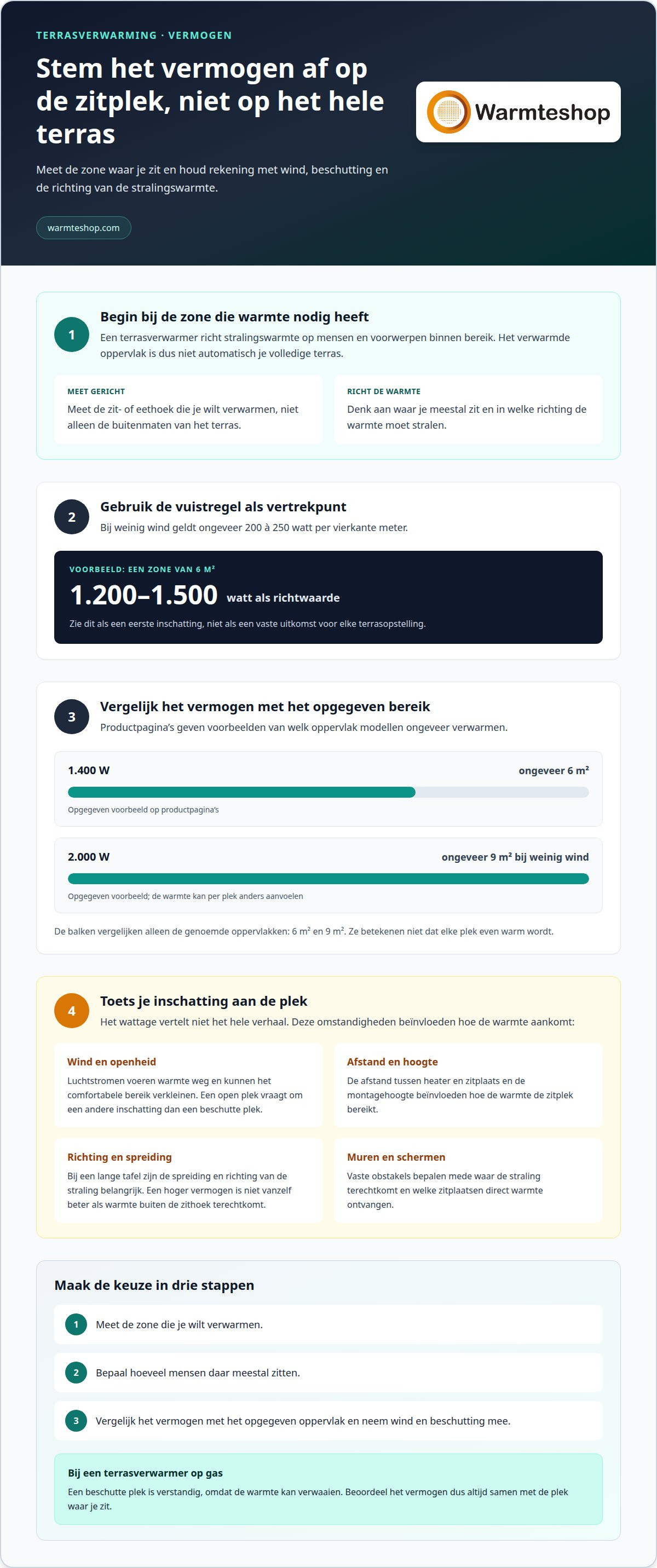
Adjust the power output to the area you want to heat. A patio heater directs radiant heat at people and objects within its range. Consequently, the heated surface area is not equal to the total patio space. For example, a heater in a seating area does not need to heat the entire patio. Therefore, first determine where you usually sit and which zone requires heat.
As a rule of thumb, approximately 200 to 250 watts per m² applies in low wind conditions. For a 6 m² terrace, this results in a target value of approximately 1,200 to 1,500 watts. This is a starting point, not a fixed outcome for every setup. The distance between the patio heater and the seating area, the mounting height, and the openness of the terrace influence how the heat is received.
According to product pages, a 1,400 W electric patio heater heats approximately 6 m². A 2,000 W model heats approximately 9 m² in light wind. Use these examples as a practical comparison. They show that more power generally corresponds to a greater range, but do not imply that every corner gets equally warm. A sheltered seating area can feel different from an open space of the same surface area.
Measure the zone you want to heat, not just the external dimensions of the terrace. If the seating group is against a wall, direct the heat towards that spot. If you want to heat a long table, consider the spread and direction of the radiation. A higher power output is not automatically the best choice if the heat ends up primarily outside the seating area.
Wind plays a role in the choice. Air currents carry heat away and can reduce the comfortable range. An open 9 m² terrace therefore requires a different assessment than a sheltered spot of the same size. Also consider fixed obstacles, such as a wall or screen. These help determine where the radiation lands and which seating areas benefit directly from it.
Make your choice in three steps: first measure the desired zone, then determine how many people usually sit there, and finally compare the power output with the specified heated surface area. Take your patio conditions into account, especially wind and shelter. This prevents you from relying solely on the wattage. For an unconventional layout, comparing freestanding patio heaters help assess range and placement side by side.
According to the text, a sheltered spot is advisable for a gas patio heater because the heat can be blown away. Take this into account when determining which part of the patio needs to be made comfortable. Do not just look at where the unit can be placed, but keep the intended seating area in mind: that is where the heat needs to end up. If the zone is open, the heat will be less likely to remain in the desired location. A sheltered setup is therefore more suitable for the goal of heating a defined area. Think in advance about your usual seating position and the direction in which you want the heat to flow. This way, you assess the capacity not in isolation from the location, but in conjunction with the zone you actually use. Make this assessment before choosing a model, so that the choice aligns with the area that requires heat.
The controls determine how much effort it takes to adjust the heat. Consider a dinner party where guests take turns sitting at the table and in a lounge area. In that case, easy-to-use controls are more pleasant than constantly adjusting the setup. Before purchasing, check where the controls are located and how to use them. With a button on the housing, you have to walk to the heater. A remote control from your seat might be more convenient, if the model has one.
With dimming settings, you can adjust the heat to suit the moment. For example, you can start with a higher setting when you sit outside. Later, a lower setting might suffice, depending on the temperature and the shelter. Don't just compare the number of settings, but also check if it is clear which setting is active. A simple indicator prevents guesswork when you are sitting outside.
Make these points concrete when comparing:
A patio attached to the house sometimes requires different controls than a fixed seating area. If the stand is positioned next to an outdoor table, a button nearby may be easily accessible. If it is further away, operation from the seat is more important. Also consider the cable routing: controls on the heater are inconvenient if they are difficult to reach. Therefore, evaluate the controls in conjunction with the placement.
Note the difference between power and control. A dimming setting changes the heat output, but the stated power remains an important characteristic of the appliance. Do not rely on a savings percentage without product specifications. If you want to lower the heat, choose a setting that suits the situation. A different setting may be pleasant in a sheltered corner than on an open terrace.
Check the user manual to see how to switch on the patio heater, select settings, and switch it off. Follow these instructions during the first use. If multiple people are operating the device, agree on which button or remote control belongs to which unit. This prevents searching during a meal. Choose a control system that you can use without complicated procedures. With clear controls, you can adjust the heat to your patio more easily.
What safety rules apply to free-standing patio heaters? Follow the instructions for placement, spacing, and connection. Use a gas heater only outdoors or in a well-ventilated area. Due to the risk of fire, do not place it under a completely enclosed canopy.
The IP rating helps you assess the protection the housing offers against solid particles and water. Compare the stated class with the location where the heater will be placed. For example, an open-air patio will be exposed to more rain than a sheltered veranda. The description 'suitable for outdoor use' does not, in itself, indicate how the device handles all weather conditions.
Therefore, pay attention to the product information as well as the location where you place the heater. Is it next to a wall, under a partial canopy, or on an open terrace? Rain can also come from the side. Wind blows moisture and dirt to areas that remain drier under a roof. So, do not choose the placement based solely on the weather resistance of the housing.
The IP rating does not mean that you can let a heater get wet if the manufacturer advises against it. Do not leave the device outside unnecessarily during prolonged rain. Store it in a dry place after use if the user manual prescribes this. Use a protective cover only if the manufacturer permits it and the device has completely cooled down. This prevents moisture from becoming trapped around hot parts.
Check three visible parts before use:
Stop using the device as soon as you notice any damage. Only clean an electric patio heater after it has been switched off and cooled down. Do not use a wet cloth on parts where the manufacturer advises against it. Consult the manual for the correct cleaning of your model. This will prevent cleaning fluid from entering openings or connections.
The ground surface and surroundings also matter. Place the patio heater on a stable surface and maintain the prescribed distance from furniture, plants, and other objects. Do not place it close to curtains or other easily flammable materials. Good ventilation is especially important for a gas model: an enclosed canopy is not suitable for this. Move the unit in strong winds or precipitation if the instructions indicate this.
Use these steps when making your choice: first, determine how much rain and dirt the location will be exposed to. Then, compare those conditions with the IP rating and the installation instructions. Finally, choose a storage location that aligns with the manufacturer's recommendation. This way, you assess weather resistance as part of the entire setup, not as a separate indication on the product.
For a lounge area, you usually choose between electric and gas heating. An electric patio heater uses electricity, while a gas model runs on gas. Both can provide warmth on a patio, but the connection and usage are suitable for different situations. Therefore, first consider where your lounge area is located and how you intend to use the heater.
With an electric infrared heater, the heat is directed at people and objects. This can be pleasant if your seating area has a fixed spot. Consider two armchairs around a low table: direct the heater towards that seating area, not towards an empty passageway. This way, you tailor the direction of the heat to the use of the lounge.
A gas heater may be suitable if an electrical connection is not practical. In that case, pay close attention to the location and ventilation. A gas heater is only suitable for outdoors or well-ventilated spaces. Due to the risk of fire, do not place it under a fully enclosed canopy. In an open lounge setup, the wind can carry away heat, so a sheltered spot is important.
Compare the types based on concrete points of use:
The shape of the lounge area helps determine which type is practical. For a compact seating area, a focused heat source may suffice. In a larger setup, you need to consider which seats are within reach. Position the heater so that guests do not have to constantly change places to feel the warmth. A long sofa, for example, requires a different placement than individual chairs around a table.
The time of use also makes a difference. For a fixed evening spot, an electric heater with a suitable connection is a logical option. If you change the layout often, consider in advance how the heat reaches the new seating areas. With gas heating, also take into account that the area must remain well-ventilated. The layout of the lounge and the available connection will help you refine your choice.
Make your decision in this order: first determine the seating area, then choose between electricity and gas, and finally assess placement and ventilation. If in doubt, look at the different models of lounge heaters and compare how their shape fits your seating area. This way, you choose a freestanding patio heater based on where you actually want to sit.
Consumption can also be a factor when choosing a heater for your lounge area. View these amounts as estimates based on the described assumptions, not as fixed costs for every heater or every usage moment. Take these amounts into account in your decision-making, along with the connection and the location where you need heat.
A separate calculation example shows what power and electricity prices can mean. Therefore, compare models not only on shape and placement, but also on the consumption that suits your usage. The seating position, connection, and cost estimates combined provide a more complete picture of the choice.
Warmteshop helps you tailor your heating choice to your terrace and usage. Weigh your seating position, desired warmth, operation, and weather conditions together. This way, you look beyond just the appearance of a freestanding model and choose a solution that suits your outdoor lifestyle.
Would you also like to see how infrared heating works in other rooms? The range of infrared heating shows how targeted heat is used in various applications. This helps you better understand the technology behind patio heating.
Do you have questions about choosing your terrace? Feel free to contact Warmteshop.
A suitable heater can make your patio more usable when the evening cools down. Choose a model that complements your outdoor seating arrangement, so the warmth contributes to a pleasant, practical setup. With floor-standing patio heaters, you direct the heat towards a seating area.
Indoors, too, you can tailor the heat to the room. In addition to patio heating, Warmteshop offers infrared heating, infrared panels, and infrared mirrors, among other things. This allows you to consider a solution for different areas of your home that matches your desired comfort.
Want to take the next step? View the freestanding patio heaters and discover which setup suits your patio. A well-considered choice helps you sit comfortably outside, even on cooler days.
A freestanding model is convenient if you want to direct the heat to different areas. You can adjust the setup if, for example, you rearrange the lounge area or if guests are seated at a different table. This choice works particularly well on terraces without a fixed location for wall or ceiling heating. When installing, ensure a stable surface, sufficient space, and a safe power or gas supply.
The price depends on the type of heating, the design, and the features of the chosen model. Electric and gas models, for example, differ in connection and technology. Power and operation can also vary by version. Therefore, do not compare only the purchase price, but also consider the operating costs and the location where you intend to use the heater. This way, you can base your choice on what matters to your patio.
Match the power output to the part of your terrace where you actually sit. As a guideline, approximately 200 to 250 watts per square meter applies in low wind conditions. A 1,400-watt heater heats about 6 m²; a 2,000-watt model about 9 m². Consider shelter and the distance to the seating area, as these affect how effectively the heat is delivered.
The range depends on the power output and the conditions around the heater. In low wind conditions, a 2,000-watt model can heat approximately 9 m². This does not mean that every spot within that area will feel equally warm. An open terrace may react differently than a sheltered corner. Therefore, consider the seating areas you want to heat, rather than just the total surface area.
A 2,000-watt electric patio heater consumes 2.0 kWh per hour when operating at full power. Consumption therefore depends on the power output and the duration of use. For a gas model, consumption varies by unit; consult the product specifications for this. Note how long you use the heater and compare that with the stated consumption. This will give you a suitable estimate for your usage.


