

Infrared heating in the bathroom: required power and comfort
, by Warmteshop, 16 min read
An infrared panel of approximately 700 watts is a suitable starting point for most bathrooms. For infrared heating in the bathroom, the required power averages around 65 to 100 watts per square meter; the ru…
An infrared panel of approximately 700 watts is a suitable starting point for most bathrooms. For infrared heating in the bathroom, the required power averages around 65 to 100 watts per square meter; the room, insulation, and placement determine where you fall within that guideline.
A cold floor or chilly air after showering makes comfort in the bathroom especially important. Infrared heating works differently from heating that primarily warms the air: it heats people and surfaces directly, so you feel warmth where you need it.
In this article, you will read when an infrared panel might be suitable, how to match the output to your bathroom, and the role insulation and installation play. You will also discover how targeted use can help save energy and what to look out for to ensure a safe and comfortable setup.
An infrared panel heats people and surfaces directly with radiant heat. As a result, infrared heating in the bathroom can feel pleasant, without first heating up all the air.
You can mount panels on the wall or ceiling. First, consider where you want to experience warmth and how much wall space is available. A ceiling panel is less noticeable and leaves walls free for, for example, a mirror. For ceiling heights of up to approximately 2.5 meters, ceiling mounting may be suitable. A wall panel is an alternative when ceiling mounting does not suit the space well.
The placement partly determines how the heat is distributed. A wall panel heats the bathroom floor less directly than a ceiling panel. Therefore, consider your daily usage: do you mainly stand at the sink, or do you also want warm feet when you step out of the shower? First determine where you need heat; this will help you choose the installation location.
Ceiling panels can heat surfaces in the bathroom. As a result, the room can dry faster and condensation on walls and floors can decrease. This can also help reduce the risk of mold formation. The effect depends partly on placement and ventilation. Therefore, a panel does not replace ventilating after showering.
Wall panels offer a visible, stylish way to direct heat to a specific spot. An infrared mirror, for example, combines mirroring with heating. When mounting on the wall or ceiling, take fixed elements such as the shower, washbasin, and door into account. This prevents furniture or other obstacles from blocking the heat radiation to the desired location.
Infrared panels do not cause air circulation like systems that move air. As a result, they do not disperse dust particles via an airflow. The panels do heat surfaces, however, which can contribute to a drier bathroom. Proper placement remains important: direct the radiant heat to the areas where you want comfort and take the layout into account.
The cost of infrared heating, including installation, depends on the chosen panel, the required power, and the mounting location. The necessary electrical connection can also affect the work involved. Ceiling mounting, for example, requires a different placement than a wall panel next to the mirror. The choice between a standard panel and an infrared mirror also plays a role.
Therefore, compare not only the panel but also what the installation entails. First determine the desired location and the type of panel; only then will it become clear which installation is required. In this way, the price depends on the specific setup, not just on the appearance of the panel. Review various infrared heating solutions if you want to weigh the options for your bathroom.
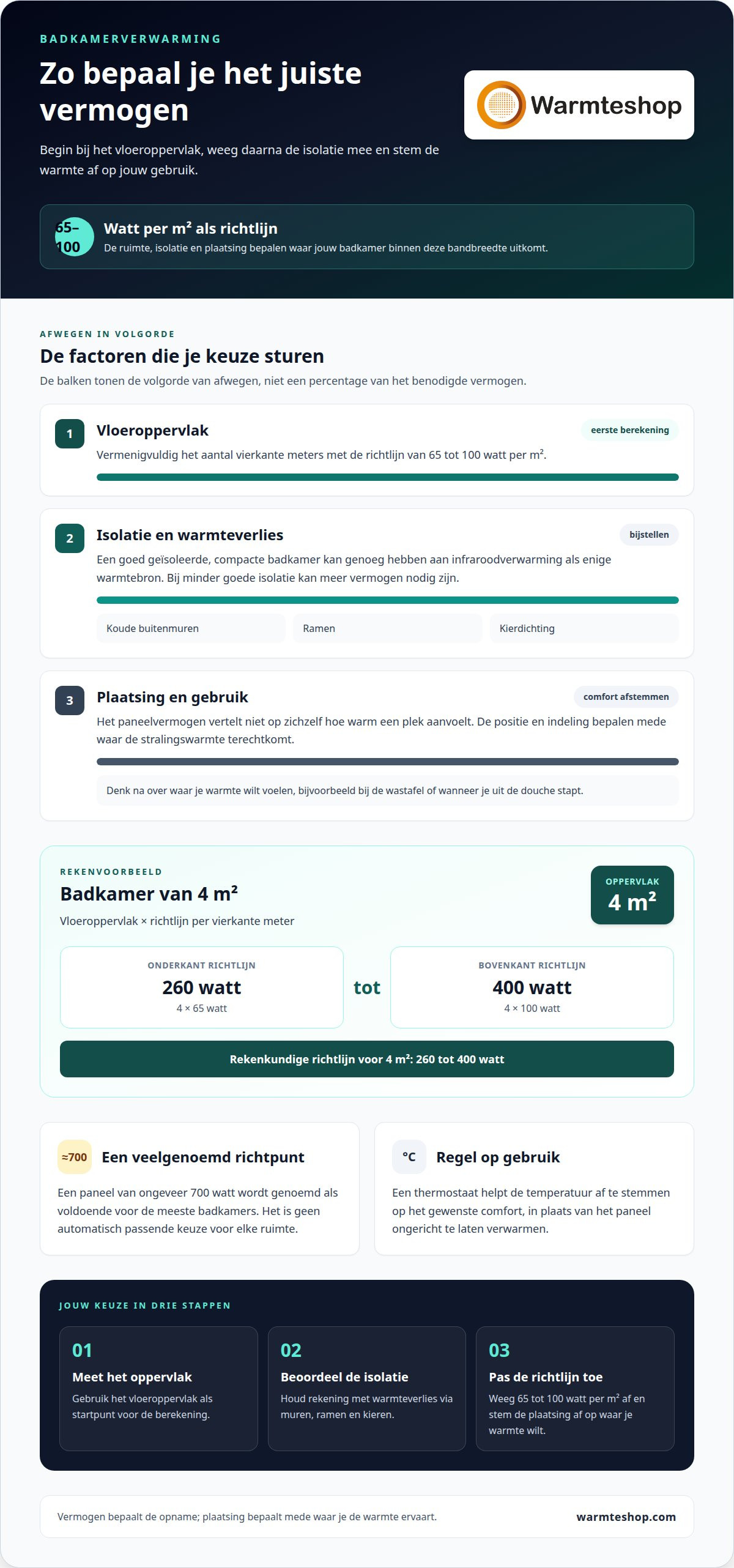
The required power depends mainly on the floor area and insulation. For a bathroom, the guideline is 65 to 100 watts per square meter.
Use the floor area as the first step: multiply the number of square meters by the guideline. Mathematically, a four-square-meter bathroom requires 260 to 400 watts. For smaller bathrooms, 65 watts per square meter may be sufficient. The guideline increases when the space requires more power for comfortable use.
A panel of approximately 700 watts is cited as sufficient for most bathrooms. That is a guideline, not a capacity that automatically suits every space. A well-insulated, compact bathroom requires something different than a larger space with heat loss. Therefore, first look at the surface area and insulation, and match the panel capacity accordingly.
The power output indicates how much electrical energy the panel consumes when heating. In itself, this does not indicate how warm you perceive a particular spot to be. Infrared heat heats people and surfaces directly; the position and layout of the panel partly determine where the heat ends up. Therefore, do not just choose a panel with an appropriate power output, but also tailor it to the use of the bathroom.
Insulation partly determines how much heat a bathroom retains. In a small, well-insulated bathroom, infrared heating may be sufficient as the sole heat source. With poorer insulation, more heat is lost. In that case, a higher output may be required to achieve the desired comfort.
Therefore, do not assess only the floor area. Also pay attention to cold exterior walls, windows, and the condition of the airtightness. Heat can be lost through these components, causing a bathroom to cool down faster. Consequently, two bathrooms with the same floor area can still have different power requirements if their insulation differs.
Make the choice in three steps. First, measure the floor area, then determine how well the bathroom is insulated, and finally apply the guideline of 65 to 100 watts per square meter. Use 65 watts per square meter as a starting point for a smaller bathroom. For greater heat loss, take the higher end of the guideline into account in your assessment. This prevents the size alone from determining the choice.
Thermostat control helps to tailor the heating to the desired usage. With a heating thermostat, you can regulate the temperature instead of letting the panel heat indiscriminately. This way, you connect the chosen power output with the comfort you seek in the bathroom.
Saving starts with targeted heating, rather than leaving the panel on for unnecessarily long periods. Consumption depends on the power output, operating time, and selected temperature.
As supplementary heating, a panel provides extra comfort when you need it. For example, you can switch it on around your daily bathroom routine, instead of heating the room continuously. This limits usage time and allows you to use electric heat purposefully.
As the primary heating source, the panel provides heat for the entire bathroom. This requires a suitable setup and sufficient capacity for the space. In a small, well-insulated bathroom, infrared heating can suffice as the sole heat source. In a less well-insulated room, heat loss plays a greater role.
A 700-watt panel consumes 0.7 kWh per hour when heating continuously at full power. That is the maximum consumption for that hour; the actual amount depends on how long the panel is active. A thermostat control can help adjust the temperature to usage, so that heating does not continue unnecessarily.
The most important step to save energy is aligning the usage time with your routine. For example, heat only around the times you use the bathroom. Do not run infrared panels 24/7 to heat an entire room; that consumes a lot of energy. With targeted heating, you utilize the heat at times when comfort is actually needed.
The function of the panel also makes a difference. As supplementary heating, it makes a specific spot more comfortable, whereas primary heating must serve the entire room. Additionally, take insulation and the desired temperature into account. These factors influence how much and for how long the panel needs to heat.
Infrared panels run on electricity and can be powered by sustainable energy from your own solar panels. Self-generated power can therefore be relevant to your heating usage. Adjust usage to the available electricity and your bathroom routine. This way, you combine electric heating with more conscious energy use, without assuming fixed consumption or savings.
A stylish panel does not automatically consume less energy thanks to its design. Pay particular attention to the power output, operating time, and controls. For example, compare a panel that is only switched on during peak usage times with the same panel that heats for hours. The operating time partly determines how much electricity it consumes.
You can also install an infrared panel on the ceiling. This keeps wall space free and the panel is less noticeable. This is practical if you want to keep the walls clear. However, coordinate the placement with the available space and the areas where you need heat.
An infrared panel emits radiant heat to people, objects, and surfaces. As a result, you feel the heat directly, without waiting for all the air to reach the right temperature first.
The radiant heat from most panels is noticeable within approximately five minutes. According to the available product information, a bathroom panel heats up fully in an average of 5 to 10 minutes. For pleasant warmth, you can therefore switch on the panel 10 to 15 minutes before use. This way, the heat starts working before you even enter the bathroom.
The heat from most infrared panels can be felt up to three meters away. This range helps you determine where to place the panel in relation to the sink, shower, or changing area. If you primarily want warmth at the sink, position the panel so that the radiation reaches that spot. The mentioned distance can help determine the position.
A standard heating system primarily heats the air. Infrared radiation, on the other hand, heats people and surfaces, such as the floor or a wall. As a result, a panel can provide pleasant warmth without all the air in the room first reaching the same temperature. That difference is noticeable when you want comfort in one spot, for example at the sink after showering.
The radiation reaches people and surfaces in the direction of the panel. Therefore, consider where you are standing and which objects might block the direct line. A cabinet or high partition between you and the panel can affect heat distribution. With an unobstructed direction of radiation, the heat is easier to direct to the desired spot.
The surface area and shape of the panel also influence heat distribution. A wide panel can cover a larger portion of a wall, while a smaller panel can be positioned more precisely. Therefore, do not choose the arrangement based solely on appearance. Also consider the location where you want heat, the line of sight, and the desired heat distribution.
Infrared panels emit heat from the front. The direction of that front is therefore more important than simply the presence of a panel. Mounting it opposite a place you use frequently can provide more immediate comfort than placing it behind an obstacle. Consider, for example, the spot where you stand after drying off. The radiation angle helps you determine the correct position in this way.
A panel is therefore particularly interesting when you want targeted heat, such as around the sink or after showering. Review the options for infrared heating for the bathroom, keeping both the desired location and the direction of radiation in mind.
Safe installation starts with the humid environment and the location of the panel. Pay attention to the IP rating, safety zones, and surface temperature.
The safety zones help determine where electrical equipment can be placed in the bathroom. Zone 2 extends up to 60 centimeters from zone 1. Therefore, carefully map out the position of the bath or shower and the available wall space before choosing an infrared mirror.
Pay attention to the IP rating of the panel when making your choice. This value indicates how well the device is protected against water and moisture. An IP rating in itself does not mean that the panel is suitable for any location, such as directly next to a shower. The intended mounting location must match the product information.
In a smaller bathroom, the distance between the shower, washbasin, and mirror is often limited. If necessary, draw these elements on a simple floor plan and mark the zone boundaries. This way, you can see if the mirror fits in the desired location and avoid misjudging the available space. Also, take into account the electrical connection and the panel mounting instructions.
Infrared heating converts electricity into long-wave radiation. This radiation heats the skin and does not penetrate further. This works differently from heating that first warms the air. For a pleasant experience, proper placement remains important: point the front of the panel at the spot where you want to feel the warmth.
A mirror panel can become warm during use. According to the provider, infrared mirrors operate at temperatures between 85 and 100 °C. Therefore, do not touch the heating surface when the panel is switched on or has been used shortly before. Keep towels and other objects away from the panel so that they do not cover the heating surface.
For an efficient and safe choice, three points are important: the IP rating, the mounting location, and the surface temperature. During installation, follow the instructions for the panel and take the humid environment into account. In this way, assess not only whether a mirror fits in terms of size, but also whether the placement is suitable for the use of your bathroom.
View the infrared mirrors and compare their application with the space you have in mind. If you want to choose an infrared mirror that fits your bathroom layout, view the options.
Warmteshop helps you tailor infrared heating to the space and desired comfort. For the bathroom, you can choose an infrared panel or an infrared mirror, depending on where you want to experience warmth and how much wall space is available. Power output, installation, and moisture resistance help you weigh the options.
For other applications, Warmteshop also offers industrial infrared heaters. The range includes solutions for diverse heating needs, from a comfortable bathroom to an industrial environment. First, determine where you need heat and which type of heating suits your needs. Contact Warmteshop to discuss your heating requirements.
The best choice starts with how you use the bathroom. Consider where you want to feel warmth, how much space is available, and how the heating fits into your daily routine. This way, you consciously tailor the comfort to your home and preferences.
When it comes to infrared heating in the bathroom, it's not just about technology. Appearance and function also matter. Warmteshop offers infrared heating, infrared panels, and infrared mirrors, allowing you to consider various applications. Personal advice helps you tailor the options to your bathroom and preferences.
Would you like to discuss your situation and determine a suitable direction? Contact Warmteshop. With a clear picture of your wishes, you take a practical step towards a bathroom that feels comfortable and suits your lifestyle.
An infrared panel typically lasts up to 20 years or longer. The lifespan depends partly on the quality of the panel and how carefully you use it. In the bathroom, it is important that the panel is suitable for the humid environment and is installed according to the instructions. Ensure proper ventilation and maintenance, and prevent towels from covering the heating surface.
Installation depends on the location, the mounting, and the electrical connection. A panel on an accessible wall may be easier to install than a ceiling panel that requires working above your head. Measure the location carefully and follow the model's installation instructions. In the bathroom, also consider moisture resistance and the distance to the shower or bath.
Operating costs depend on the power output, usage time, and your electricity tariff. Estimate consumption by multiplying the power drawn by the time the panel heats. A panel switched on only during peak usage times consumes less than the same panel heating for an extended period. With a thermostat, you can adjust the temperature to suit your routine.
Electric heating cannot be judged as expensive or cheap based on a single fixed amount. The costs depend on your electricity tariff and the total consumption of the device. Therefore, compare the power output with the expected operating time. It also makes a difference whether you heat a specific spot or maintain the temperature of the entire room for an extended period.
You feel infrared heat directly on people and surfaces, meaning comfort does not depend entirely on heating up the entire air. How quickly the room as a whole becomes comfortable also depends on insulation, panel power, and placement. A panel directed towards the spot where you get ready can provide comfort there sooner than in a more distant corner.
Describe your situation concretely when seeking advice on infrared panels. Consider the dimensions of the bathroom, the desired installation location, and whether you intend to use the panel as primary or supplementary heating. The choice between a standard panel and an infrared mirror may also be relevant. Contact Warmteshop to discuss your question regarding the possibilities.
Yes, in a small, well-insulated bathroom, infrared heating can be sufficient as the sole heat source. When making this assessment, consider the floor area, insulation, and the areas where you need heat. A larger bathroom or a room with more heat loss requires a different consideration. Also, think about how often you use the bathroom and when you want heat.
For a bathroom, calculate an average of 65 to 100 watts per square meter. For a smaller bathroom, 65 watts per square meter may be sufficient. Apply this guideline to the floor area and then take the insulation into account. A bathroom that retains heat less well generally requires a higher power output than a comparable, well-insulated room.


