

Wireless Elektrobock thermostats opt for infrared heating
, by Warmteshop, 16 min read
The best wireless Elektrobock thermostat is not automatically the most comprehensive, but the one that matches your infrared heating and receiver. Therefore, when choosing wireless Elektrobock thermostats, first look for compatibility…
The best wireless Elektrobock thermostat is not automatically the most comprehensive, but the one that suits your infrared heating and receiver. Therefore, when choosing wireless Elektrobock thermostats, first look at compatibility, and then at temperature control and functions that fit your daily routine. Moreover, wireless communication does not automatically mean that you control the heating via Wi-Fi or an app.
Choosing a thermostat may seem technical, but it revolves around a few practical questions: how do you want to control the temperature, do you want to use heating schedules, and where will the thermostat be mounted? The distance and obstacles between the thermostat and the receiver can also have an impact.
In this article, you will read what to look for when making your choice, how temperature control and schedules work, and which points to consider for electric or infrared heating. This will give you a clear understanding of the differences between the options and help you better determine which thermostat suits your space and heating method.
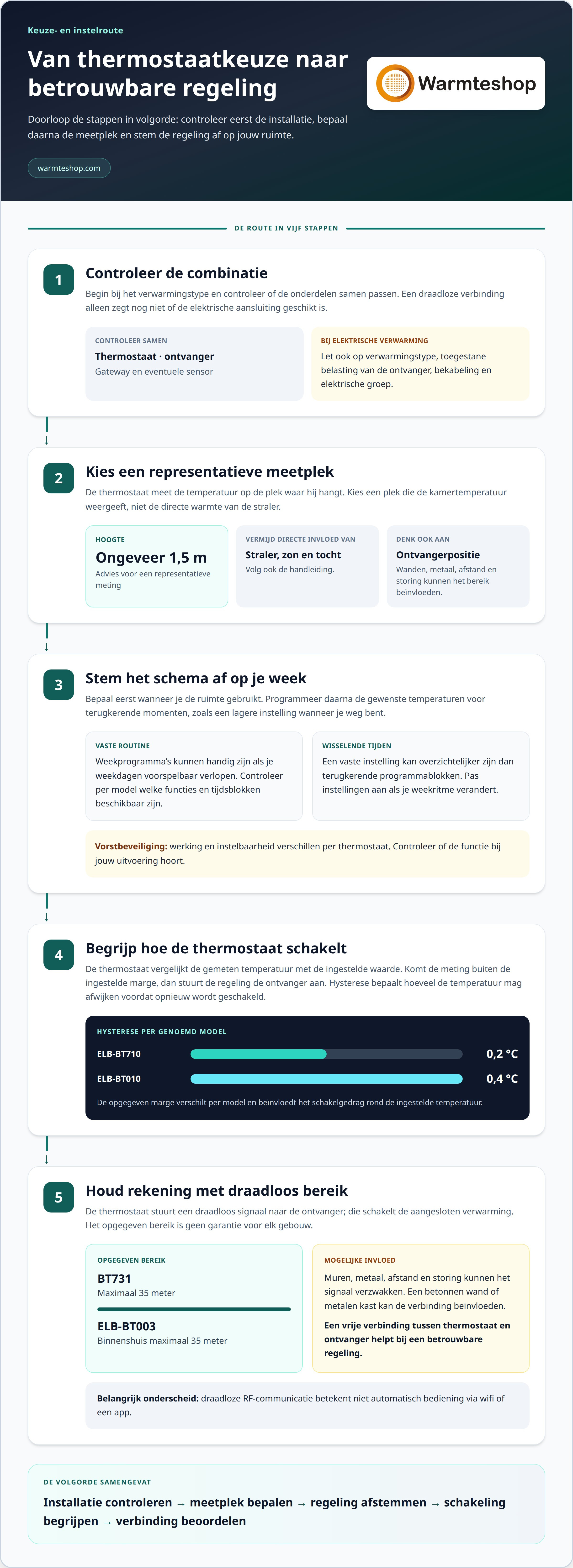
Elektrobock thermostats can offer features such as weekly programs and frost protection. The design varies by model; hysteresis is specifically specified for the ELB-BT710 and ELB-BT010.
With a weekly schedule, you tailor temperature settings to fixed usage times. For example, you can set a lower temperature when you are away during the day and program the desired temperature for the times you use the room. This way, the control aligns with your recurring weekly rhythm.
Programming options vary by model. Therefore, check the model specifications to see which functions are available and how to set up time blocks. A schedule is particularly practical if your weekdays follow a predictable pattern. With varying times, a fixed setting can be clearer than recurring blocks.
Frost protection prevents the temperature from dropping unchecked when you rarely use a room. Operation and adjustability vary by thermostat. Therefore, when choosing, check whether the model has the desired protection function. This prevents you from relying on a feature that is not included with your specific model.
Hysteresis determines how much the temperature is allowed to deviate before the thermostat switches again. For the Elektrobock ELB-BT710, the hysteresis is 0.2 °C. The ELB-BT010 has a hysteresis of 0.4 °C. This difference affects the switching behavior around the set temperature.
The thermostat measures the temperature at the location where it is mounted. According to the manual, choose a representative measurement location, out of the direct influence of radiators, sunlight, and drafts. Otherwise, the measurement may deviate from the temperature you wish to regulate in the room. For example, mount the thermostat in a place where heat or sunlight does not fall directly on it.
The product page recommends placement at a height of approximately 1.5 meters for a representative measurement. Also take the position of the receiver into account. Walls, metal, distance, and interference can affect the wireless range. A clear connection between both components therefore helps ensure reliable control.
A thermostat compares the measured temperature with the set value. When the measurement falls outside the set margin, the control system triggers the receiver. Hysteresis prevents small temperature differences from triggering immediate switching every time. For the ELB-BT710, this margin is 0.2 °C; the ELB-BT010 uses 0.4 °C.
With infrared heating, also pay attention to the measurement position relative to the radiator. The thermostat must measure the room temperature, not the heat from the panel directly. Therefore, use the manual as a guide and assess the placement in the room. The available thermostats for temperature control help you compare the models.
Start by determining when you use the room. Next, choose the temperature settings and schedule the recurring times. A bedroom that is rarely used during the day, for example, requires a different schedule than a home office that is occupied during the day. Adjust the settings to usage, not just the clock.
After setup, check whether the selected times logically align. A comfort temperature that starts early, for example, fits a fixed morning routine. If your weekly rhythm changes, adjust the program blocks accordingly. This ensures the control remains aligned with your daily routine. The hysteresis of the chosen model determines the switching behavior in this regard.
For electric heating, the choice depends on the heating type and the receiver. Also check how the thermostat communicates and switches.
Not every thermostat is compatible with all central heating boilers or electrical systems. The combination of thermostat, receiver, gateway, and any sensor determines whether the control works. Check these components together. A receiver that is not compatible with the installation cannot control the heating properly.
For electric heating, the heating type, the receiver's permissible load, the wiring, and the electrical circuit are also important. Have these points assessed together. A thermostat can communicate wirelessly, but that does not mean the electrical connection is suitable. The characteristics of the receiver are therefore at least as relevant as the thermostat model.
The same sequence applies to an infrared panel or electric convector: first determine which system you want to control. Then compare the required connection with the receiver and thermostat. Also check whether a gateway or sensor is part of the intended control system. This prevents you from relying solely on the appearance or the control screen.
The thermostat measures the temperature and wirelessly sends a signal to the receiver. That receiver then switches the connected heating on and off. Elektrobock models may differ in range and specifications. The stated range of the BT731 is a maximum of 35 meters. For the ELB-BT003, a maximum indoor range of 35 meters is specified.
A stated range is not guaranteed for every building. Walls, metal, distance, and interference can affect the wireless signal. A concrete wall or metal cabinet between the thermostat and receiver can weaken the connection. Therefore, position the components so that the signal encounters as few obstacles as possible. RF communication does not automatically mean operation via Wi-Fi or an app.
In case of connection problems, first check whether distance or an obstacle is the cause. Move the thermostat or receiver according to the product manual and see if communication is restored. Also check if the thermostat and receiver are compatible. The model details will help you assess this combination.
Follow the manual for the selected model to pair. The steps vary per thermostat and receiver, so do not use the same button sequence for every Elektrobock version. First, check the model designations and prepare the thermostat and receiver. Then, follow the described pairing procedure and check if the receiver responds to the thermostat signal.
A professional installation is required for a permanent electrical connection. Have the permissible load, heating type, cabling, and electrical circuit assessed together. This ensures that not only the wireless connection but also the connection to which the heating switches is taken into account.
If the system is unresponsive, check the pairing, distance, and potential sources of interference in that order. Next, examine the thermostat's power supply and the receiver connection. Do not modify any wiring while troubleshooting. Refer to the model manual for the troubleshooting steps specific to your model. If you wish to compare models based on features and application, view the wireless Elektrobock thermostats.
Elektrobock models differ in measuring range, accuracy, and switching capacity. The price also varies by model and version. Therefore, compare not only the purchase price, but especially the technical features that suit your infrared heating.
The setting range and measurement accuracy of the Elektrobock BT710 are practical points of comparison when choosing a thermostat. The maximum switching capacity is 16 A. These characteristics help determine whether the thermostat is suitable for the desired temperature control and the load on the receiver.
Another distinction is the model designation. ELB-BT003 is the designation for the Netherlands; in Belgium, BT003-BE is listed. The ELB-BT003 has a stated sensitivity of -95 dBm and consumes 1 VA. Such data is particularly relevant when technically comparing models side by side.
Start with the type of heating you want to control. An infrared panel requires a suitable combination of thermostat and receiver. Next, compare the setting range, measurement accuracy, and maximum switching capacity. If you want to control the temperature accurately, the measurement characteristics provide a practical point of comparison.
Also check the model code upon purchase. The designations BT003 and BT003-BE refer to different country versions. This prevents confusion when comparing models or consulting the manual. However, the name alone does not tell the whole story regarding the application; also evaluate the receiver's technical specifications.
There is no fixed price that applies to every Elektrobock model. The choice depends on the model and the functions you require. Therefore, compare the price of the version with features such as the temperature range, measurement accuracy, and switching capacity. This way, you weigh the costs against the technical requirements of your installation.
Therefore, do not compare wireless Elektrobock thermostats solely by brand or appearance. Take the model code and receiver details into account. A thermostat with a suitable range may still be unsuitable if the switching capacity does not match the installation. Therefore, have the permissible load, heating type, wiring, and electrical circuit assessed together.
A practical comparison starts with your heating system. Note which type of infrared heating you want to control and then check the specifications of the thermostat and receiver. Next, compare the desired temperature settings with the range of the model. The BT710, for example, offers an adjustable range of 5 to 40 °C.
Use the same check when comparing other versions. View the model code, measurement data, and switching capacity as a whole. This temperature control thermostats specifically based on their application. In this way, you base your choice on the required control and connection, rather than on a single specification.
Also view the price of the complete version. The Elektrobock ELB BT710 wireless thermostat for infrared heating costs €85.00 including VAT. The Elektrobock ELB BT010 wireless thermostat for infrared heating costs €75.00 including VAT.
When comparing, also pay attention to which model and price you compare side by side. This way, you weigh the costs against the features and receiver that suit your heating system.
A wireless thermostat does not use a signal cable to the receiver. This does not mean that every component works without power cabling. The thermostat and receiver can be powered in different ways. Therefore, check for each model which batteries are required and how the receiver is powered.
The Elektrobock ELB-BT010 operates on 2 × 1.5 V AA batteries. The Elektrobock PT24 room thermostat uses 2 AAA batteries. This difference makes the model code important when preparing batteries. AA and AAA batteries are not interchangeable in the same battery compartment.
When replacing, use the battery type and voltage from the model specifications. Also check the markings in the battery compartment. Insert the batteries according to the indicated positive and negative terminals. For the ELB-BT010, this means using two 1.5 V AA batteries, not two AAA batteries.
The batteries power the thermostat, but not necessarily the entire heating control. The wireless signal only replaces the connection between the thermostat and the receiver. The power supply to the receiver depends on the model. Therefore, check the manuals for both the thermostat and the receiver before connecting the system.
With a system equipped with an ELB-BT010, you can therefore first inspect the thermostat's battery compartment. Then, look for the power connection in the receiver manual. This way, you keep the control unit's battery power supply separate from the heating's electrical connection. The specifications of both components together determine the correct preparation.
Replace the batteries when the thermostat is no longer responding properly. First, check which type your model requires. Then, remove the old batteries from the compartment and insert the new ones according to the terminal markings. Next, test whether the thermostat is responding again and the receiver is receiving the signal.
If an ELB-BT010 does not respond after replacement, first check the placement of both AA batteries. Then check if the thermostat and receiver are still paired. Follow the model manual for re-pairing. This way, you distinguish a power supply problem from a connection problem without immediately tampering with the heating wiring.
When making your choice, do not compare only the screen or program. Also note the battery type of each model. The ELB-BT010 uses 1.5 V AA batteries; the PT24 uses AAA batteries. This specific difference helps you choose the appropriate batteries in advance and prevents confusion during replacement.
A wireless connection therefore does not mean that every component runs on batteries. Check how the thermostat and receiver are powered for each Elektrobock model. Keep the model code at hand when consulting the manual. This way, you base the installation on the correct data and do not confuse the thermostat's battery power with the heating system's power supply.
Compare Elektrobock models based on measuring range, accuracy, circuitry, and wireless range. The model name PT32 or PT59 alone does not reveal how the thermostat differs technically. Therefore, look at the specifications of the specific model and the corresponding receiver.
The BT710 provides a concrete example of useful points of comparison. This model has an adjustment range of 5 to 40 °C and a measurement accuracy of 0.5 °C. The hysteresis is 0.2 °C. Such data explain how to set the temperature and how the thermostat switches around that value.
Compare the same characteristics when evaluating PT32 and PT59 side by side. Pay attention to the adjustment range, measurement accuracy, and hysteresis. Also check the maximum switching capacity. For the BT710, this is 16 A. This shows why the receiver and electrical installation are part of the comparison.
Wireless range also varies by version. A range of up to 35 meters is specified for the BT731. For the ELB-BT003, the maximum indoor range is 35 meters. These are product specifications, not a fixed distance for every room. Walls, metal, distance, and interference can affect the signal.
Use that comparison as a checklist for PT32 and PT59. Check the range associated with each model and assess where the receiver will be placed. A thermostat with matching temperature functions is not automatically suitable for every receiver. Therefore, check the compatibility of the thermostat, receiver, gateway, and sensor as a combination.
The right choice depends on the room and the desired control. For an accurate comparison, first note down the desired temperature settings. Then compare the measurement accuracy and hysteresis of the models. Finally, check whether the model offers a weekly program if you want to set fixed heating times.
The BT710 can serve as a reference for this check. The values of 5 to 40 °C, 0.5 °C, and 0.2 °C make the product specifications concrete. Do not transfer these figures for PT32 or PT59. Compare only the values corresponding to the relevant model designation.
Start with the exact model code on the thermostat and receiver. Then note the range, temperature settings, accuracy, and switching options. This way, you compare the features and not just the name. For electric heating, also include the heating type and the permissible load.
The same approach applies to PT32 and PT59: base your choice on the corresponding model specifications. Furthermore, the ELB-BT003 shows that country designations differ: ELB-BT003 is used for the Netherlands, and BT003-BE for Belgium. View the wireless Elektrobock thermostats and compare the models based on the features required by your control system.
Warmteshop helps you choose a wireless thermostat that suits your infrared heating. The right combination depends on the receiver, the heating type, and the desired temperature control, among other things. For infrared mirrors and infrared glass heating, it is also important that the thermostat connects to the system.
Use the model specifications to compare features, power supply, and switching capacity. This will help you make a choice that suits your space and daily use. Keep in mind that wireless control does not automatically mean Wi-Fi or app control.
Would you like to discuss your situation and view suitable wireless thermostats? Contact Warmteshop.
Choosing the right thermostat starts with how you use a room. Think ahead: is your daily routine changing, is a room getting a different function, or do you want to adjust the heating? Take these preferences into account so that you choose a control system that matches your living comfort.
Use the model features as a guide in your choice. Wireless Elektrobock thermostats differ in functions and technical design. Therefore, focus on what your heating system needs and which controls are convenient for daily use. This way, you make a targeted choice without including features that add little value to your situation.
Would you like to compare the models side by side at your leisure? View the wireless Elektrobock thermostats and determine which control system suits your next step towards comfortable heating.
The mentioned wireless models are the BT710, ELB-BT010, ELB-BT003, BT731, PT24, PT32, and PT59. For the Netherlands, the model designation ELB-BT003 is used.
Yes. The BT710 runs on 2 x 1.5 V AA batteries, the ELB-BT710 and ELB-BT010 on 2 x 1.5 V batteries, and the PT24 on 2 x AAA batteries.


