

Infrared heating for the home office: wattage and consumption
, by Warmteshop, 18 min read
A higher wattage does not automatically make infrared heating less sustainable: consumption also depends on how long you heat and whether you use the heat in a targeted manner. For a small workspace, a panel of 300 to 600 wa…
A higher wattage does not automatically make infrared heating less sustainable: consumption also depends on how long you heat and whether you apply the heat specifically. For a small workspace, a panel of 300 to 600 watts is often sufficient. Moreover, with infrared heating for your home office, you heat the spot where you are sitting, rather than bringing the entire room up to temperature at once.
It is only natural that you want to know what infrared heating at your home office means for your power consumption and comfort. Infrared heating uses electricity, so its sustainability depends partly on its source and your usage. A lower base temperature can be combined with targeted heat at your desk, allowing you to work comfortably without turning up the thermostat for the entire house.
In this article, you will learn how to estimate the wattage for a small workspace and which factors influence consumption. You will also discover why wall or ceiling mounting makes a difference: the direction of the radiant heat partly determines where you feel the warmth. This allows you to tailor your choice to your workspace, your heating habits, and the comfort you seek.
With infrared heating for your home office, sustainability depends on the power source, the duration of use, and the room you are heating. A panel emits radiant heat to nearby people and objects. This allows you to warm your legs and feet, for example, without immediately bringing the entire room to the same temperature.
This is practical if you sit in one fixed spot while working. Direct the heat onto your chair and desk, not onto an empty corner or cabinet. A panel under the desk can warm your legs and feet; a wall panel can reach another spot in the work zone. This way, you tailor the infrared heating at your home office to your sitting position.
Infrared heating uses electricity. The climate impact depends in part on how that electricity is generated. Your usage also counts: a panel that only provides heat when you are sitting at your desk has a different consumption profile than heating that keeps an entire room at temperature for an extended period. The radiation itself does not automatically make electricity sustainable or CO₂-neutral.
Long-wave infrared radiation from heating panels has a wavelength of approximately 10 micrometers. This technical value helps explain why the heat is primarily noticeable on nearby people and surfaces. For example, you might experience a warm desk area, while a spot further away in the same room receives less heat.
For targeted heat, position and an unobstructed direction of radiation are important. Place a panel so that furniture does not block the heat and the radiation reaches your workspace. A thermostat control can help ensure the heating is used only during working hours. This way, infrared heating for your home office aligns with your daily rhythm.
What safety regulations apply to infrared heating in the home? According to the mentioned standards, the electrical installation must comply with NEN 1010; NEN 3140 applies for safe use and maintenance. Additionally, choose a panel with overheating protection and a CE mark.
How much does an infrared panel for a home office cost in the Netherlands? The purchase price varies by panel and model. Power consumption depends on the output and usage time. This allows you to make an estimate that suits your work rhythm.
What subsidies or tax benefits are available in the Netherlands for infrared heating? That amount in itself says nothing about a subsidy for a single panel.
A carefully chosen panel can provide comfort without immediately heating the entire room. Placement, operating time, and the power source together determine how sustainable the application is in practice. Explore the options for infrared heating for different rooms and tailor the type of heating to the location you wish to heat.
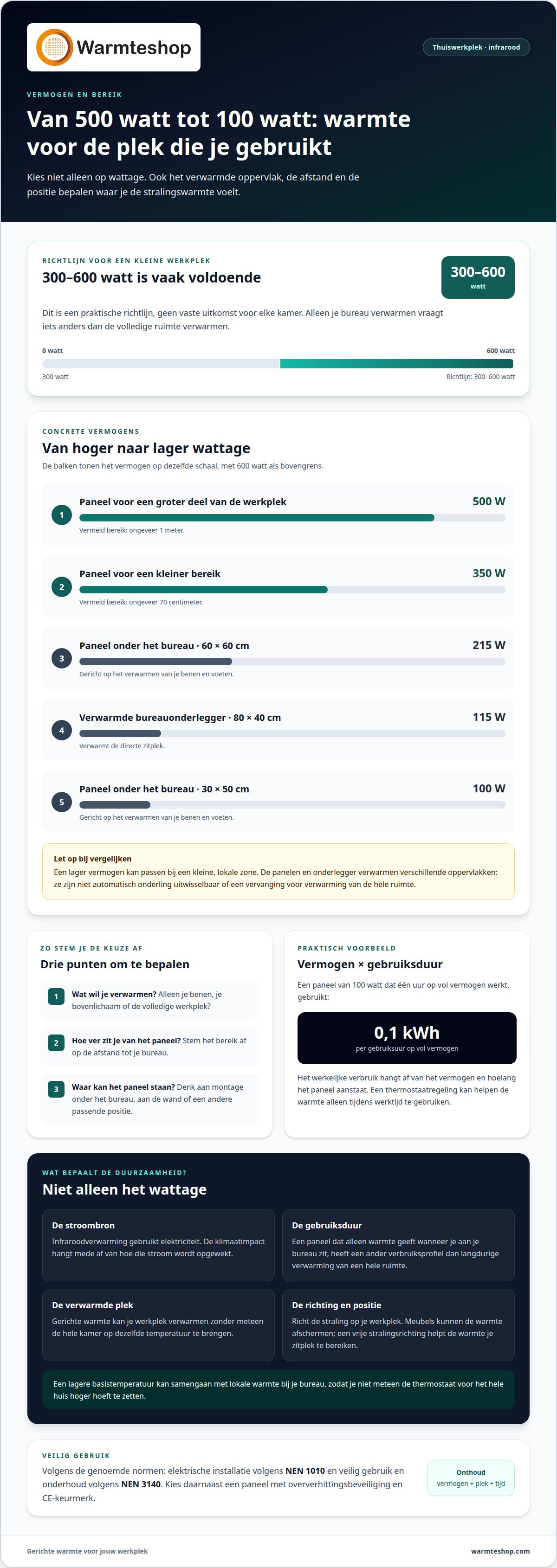
For a small workspace, an infrared panel of 300 to 600 watts is often sufficient. That is a practical guideline, not a fixed solution for every room. The required heat also depends on the area you want to heat, the distance to the panel, and the conditions in the room. Focusing on a single desk requires a different approach than heating the entire room.
Lower power outputs are also available for localized heating. A panel for mounting under a 30 by 50 centimeter desk has a power output of 100 watts. A larger 60 by 60 centimeter model has 215 watts. Such infrared panels direct heat towards your legs and feet. This makes them suitable as a supplement to room heating, not automatically as a replacement.
An 80 by 40 centimeter heated desk pad uses 115 watts. A foldable infrared panel can be an option for heating a workspace locally. These designs are flexible: you heat the immediate seating area without choosing a wall panel for the entire room. When comparing, look not only at wattage, but also at the heated surface and the direction in which the heat is emitted.
For panels covering a larger portion of the workspace, a different consideration applies. According to the stated guideline, a 500-watt panel has a range of approximately 1 meter. For a 350-watt panel, approximately 70 centimeters is mentioned. These are practical indications of the range, not a guarantee that every workspace will feel the same. The position of your chair and any obstacles make a difference.
A simple approach helps with the selection. First, determine whether you want to heat only your legs, your upper body, or the entire workspace. Next, choose a panel with a range that matches the distance to your desk. Finally, check if the available space allows for mounting under the desk, on the wall, or in another position. This prevents you from choosing a power output for a larger surface area than necessary.
At the office, an average of 22 degrees is cited as the desired daytime temperature. That does not mean your home workspace needs exactly that temperature. With local heating, you can regulate the heat per workstation, instead of turning up the thermostat for everyone. A thermostat control makes it possible to tailor the heat to the usage of that specific spot.
Power consumption depends on the output and the time the panel is switched on. A 100-watt panel consumes 0.1 kilowatt-hour per hour of use when operating at full power for that hour. Therefore, a lower output may be suitable for a small, local zone; the correct wattage depends on how much heat you need at that location.
When choosing energy-efficient heating, the combination of power, range, and control matters. Check out thermostats for heating control if you want to control the temperature of your workspace separately. This way, the control aligns with your working hours and the chosen heating zone.
A lower thermostat setting can be combined with targeted heat at your desk. Infrared is not automatically more economical than an electric heater or central heating: consumption depends on the power output, the duration of use, and the heated surface area.
Measure the consumption over a fixed period, for example, a full work session. Note the power in watts and how long the panel is on. A 35-watt desk mat consumes 0.035 kilowatt-hours at full power for one hour. The actual measurement shows how much power your usage requires.
Compare the same workspace under similar conditions. Also note when you switch the heating on and off. This way, you can see if brief heating during concentrated work time makes a difference. With a separate meter, you can measure the power consumption of a spot heater individually.
The thermostat helps determine how much heat the rest of the home requires. In Dutch households, 19°C is often maintained during the day, or 18°C during quiet moments. By setting the base temperature lower and heating only your work zone, you prevent keeping an empty room at the same temperature all the time.
Heating one degree lower reduces heating costs by approximately 6% according to the mentioned guideline. For underfloor heating, a setting of around 17 or 18 degrees is recommended for nighttime use. The appropriate setting depends on the heating system and the comfort you require. A lower setting works best if you are not simultaneously heating other rooms.
Both an electric heater and an infrared panel use electricity. The main difference lies in heat output: infrared heats people and surfaces directly, whereas an electric heater heats the ambient air. Therefore, localized heat may be appropriate for a single desk; for an entire room, the total heat demand is taken into account.
With central heating, you look at the energy consumption of the entire system and the room. Therefore, do not just compare the wattage of a panel with that of a heater. Also keep the operating time, the thermostat setting, and the size of the heated zone the same. This way, you can fairly assess which system suits your workday.
Solar panels can change the decision if they generate power while you are working. If your own generated power is available at that moment, a space heater can use it. Timing is crucial: heating outside of self-generated hours requires power from another source. Therefore, track panel consumption and usage times separately.
A thermostat set to 15°C at night is a mentioned savings tip; according to the cited guideline, setting it lower saves approximately €60 per year. That amount is not a fixed outcome for every home. Combine a suitable night setting with targeted heating during the day and consider underfloor heating as primary heating if you wish to include that heating zone in your assessment.
A portable infrared panel can suit changing workspaces. At home, for example, you place it by your desk; at the office, it can be moved to another frequently used work zone. This way, you direct the heat to where someone is sitting, instead of constantly heating an entire room. The best choice depends on the desired zone and the available power.
On a work-from-home day, your usage sometimes changes moment by moment. You might work at a desk first and then move to another spot later. A portable panel makes this setup more flexible than a fixed installation. Some mobile panels have power outputs of 350, 450, 580, or 700 watts. Choose based on the work zone that requires heat.
A foldable infrared desk heater has a power output of 165 watts and three settings. This allows you to adjust the heat setting to suit your working moment. A foldable infrared panel also has three heat settings. These options are practical when you are sitting at a desk and do not need the same heat constantly. The power output alone does not indicate how much comfort each user experiences.
Local heating can also be useful in the office if the temperature is perceived differently at each workstation. A panel directs heat towards the user and the immediate surroundings. As a result, a shared space does not need to be set to a warmer temperature for every employee at the same time. Consider, for example, a desk by a window, while other workstations already feel comfortable.
An infrared panel can provide palpable warmth within minutes. This suits a workday where you only switch on the heating when you sit down. Infrared desk panels are designed to operate silently. This is useful during phone calls or focused work, when background noise can be distracting.
Thin, lightweight panels are easier to move than a fixed installation. They have no moving parts that wear out or need to be replaced. Some desk heaters are ready to use immediately as a plug-and-play solution. Simply move the panel to a location where the radiant heat reaches the user and the workspace remains practically arranged.
For a home office, infrared heating can also serve as the primary heating source for that space. In that case, the rest of the house can remain unheated during working hours. On cold days, workplace heating can actually be a supplement to the existing heating. These applications differ: the former heats the office as a room, while the latter primarily supports the occupied workspace.
Make your choice based on your daily routine. Note where you work, when the spot is occupied, and whether you want a fixed or portable solution. Then compare the panel type, power output, and setting options. This way, you tailor the heating to working from home or shared office work, balancing comfort and energy consumption.
The mounting location determines which part of your workspace receives radiant heat. A ceiling panel can direct heat from above; a wall panel fits when the desk setup offers a free wall. Therefore, first consider where you sit and which surfaces or body parts require heat. An infrared panel under the desk, for example, is aimed at the feet and legs, not automatically at the entire room.
For ceiling mounting, approximately 2.6 meters above the floor is considered the recommended height. This ensures the panel hangs above the work zone, allowing the radiation to reach the area where you work. The relationship between the panel and the desk remains important: a cabinet or tall partition can block the direction of radiation. Therefore, assess the line of sight from the panel to your chair, desk, and legs.
If the ceiling is higher than 3 meters, a panel with wires can be hung lower. This reduces the distance to the workspace and directs the heat better towards the occupied zone. When mounting lower, the location must be chosen carefully. Consider a desk with a chair underneath, where the user sits for extended periods.
A wall panel offers a solution when the ceiling is unsuitable for mounting. Position it so that furniture does not directly block the radiant heat. A panel next to or opposite the desk can reach the user, depending on the layout. If you change the position of your desk, reassess whether the panel is still providing targeted heat.
The difference between targeted workplace heating and heating the entire room is practical. A panel directed at you supports local comfort; it does not automatically bring every corner to the same temperature. If you want to heat other areas as well, consider the layout and where people spend time. A desk by the window, for example, requires different positioning than a chair in the middle of the room.
Use this quick check before choosing a mounting location:
An infrared panel on the ceiling is particularly suitable when the workspace remains underneath. A wall panel may be more logical for a fixed desk with an unobstructed direction of radiation. Do not choose solely based on a location where installation seems easy. Match the placement to your sitting posture, the direction of the heat, and whether you want to heat only your workspace or a larger part of the room.
Warmteshop helps you tailor an infrared solution to the space and its use. Industrial infrared heaters are intended for larger-scale heating needs; for a compact home office, an infrared panel is usually the more obvious choice. Start by determining which area needs heat, which zone you want to heat, and how you use the space.
If you primarily work at a single desk, weigh the placement and required power against your work rhythm. If you also wish to heat other rooms or applications, infrared heating and an infrared mirror are other options in the range. This allows you to make a targeted choice without using an industrial solution for a small workspace.
Would you like to discuss your situation? Contact Warmteshop.
The next step is not just choosing a panel, but determining how your workspace fits into your daily routine. Do you always work in the same spot, or do you switch between your desk and the kitchen table? This helps you determine whether a fixed setup or a more flexible solution is a better fit. This way, you turn infrared heating for your home workspace into a targeted comfort choice, tailored to your way of working.
Warmteshop offers infrared heating and infrared panels for various applications, in addition to infrared mirrors. Think in terms of the area you want to heat and the aesthetic that suits your space. With these starting points, you can search specifically for a solution that is practical and meets your needs.
Would you like to discuss your situation and a possible solution? Contact Warmteshop. A well-considered choice starts with your workplace and can make every workday just a little more pleasant.
Infrared heating works well when you sit in one place for extended periods and primarily need warmth there. You can direct the heat towards your chair or desk without rearranging the entire workspace. This makes it practical for a fixed home office. If you frequently move to a different room, a fixed setup might be less suitable than a portable solution.
Infrared heating is electric heating that emits heat via infrared radiation. For your workspace, you can choose a panel that you mount in a fixed location or a version for local use. The choice depends on where you want to feel the heat and the position of your desk. Also consider the power supply and the space the panel will occupy in advance.
An infrared panel converts electrical energy into radiant heat. This heat reaches the spot the panel is aimed at, such as a chair or desk area. Therefore, the direction of the panel makes a difference. A screen, cabinet, or other large object between you and the panel can block the radiation. So, consider the layout, not just the panel itself.
Pay attention to the power output, dimensions, controls, and intended mounting location. A compact panel might fit a single desk, while a larger panel takes up more space and requires a different direction of radiation. Also, check if you can regulate the heat in a way that suits your workday. Compare the technical specifications with your setup, not just the appearance.
Position a panel so that the heat reaches the workspace being used and is not shielded by furniture. A ceiling-mounted unit may be suitable above a fixed work zone; a wall-mounted unit may fit a desk along the wall. Take into account the height, the position of your chair, and the free space around the panel. If the layout changes, reassess the direction of radiation.
Start by determining whether you want to heat only your feet, your upper body, or the entire workspace. Then, match the panel type and power output to the distance from your seat. Also consider the installation, available wall or ceiling space, and operation. A panel that is well-suited to a fixed desk is not automatically the most practical choice for a changing workspace.
Infrared desk heating is an option if you want extra warmth, especially while sitting. A panel under the desk can direct heat towards your legs without having to place a large device next to your chair. When making your choice, pay attention to legroom, cable routing, and controls. This way, your workspace remains usable, and you can adjust the heating to the moments when you are sitting.
Choose infrared panels when you want to apply heat in a targeted manner, for example at a fixed workspace or in a room that is not constantly in use. They can also serve as a supplement to an existing heating system. To heat an entire room, you must take the total heat demand into account; a local panel is not automatically sufficient as primary heating. Therefore, first determine which zone needs to be comfortable.


