

Indoor temperature and signs of overheating in children
, by Warmteshop, 17 min read
, by Warmteshop, 17 min read
Healthy warmth for my growing children is not about a single legally established maximum temperature: in the Netherlands, there isn't one. However, an indoor temperature above 25°C does require extra attention, because the…
Healthy warmth for my growing children is not about a single legally established maximum temperature: there isn't one in the Netherlands. However, an indoor temperature above 25°C does require extra attention, as comfort levels and performance decline, and young children are more sensitive to heat. So, pay attention not only to the thermometer, but also to how your child behaves.
You want your child to be able to play and sleep comfortably at home. However, it is sometimes difficult to determine when a warm room is more than just unpleasant. Young children are less able to regulate their body temperature and are therefore at a higher risk of dehydration or overheating.
In this article, you will read what to look out for regarding indoor temperature and which signs may indicate overheating, such as unusual fatigue, rapid breathing, or shortness of breath. You will also discover how to keep the indoor climate more comfortable on warm days and when symptoms warrant consulting a doctor.
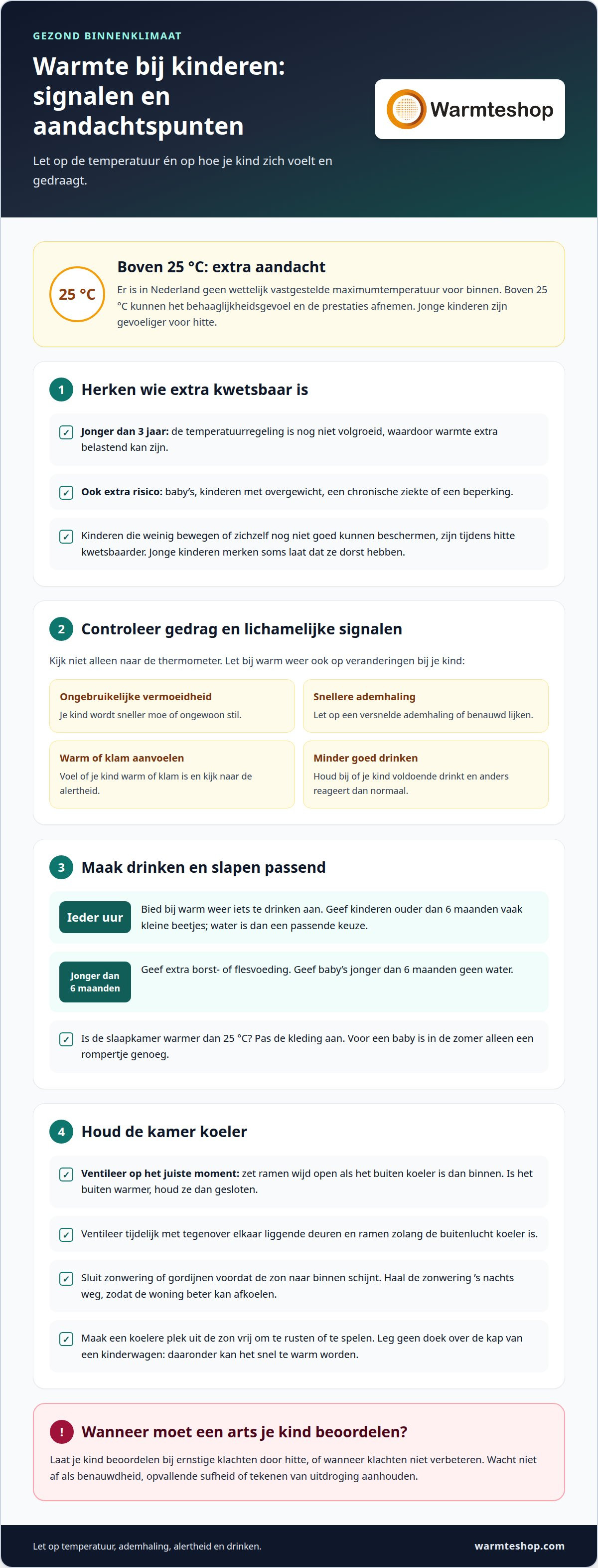
Young children require extra attention when the indoor temperature exceeds 25°C. Their bodies do not yet regulate temperature effectively. As a result, they can dehydrate or overheat more quickly. A warm room is therefore more than just discomfort. Pay attention to both temperature and behavior.
In very hot weather, children can tire more quickly. Rapid breathing or appearing short of breath are also signs. Severe heat can lead to dehydration or overheating. Children under 3 years of age are particularly sensitive. Their temperature regulation is not yet fully developed. Babies and overweight children are also at increased risk. This also applies to those with a chronic illness or disability.
Children who are sedentary are more vulnerable during heatwaves. Furthermore, young children cannot yet protect themselves effectively. They sometimes realize they are thirsty late. Therefore, offer them something to drink every hour during hot weather. Give children older than 6 months small amounts frequently. Water is a suitable choice in this case. Babies younger than 6 months should receive extra breast milk or formula, not water.
A bedroom warmer than 25 degrees requires appropriate clothing. For a baby, a onesie is sufficient in the summer. Also, check if your child feels warm or clammy. Observe alertness, breathing, and feeding. A child who becomes unusually quiet deserves extra attention. Keep them in a shady or well-ventilated room so they can rest or play out of direct sunlight.
Cooling starts with ventilating at the right time. Open windows wide when it is cooler outside than inside. If it is warmer outside, keep them closed. Ventilate temporarily using opposite doors and windows as long as the outside air is cooler. Close blinds or curtains before the sun shines in. Remove blinds at night so the home can cool down more effectively.
At indoor temperatures above 25°C, comfort and performance decrease. This can make playing, resting, and sleeping more difficult. Therefore, clear a cooler spot, such as a room out of the sun. If it is too warm at home, find a cool public place, such as a library. A stroller also deserves attention: do not place a cloth over the hood. It can quickly become too hot under that cloth.
Dutch law does not set a maximum permitted indoor temperature. However, the temperature must not rise so high that it is harmful to health. In the event of severe heat-related symptoms, or symptoms that do not improve, a doctor must assess your child. Do not wait if shortness of breath, noticeable drowsiness, or signs of dehydration persist. You can also consciously choose healthy warmth for your growing children; infrared heating from Warmteshop is a heating option for cooler days.
Symptoms of dehydration or overheating can appear quickly. Therefore, in warm weather, pay attention not only to how warm the room is, but also to changes in your child. Becoming tired more quickly, rapid breathing, or appearing short of breath are reasons to be extra alert. Such signs deserve attention, especially if your child is also unusually quiet or not drinking as well. Infants and children who are overweight, have a mental or physical disability, or have a chronic illness are at an increased risk of health problems due to heat. Young children, too, cannot yet protect themselves well against heat. Keep this vulnerability in mind when choosing a place to rest or play; a cooler room out of the sun may be appropriate.
Make drinking a regular focus during warm hours: offer something to drink every hour and give young children small amounts. Also check if the bedroom is not too warm and adjust clothing accordingly. Opening windows wide only helps if it is cooler outside than inside. Otherwise, the room may not cool down as a result. Dutch law does not set a maximum indoor temperature. However, the temperature indoors must not rise to such a high level that it is harmful to health. Take signals seriously and have a doctor assess your child in case of severe symptoms or if they do not improve. Continue to monitor breathing, alertness, and drinking.
Heating does not automatically remove moisture from your home. Warm air can feel drier, especially if you ventilate infrequently. Mold typically forms in places where moisture lingers, such as on a cold exterior wall. Therefore, do not just focus on the heating, but also address sources of moisture, ventilate, and clean dusty surfaces.
Start with moisture released daily. Cooking, showering, and drying laundry bring water vapor into the house. Use the extractor hood while cooking and let it run for a while afterwards. Turn on the ventilation while showering. Preferably dry laundry in a well-ventilated room. If there is a drying rack in the bedroom, keep the door open and ensure air circulation.
Ventilation removes humid air to the outside. Ensure that curtains or furniture do not block ventilation grilles. Clean the grilles regularly so that air can continue to flow. A mechanical ventilation system requires maintenance: clean the valves and keep the air intake clear. Do not turn off the ventilation because the heating is on. Heating and ventilation have different functions.
Condensation on windows is a practical signal to pay attention to. Dry wet edges and see if the condensation returns. Also check the corners behind a cupboard, the wall around a window, and areas behind a bed. Move furniture slightly away from cold exterior walls so that air can circulate along the wall. Remove dust from vents and radiators with a soft cloth or vacuum cleaner.
Dust can accumulate on floors, textiles, and heating surfaces. Regular cleaning helps limit this buildup. Vacuum the nursery, including under the bed and along the baseboards. Wash bedding according to the care label and shake out blankets outdoors. Clean a heater only when it is switched off and cooled down. Do not use a wet cloth on electrical components.
A musty smell, dark spot, or recurring damp stain calls for a targeted approach. First, look for the source, such as a leak, condensation, wet laundry, or insufficient ventilation. Ventilate extra after activities that release a lot of water vapor. Clean a small damp spot and dry the area completely. If the mold returns, cleaning alone is not enough. Address the cause of the moisture as well.
Dry eyes, a dry throat, or an itchy nose can have various causes. Therefore, view the room as a whole: dust, ventilation, moisture, and heat all play a role. Avoid strong air fresheners if they worsen symptoms. Do not place a bowl of water on a heater as a permanent solution. Such a bowl does not replace ventilation and does not solve a moisture problem.
The type of heating also does not change the need for air ventilation. When choosing infrared heating for your home, it remains important to limit sources of moisture and keep ventilation openings clear. Therefore, combine even heat with cleaning, maintenance, and attention to condensation. This way, you keep the nursery comfortable without ignoring signs of moisture and dust.
In warm weather, the GGD advises children to wear light clothing, preferably no more than one layer. Also, assess the conditions in the room as a whole: heat, air circulation, moisture, and dust are interconnected. Pay attention to condensation, musty odors, and areas where moisture collects. Keep ventilation grilles clear and clean dusty surfaces regularly. This way, you are not replacing the ventilation system, but rather keeping a better eye on the airflow and the room. If symptoms arise when the heating is on, check if the room is getting too warm and if sufficient fresh air is entering. Adjust the heat and continue ventilating, even when using the heating.
Symptoms following sun exposure require special attention and are not the same as dry air or mold. If your child develops many blisters, swollen skin, chills, fever, nausea, vomiting, or a headache after a sunburn, have it assessed by a general practitioner. Do not attempt to resolve such symptoms simply by turning down the heating or changing ventilation. Consider the circumstances associated with the complaint and seek a medical assessment if these symptoms occur. This way, you maintain focus on the indoor climate without overlooking other potential causes of the symptoms.
Heating costs in the Netherlands do not depend solely on the appliance. The electricity price on your energy bill, the duration of use, and heat loss also play a role. Therefore, the purchase price alone says little about the total expenses. In addition to the purchase price, calculate the expected electricity consumption.
To do this, use the power rating on the product label. Multiply the power rating in kilowatts by the number of usage hours to calculate the consumption in kilowatt-hours. Then multiply that consumption by the electricity rate on your bill. The result is the amount of electricity costs for that usage period. Repeat the calculation for other usage patterns, for example, heating while playing or only before going to sleep.
You can calculate the costs without assuming fixed rates. Suppose a heater has a certain capacity and is on for a few hours daily. The longer you use it, the higher the consumption. A higher capacity also increases consumption for the same duration of use. Therefore, compare different scenarios with your electricity tariff, instead of assuming a general amount.
The room itself partly determines how much heat is needed. A poorly insulated room loses heat faster than a well-insulated room. Gaps around windows and doors can increase the heat demand. Furthermore, a room used only in the evening requires a different heating pattern than a room where children play. Note when the room is occupied and for how long heating is required.
With a thermostat control, you adjust the heating to usage. Set a schedule that fits your family's daily routine. For example, heat only the rooms that are actually in use. Then check whether the set times align with your presence. This prevents rooms from being heated unnecessarily while everyone is elsewhere.
When making a purchase, do not compare only the output. Also consider the space you want to heat, the operating time, and the controls. A high-output heater that runs for a long time may consume more energy than a lower-output heater with a shorter operating time. The appropriate choice depends on the heat demand and usage in the home. Calculate the same scenarios before making a decision.
Keep purchase costs and operating costs separate. The purchase is a one-time expense; electricity consumption incurs costs again during use. Any installation costs depend on the chosen solution and the situation in the home. Include these costs separately in your budget. This way, you are not comparing a purchase price with a total amount that includes years of usage.
For a clear comparison, you can collect this data:
Adjust your calculation if usage changes. A child's room that is occupied more frequently requires a different scenario than a guest room. An adjusted thermostat schedule also changes consumption. Keep your assumptions visible so you can see which factor carries the most weight. Then, tailor energy-efficient heating to comfort, usage, and your budget.
Start by using the nursery. A baby room requires heat at different times than a playroom. Note when your child sleeps, plays, or gets dressed there. This way, you can adjust the heating to the daily routine. Do not automatically heat all rooms in the same way.
With a thermostat control, you adjust the heat to that routine. For example, set a heating period for the times when the room is being used. Turn down the heating when the room is empty for an extended period. Then check in time whether the room feels comfortable. A fixed schedule prevents the heating from staying on unnecessarily long.
Monitor the temperature with a thermometer. At an indoor temperature above 25°C, comfort levels and performance decline. Young children are particularly sensitive to heat. A nursery warmer than 25 degrees therefore requires attention. In the summer, a romper is sufficient for a baby. Also, pay attention to your child's behavior.
The position of a heater affects the heat distribution in the room. Do not place a cupboard or large piece of furniture directly in front of the heating surface, as this can impede heat distribution. Also keep curtains and bedding away from heating equipment. Always follow the manufacturer's instructions regarding use and placement.
Limit heat loss before turning up the heating. Close windows and doors when the room is being heated. Check that window coverings are not blocking heat, but do not cover ventilation openings. Ventilation remains important for air exchange. Choose the moment wisely: open windows when it is cooler outside than inside.
With infrared heating, the position of the panel is important for heat distribution. First, determine which part of the room needs to feel comfortable. Consider where your child plays or sits and where the furniture is located. A panel that emits heat where it is needed is better suited for targeted heating. The appropriate setup depends on the room and its use.
Perform a quick check before using the heater:
An economical approach therefore does not start with maximum heating. Adjust the usage time to sleep, play, and care. Look at both the temperature and your child's comfort. If the room rises above 25°C, adjust the heating schedule. This way, you combine targeted heating with attention to a safe, comfortable nursery.
Warmteshop helps you choose a heating solution that suits the space and usage. If you are looking for targeted heat for a specific spot in your home, infrared heating can be an option. Warmteshop also offers infrared mirrors, infrared glass heating, and infrared towel dryers. Which solution fits depends on where you want heat and how you use the space.
A child's room requires attention to temperature, usage time, and safe placement. Heating does not replace ventilation and does not prevent overheating. Use the insights from this article to clarify your needs and then discuss which heating option suits your home.
Would you like to discuss the possibilities for your situation? Contact Warmteshop.
The layout of a child's room changes along with your family. Therefore, when choosing a new heating system, consider not only today but also how you will use the space in the future. Think about where your child plays, sleeps, and gets ready. This will help you determine which areas need warmth and which type of heating is suitable.
Healthy warmth for my growing children starts with a choice that suits the space and daily use. Warmteshop offers infrared heating, infrared panels, and infrared mirrors, among other things. This allows you to explore a heating solution that fits your home. The right choice depends on the application, the desired placement, and your living comfort.
Would you like to discuss your situation and the possibilities? Contact Warmteshop. This way, you can take the next step towards a comfortable home for your family with confidence.
Watch for changes in behavior, breathing, and drinking. Unusual fatigue, faster breathing, or shortness of breath may indicate heat-related symptoms. Offer your child drinks regularly and let them rest in a cooler, well-ventilated room. Also, pay attention to how often a baby urinates. In case of severe symptoms or symptoms that do not improve, a doctor should assess your child.
Healthy warmth means that your child feels comfortable without the room overheating. You can phrase your wish as: “I want healthy warmth for my growing children.” It involves heating at times and places that fit into your daily life. Think, for example, of a pleasant play area, fresh air, and attention to moisture and dust in the room.
There is no legally established maximum indoor temperature in the Netherlands, but above 25°C, comfort and health require extra attention. Young children, in particular, are sensitive to heat. In a bedroom warmer than 25 degrees, a baby wearing only a onesie is sufficient in the summer. In addition to the thermometer, observe your child's behavior and breathing, as these signals provide additional information.
There is no single heating system that is automatically the healthiest choice for every home. When considering the desire “I want healthy warmth for my growing children,” ventilation, humidity control, and appropriate regulation also play a role. Infrared heating is an option for targeted heat, with infrared panels and infrared mirrors serving as examples. The suitable solution depends on the room, the placement, and the usage. Heating does not replace ventilation.


