

Home gym heaters: package sizes and prices
, by Warmteshop, 16 min read
, by Warmteshop, 16 min read
The most powerful heater is not automatically the most comfortable choice for your workout space. When it comes to heating for a home gym, the layout, the desired temperature, and your training routine play the most important roles. Size and price also…
The most powerful heater is not automatically the most pleasant choice for your workout space. When it comes to heating for a home gym, the layout, desired heat, and your training routine play the main roles. Size and price also determine which option fits your plans.
You want to be able to train comfortably without choosing a solution that doesn't fit the space. That makes sense: a compact workout space requires different considerations than a large home gym. Furthermore, the packaging indicates the quantity and can influence the price per package and any discounts for multiple packages.
In this article, you will learn how to evaluate pack sizes, what to look for regarding prices, and how discounts for multiple packs work. You will also discover which points are important for home gym heating and how to clearly compare options side by side. This will help you determine which home gym heating suits your workout space and plans.
The best choice depends on your training space and routine. A compact room with a yoga mat requires something different than a garage with a weight bench. First, consider where you train, which zones you use, and when you need heat. This way, you avoid heating the entire room when you mainly use just one training spot.
Infrared heating emits radiant heat to people and surfaces. This can be pleasant if you remain in one fixed spot during quiet exercises, for example on a mat against the wall. An infrared panel can be mounted on the wall or ceiling. When placing it, take your space and training equipment into account.
A convection heater primarily heats the air in the room. This can be suitable for a home gym where you switch between an exercise bike, weights, and a rack. The heat spreads throughout the room but can feel different from direct radiant heat. When placing it, also take into account the available floor and wall space.
Electric heating is a practical solution for a room without a central heat source. The right model depends on the layout, insulation, and when you exercise. A small, well-insulated room has different needs than an unheated garage. Also consider the controls: with a thermostat, you can regulate the temperature during use.
Compare the options based on your own usage situation. These points will help you narrow down your choice:
A room with a mirrored wall, for example, requires a different layout than a gym with freestanding racks. Keep panels free of items that could impede heat dissipation. Do not place a freestanding machine in a walkway where you move during exercises. Safe use begins with a tidy training zone and a well-thought-out layout.
For a permanent sports space, an infrared heating system be suitable if direct radiant heat connects to your training area. If you primarily opt for general warmth throughout the room, compare electric heating methods based on their operation and placement. The appropriate heating for your home gym is therefore the solution that fits the space, the sport, and your daily use.
Tailor the heating to the areas where you train. At a fixed training spot, targeted infrared heat can warm that zone. If you move between different zones, air heating may be a better fit.
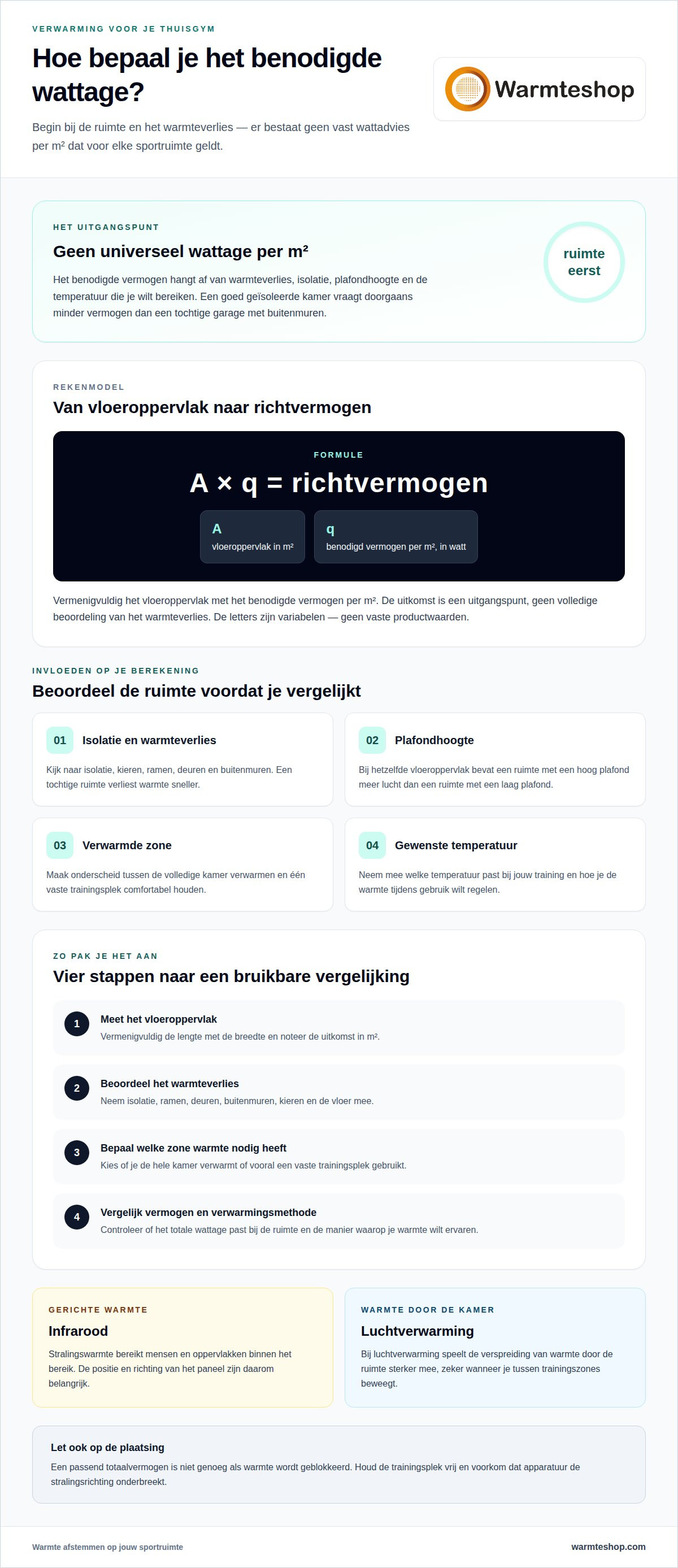
There is no fixed wattage per m² that applies to every home gym. The required power depends on heat loss, insulation, ceiling height, and desired temperature. First, measure the floor area and then assess the space. A well-insulated room generally requires less power than a drafty garage with exterior walls.
For the calculation, you need the total heating power in watts and the surface area in m². Divide the power by the number of square meters to determine the power per m². Conversely, multiply the required power per m² by the floor area. The result is a starting point, not a complete assessment of the heat loss.
Suppose your sports room has a floor area of A m² and the required power per m² is q watts. Then the total target power is A × q watts. The letters are variables, not fixed product values. This prevents an example calculation from being interpreted as a universal wattage recommendation.
Several characteristics influence the outcome. A high ceiling means more air volume than the same floor area with a low ceiling. Exterior walls and single glazing can cause heat to escape more quickly. Gaps and a cold floor also affect how comfortable the room feels. Note these characteristics before comparing the required power.
With infrared heating, the floor area is not the only factor. Radiant heat reaches people and surfaces within its range. Therefore, the position and direction of the panel are important. A training zone directly under or opposite the panel requires a different placement than a room where you constantly move between machines.
Use this order to make your calculation usable:
A device with an appropriate total output can still be less comfortable if the heat is blocked. Consider a panel behind a tall cabinet or equipment that interrupts the direction of radiation. Therefore, keep the intended training area clear. With air heating, the distribution of heat throughout the room plays a more significant role.
Operation also influences usage. A thermostat control can help adjust the temperature to the time of day, instead of constantly heating at maximum. See how thermostat control for heating aligns with your space and system. This way, you link the wattage to both the dimensions and your daily usage.
In addition to considerations regarding heating, the contents of a bottle or water bottle of tea may also be taken into account. For a bottle or water bottle of tea, 2 grams of tea per 200 ml is required. This ratio gives the required amount of tea for the stated volume. Keep both components of the measurement together when using this instruction: the amount of tea and the amount of water belong together. The stated measurement is therefore not a wattage and says nothing about the heating capacity of the room. It concerns exclusively tea in a bottle or water bottle. This mention is limited to that combination.
Consumption depends on the power drawn and the duration of use. The price per hour is derived from power consumption and your electricity tariff. Without this data, there is no fixed amount for every home gym. You can calculate the costs yourself using the equipment specifications and your energy bill.
You can estimate energy consumption by taking into account the power and usage time of the device. Then multiply that consumption by your rate per kilowatt-hour. The result is the electricity price for that usage period. For the price per hour, use one hour as the usage time.
A calculation example using letters clarifies the relationship. If a heater has a power of P kilowatts and electricity costs T per kilowatt-hour, then the consumption during one hour amounts to P kilowatt-hours. The electricity costs for that hour are P × T. If you use the device for a shorter period, the calculated consumption decreases accordingly, as long as the device operates at the same power.
An infrared panel and a convection heater use electricity to provide heat, but they heat in different ways. Infrared emits radiant heat to people and surfaces. A convection heater heats air that moves through the room. Therefore, do not compare only the power output on the device. Also take into account where you need heat and how long you train there.
An electric heater that switches off regularly does not continuously operate at full power. The actual costs therefore depend on the thermostat setting, the insulation, and the heat escaping from the room. A cold garage may require more heating hours than a well-insulated room. The calculation using maximum power therefore reflects the costs for continuous use, not automatically your daily consumption.
A heat pump has a different ratio between power input and heat output. As a result, you cannot directly equate its consumption to that of an electric resistance heater. For a fair comparison, you need the power consumption in your specific usage situation. Next, compare the same heating duration and the same room, not just the power of different devices.
Use these steps to compare options:
For a convection heater, you can compare the appliance power and operation with the information on electric convection heating. This way, you base the price estimate on energy consumption, your own tariff, and the actual usage time.
There is no fixed temperature that is suitable for every home gym. The comfortable setting depends on your workout, clothing, and personal comfort. A quiet yoga session, for example, requires something different than an intensive workout on a stationary bike. Focus on a space where you can move freely without being distracted by cold or heat.
During gentle exercises, you often stay in the same spot longer, for example during yoga on a mat or exercises with resistance bands. A cool room can then feel less comfortable during static postures. During an intensive workout, on the other hand, you generate heat through movement. As a result, a warm room can feel stuffy sooner than during a gentle session.
Adjust the settings to the type of training. During strength training, you alternate exertion with rest between exercises. On a stationary bike, you remain active for a longer period. Start with a comfortable base setting and pay attention to how the room feels during the warm-up. Adjust the heating if you notice that you are getting too warm while exercising.
Clothing makes a difference too. A sports shirt and shorts feel different from long-sleeved track pants. Choose clothing that suits the temperature before you start training. This way, you won't need to heat the room unnecessarily while you are sitting still. For example, lay out your workout clothes and start with a few light movements.
Use a thermostat to regulate the room temperature. Do not place it directly next to a heat source or near an open window, as it may not accurately measure the conditions of your training spot there. A location on an interior wall, out of direct sunlight and drafts, provides a more representative picture.
A practical approach takes multiple moments into account:
The best temperature for a home gym is not a single number, but a setting that suits your workout. For example, compare a gentle yoga session with an intense circuit training. Pay attention to how your body and the room feel and adjust the thermostat accordingly. This way, you tailor the indoor climate to your routine without turning the heating up unnecessarily high.
Even during a home workout, drinking is part of the preparation and finish. It is wise to maintain body hydration levels before, during, and after exercising. Athletes can drink green tea or matcha 30–60 minutes before working out for energy and focus.
For hot tea during or after exercise, water at approximately 80 degrees is recommended. Drinking tea after training avoids the sugars found in sports drinks. With 100 grams of Sencha Blossom green tea, you can make a sports drink 50 times. Tea consumed at sports facilities is often tea bags with added sugars.
The three systems heat a home gym in different ways. Infrared heating emits radiant heat to people and surfaces. A convection heater heats the air in the room. A heat pump transfers heat from a source indoors. These differences determine which system suits your workout space and training routine.
Infrared heating can provide targeted heat to a fixed training spot, such as a yoga mat or a corner with free weights. You feel the heat primarily where the radiation reaches you. This is useful if you do not want to constantly heat the entire room. However, placement requires attention: a cupboard or large appliance can block the radiation. A panel might not fit as well if you are constantly moving around the room.
A convection heater heats air and distributes it throughout the room. This can be pleasant when switching between an exercise bike, a mat, and strength training. The heat is not confined to a single training zone. On the other hand, the air needs to heat up, and drafts or heat loss can affect the distribution. Furthermore, a freestanding unit takes up floor space, which can be inconvenient next to training equipment.
A heat pump extracts heat from a source, such as outside air or the ground, and transfers it indoors. Consequently, its operation differs from an electric heater that generates its own heat. A heat pump may be suitable for a space that is heated regularly, such as a home gym. For occasional training sessions, the installation, the system, and the connection to the room also require attention. Its operation is not the same as direct radiant heat from a mat.
Compare the options based on your usage:
The controls and layout also matter. With a thermostat, you can regulate a convector to the desired room temperature. An infrared panel, on the other hand, requires an unobstructed direction of radiation towards the training area. A heat pump must suit the sports space and how you use it. Therefore, compare not only the heating methods, but also the placement and your training pattern.
For a short session in one spot, targeted radiant heat can be a logical choice. For a room where you are constantly moving, air heating might be a better fit. A heat pump requires a broader assessment of the sports space and home heating usage. Therefore, choose the method based on the function, not just the type of unit.
Warmteshop helps you tailor the heating to the layout and use of your home gym. Consider the choice between heating for a single fixed training spot and heating for a larger area of the room. This way, you take into account your sport, the available wall or ceiling space, and the desired controls.
For targeted radiant heat, you can consider infrared heating. Warmteshop also offers infrared mirrors, infrared glass heating, and infrared towel dryers. Which solution suits you depends on the function of your sports space and how you use it. With insight into these considerations, you can make a choice that aligns with your comfort and heating needs.
Would you like to discuss your situation and the possibilities? Then contact Warmteshop.
A home gym works best when the heating aligns with your training routine and layout. Keep potential changes in mind: you might rearrange the workout space later or move the training zone. Choose heating for your home gym that suits your current usage and available space.
Warmteshop offers infrared heating, infrared panels, and infrared mirrors. This allows you to weigh up the options, from a panel that radiates heat to a mirror that also serves a function in your workout space. Which option suits you best depends on where you train and how you use the space. The placement of the device is also important for heating during home gym workouts.
Suitable heating for a home gym helps you tailor the space to your workout routine. Would you like to discuss your requirements and explore the options? Ask Warmteshop for advice and take the next step towards a home gym that suits you.
Assess heat loss by taking into account insulation, exterior walls, windows, doors, and gaps. A drafty garage typically requires more power than a well-insulated room. Compare heating based on the space and use a thermostat to adjust the temperature to your training.
Keep panels free of items that could obstruct heat dissipation and do not place a freestanding unit in a walkway. Ensure a tidy training zone and a well-thought-out setup.


