

Patio heater consumption: what will electric heating cost in 2026?
, by Warmteshop, 17 min read
, by Warmteshop, 17 min read
Did you know that in 2026, an electric patio heater will be on average three times cheaper to operate than a traditional gas heater? Many people still hesitate to heat their outdoor space for fear of an unexpectedly high…
Did you know that in 2026, an electric patio heater will be, on average, three times cheaper to operate than a traditional gas heater? Many people still hesitate to heat their outdoor space for fear of an unexpectedly high electricity bill or uncertainty regarding the actual consumption of the patio heater. It is understandable that you want to keep a grip on your expenses, especially now that electricity prices in May 2026 fluctuate between €0.23 and €0.30 per kilowatt-hour.
In this article, you will discover the exact hourly costs of electric heating and learn how to maximize savings on your energy bill with the right infrared technology. Infrared works exactly like the natural warmth of the sun: it heats your body and objects directly instead of the surrounding air. We provide a clear overview of the hourly costs, explain which technology offers the highest efficiency, and give concrete tips to minimize your consumption without sacrificing coziness.
Understanding the actual consumption of a patio heater begins with debunking a persistent myth. Many people believe that a high-wattage device is automatically an energy guzzler. In practice, the opposite is often true. Consumption is determined not only by how much power comes out of the socket, but primarily by how effectively that power is converted into palpable heat on your skin. The efficiency of heat transfer ultimately determines whether you sit comfortably outdoors or spend money unnecessarily on heating the outside air.
With electric heating, everything revolves around the principle of Joule heating, where electrical energy is converted into thermal energy. With a high-quality infrared patio heater, virtually no energy is lost to heating the air. This is a crucial difference compared to gas heaters or traditional convectors. The environment plays a key role here. On an open, windy terrace, a device that heats the air stands no chance; the heat simply blows away before you can enjoy it. A patio heater that uses direct radiation, however, works like the sun on a cold winter day: you feel the warmth immediately, regardless of the air temperature.
To calculate your patio heater's consumption, use a simple formula. Divide the wattage of your unit by 1000 and multiply this by the number of hours it is switched on. A 2000-watt heater therefore consumes exactly 2 kWh per hour. However, this number does not tell the whole story. A powerful, high-efficiency 2000-watt heater can heat a space faster and more comfortably than a lower-quality 1500-watt model that has to run at full power constantly. Additionally, local mains voltage can affect performance. If the voltage in your area is slightly lower than the standard 230 volts, your unit will produce less heat. As a result, you may leave it on longer to achieve the same level of comfort.
The efficiency of your patio heater depends entirely on the chosen wavelength. Short-wave infrared, often recognizable by a bright light, penetrates deeper into the skin and is virtually unaffected by wind. This makes it the most economical choice for open patios. Long-wave heaters, also known as dark heaters, emit no light but are very sensitive to wind. They heat the air surrounding the element. They work excellently in a fully enclosed conservatory, but outdoors they consume unnecessary energy because the heat is constantly blown away. By choosing the right technology for your specific situation, you avoid paying for heat that never reaches you.
In May 2026, electricity prices in Flanders will range between €0.2304 and €0.3013 per kWh, including all network costs and VAT. This is a favorable development for your wallet, as rates for both fixed and variable contracts have fallen by an average of 5 percent compared to April 2026. To patio heater consumption , we look at the actual costs per hour. For a powerful 2000-watt model, you currently pay between €0.46 and €0.60 per hour. This makes electric heating a surprisingly affordable option for those who want to enjoy the outdoors even on cooler evenings.
The costs naturally vary based on the chosen capacity. Below is an overview of the average hourly costs in May 2026:
Do you want to know exactly what your system consumes? By using smart home Wi-Fi modules or a smart plug, you can monitor your energy consumption in real time via an app on your smartphone. This provides a reassuring sense of control over your monthly energy bill.
Suppose you enjoy the outdoors for three hours on a Saturday evening with a 2000-watt infrared heater at full power. At an average price of €0.26 per kWh, this evening will cost you only €1.56. For occasional users who only turn on the heater on weekends, the annual costs remain very limited as a result. Even with more intensive use, the investment in living comfort is often lower than the cost of a single visit to a heated restaurant terrace. For optimal results, you can view our collection of electric patio heaters to find a model that fits your space perfectly.
The efficiency of infrared technology ensures that you do not always need full power to stay comfortable. By choosing a model with a dimmer, you immediately reduce energy consumption. When you set the heater to 50 percent of its power, you also halve the hourly running costs. A stepless dimmer offers the most flexibility in this regard; you adjust the heat precisely so that it feels like the soft rays of the afternoon sun. This is not only more pleasant for your skin but also a smart way to prevent unnecessary energy loss at times when subtle warmth suffices.
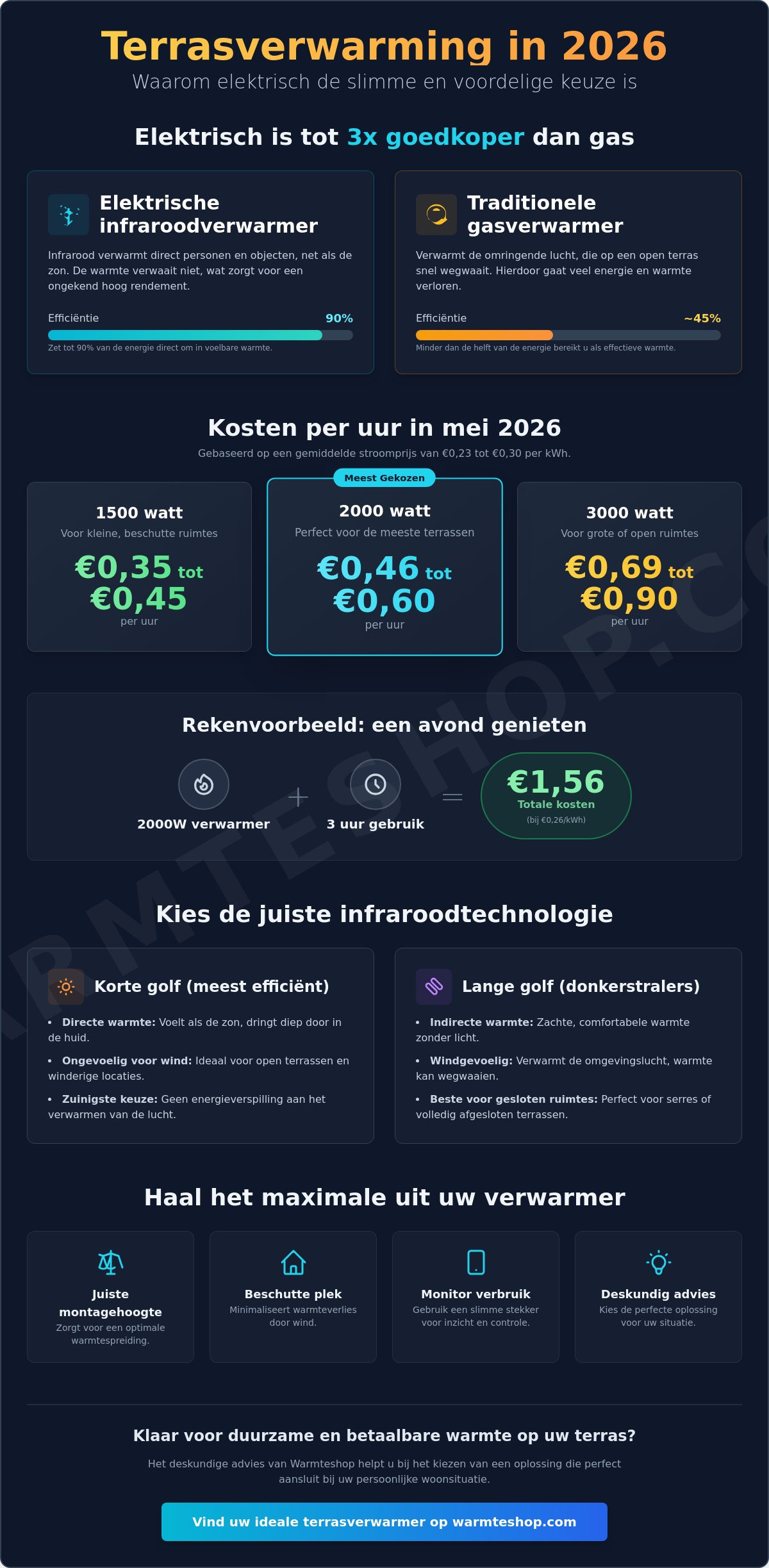
When comparing heating systems, many people look only at the price of the fuel. However, true economy lies in efficiency. While a modern infrared heater converts over 90 percent of the energy consumed into direct heat, a gas heater performs significantly worse with an efficiency of only 30 percent. Consequently, the consumption of an electric patio heater is much more favorable for your wallet in practice. Current data from May 2026 shows that an electric version is, on average, three times cheaper to operate than a traditional gas heater, which quickly consumes €1.79 per hour of propane.
In addition to direct consumption costs, the hidden costs of gas play a major role. Consider the time and fuel required to have gas cylinders filled, the hauling of heavy tanks, and the necessary secure storage space. Moreover, within the context of the energy transition, the choice for electricity is increasingly becoming a necessity. For instance, the use of gas patio heaters will be banned in the Brussels-Capital Region from June 2026, a measure stemming from the pursuit of lower CO2 emissions. Electric heating, especially in combination with green energy, is the only logical and future-proof path.
The biggest problem with gas heaters is the way they distribute heat. They work on the basis of convection, which means they heat the air surrounding the flame. However, warm air rises immediately. On a patio, this means that the heat produced disappears straight upwards, far out of reach of the people sitting underneath. Furthermore, a gas flame is extremely sensitive to wind. Even a gentle breeze blows the layer of warm air away, meaning you are literally wasting your time. This explains why you often need enormous power with gas heaters to experience only a fraction of the comfort.
Infrared technology takes a fundamentally different approach by completely bypassing the air. The radiation heats only the objects and people within the beam, just as the natural warmth of the sun does. This ensures an immediate warmth experience without the need for a lengthy and costly start-up time. As soon as you flip the switch, you enjoy comfort. Curious which model best suits your patio? Then take a look at our extensive patio heater collection for an overview of the most energy-efficient solutions currently available.
Getting the most out of your investment means looking beyond just the unit itself. The way you position the heater has a direct impact on the patio heater's energy consumption. When a unit is hung too high, it has to work harder to achieve the same intensity at seating height. For most models, a height between 2.10 and 2.50 meters is ideal. If you hang the heater higher, the radiation beam spreads over too large an area. As a result, the effective heat on your skin decreases, while the meter in the fuse box keeps up the same rate.
Maintenance is often overlooked, but is essential for low consumption. Dust and dirt on the reflectors absorb heat instead of reflecting it onto the patio. A simple cleaning before the season starts ensures that you do not waste energy heating the device's housing. The presence of side walls or a glass windbreak also helps indirectly to keep costs low. Although infrared radiation does not blow away, your body cools down faster in the wind. As a result, you tend to set the heater to a higher setting than strictly necessary in a sheltered environment.
By mounting the heater at an angle of approximately 45 degrees, you concentrate the radiant heat precisely on the seating area. This prevents unnecessary heating of the facade or ceiling. If you place the heater under a sunshade or canopy, you also benefit from the reflective properties of these materials. The heat remains in the immediate vicinity longer, significantly increasing the efficiency of your system. However, when mounting under flammable materials, always observe the manufacturer's prescribed safety distances.
One of the biggest energy vampires on the patio is a heater that remains on even when no one is sitting outside. Smart technologies such as motion sensors solve this problem immediately. By connecting your system to advanced thermostats or smart home Wi-Fi modules, you maintain full control. You can easily set timers or regulate the temperature via an app on your smartphone. This ensures that patio heater consumption always stays in line with your actual needs and never costs a euro too much.
Prepare your terrace for the future today and view our range of smart electric patio heating for optimal efficiency and maximum living comfort.
Warmteshop positions itself as your reliable guide in the world of the energy transition. We view the switch to green energy not as an obligation, but as a smart upgrade to your living comfort. Our infrared technology is designed to mimic the natural warmth of the sun. This ensures healthy and direct heat that warms people and the space, rather than the air. By choosing this innovative technology, you keep the actual consumption of your patio heater fully under control, while contributing to a CO2-neutral future.
Choosing a high-quality system from Warmteshop is an investment that pays for itself in the long run. While cheaper models often lose a lot of stray light and unnecessary heat to the rear, our heaters focus the energy exactly where you need it. This high efficiency, combined with the long lifespan of the heating elements, results in a significantly lower total cost of ownership. You enjoy a carefree outdoor lifestyle without fear of an exploding energy bill.
Our units represent a careful blend of technical perfection and aesthetic design. We understand that a patio heater must not only be functional but also complement the look of your home. Our designs are therefore sleek, modern, and discreet. Thanks to the use of advanced materials, our systems achieve an efficiency of over 90 percent. Would you like to know more about what to look for when making your purchase? Then read our comprehensive guide on buying a patio heater for all the details on optimal outdoor comfort.
No two terraces are the same, which is why we do not believe in standard solutions. Our experts are ready to perform a detailed heat calculation for your specific outdoor space. We take into account the dimensions, the degree of shelter, and your personal preferences. This pragmatic and expert approach prevents you from purchasing a system with excessive capacity, which directly benefits your patio heater energy consumption. We would be delighted to invite you to one of our physical showrooms in the Netherlands to experience the power and comfort of infrared for yourself.
Are you ready to transform your terrace into an oasis of sustainable warmth? View all infrared patio heaters in our webshop or stop by for a live demonstration and tailored advice from our specialists.
It is clear that in 2026, electric heating is not only the most sustainable but also the most economical choice for your outdoor space. By focusing on the actual efficiency of infrared technology rather than just the wattage, you keep patio heater consumption surprisingly low. With current energy prices and the transition to green power, you can enjoy a comfortable patio without unnecessary costs or energy loss. Switching to electric infrared radiation is therefore a smart upgrade for your living comfort and your wallet.
Warmteshop has been the specialist in infrared solutions since 2008. With more than 30 showrooms in the Benelux, we offer you the opportunity to personally experience the healthy warmth of our systems. Our experts are ready to provide professional advice and are happy to create a customized heat calculation for your specific living situation. This ensures you receive a solution that perfectly matches your wishes and budget, so you can enjoy the outdoors worry-free.
Discover our energy-efficient patio heaters at Warmteshop and turn your patio into a place where you can relax comfortably all year round.
A patio heater consumes exactly the number of kilowatt-hours equal to its power output divided by one thousand. A 2000-watt model therefore consumes exactly 2 kWh per hour when operating at full power. However, the actual consumption of the patio heater may be lower if you use a dimmer or a thermostat control that reduces the power once the desired comfort temperature is reached.
Yes, an electric patio heater is on average three times cheaper to operate than a gas version. While a 2000-watt electric heater will cost between €0.46 and €0.60 per hour in May 2026, you pay approximately €1.79 per hour for propane for an average gas heater. In addition to lower operating costs, you also save on the purchase and the cumbersome transport of heavy gas cylinders.
A lower wattage does not automatically lead to a lower energy bill if the appliance has to stay on longer to keep you warm. It is often more efficient to choose a more powerful appliance with a dimmer. This allows you to reach the desired temperature faster, after which you can switch the power down to a more economical setting, which often reduces total energy consumption over the entire evening.
Wind has no direct influence on the amount of power your heater consumes, but it does affect the sensation of warmth with certain technologies. Short-wave infrared radiation is virtually unaffected by wind and heats your body directly. With long-wave heaters, however, the heat blows away more quickly, making you inclined to turn up the setting. For an open terrace, short-wave technology is therefore the most energy-efficient choice.
For an average four-hour evening with a 2000-watt patio heater, you will pay approximately €2.08 at an average electricity rate of €0.26 per kWh. This amount is based on continuous use at full power. In practice, costs are often lower because you usually dim the heater to a lower power level after reaching a comfortable temperature, which significantly limits the actual consumption of the patio heater.
Certainly, there are modern systems equipped with motion sensors or adjustable timers. These technologies ensure that the heater is only on when people are actually present on the terrace. Furthermore, by connecting your patio heater to smart home Wi-Fi modules, you can set schedules via an app, so you never accidentally waste energy on an empty terrace.
The efficiency of an infrared patio heater is impressively high at over 90 percent compared to the 30 percent of a gas heater. Infrared heaters convert virtually all electricity into direct radiant heat that reaches your skin, just like the sun. With gas heaters, most of the energy disappears into the atmosphere as rising warm air, meaning that with gas you are literally wasting your time.
Infrared is a very safe choice for your wallet due to its high efficiency and independence from fossil fuels. Now that cities are increasingly restricting the use of gas heaters, electricity offers the most stable foundation for the future. Thanks to targeted heating and the possibility of using self-generated green power, infrared remains the most cost-effective method for sustainably enjoying the outdoors.


