
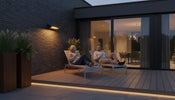
Buying a Patio Heater in 2026: The Ultimate Guide to Optimal Outdoor Comfort
, by Warmteshop, 19 min read
, by Warmteshop, 19 min read
Did you know that, on average, 60% of the heat from traditional heating systems simply blows away before it reaches your seating area? It is a familiar problem for many outdoor enthusiasts: you invest in a patio heater…
Did you know that, on average, 60% of the heat from traditional heating systems simply blows away before it reaches your seating area? It is a familiar problem for many outdoor enthusiasts: you invest in a patio heater, but still end up with cold hands while the energy bill mounts unnecessarily. At Warmteshop, we believe that outdoor comfort should not be a compromise between coziness and efficiency, but a smart upgrade to a sustainable lifestyle.
In this guide for 2026, you will discover how to find the ideal balance between advanced technology, precise power output, and stylish integration into your garden design. We explain why accurately calculating the wattage per square meter is crucial to prevent cold zones. You will learn how modern short-wave infrared radiation, comparable to the healthy warmth of the sun, makes your patio comfortable within 5 seconds. Furthermore, we demonstrate how smart thermostat controls reduce your running costs by up to 30%, allowing you to responsibly enjoy an atmospheric and warm outdoor retreat all year round.
In 2026, an outdoor space is much more than just a place to sit; it has become a full-fledged extension of your interior. To guarantee this comfort all year round, choosing the right patio heater essential. But what really makes a system effective? The core question when purchasing revolves around the method of heat transfer. While traditional systems often heat the air, modern consumers are now opting en masse for radiant heat. What is a patio heater? At its core, it is a device that locally increases the outdoor temperature, but the technological leap we have made in recent years has shifted the focus from brute force to targeted efficiency.
The fundamental difference lies in the physics. Conventional gas heaters work on the basis of convection. They heat the air, which then rises and disappears at the slightest gust of wind. In an open outdoor space, this leads to an energy loss of approximately 60%. Infrared technology, on the other hand, heats objects and people directly, similar to the rays of the sun. This process is insensitive to wind and ensures an immediate sense of comfort. 2026 marks the year of the definitive transition in this regard. Due to stricter environmental requirements and the desire for CO2-neutral solutions, the electric patio heater has become the standard for both private gardens and the professional hospitality industry.
Electric systems offer advantages that simply cannot be matched by gas. The technology is safer, maintenance-free, and fits perfectly within a sustainable lifestyle. The main reasons for this choice are:
The aesthetics of your terrace determine which model fits best. In 2026, we see heating increasingly being invisibly integrated into the architecture. Wall-mounted models are the most popular choice for fixed canopies and facades. They take up no floor space and can be adjusted to the exact right angle for optimal coverage. For situations where flexibility is desired, freestanding heaters offer a solution. You can move these effortlessly from the dining table to the lounge set.
For a minimalist finish in modern verandas, ceiling-mounted and recessed options are the gold standard. These models sit flush with the ceiling, allowing the technology to blend seamlessly into the design. This type of installation is often seen in high-end projects where comfort and visual tranquility go hand in hand. Whichever model you choose, the focus is always on creating healthy, natural warmth that elevates the outdoor experience.
In 2026, the choice of a specific infrared technology will no longer be a matter of chance, but a conscious decision based on the physics of your outdoor space. The infrared spectrum is divided into three zones: IR-A (short wave), IR-B (medium wave), and IR-C (long wave). Each zone has a unique interaction with the environment and human skin. While one technology bypasses the air to heat you directly, the other focuses on creating a constant, mild ambient temperature. A good understanding of how infrared heating works helps you avoid a bad purchase and optimize your energy consumption by up to 30%.
The intensity of the radiation determines not only the heat but also the visual impact on your terrace. In the past, a patio heater was synonymous with a bright red glow. Nowadays, advanced "low-glare" and "no-glare" filters make it possible to enjoy maximum heat without the atmosphere on your terrace being disturbed by dominant light. The transition to these smart systems is a logical upgrade for those who want to combine comfort and aesthetics.
Short-wave infrared radiation is the most powerful form of outdoor heating. This radiation has the unique property of not heating the air, but penetrating directly into objects and people. The rays reach up to 5 millimeters deep into the skin, resulting in an immediate feeling of comfort. This makes the IR-A patio heater essential for exposed areas such as open balconies, roof terraces, or the hospitality industry. High-quality elements such as HeLeN or Gold lamps convert up to 92% of the electricity into direct heat. Even at a wind speed of 15 kilometers per hour, the heat experience remains constant, because the wind simply cannot blow the radiation away.
Long-wave radiation, often used in so-called dark radiators, works fundamentally differently. This technique mimics the natural warmth of the sun on a cloudy day; the heat is comfortable, even, and completely free of visible light. Because IR-C radiation uses air molecules indirectly and penetrates less deeply into the skin, this type is very sensitive to drafts. However, in a fully enclosed conservatory or a veranda with glass sliding walls, long-wave radiation offers unprecedented aesthetic added value. The panels blend seamlessly into the modern architecture of your home. For an optimal indoor-outdoor climate, you might consider integrating a designer patio heater that complements the clean lines of your canopy.
When making your choice, the balance between exposure to wind and the desired light intensity is decisive. In 2026, we expect 75% of consumers to opt for a hybrid solution, where different zones in the garden are equipped with the technology that performs best there.
In 2026, the choice between gas and electricity will no longer be a matter of taste, but a decision based on hard numbers. While a traditional gas heater converts only 40 to 50 percent of its energy into useful heat, an electric infrared patio heater an efficiency of 92 percent or higher. Gas heaters heat the surrounding air, which immediately blows away at the slightest breeze. Infrared technology works exactly like the sun; it does not heat the air, but directly the people and objects present. This direct transfer prevents energy waste and ensures a constant, comfortable experience.
Operational costs also speak in favor of electricity. Due to rising gas prices and the increasing availability of self-generated solar energy, electric heating has become significantly more economical per hour of operation. Moreover, the lifespan of an electric heater is many times longer. There are no moving parts to wear out, and lugging around heavy, unwieldy gas cylinders is definitely a thing of the past. Furthermore, with green electricity, you transform your terrace into a completely CO2-neutral comfort zone.
A calculation example makes the difference immediately clear. A 2000W electric heater consumes exactly 2 kWh per hour. With a gas heater, consumption is often 1 to 1.5 kg of propane per hour to achieve a comparable sense of warmth, resulting in costs up to three times higher in 2026. Wind has virtually no influence on the radiant heat of infrared, whereas a gas flame loses much of its effectiveness at wind force 3. By using smart thermostats and dimmers, you can precisely adjust the power output, resulting in additional savings of up to 30 percent on energy costs.
Safety is a decisive factor when designing your outdoor space. Gas appliances pose risks such as open flames, potential gas leaks, and the need for adequate ventilation to prevent carbon monoxide poisoning. Therefore, always follow the official safety guidelines for patio heaters to avoid incidents. An electric patio heater requires only a grounded outlet and provides instant heat at the touch of a button.
The degree of protection against weather influences is expressed in IP ratings. For a sheltered terrace, IP44 is often sufficient, providing protection against splashing water. For installations that are fully exposed to the rain, our experts recommend a minimum of IP65. This guarantees that the equipment remains dust-free and is resistant to low-pressure water jets. The absence of a storage area for flammable gas cylinders saves valuable square meters on your terrace and enhances the overall aesthetics of your outdoor living space.
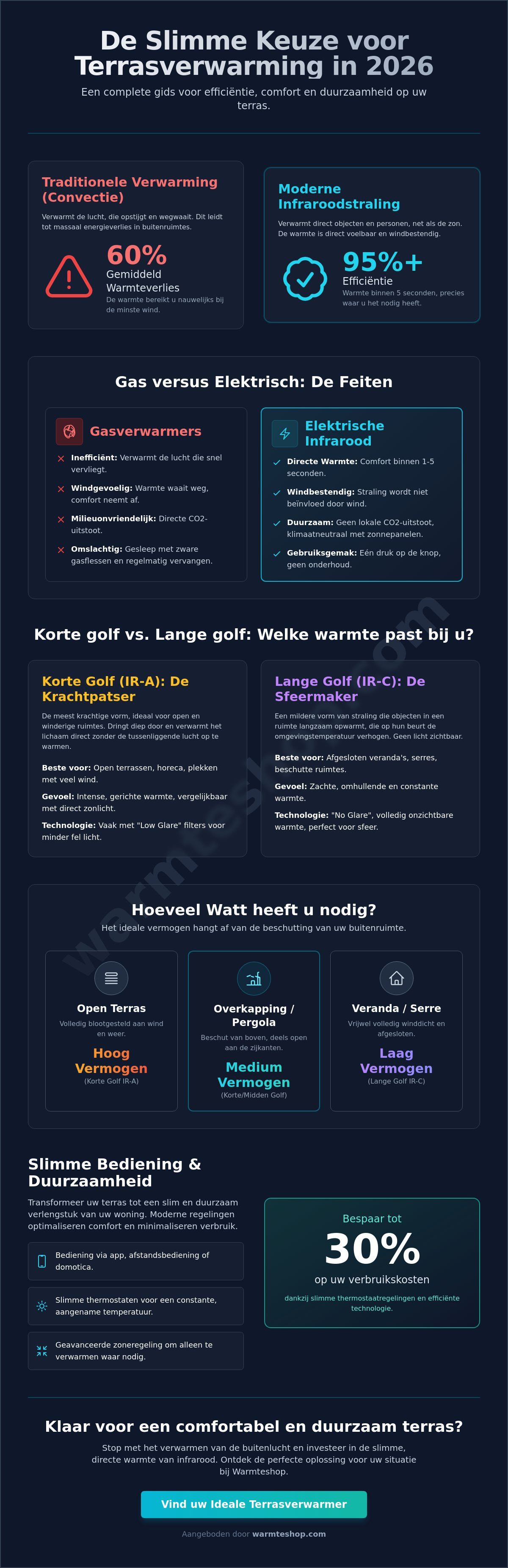
The environment determines the intensity of the radiation required to mimic the natural heat of the sun. Use the following values as a firm guideline for your calculation:
The position of your appliance is just as important as the power output itself. Choose a "cross-position" arrangement for larger areas. By placing two heaters opposite each other, you prevent cold zones and ensure you are heated evenly from both sides. This significantly increases comfort without drastically raising total energy consumption.
Take the optimal mounting height into account. The "sweet spot" for most powerful heaters lies between 2.10 and 2.50 meters. At this height, the beam spreads wide enough to set a table, while the heat intensity remains strong. Always use adjustable brackets. These allow you to precisely adjust the beam angle to your seating area, ensuring that no precious energy is lost heating the garden wall or bare tiles.
Are you ready to transform your terrace into an oasis of warmth? Discover our full range and choose the perfect patio heater for your outdoor space.
Warmteshop brings the natural warmth of the sun directly to your outdoor space with advanced infrared technology. Our systems are designed to deliver top performance for years without any loss of efficiency. While traditional heaters often lose power after a few seasons, our short-wave heaters maintain their full intensity for more than 10,000 operating hours. This makes purchasing a high-quality patio heater a smart long-term investment.
We emphasize zone-controlled heating. Through integration with wireless thermostats , you heat only the zones currently in use. This prevents energy from being wasted on empty corners of your terrace. Furthermore, our designs are stylish and minimalist. They blend seamlessly with the architecture of modern canopies and facades, ensuring technology and aesthetics go hand in hand. Our advisors guide you every step of the way to determine the ideal configuration for your specific situation.
In 2026, the comfort of your terrace will be determined by ease of use. You operate our systems effortlessly via your smartphone or by connecting to your existing home automation system. With advanced dimmers, you can precisely adjust the heating requirements to the current outdoor temperature. When the mercury hits 17 degrees outside, 40% of the maximum power is often sufficient for a comfortable feeling. Many of our customers nowadays connect their installation to solar panels. This results in a completely CO2-neutral terrace, where the solar energy generated during the day is converted into healthy radiant heat during the evening hours.
With over 15 years of experience as a market leader in infrared heating, we understand the dynamics of heat transfer like no other. Our position as an expert is built on a foundation of technical innovation and tangible results. We have an extensive network of showrooms where you can personally experience the heat before making a decision.
We view the transition to green energy not as an obligation, but as an opportunity to enhance your living comfort. A patio heater from Warmteshop offers healthy, comforting warmth that heats people and objects, rather than the air. This ensures a stable climate, even when there is a light breeze. This way, you enjoy your garden all year round with the assurance of sustainable quality.
Choosing the right patio heater determines how often you will actually enjoy your outdoor space in 2026. By focusing on short-wave infrared radiation, you opt for the direct, healthy warmth of the sun; a technology where the wind has no influence on your personal comfort. Switching from traditional gas systems to modern electric solutions significantly reduces your ecological footprint and maximizes the energy efficiency of your patio. Since 2008, Warmteshop has been the undisputed market leader in this advanced technology. We are happy to assist you with the correct calculation, ensuring you install exactly the wattage required by your specific situation.
With over 30 showrooms spread across the region, our experts are ready to provide you with professional advice that goes beyond just technology. We consider the aesthetics of your home and the desired atmosphere, ensuring your terrace becomes a full-fledged extension of your living room. Our focus is always on sustainable quality and systems that last for decades. This way, you are investing not just in warmth, but in a future-proof upgrade to your living comfort. Discover our full range of patio heaters at Warmteshop and experience for yourself how innovation and coziness come together on your own terrace.
You need at least 1,750 to 2,000 watts to effectively heat a 10m² terrace. This calculation is based on a standard requirement of 175 to 200 watts per square meter for a semi-open outdoor space. In a fully open garden with a lot of wind, this requirement is often 20% higher to experience the same level of comfort. A powerful patio heater ensures that the perceived temperature rises immediately as soon as you switch on the device.
An electric heater can remain outdoors all year round provided it has at least an IP65 certification. This rating guarantees that the housing is completely dustproof and resistant to water jets from all directions. For locations within 500 meters of the coast, we recommend models made of anodized aluminum. These materials prevent corrosion caused by salty sea air, which extends the lifespan by an average of 5 years compared to standard powder-coated steel.
The biggest difference lies in the perceived warmth and the light intensity emitted by the lamp. A carbon heater gives off a softer, deep orange glow and is less susceptible to wind due to the long-wave radiation, which heats the air less. Halogen heaters, on the other hand, deliver intense, direct heat with a brighter light, comparable to the power of the sun on a clear day. Carbon elements have an expected lifespan of 10,000 burning hours, whereas halogen lamps often last around 5,000 hours.
The consumption of a patio heater costs an average of €0.42 per hour at a maximum power of 2000 watts. This amount is based on the average electricity price of €0.21 per kWh as reported by Eurostat in the first half of 2024. By choosing a model with a built-in dimmer, you can easily reduce these operating costs by 30% to 50% on less cold evenings.
Infrared radiation is absolutely not harmful to health and has been used in the medical world for muscle recovery since the beginning of the 20th century. Unlike the sun, an infrared device contains no harmful UV radiation, so the skin does not burn or get damaged. On the contrary, the radiation stimulates blood circulation and provides a healthy warmth that penetrates deep into the body. It feels like a natural embrace of warmth without drying out the surrounding air.
You can easily connect a heater of up to 3000 watts to a standard 230-volt European socket. An average circuit in a modern home is fused at 16 amperes, which allows a maximum load of 3680 watts. However, ensure that no other heavy appliances, such as a dishwasher or washing machine, are running on the same circuit simultaneously. Preferably use a grounded socket to ensure safety during damp weather conditions.
The ideal mounting height for a wall-mounted model is between 2.10 and 2.30 meters measured from the floor. This specific height ensures optimal distribution of heat waves without the radiation becoming too intense for your head. Always maintain a clearance of at least 30 centimeters between the top of the unit and the ceiling or a sunshade. This prevents unwanted heat buildup and guarantees safe, long-lasting operation of the system.
You prevent the fuse from blowing by having a C-characteristic circuit breaker installed in your meter cabinet by a certified installer. Electric heaters have a peak current during startup that is 5 to 10 times higher than the normal consumption during the first milliseconds. A standard B-characteristic fuse often incorrectly interprets this as a short circuit and switches off the power immediately. A C-type circuit breaker is specifically designed to absorb these short peaks, ensuring your system always starts up reliably.


