

Choosing a dimmer for a patio heater by brand and wattage
, by Warmteshop, 17 min read
, by Warmteshop, 17 min read
A dimmer that fits the plug is not automatically suitable for your patio heater. Choose a dimmer that matches the brand, type, and wattage of the unit. Some patio heaters are only on and off …
A dimmer that fits the plug is not automatically suitable for your patio heater. Choose a dimmer that matches the brand, type, and power of the unit. Some patio heaters can only be switched on and off; others require a special dimming module. Therefore, check whether the dimmer is suitable for both the heater and the total load.
It makes sense to look at the controls first: you want to be able to easily adjust the heat to suit the time and your location. However, a good choice starts with the connection and technical suitability. Pay particular attention to the power output, the wall socket, and the method of connecting one or more heaters.
In this article, you will learn how to choose a dimmer for your patio heater based on brand and wattage, how stepless dimming and fixed heat settings work, and which connection is compatible. This way, you determine in advance which controls are suitable and how to comfortably regulate the heat, without choosing a dimmer that is not compatible with the unit.
Before purchasing, check the brand, type, and wattage on the rating plate of your patio heater. Overloading can damage the dimmer. Before use, check whether the use of a dimmer affects the warranty.
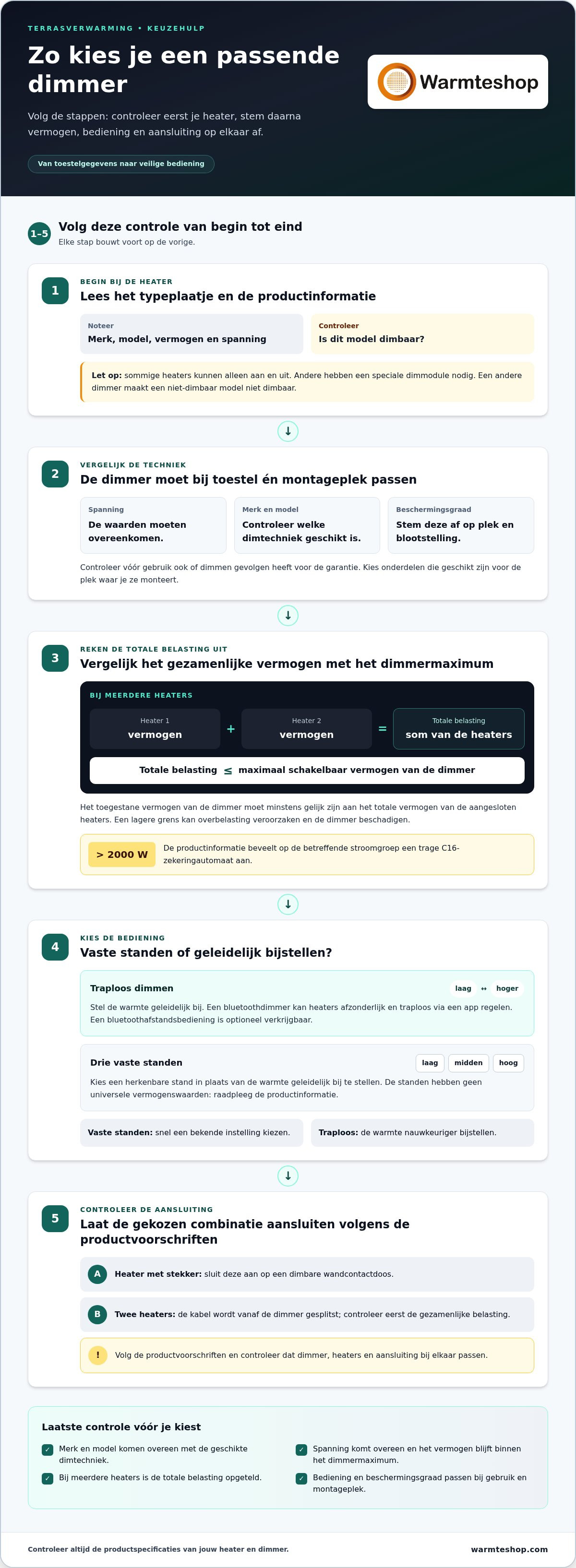
Start with the details of both the patio heater and the dimmer. You can easily compare them using the steps below.
First, note the wattage and voltage of the patio heater and compare them with the values on the dimmer. The voltage must match, and the heater's wattage must not exceed the dimmer's maximum load. If you are connecting multiple patio heaters, add their wattages together.
Also pay attention to the protection rating of the components. Outdoor conditions play a role that do not occur indoors. Choose components that are suitable for the location where you will be mounting them. The protection rating indicates the extent to which a component is resistant to external influences. The specified value must match the mounting location and the exposure.
Also compare the brand and model. Not all patio heaters use the same dimming technology. The product information states which control method is suitable. A model that can only be switched on and off will not become dimmable by connecting a different dimmer to it.
The maximum switchable power of a dimmer is expressed in watts. This is the limit for the connected patio heater or heaters combined. Choose a dimmer whose permissible load is at least equal to the total power of the connected devices. A lower limit can lead to overloading.
For two patio heaters, therefore, add up both power ratings. Compare the result with the maximum on the dimmer, not just with the power of a single unit. For use above 2000 W, the product information recommends a slow-blow C16 circuit breaker on the relevant circuit. Have the selected combination connected according to the product instructions.
Check these details before you order:
This is how you control the heat with a dimmer that matches the device specifications. When looking at different models, compare the specifications of an outdoor patio heater with the dimmer specifications, not just the brand.
The controls determine exactly how you can adjust the heat. Compare stepless control with fixed settings and choose what suits your patio use.
With stepless dimming, you gradually adjust the heat by rotating or sliding the control. This allows you to fine-tune the radiant heat without fixed intermediate settings. This is useful when you remain seated in the same spot, but the desired warmth changes over the course of the evening.
A Bluetooth dimmer can control multiple patio heaters individually and steplessly via an app. Consider a patio with a seating area and a dining table: you adjust the heat in one spot without changing the setting for the other. This way, you tailor the control to the use of each zone.
The Bluetooth version is operated by default using a free app. A Bluetooth remote control is available as an option. Consider in advance what is practical in practice: with the app, you control the dimmer via your phone, whereas with a remote control, you can adjust it directly. The dimmer and patio heater must be compatible with this method of operation.
Pay attention to how the controls work when making your choice. Check if you can easily increase or decrease the setting and if individual dimmers respond independently. Try the controls with a single patio heater first. This way, you will see if the controls work logically for your patio, for example, when you only heat the seating area.
A three-position dimmer offers a fixed choice of low, medium, and high heat. You select a setting instead of gradually adjusting the heat. This makes operation straightforward: a lower setting can suit mild conditions, and a higher setting when you want more heat.
The settings do not correspond to universal power values. Therefore, consult the product information for the dimmer and patio heater to see how the settings work. Do not deduce a specific wattage from the designations low, medium, and high. The available settings and heat output depend on the combination of devices.
Compare the control options based on ease of use. With three fixed settings, you can quickly select a familiar setting; stepless dimming offers more options for adjusting the heat. Also consider who will be operating the patio heater. Fixed settings are immediately recognizable to housemates or guests, while stepless control allows for more precise adjustment.
A simple selection guide:
View the dimmers for patio heaters and compare the available control options with your preference. This way, you choose a control system that suits both your desired comfort and how you want to control the heat.
The connection determines how the dimmer and patio heater work together. In the described setup, the dimmer is placed between the mains power and a wall socket. Next, you plug the patio heater into that dimmable socket. Always follow the dimmer's manual when making the connection.
First, determine how the dimmer is connected. In this setup, the input is connected to the mains power. A cable runs from the output to a wall socket, into which you plug the patio heater. The dimmer then regulates the heat via that connection.
This setup uses a dimmable wall socket. The patio heater remains connected to the socket via a plug and can be disconnected by removing the plug. This is different from a connection where the heater is connected directly to fixed wiring.
If you want to operate two patio heaters, the cable from the dimmer is split to two wall sockets. Each patio heater receives its own plug connection to a dimmable socket. Use this distribution only if the dimmer and connection are suitable for the combined load.
Check the connection points on the dimmer before use. The markings for mains, output, and load help you connect the cables in the correct place. Compare them with the device's connection diagram. Do not swap the input and output.
For a plugged patio heater, the wall socket forms the connection between the dimmer and the unit. You disconnect the heater by removing the plug from the socket. With two units, each unit has its own plug connection. Keep the setup organized so you can see which dimmer output belongs to which patio heater.
The exact connection points vary depending on the dimmer model. Follow the supplied diagram and use the indicated input and output. Only connect the patio heater after the dimmer and socket have been connected according to the diagram. This keeps the connection clear and allows the dimmer to regulate the heat of the connected heater.
There are plug-in and built-in dimmers, in addition to remote control. The suitable version depends on the connection and the type of heater.
A dimmer only works with devices that can be dimmed manually. This applies to infrared and halogen heaters if the specific model is dimmable.
A plug-in dimmer works with a dimmable wall socket into which you plug the heater directly. You can disconnect the heater by unplugging it. This version is compatible with a plug-in heater, provided the unit and connection are suitable for dimming.
A built-in dimmer is integrated into the electrical installation, rather than being used as a plug-in solution between the connection and the unit. Check which connection your patio heater uses before making a choice. The product information determines whether the dimmer and heater are compatible.
A remote control describes the operation, not the connection type. The Bluetooth version is operated by default using a free app; a Bluetooth remote control is available as an option. With the app, you can adjust multiple patio heater dimmers individually and steplessly.
Make this comparison before you choose:
A remote control does not replace the dimmer. The dimmer regulates the power; the remote control or app transmits the selected setting. Therefore, check both the controls and the compatibility with the heater.
The heating type in itself does not provide a definitive answer. An infrared or halogen heater is only suitable if the unit can be manually dimmed. Some models require a special dimming module; others can only be switched on and off.
Look up the brand and model in the product information. Check whether dimming is explicitly supported and whether a specific dimming module is required. Then compare the connection with that of the dimmer. A standard dimmer is not automatically suitable because the heater operates electrically.
Also check which controls belong to the device. A model with its own dimming module may require a different solution than a plug-in heater. For a plug-in heater, the dimmer must be suitable for use with a dimmable wall socket. Follow the connection instructions for both devices.
Use this short check:
Therefore, a dimmer is not suitable simply because the heater is infrared or halogen. The model information and permitted operation are the deciding factors. This way, you avoid choosing a dimmer for a heater that can only be turned on and off.
No, not automatically. Some electric patio heaters are not dimmable, while others require a special dimming module. Still other devices can only be switched on and off. Therefore, a standard wall dimmer is not automatically suitable. First, check the user manual to see if dimming is supported and which control method is prescribed.
The word 'electric' describes how the heater works, but does not indicate whether you can regulate the power. The heating type is also inconclusive. An infrared model may require its own dimming module, while another model can only be switched on and off. The permitted operation of the specific device determines your choice.
Use these steps before connecting a dimmer:
A plug connection does not automatically enable dimming. A plug-in heater can only be controlled via a dimmable wall socket if the device supports manual dimming. If the product information states that the model can only be switched on or off, a plug-in dimmer does not change this. Choose a control method that matches the functions of the device.
Also note the difference between a wall dimmer and a dimmer for a patio heater. They may both appear intended to regulate heat or light, but the name does not prove they are suitable. Compare the permitted use and connection method in the manuals. Do not choose based solely on appearance or operation.
If the heater requires a special dimming module, follow the instructions for that module. Do not use another dimmer as a replacement, unless the product information permits that combination. If the heater does not have a dimming function, operate it only as described. This prevents you from assuming functions that the device does not have.
Check whether the device can be manually dimmed and whether the connection fits. A standard dimmer does not automatically meet these conditions. Use the brand, model, and product information to determine the correct solution. Check this information before purchasing or connecting the dimmer.
Unsure between two control methods? First, check what your patio heater's manual allows and then choose the dimmer intended for it. A model with a dedicated dimming module requires that module; a non-dimmable model will continue to use on-off control. This way, you avoid a mismatch.
Warmteshop offers infrared heating for those who want to re-evaluate their heating solution alongside the dimmer. Infrared heat provides direct radiant heat, comparable to the pleasant warmth of the sun. This allows you to consider which solution suits the space and the comfort you are looking for.
Infrared mirrors, infrared glass heaters, and infrared towel dryers are also part of the range. These solutions are intended for other locations and heating needs in the home. Start your choice with the application: where do you want to experience warmth and how do you use that space?
Would you like to discuss your heating choice? Then contact Warmteshop.
A dimmer helps determine the feel of your terrace. Therefore, consider not only the controls but also how you use the space. Do you usually sit in the same spot, or do you want to heat different parts of the terrace? This way, you choose a solution that suits your daily use.
Do you also want to comfortably heat other rooms? Warmteshop offers infrared heating, infrared panels, and infrared mirrors. The products are suitable for various places in the home. Tailor your choice to the comfort you are looking for, both indoors and outdoors.
Explore the options and take the next step towards a suitable dimmer for your patio heater. Ask Warmteshop for advice and discover which controls suit your heater and patio. With the right settings, you make sitting outside more comfortable, exactly when you want.
First, compare the brand and model of your heater with the dimmer's product information. Next, check the permitted operation, the connection type, and the maximum power. If you are using two heaters, add their power ratings together. Also consider your control preference: a rotary knob, fixed settings, or app control makes a difference in daily use.
A dimmer regulates the heat output of a compatible electric patio heater. You adjust the heat with a dimmer that matches the unit, rather than simply switching it on and off. Some models offer fixed settings, while others provide stepless control. For example, a dimmer can be placed between the mains power supply and a dimmable wall socket, after which you connect the heater to it.
Only a dimmer compatible with the brand, model, and authorized operation of the heater is suitable. Check whether the unit is manually dimmable and whether a special dimming module is required. An infrared or halogen heater is not automatically dimmable due to the heating type. Follow the product information, especially if the unit can only be switched on and off.
The dimmer must be able to handle at least the total power of the connected heater or heaters. Compare the wattage specifications on the devices with the maximum switching capacity of the dimmer. The specified current rating must also be suitable for the connected load and installation. For use above 2000 W, the product information recommends a slow-blow C16 circuit breaker on the relevant circuit.
Follow the wiring diagram for the dimmer and heater and do not improvise with the connection points. With a dimmable wall socket, the connection runs from the output of the dimmer to the socket. Then plug the heater into the dimmable connection. For two heaters, the cable is split from the dimmer to two wall sockets. Keep the connections organized and follow the product instructions.
When using an outdoor dimmer, only use one whose protection rating and product information match the installation location. There is no universal IP rating for every setup: the shelter, moisture exposure, and placement determine the required protection. Check the specifications of both the dimmer and the connection. A suitable heater does not automatically make a dimmer suitable for outdoor use.
Overloading can damage the dimmer; therefore, do not exceed the maximum wattage and only dim patio heaters that are allowed to be manually dimmed. Warranty conditions follow the manufacturer's provisions. Above 2000 W, the product information recommends a slow-blow C16 circuit breaker on the relevant circuit.


