

Choosing a wireless Salus thermostat set for your home
, by Warmteshop, 16 min read
, by Warmteshop, 16 min read
The Salus RT510SR set communicates at 868 MHz and comes with a built-in receiver. This makes the set a potential choice if you want to control your heating wirelessly and are looking for a built-in receiver. With wireless S…
The Salus RT510SR set communicates at 868 MHz and comes with a built-in receiver. This makes the set a potential choice if you want to control your heating wirelessly and are looking for a built-in receiver. With wireless Salus thermostats at 868 MHz, the choice is not just about the frequency: the range in your home, compatibility with your installation, and mounting also play a role.
It is logical to look at the frequency first, but that does not automatically tell you whether a thermostat set is suitable for your home. The distance and obstacles between the thermostat and the receiver also play a role, as does the way the receiver is connected. Furthermore, check what is included in the packaging so you know which components belong to the set.
In this article, you will discover how to evaluate those points step by step and where the Salus RT510SR set fits into the range of wireless thermostats. You will read what 868 MHz means for the connection, how range and compatibility influence your choice, and what to look for regarding installation and packaging. This allows you to weigh the features against the heating you want to control and the layout of your home.
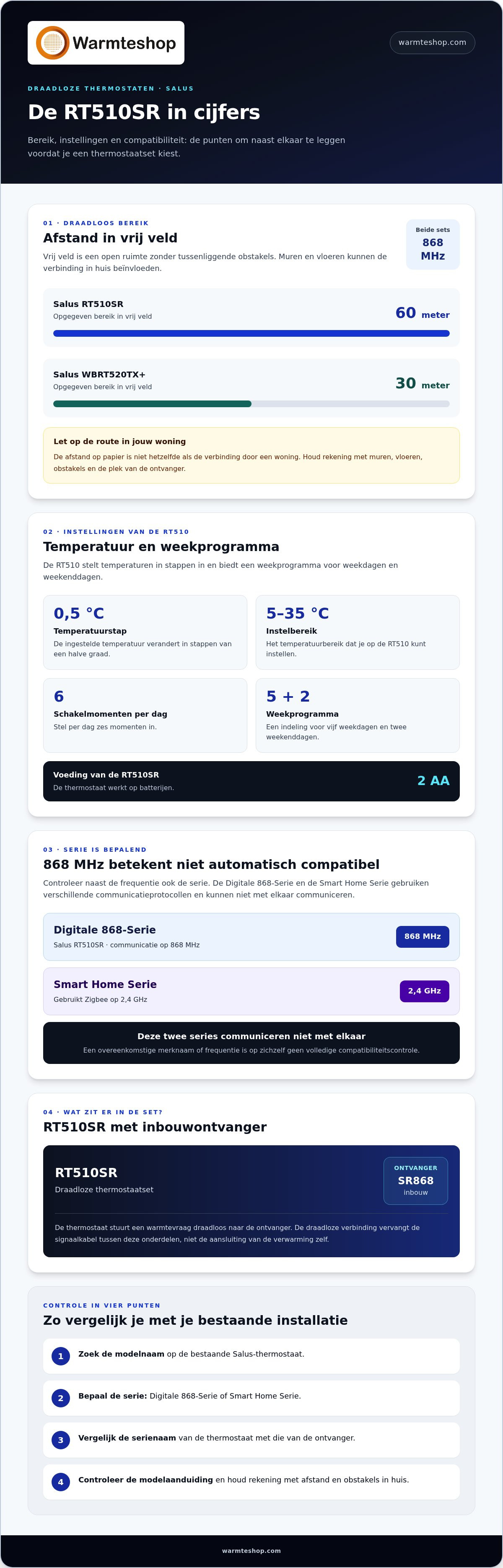
What features and specifications do wireless SALUS thermostats have? The RT510 sets temperatures in 0.5°C increments, with a range of 5°C to 35°C. You can set six switching times per day and choose a weekly program for five weekdays and two weekend days. The RT510SR communicates at 868 MHz.
868 MHz describes the radio frequency at which the thermostat sends signals to the receiver. The number itself does not indicate how far the connection reaches. To determine that, you must look at the range of the specific model and the conditions in your home. For wireless Salus thermostats operating on 868 MHz, the specified distances vary by set.
The Salus RT510SR has a wireless range of 60 meters in open field. The Salus WBRT520TX+ also operates at 868 MHz, with a range of up to 30 meters. Open field means an open space without intervening obstacles. A home contains walls and other barriers, meaning the actual connection may turn out differently than the maximum distance stated on paper.
Therefore, first check the possible route between the thermostat and the receiver. Pay attention to walls, floors, and the location where the receiver is mounted. A thermostat on one side of the house may have a different connection than one in the same room as the receiver. When making your comparison, also take into account the difference between 60 meters in open field and 30 meters for the WBRT520TX+.
In addition to range, operation and power supply play a role. The RT510SR runs on two AA batteries. The number of receivers you can pair varies by model. These features are model-specific, so compare the name on the thermostat set with the specifications you need. Check the available wireless thermostats if you want to compare models side by side.
How do you resolve connection problems between a SALUS thermostat and receiver? Start by checking the two AA batteries of the RT510SR and temporarily reduce the distance between the thermostat and receiver. Then check if any obstacles might be interfering with the connection and follow the pairing steps for your model.
A practical choice therefore begins with the model name and placement. Compare the stated range of the RT510SR and WBRT520TX+ with the route through your home. Next, select features such as temperature steps, a weekly program, and the number of receivers based on how you want to control the heating.
For a Salus thermostat set, check not only the frequency but also the series. The Digital 868 Series and the Smart Home Series use different communication protocols.
The Salus Digital 868 Series communicates at 868 MHz. The Smart Home Series uses Zigbee at 2.4 GHz. These two series cannot communicate with each other. This distinction is crucial when combining a thermostat and receiver, or when you want to expand an existing system. Therefore, look at the series name and model designation on both components, not just the Salus brand.
A matching frequency is an important indicator, but not a complete compatibility check in itself. Match the thermostat to a receiver from the same series. This prevents you from selecting a component that belongs to a different Salus ecosystem. For an existing installation, the name of the current series is the most convenient starting point for your comparison.
The Salus RT510SR thermostat set communicates at 868 MHz. This means the set belongs to the Digital 868 Series, not the Smart Home Series with Zigbee at 2.4 GHz. Use the full model name when comparing the set to an existing thermostat or receiver. The RT510SR designation helps you match the correct product information to the correct system.
Also note the difference between the thermostat and the receiver. A complete set indicates which components are offered together, whereas individual components must be evaluated separately. Therefore, compare the model names before using them together. The same brand name does not prove that two devices belong to the same series.
Use this sequence to practically test your choice:
These steps are particularly useful when replacing an existing system. A thermostat from the Smart Home Series is not compatible with a receiver from the Digital 868 Series, even though Salus is installed on both devices. Conversely, the same series selection applies when expanding a system: first determine which ecosystem is already present, and only then compare the desired thermostat.
The model name provides guidance, while the series determines which devices can communicate with each other. Keep these two pieces of information together when comparing product information. This allows you to distinguish between a set that operates at 868 MHz and a solution that fits your existing Salus system. View the wireless Salus thermostats and compare the model designations before making a choice.
With the Salus RT510SR, control is via a wireless connection between the thermostat and the receiver. The thermostat measures the temperature at its location and transmits a heat demand. The SR868 built-in receiver receives that signal and switches the connected heating on and off according to that demand. The radio connection therefore replaces the signal cable between the two components, not the connection of the heating itself.
That distinction helps with planning the installation. The thermostat determines when heat is needed; the receiver executes the switching command. One SR868 flush-mounted receiver is included with the RT510SR set. Therefore, you look not only at the location of the controls, but also at the location where the receiver controls the heating.
A wireless connection does not mean that all parts are freely interchangeable. The thermostat and receiver must function as a compatible combination. During installation, keep the model names RT510SR and SR868 together and follow the pairing steps for that set. The 868 MHz designation helps identify wireless operation but does not replace checking the model combination.
Wireless control is convenient if you want to place the thermostat in a usable location, independent of the receiver's position. Consider a thermostat in the living room and a receiver at the heating connection. The wireless connection transmits commands between these points. The power supply and mounting of the receiver are separate installation matters.
If the heating does not respond, proceed systematically:
This sequence helps distinguish between an operating problem and a wireless pairing problem. With the RT510SR, a dead battery can shut down the thermostat; incorrect pairing prevents the receiver from recognizing the command. Therefore, check the power supply and model combination first before changing the placement.
The wireless control itself does not replace a suitable electrical connection. The SR868 is a built-in receiver, intended to be part of the installation. Connect the mounting to the heating setup and keep the thermostat accessible for daily use. This keeps operation simple, while the receiver transmits the heat demand to the heating system.
When choosing between wireless Salus thermostats operating at 868 MHz, you therefore compare the thermostat, the accompanying receiver, and how you intend to use the set. The RT510SR is a concrete example of a set with an SR868 flush-mounted receiver. By evaluating these components as a single control system, you know what to look out for regarding operation and installation.
With a wireless Salus set, the thermostat and receiver are located in different places. You use the thermostat for control; the receiver switches the heating on and off. The RT510SR set includes one SR868 built-in receiver. Therefore, first determine where the heating will be connected and where you practically want to control the temperature.
The SR868 is designed for flush mounting and measures 4.4 × 4.4 cm. The receiver is 2.6 cm thick and has a connection voltage of 230 V. These dimensions provide a guideline for assessing the available installation space. When mounting, take into account the location of the connection and the space occupied by the receiver.
A built-in receiver requires a different placement choice than a plug-in receiver. The Salus SPE868 is a wireless plug-in receiver with a connection voltage of 230 V. The choice between these types depends on the available connection options and the desired setup. The RT510SR set is supplied with the SR868, not the SPE868.
Also pay attention to the switching capacity when combining the receiver with heating. The SR868 has a switching capacity of 16 A and can connect a maximum of 3600 W of heating. Compare that maximum with the power of the device you want to control. This will help you determine whether the receiver is suitable for the intended electrical load.
Choose the location of the thermostat with daily use in mind. Place it in an accessible spot where you can easily read and adjust the temperature, for example, centrally in the room you want to control. Also consider the distance and route to the receiver: walls and floors can affect the wireless connection.
Go through these points before choosing a final spot:
The receiver operates on 230 V, so the connection location is part of the installation plan. For connection and pairing, follow the instructions included with the Salus components. Distinguish between the electrical connection of the receiver and the wireless connection to the thermostat. These are two different parts of the setup.
Appropriate installation therefore begins with three concrete factors: the type of receiver, the available space, and the heating capacity. The RT510SR uses an SR868 built-in receiver; the SPE868 is a separate plug-in option. By aligning this choice with the existing connection location and daily usage, you can determine in advance which placement makes sense.
The Salus RT510SR set communicates at 868 MHz. The Salus WBRT520TX+ also operates on this radio frequency. If you are looking for a thermostat for the Digital 868 Series, these are two concrete models to compare. When doing so, do not only look at the frequency, but also at the range, settings, and the receiver included with the set.
The RT510SR comes with one SR868 flush-mount receiver. The RT510 can pair up to five receivers. These are different features: the first describes the contents of the RT510SR set, the second a capability of the RT510 thermostat. Therefore, check the full model name before attributing a feature to a set.
The temperature settings also differ. The RT510 has an adjustable range of 5 °C to 35 °C and operates in 0.5 °C increments. The WBRT520TX+ has an adjustable range of 5 °C to 32.5 °C. Compare these ranges with the temperatures you want to set at home, rather than relying solely on the frequency.
The programming options also differ. With the RT510, you set six switching times per day and choose a weekly schedule for five weekdays and two weekend days. The WBRT520TX+ is programmable for seven separate days. A custom daily schedule is suitable when your weekly rhythm varies from day to day; a weekday and weekend schedule aligns with a recurring pattern.
Use these points for a quick comparison:
For an existing Salus installation, also pay attention to the series. The Digital 868 Series communicates at 868 MHz; the Smart Home Series uses Zigbee at 2.4 GHz. These series do not communicate with each other. Therefore, a matching frequency alone does not automatically make a thermostat compatible with every Salus receiver.
Start your comparison with the model name on the thermostat and receiver. Then choose the programming layout and temperature settings that suit your usage. View the available wireless thermostats and compare the model designations with these features.
Warmteshop helps you explore infrared heating for your home. Consider an infrared mirror for the bathroom, infrared glass heating, or an infrared towel dryer. Which solution suits you depends on the room and how you want to experience warmth. A thermostat set and a heating product are different components of your choice. Match them to the setup you have in mind.
Infrared heating emits heat to people and surfaces, comparable to the pleasant radiation of the sun. This allows you to consider the desired comfort for each room and a design that suits your interior. View the Warmteshop range and contact us, or visit warmteshop.com to explore your options further.
Choosing a thermostat makes more sense when you also consider the warmth you want to experience in each room. Does the control system suit an infrared panel in your workspace, or are you looking for an infrared mirror for the bathroom? By considering the controls and heating solution together, you create a plan that fits your home and daily routines.
Warmteshop offers infrared heating, infrared panels, and infrared mirrors. This allows you to explore both the thermostat and potential heating solutions for various rooms. Would you like to look further into wireless Salus thermostats operating at 868 MHz? View the wireless thermostats and determine which control system suits your plans.
Do you have questions about the possibilities for your home? Contact Warmteshop. With a well-considered choice, you take a comfortable step forward.
The RT510SR is a practical choice if you are looking for a wireless thermostat with a built-in receiver. The set combines thermostat control with a receiver that is built into the system. This can be suitable if a separate plug-in receiver does not fit the desired setup. Beforehand, compare the model designation and the location of the receiver with your existing heating system.
The main difference is the wireless communication technology and the compatible product series. The Salus Digital 868 Series uses 868 MHz; the Smart Home Series operates with Zigbee at 2.4 GHz. These series do not communicate with each other. A higher or lower frequency does not in itself mean that a thermostat regulates better. Be sure to check whether the thermostat and receiver within the same series work together.
That depends on the connection and the switching load of the heating system, not just the frequency. The SR868 receiver has a connection voltage of 230 V and can switch a maximum of 3600 W of heating. Compare these specifications with the connection and power of your appliance. A boiler name alone does not determine compatibility; the type of control contact and the receiver are also important.
Start by identifying the thermostat and associated receiver, for example the RT510SR and SR868. Install the receiver according to the supplied mounting instructions and insert the correct batteries into the thermostat. Then follow the pairing steps specific to that model. Next, set a different temperature and check if the receiver responds. The exact operation may vary by model.
There is no single indoor range that applies to every home: walls and floors affect the wireless connection. As a reference, the RT510SR has a range of 60 meters in open field; for the WBRT520TX+, a range of up to 30 meters applies. Open field is not the same as a home with obstacles. The position of the thermostat and receiver also determines how the connection functions at home.
There is no universally best choice; compare the features to your usage. The RT510SR comes with an SR868 built-in receiver, while the WBRT520TX+ is programmable for individual days. Additionally, consider the temperature settings and how you intend to mount the receiver. Choose a Salus model based on those specific characteristics and take into account the series of your existing equipment.


