

Choosing ceramic hybrid panels for your space
, by Warmteshop, 16 min read
, by Warmteshop, 16 min read
Ceramic hybrid panels operate on electricity and combine convection heat with radiant heat. This radiation heats people and surfaces, while the combination of both forms of heat contributes to comfort…
Ceramic hybrid panels operate on electricity and combine convection heat with radiant heat. This radiation heats people and surfaces, while the combination of both forms of heat contributes to the comfort in the room. According to the power chart, a 395-watt panel is suitable for a heated surface of 8 m².
Your choice therefore depends not only on the number of square meters. Heat loss, insulation, and the use of the space also play a role. A panel suitable for a well-insulated room may be less suitable for a room with more heat loss.
In this article, you will read how ceramic hybrid panels emit heat, which power output suits different rooms, and what to look out for during installation and operation. This allows you to weigh the features and versions against your living situation: from the desired location on the wall or ceiling to the way you use the heating. This makes it easier to determine whether this form of electric heating meets your comfort preferences.
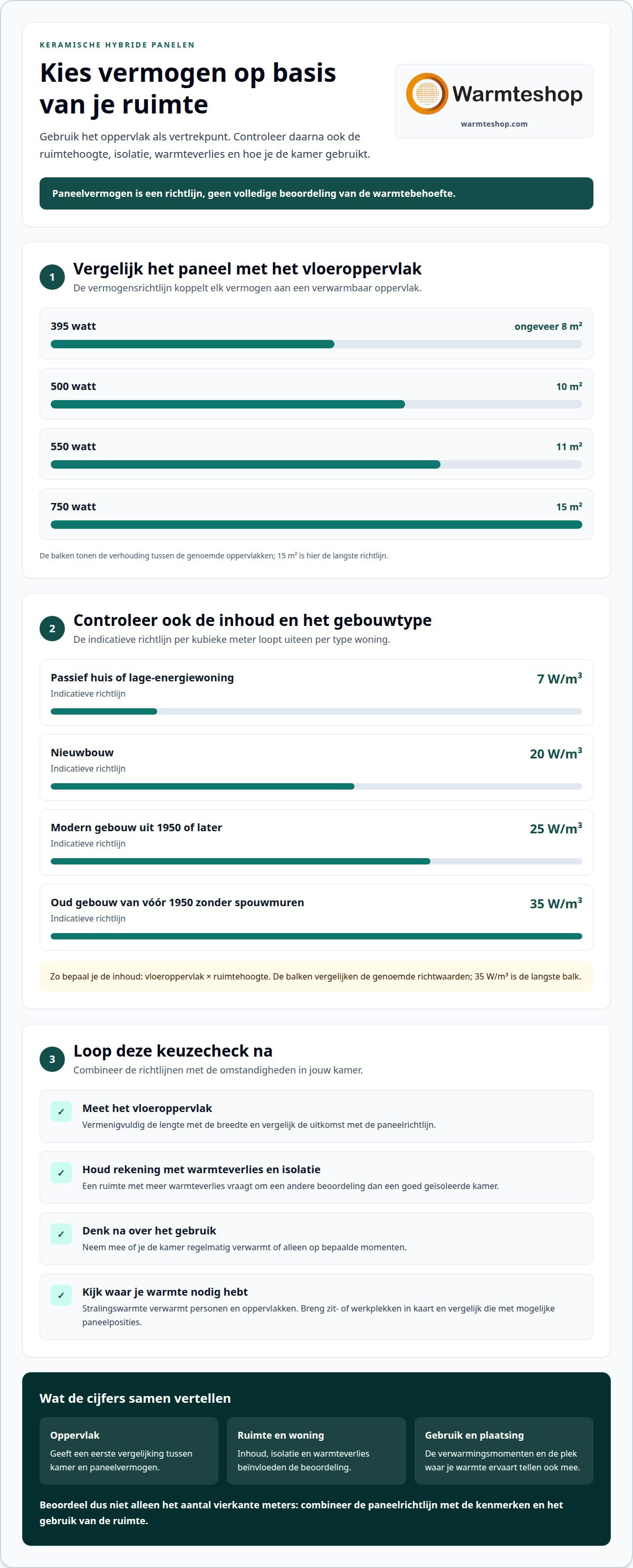
The panel power provides an initial guideline for the heatable surface area. According to the power chart, a 395-Watt panel heats approximately 8 m². A 500-Watt model is associated with 10 m². 550 Watts corresponds to 11 m². A 750-Watt panel is suitable for 15 m². These values help you compare different ceramic hybrid panels for your room.
Use the guideline as a starting point, not as the sole basis for your choice. The required power also depends on heat loss, insulation, and space usage. A room with significant heat loss requires a different assessment than a well-insulated room. It also matters whether you heat the room regularly or only at specific times. Therefore, consider both the surface area and the conditions within the room.
For an initial comparison, measure the length and width of the room. Multiply these measurements to determine the floor area. Then compare the result with the panel guideline. For example, a 10 m² room aligns with the 500-Watt guideline. Insulation and heat loss remain important factors in this regard. Therefore, the surface area alone does not tell the whole story.
The volume of a room can also help assess the required power. To do this, you multiply the floor area by the height of the room. The indicative table states 7 W/m³ for a passive house or low-energy home. For new construction, it states 20 W/m³. A modern building from 1950 or later is assigned 25 W/m³. For an old building from before 1950 without cavity walls, the table states 35 W/m³. These are guideline values per cubic meter.
Radiant heat focuses on people and surfaces, not just the air. Consider the heat that reaches a seating area or desk when the panel is properly aimed at it. The position therefore partly determines how you experience the heat in the room. Map out where you sit or work and compare those spots with possible panel positions. In this way, assess the output and the heated surface area in conjunction.
Finally, use the building type as an additional check. A passive house and an older building do not require the same indicative amount of power per cubic meter. Combine the table with the power schedule in Watts and the measured room area. This way, you base your choice on the characteristics of the room, not just on a single surface area measurement.
Ceramic hybrid panels combine convection heat with radiant heat. The radiation heats people and surfaces, while convection also releases heat into the air. The panel runs on electricity, so operating costs depend partly on the operating time and settings. Therefore, when making your choice, not only the material and design matter, but also the heating purpose and power output.
According to the product information, a ceramic panel has a warm-up time of 5-10 minutes. After being disconnected from the mains, it continues to emit heat for 30-50 minutes. This heat storage is practical when you switch off the panel, but it also means that the heat does not dissipate immediately. Keep this in mind when operating it and when choosing a location in the room.
The finish can match your interior. The catalogue lists grey marble as a panel colour. View the visible wall and the desired installation location before choosing a model. In this way, ceramic hybrid panels can be a functional heating choice that also fits the interior. Appearance does not replace an assessment of power output and heat demand.
In the Netherlands, any potential subsidy or tax scheme depends on the conditions and the chosen measure. Therefore, the panel type alone does not automatically determine whether you qualify. Take the characteristics of the home and the heating solution into account in your assessment.
The costs, including installation, depend on factors such as the number of panels, the chosen capacity, the mounting location, and any necessary modifications to the electrical connection. Request a breakdown of the panel, control system, and mounting so you can see which components determine the total investment. Ceramic hybrid panels vary in design and capacity. Therefore, a single general total price does not provide a reliable comparison.
Product datasheets state that a suitably chosen panel can save 30% to 60% on energy. Additionally, the annual monetary savings depend on usage duration, settings, and electricity tariff. Therefore, compare your current heating usage with the expected utilization of the panel. The stated percentage is not a fixed amount and says nothing in itself about your personal annual savings.
The product information states a lifespan of 30 years for ceramic infrared panels. A practical point to consider is the dependence on electricity: without power, the panel does not emit new heat. Furthermore, an incorrect power rating may not match the room's heating needs as well. Reliable suppliers provide insight into features, power output, and application, allowing you to compare models effectively.
When comparing, consider not only the appearance but also which output suits your room and how you use the space. Ceramic hybrid panels combine two forms of heat output, but the placement and operation partly determine how that heat is perceived. View the ceramic panel models and compare the features with your heating goal.
This means that, in addition to the choice of panel and power output, there is also an accessory to consider. When comparing versions, do not look solely at the purchase of the panel, but note any accessories separately. This ensures clarity regarding which amount corresponds to the panel and which to an additional choice.
According to the product description, you can hang a ceramic infrared panel on the wall within a few minutes. First, choose a location that suits the use of the room. A panel at a fixed workspace heats a different zone than a panel opposite the seating area. Also consider visibility and available wall space.
Read the instructions included with the panel before installation. Check how to mount and connect the panel. Keep the chosen location free of objects that could hinder heat dissipation. A logical installation therefore begins with three choices: the wall, the direction, and the location where you want to experience warmth.
In the Netherlands, any permits and building regulations depend on the building and the work being carried out. Simply hanging a panel is different from a structural modification or a change to the electrical connection. Therefore, first determine what work the chosen installation requires.
After being switched on, a ceramic panel has a warm-up time of 5-10 minutes. Keep this in mind when using the heating. For example, do not wait to switch on the panel until you expect immediate warmth. The warm-up time helps you align usage with your daily routine.
The panel runs on electricity. With a thermostat, you can adjust heating times to suit the room. However, Wi-Fi control does not guarantee lower electricity consumption. That depends partly on how long you heat and which settings you choose. Therefore, do not choose based solely on a smart control function.
According to the product information, a ceramic infrared panel continues to emit heat for 30-50 minutes after being disconnected from the mains. While the control unit does stop the power supply, the heat does not dissipate immediately. Keep this run-on time in mind when adjusting the temperature or switching off the panel.
After initial use, check whether the chosen location heats the intended zone. Assess the comfort after the run-in period and then adjust your settings. A panel at a desk, for example, requires different usage times than a panel in a seating area. By considering the mounting location and operation together, you tailor the heat to your daily routine.
The best location depends on what you do in the room. In a living room, it is often about the seating area; in a bedroom, about comfort around the bed; and in an office, about warmth at the desk. In a bathroom, the available wall space and the location are important. Ceramic hybrid panels combine two forms of heat output. Therefore, focus your choice on the zone where you want to experience warmth.
First, map out the fixed seating areas in the living room. A panel opposite the sofa heats a different zone than a panel next to the dining table. Consider which wall remains clear once the furniture is in place. Radiant heat reaches people and surfaces, so the direction of the panel also matters. In an open-plan living room, assess the seating area and dining area separately. This ensures the placement aligns with how you use the space.
Start in the bedroom by considering the times you use the room. If you often read in bed, look at the area around the bed. If you also use the room as a workspace, include the desk in your layout. Take into account the walking path and the visible wall. The placement should fit your daily setup, not just the floor plan. Therefore, note where the bed, the wardrobe, and your regular seating area are located.
In an office, the workspace is the starting point. First, place the desk and chair on the room layout. Then, consider which wall offers a logical position. A panel facing a different zone might not align as well with your workday. In a shared office, also consider the placement of colleagues. This allows you to see if a single heating point suits the use of the space.
In the bathroom, wall space and your daily routine are determining factors. Determine where you get dressed and where you stand after showering. Then, look for a spot that aligns with this. For installation, follow the panel instructions and take into account the layout around the sink and shower. These fixed elements often limit the available wall space. Therefore, finding a suitable location begins with a practical view of the entire room.
Compare the usage area, the free-mounting wall, and the desired heating zone for each room. A living room with a built-in sofa requires a different assessment than a home office with a desk. Note which activity is central and where you want to feel the warmth. This way, you evaluate ceramic hybrid panels per room, rather than as a single solution for the entire house. Ensure the final placement aligns with the layout and the installation instructions.
The power output is stated on the panel in Watts. This indicates how much electrical power the panel uses when heating, but not how much electricity you consume annually. The operating time and control system also play a role in this. Ceramic hybrid panels convert electricity into heat via radiation and convection. Your actual energy consumption therefore depends partly on how you use them.
For a simple consumption estimate, convert the power to kilowatts and multiply this by the heating hours. A 500-watt panel, for example, is 0.5 kilowatts. Multiply that by the time the panel heats. With multiple panels, add up the power ratings. This allows you to compare different usage schedules without assuming a fixed annual consumption.
Heat demand varies by home and room. Insulation, heat loss, building volume, and usage influence the required power. A workspace used daily requires a different heating schedule than a guest room. Therefore, use power tables as a starting point and compare the characteristics of your room with them. The location where you want to experience warmth also plays a role.
With thermostat control, you align heating times with your daily rhythm. If you work from home, for example, you can schedule the heating around the hours when you use your desk. Wi-Fi control does not automatically change this usage logic. It does not guarantee lower electricity consumption: the settings and heating duration remain the determining factors.
Product datasheets mention a potential energy saving of 30% to 60% with a well-chosen panel. That percentage is not a fixed annual result. Your savings depend, among other things, on previous heating usage, the chosen settings, and the electricity tariff. Therefore, it is best to compare ceramic hybrid panels based on your own usage situation, not just on a single stated savings percentage.
If you want to monitor consumption, note the panel power, the settings, and the times you heat. Change one setting at a time and compare periods when you use the room in a similar way. This way, you can see which adjustment affects consumption. Evaluate ceramic hybrid panels in this manner based on both heating comfort and power consumption, not just their maximum power.
View the panel models and compare the output with your heating goal. Discover the available panel models.
Warmteshop helps you choose a suitable solution for your space. Check which power output matches the usage, insulation, and desired heating zone. With an infrared panel, for example, you direct the heat to a seating area or workspace. An infrared mirror or infrared glass heater might be suitable if you also want to match the heating to the interior design.
Undecided between different models? Warmteshop offers expert personal advice, allowing you to calmly compare features and applications. This way, you choose a solution that suits your living comfort and how you use the space.
Contact Warmteshop or visit warmteshop.com.
A heating choice becomes stronger if you look not only at the panel but also at how you use the space daily. Consider fixed seating areas, work moments, and the atmosphere you want to maintain. This way, you connect the technology to your way of living and prevent the product choice from being detached from practical reality.
With ceramic hybrid panels, appearance, operation, and heat demand all play a role. Therefore, determine which location in the house takes priority and which type of operation you find convenient. Also consider changes in usage, such as a workspace being used from home more often or a room acquiring a different function. With these starting points, you can compare more effectively and make a choice that suits both your comfort and your interior.
Would you like to calmly compare the possible designs side by side? Discover the ceramic panel options and determine which direction suits your space. A well-considered choice starts with your daily comfort and brings you closer to a pleasant, future-proof way of heating.
A ceramic infrared panel uses electricity to emit heat. The radiation heats people and surfaces in the room. Consider a desk: the heat is intended for the workspace, not just the surrounding air. Ceramic retains heat even after being switched off. Keep this in mind when operating the panel and adjusting the temperature of your workspace.
The suitable panel depends on the room, the desired heating location, and the interior. For a desk, a wall panel might fit the available wall space. In a room with limited wall space, you might consider a ceiling-mounted version. First, determine where you want to experience warmth. Then, compare the panel output with the heating requirements and see which design suits the decor.
Ceramic hybrid panels combine radiant heat with convection heat. Radiation heats people and surfaces directly, while convection transfers heat to the air. Both forms therefore work alongside each other. Think of a reading nook: you feel the radiation on your seat, while convection heat warms the air in the room. The panel operates electrically and emits heat from the ceramic element.
For installation, follow the instructions for the chosen panel and determine in advance where you need heat. Check whether the mounting location suits the room layout and the desired heating zone. For maintenance, follow the manufacturer's cleaning and operating instructions. Periodically check the mounting, the visible condition, and the operation. This keeps installation and daily use organized.
Product datasheets state that a suitably chosen panel can save 30% to 60% energy. The annual monetary savings depend on the lifespan, settings, and electricity tariff.
A reliable provider makes the characteristics, capacity, and application clear. Compare that information with the heat demand and usage of your space.


