

Electric wall convector as primary or supplementary heating
, by Warmteshop, 17 min read
, by Warmteshop, 17 min read
An electric wall convector can serve as both primary and supplementary heating: the difference lies mainly in the output, insulation, and size of the room. With normal insulation and an average ceiling height of…
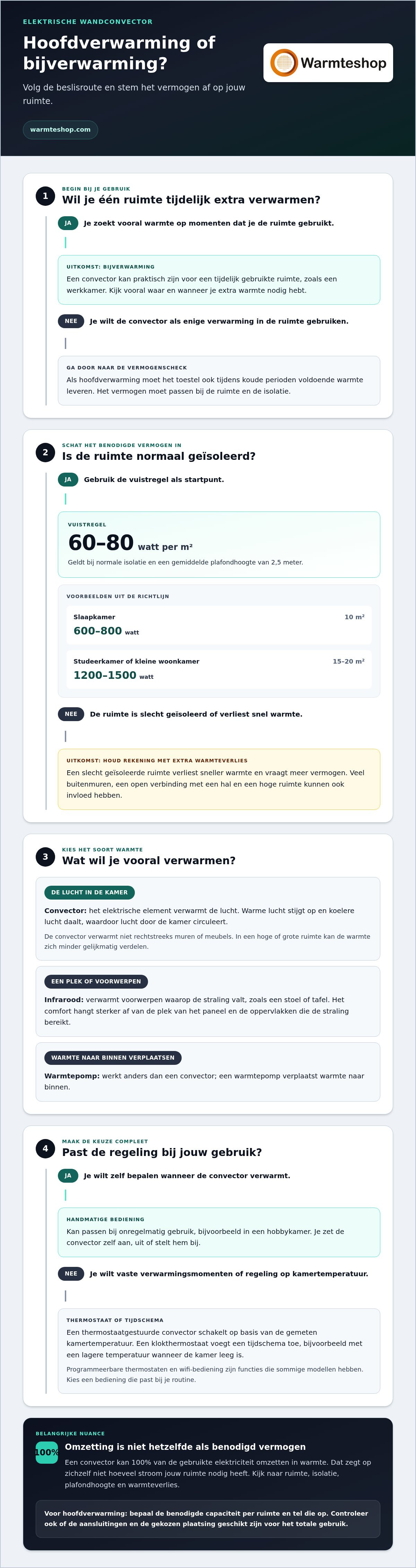
An electric wall convector can serve as both primary and supplementary heating: the difference lies mainly in the output, insulation, and size of the room. With standard insulation and an average ceiling height of 2.5 meters, a rule of thumb of 60 to 80 watts per square meter applies. The convector heats the air, which then circulates through the room.
If you want quick heat in a single room, supplementary heating is often practical. If you use a convector as your sole heating source, the output must match the room and insulation. This prevents the room from heating up insufficiently or using more power than necessary.
In this article, you will read how convection heating works, how to estimate the required power, and what to look out for regarding installation and consumption. You will also discover when electric heating can be an alternative to central heating and when another form of heating is better suited to your living space.
An electric convector can serve as primary heating when the output matches the room and insulation. Unlike infrared, a convector primarily heats the air. A heat pump transfers heat, rather than converting electricity directly into heat.
As supplementary heating, a convector is useful for a room you use temporarily, such as a home office. As primary heating, the unit must provide sufficient heat even during cold periods. Therefore, consider the surface area, insulation, and ceiling height, not just the appearance. A wall-mounted model keeps the floor clear.
For standard insulation and an average ceiling height of 2.5 meters, a rule of thumb of 60 to 80 watts per square meter applies. A 10 m² bedroom therefore requires approximately 600 to 800 watts. This is a guideline for those circumstances, not a universal measure. A poorly insulated room loses heat faster and requires more power.
The operation is simple: an electric element heats the air inside the convector. This warm air rises, while cooler air descends and is heated again by the device. This creates air circulation throughout the room. The convector therefore does not directly heat walls or furniture, but brings the room air up to temperature.
Calculate the required capacity for primary heating per room and add them up. Then check whether the connections and the chosen placement are suitable for the total usage. In a small, well-insulated room, one unit may suffice. A large or high room requires extra attention to ensure even heat distribution.
An electric convector heats air and circulates it through the room. Infrared heating heats objects onto which the radiation falls, such as a chair or table. As a result, the heat feels different: convection primarily heats the room air, whereas infrared heat can be directed locally onto people and objects.
An advantage of convection is that the air in an enclosed room gradually becomes warmer. The heat cannot distribute as evenly in a high or large space. With infrared, comfort depends more strongly on the location of the panel and the surfaces the radiation reaches. A heat pump works differently: it moves heat indoors.
To choose between these systems, first determine what you want to heat: the air in the entire room, a specific spot, or the home as a whole. Consider, for example, a bedroom you use briefly versus a living room where you spend a long time. A convector can convert 100% of the electricity used into heat; however, that in itself does not indicate how much power the room requires.
An electric wall convector is particularly suitable if you are looking for forced-air heating and match the output to the room. For primary heating, insulation and heat loss are important factors. For supplementary heating, what matters most is where and when you need extra heat. Therefore, choose the technology based on usage, not just on the unit's output.
The required power depends on the room, the insulation, and the ceiling height. As a rule of thumb, a study or small living room of 15 to 20 m² requires approximately 1,200 to 1,500 watts. This is based on an average ceiling height of 2.5 meters. Use this as a starting point and then tailor your choice to the heat loss of your room.
A room with many exterior walls or limited insulation loses heat more quickly, while a well-insulated room retains heat longer. The layout also plays a role: an open connection to a hallway can require extra heat. Therefore, do not look solely at the floor area. Also determine which parts of the room you want to heat and how often you use the convector.
A thermostat helps maintain the temperature around the set value. Without a thermostat, you have to switch the heating on and off or adjust it yourself. A thermostat-controlled convector switches on based on the measured room temperature. This prevents the unit from continuing to heat unnecessarily when the room is already comfortable.
With manual control, you decide yourself when the convector is on. This can be useful in a room you use irregularly, such as a hobby room. A programmable thermostat adds a schedule. For example, you can set a lower temperature when the room is empty and schedule heating for the times when you do use the room.
Modern convection heaters often feature a programmable thermostat or Wi-Fi control. With programmable control, you set heating times in advance. Wi-Fi control allows you to adjust settings via a connected application, on models with this feature. This way, you don't have to walk to the unit. Choose a control system that suits your daily routine.
A remote control works within the range of the device. Wi-Fi control works via a network and allows for operation from another location. These are different functions. Choose based on where you want to control the temperature, how simple the operation needs to be, and whether you want to use fixed schedules.
A higher capacity is not automatically the best choice. A device that does not suit the room can make temperature control less pleasant. Therefore, compare the output with the room size and insulation, and then look at the controls and thermostat. For more precise control, you can also consider a wireless thermostat that suits your heating setup.
An electric convector generally works well under a window or along an exterior wall. This way, the heat is directed to a spot where cold air enters the room. When choosing the location, also take into account furniture, curtains, and available wall space.
Safety and maintenance require attention during installation. The surface of an electric convector can reach 70 to 80 degrees, so touching it can be uncomfortable or painful. Switch off the unit and allow it to cool down before cleaning. For cleaning and installation, follow the manual for the selected model.
First, measure the available wall width and check where pipes or furniture are located. A convection heater under a bedroom window can capture the cold airflow at the window. Position the unit so that a bed, wardrobe, or long curtain does not block the airflow. Free airflow helps distribute the heat throughout the room.
In the bathroom, moisture and distance to the bath or shower play a role. In bathroom zone 3, starting from 60 centimeters next to the bath or shower cabin, a minimum IP rating of 21 applies to an electric convector. When choosing a model, check whether the indicated IP rating matches the intended location. A suitable rating alone does not indicate where in the bathroom you can place the unit.
Electric radiators are available as wall-mounted and portable models. Wall mounting keeps the floor clear and gives the unit a fixed place. A portable model can be moved between rooms, for example from the living room to a bedroom. So, first determine whether you want fixed heating or supplementary heating that you use in different locations.
A wall-mounted model must be installed in a sturdy, suitable location. Follow the model's installation instructions and take existing power outlets into account. An electric convector can be used in a location with a power outlet. Before installation, also check whether the position is suitable for the purpose, such as heating along an exterior wall, under a window, or in a fixed spot in the room.
Maintenance doesn't have to be a complicated task. Only clean the unit when it is switched off and cooled down. Remove dust from accessible surfaces according to the manual and then check that the air vents remain clear. With a freestanding model, you can also check the area around the unit when you move it. This ensures that placement, air circulation, and usage remain aligned.
The consumption depends on the power output and how long the heater runs. A 2000-watt electric heater consumes 2 kilowatt-hours per hour at full power. This calculation example shows the consumption when the appliance runs continuously at full power.
Calculate a usage example by converting the power to kilowatts and multiplying it by the operating time. In practice, a thermostat switches off the heating element as soon as the set temperature is reached. Consequently, the actual operating time at full power can vary.
The thermostat influences how much heat the heater emits and how long it consumes power. Without a thermostat, you have to switch the appliance off or adjust it yourself. With thermostat control, the heating adjusts to the measured temperature. As a result, a thermostat-controlled convection heater can be more economical than a model without a thermostat.
First, set the desired room temperature and then check if the room remains comfortable during use. Warm air rises, which means the temperature near the appliance may feel different than elsewhere in the room. Take the location of the thermostat into account and ensure that furniture does not block the airflow around the heater.
Insulation also determines how often the electric heater needs to reheat. In a well-insulated room, heat is retained longer. A room with high heat loss cools down faster, causing the appliance to switch on more frequently. Therefore, compare not only the power output, but also the usage pattern, the set temperature, and the conditions in the room.
A thermostat is not the same as a timer. The thermostat responds to temperature; a programmable thermostat, on the other hand, follows a set schedule. For example, set a lower temperature during hours when you are not using the room. With Wi-Fi control, you can adjust settings via a connected application, if the chosen model has that capability.
Monitor your usage using meter readings or a consumption measurement. Note the set power, duration of use, and temperature setting. Compare, for example, workdays with days when the room is occupied for longer. This way, you will discover which settings suit your routine. Appropriate thermostat control limits unnecessary heating without losing sight of the desired warmth.
Electric heating can replace central heating in a home where you heat rooms specifically. An electric convector provides heat as soon as it is switched on and operates wherever it has a power outlet. This makes it practical for a smaller living room, home office, or bedroom. If you heat the entire home continuously, the required capacity and power consumption are important considerations.
Start with an overview of your rooms and when you use them. Note which room requires heat daily and which you only use occasionally. A study you use during the day, for example, requires different controls than a bedroom that needs to be warm mainly in the evening. This way, you can determine whether room-by-room heating fits your routine.
A convector heats air: warm air rises, after which cooler air descends and is heated again. In this way, the heat spreads throughout the room. An electric heater can provide heat immediately during use and emits no harmful emissions or gases. Electric heating is therefore locally emission-free during use, but that in itself says nothing about the origin of the electricity.
Suitability depends heavily on the room. Electric convectors are particularly suitable for smaller rooms with a standard ceiling height. In high or very large rooms, the temperature difference between upstairs and downstairs can become too great. A large living room with an open staircase therefore requires extra attention to heat distribution. Do not only consider the floor area, but also the height, insulation, and open connections.
Next, make a choice for each room. For example, you can use a convector as primary heating in a suitable room and only heat other rooms when they are occupied. This differs from a single central system that distributes heat throughout the entire house. Keep in mind that every device consumes electricity when heating. The operating time and temperature setting partly determine how much electricity is required.
Electric heaters generally require less maintenance than other heating systems. They do not burn fuel during use and can emit heat quickly. Nevertheless, you must tailor the placement and controls to the room. A thermostat helps control the temperature; a fixed schedule can limit heating to the times when you are using the room.
Electric heating makes particular sense when you can determine where and when heat is needed in each room. For smaller rooms, a convector offers an immediate solution. In high, large, or open spaces, air circulation is a significant limitation. Therefore, first assess the home, daily usage, and insulation. Then, compare the required heat with the desired comfort and your heating pattern.
Warmteshop helps you choose a heating method that suits your space and usage. A convector primarily heats the air, while infrared heating emits radiant heat to people and objects, similar to the warmth of the sun. This can be pleasant when you want targeted heat in a fixed spot.
The range includes infrared mirrors for the bathroom, infrared glass heating, and infrared towel dryers, among other things. This allows you to tailor the heat source to the function of the room, rather than applying the same solution everywhere. Consider in advance where you want to feel warmth and how you use the room.
Would you like to compare convection heating with infrared heating for your situation? Contact Warmteshop to discuss your choice.
The right heating suits not only the room but also how you use it. Think ahead: is the function of a room changing, do you work from home more often, or do you prefer heat in one fixed spot? These questions help you choose between an electric wall convector and targeted radiant heat.
In addition to electric convectors, Warmteshop also offers infrared heating, infrared panels, and infrared mirrors. This allows you to compare solutions based on your desired level of warmth and the location where you need heat. The goal is a comfortable home that fits into your daily life, without unnecessarily complicated choices.
Would you like to view a convector model that suits your space? Browse the electric convectors and discover which model aligns with your heating plan. Take the first step today towards warmth that fits your home perfectly.
A convection heater heats the air using an electric heating element. The air moves through the room, thus distributing the heat. Keep the air vents clear: a chair or curtain in front of them can obstruct the airflow. In a narrow room, the position of the appliance can noticeably determine how evenly the heat feels. Therefore, choose a spot where the air can circulate freely.
This is only possible in a location compatible with the moisture load and the IP rating of the device. In bathroom zone 3, starting 60 centimeters from the bath or shower cabin, a minimum IP rating of 21 applies. First determine the position relative to the bath and shower, and then check the indication on the model. Placement in a different location requires a separate assessment of the circumstances.
Consumption depends on the power setting and the time the heating element is active. The costs also depend on your electricity tariff. For a practical test, note the meter reading before using the heater and again afterwards. Compare the readings at a similar temperature setting and usage time. This will give you insight into your home consumption, without only looking at the maximum power.
First, determine where you want to use the convector and whether it will have a fixed spot. A wall-mounted model saves floor space; a portable model can be moved to another room. Next, compare the output to the room and consider the insulation. Also look at the controls: a thermostat regulates the temperature, while a programmable control system can schedule heating times.
A convector heats the air primarily via convection. A traditional radiator emits heat via radiation and convection. As a result, the heat can feel different, even if both devices heat the same room. When making your choice, consider the desired heat distribution and the available space. A radiator is often in a fixed position; an electric convector is also available as a portable model.
No, suitability depends on the home and the individual rooms. A convector is particularly suitable for smaller rooms with a standard ceiling height. In a high or very large room, the heat may not distribute as comfortably. Therefore, assess the insulation, height, and open connections for each room. A compact, enclosed study requires a different assessment than a living room with an open staircase.
An electric wall convector is a convection heater that is mounted to the wall. Fixed mounting keeps the floor clear and provides the unit with a fixed place for heating. Before installation, check the available wall space, the position of the power outlet, and the air circulation around the unit. Follow the installation instructions for the chosen model so that the placement matches the structure and the intended heat distribution.
You can choose between wall-mounted and portable models. The controls also differ: some units have a thermostat or programmable controls, and some models offer Wi-Fi control. A version with a fan can actively move the air, but it makes noise. So, don't just compare the appearance. Also consider whether you want to move the unit, need a schedule, or prefer simple manual operation.


