

Investing in infrared heating: subsidies and return
, by Warmteshop, 17 min read
, by Warmteshop, 17 min read
No national subsidy for private individuals: in the Netherlands, there was none for infrared heating in 2025. Nevertheless, investing in infrared heating can be attractive, even without a net metering system. The return han…
No national subsidy for private individuals: in the Netherlands, there was none for infrared heating in 2025. Nevertheless, investing in infrared heating can be worthwhile, even without a net metering system. The return depends, among other things, on how much electricity the panels use and what portion of that you utilize yourself.
It is logical that you want to know in advance what the investment means for your energy costs and comfort. For entrepreneurs, the Energy Investment Deduction may play a role in 2026: according to the Netherlands Enterprise Agency, 40% of taxable profit may be deducted, provided the conditions are met. That scheme is slightly different from a subsidy for private individuals.
In this article, you will read how subsidies and tax deductions relate to each other, what electricity consumption without a net metering system means, and how to estimate the required panel capacity. This provides a clear starting point for determining whether investing in infrared heating suits your space, energy consumption, and heating method.
In 2025, there was no national subsidy for infrared heating for private individuals in the Netherlands. This does not mean that every possibility is lacking: local incentives for sustainable energy can vary. Therefore, first look at the distinction between a subsidy for households and a tax scheme for entrepreneurs. These schemes have different conditions and do not automatically apply to the same investment.
The Energy Investment Allowance (EIA) is a tax scheme for entrepreneurs, not a general subsidy for private homes. According to the Netherlands Enterprise Agency, the EIA allows for a deduction of 40% of taxable profit in 2026. The scheme therefore reduces the taxable profit on which tax is calculated; it is not a payout of 40% of the purchase price. For households making private investments, this benefit does not apply in the same way.
For infrared panels, the application and the room are also important. According to the described EIA conditions, the panels must heat indoor spaces locally, with an average height of more than 4 meters. A system that heats an entire room does not meet the stated EIA code under those conditions. This distinction makes the function of the panel more important than just the chosen power output or the installation location.
For a business EIA application, in addition to the purchase costs of heaters, labor costs and necessary installation materials can also be included. Think of assembly work and materials for the electrical connection. Keep these items separate in your records from maintenance and other work. This ensures clarity regarding which expenses are directly related to the installation and which costs arise later.
A panel can be mounted on the wall or ceiling. Installation typically does not require major renovations; cable trays can keep wires out of sight, or you can integrate wiring into walls or floors. The chosen location influences thermal comfort: a panel above a desk, for example, directs the radiant heat towards that workspace. Also, explore the options for infrared heating for different rooms.
The mounting height requires attention. For ceilings higher than 3 meters, the aforementioned placement guideline advises hanging the panel lower. An unfavorable position can cause shadows and reduce the heating effect. Additionally, for the EIA, a separate limit of more than 4 meters on average applies to the heated indoor space. These two heights therefore describe different matters: mounting advice and control requirement.
In addition to installation, include maintenance and depreciation in your calculation. Infrared panels are generally low-maintenance and long-lasting, but installation, potential repairs, and replacement remain cost items to be taken into account. Depreciation spreads a business investment over the useful life for accounting purposes; the precise treatment depends on the administration and application. For private use, the total expenditure over the usage period is particularly relevant.
With a flexible setup, you can heat specifically and limit unnecessary use. For example, a panel above a seating area heats that zone, while mounting it on another wall can serve a larger part of the room. The best infrared solution depends on the room, the installation location, and the purpose. Compare these practical choices with any potential tax conditions before investing or factoring in subsidies.
Subsidies and panel capacity answer different questions. A scheme determines whether an investment qualifies for support; the capacity determines how much heat a panel can deliver. Therefore, start with the intended use: do you want to comfortably heat a single workspace, or does the heating need to support a larger room? A panel that does not match the heat demand does not automatically provide an efficient solution.
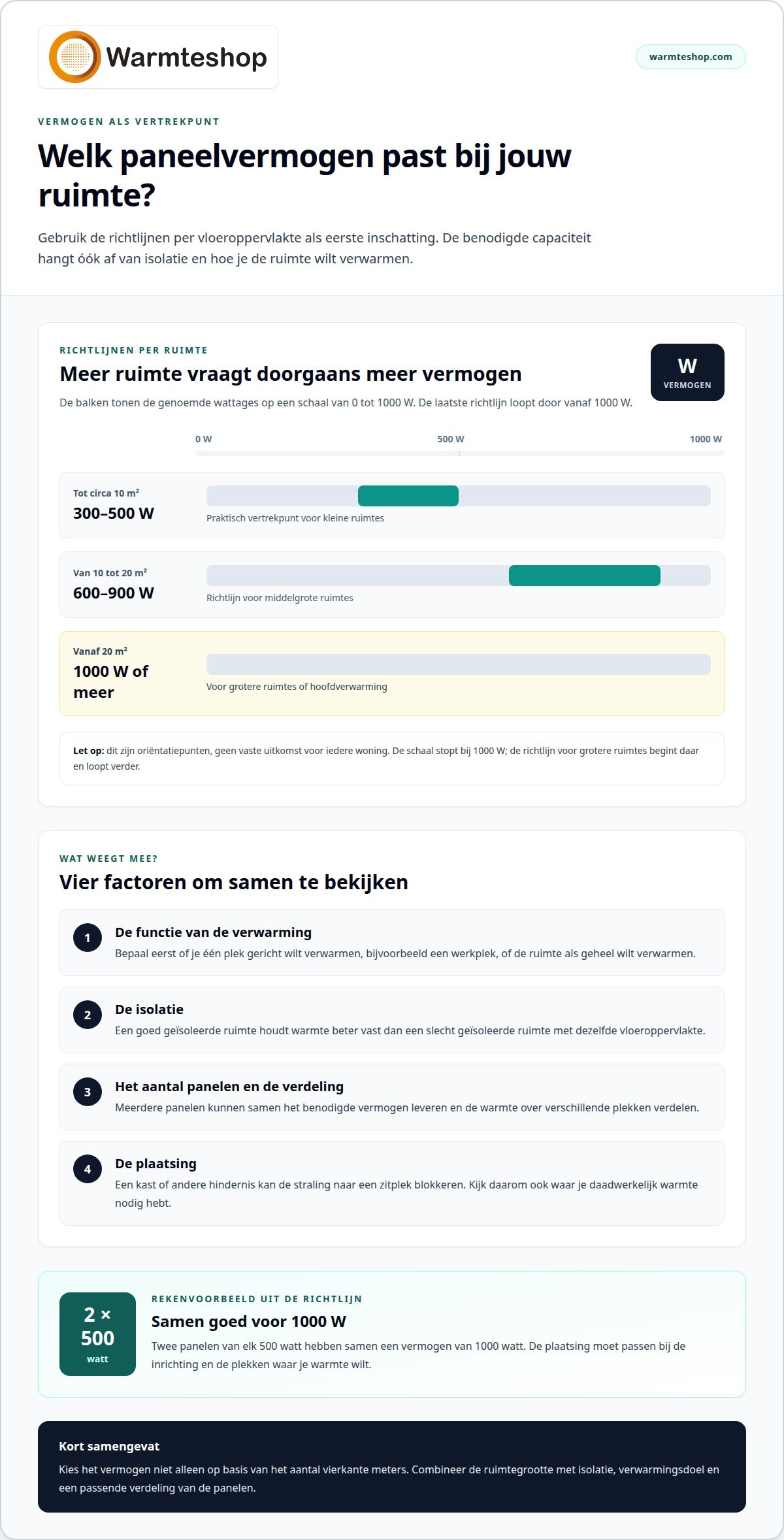
As a guideline, panels of 300 to 500 watts are suitable for small rooms up to approximately 10 m². For medium-sized rooms of 10 to 20 m², panels of 600 to 900 watts are often mentioned. From 1000 watts upwards, larger rooms or primary heating in rooms of 20 m² or larger come into play. These are reference points, not a fixed outcome for every home.
Insulation affects the required capacity. A well-insulated room retains heat better than a poorly insulated room with the same floor area. It also makes a difference whether you want targeted heat at a desk or want to heat the room as a whole. First determine the function, and then look at the combination of power and number of panels.
Multiple panels can together provide the required power. For example, two panels of 500 watts each have a combined output of 1,000 watts. This allows for distributing heat across different areas, but the placement must suit the interior design. A cabinet or other obstacle can block the radiation to a seating area. Therefore, do not look solely at the total wattage, but also at the places where you need heat.
The purchase costs depend on the chosen type, the number of panels, and the installation. A setup with multiple smaller panels differs in composition from a single, more powerful panel. Therefore, compare the costs of the complete solution, including the necessary installation materials, and not just the price per panel. This way, you can see which investment suits your space, without using output as the sole criterion.
Insufficient power can make the desired temperature unattainable if the heating remains on for a long time. Conversely, choosing too much power does not automatically make targeted spot heating more comfortable. Let the room, insulation, and intended use determine the sizing together. With a thermostat, you adjust the heating to the moment of use; for this, also view thermostats for infrared heating.
A practical rule of thumb for conventional infrared panels is 60 to 80 watts per square meter. For a 10 m² room, this amounts to approximately 600 to 800 watts in total. This is a starting point, not a fixed power requirement for every situation. The degree of insulation plays a role: a well-insulated room generally requires less power than a comparable, poorly insulated room. Therefore, anyone wishing to invest in infrared heating should start with the characteristics of the room.
First, determine which area you want to heat. For targeted supplementary heating, a panel can heat a desk or seating area, for example, without the entire room being heated in the same way. If the panels are to provide primary heating, the entire room counts. Ceiling height, windows, and the layout also influence how the heat is perceived. Therefore, the required wattage does not tell the whole story.
The power output determines the electricity consumption as long as a panel is switched on. A 500-watt panel that runs for 8 hours daily consumes 4 kWh per day. The actual operating time depends on the set temperature and how often the thermostat switches the panel on.
You can also calculate consumption with a shorter usage period. A 1500-watt panel switched on for 2 hours uses 3 kWh. The calculation is: power in kilowatts multiplied by operating hours. Multiply the result by your electricity rate to estimate the operating costs.
With multiple panels, you add up the power outputs. A total capacity of 1000 watts consumes 1 kWh during one hour of continuous heating. This example shows why the number of hours switched on is just as important as the total wattage. Therefore, before investing in infrared heating, you should map out both the power output and the operating time.
The position influences where the radiant heat lands. Place a panel so that furniture or other obstacles do not shield the desired heating zone. A thermostat helps regulate the temperature and prevents the panel from continuing to heat unnecessarily after the set temperature has been reached. With infrared heating, the thermostat can be set 2 to 3 degrees lower according to the described guideline. This way, you evaluate power, placement, and temperature control together, rather than choosing based solely on wattage.
An infrared system heats people and objects directly with radiant heat, instead of first heating all the air in a room. Compare it to sunbeams on your skin: you feel warmth where the radiation reaches you. A panel converts electricity into heat and releases it into the surroundings. As soon as the radiation falls on a person, floor, or piece of furniture, that spot becomes warm. The air can then heat up indirectly, but is not the primary target.
That direct effect makes infrared heating suitable for targeted heat. For example, a panel above a desk can heat the workspace, while other zones receive less heat. According to the described guideline, the radiation is perceptible up to a distance of approximately 3 meters. The precise experience depends on where you are sitting and any obstacles. A cabinet between the panel and the seating area can block the radiation. Therefore, not only the power output but also the direction requires attention.
After being switched on, infrared panels emit a palpable warm glow within a few seconds. This does not mean that every room is immediately at full temperature. A panel heats a specific area rather than the entire room automatically. For a comfortable workspace, this direct heat may be sufficient. If you want to heat an entire room, insulation, panel capacity, and placement also play a role. The heating must reach the areas where you need heat.
Infrared panels run on electricity and can therefore function without fossil fuels. The impact on the environment depends partly on the electricity you use. A thermostat regulates when the system emits heat. If the panel has a built-in thermostat, the heating switches off automatically as soon as the set temperature is reached. This allows you to tailor the operation to the use of the room, without having to constantly leave the panel on manually.
Infrared heating is primarily intended to heat people and objects directly, not to generate air currents. As a result, fewer dust particles, allergens, and germs are dispersed by moving air. This differs from heating that generates air currents. It does not mean that dust or allergens disappear: they can still be present on surfaces. The heat focuses primarily on people and objects, not on moving or purifying the air.
Infrared heating can also be used as supplementary heating in a bathroom. For example, a panel can provide extra comfort in the area where you dry yourself after showering. Tailor the installation to the desired zone and the electrical connection. According to technical advisors, infrared is primarily an alternative for primary heating in a very well-insulated house. In a less well-insulated home, targeted supplementary heating may therefore be more suitable than replacing the entire heating system.
The payback period for infrared heating is often estimated at 4 to 8 years. View this period as a guideline, not as a fixed outcome for every home. The calculation compares the investment with the savings on heating costs. These savings only occur when infrared heating actually replaces another part of your heating consumption. Therefore, use as an additional heat source results in a different calculation than use as primary heating.
The calculation starts with three components: purchase and installation, power consumption, and the eliminated heating costs. First, note how much power you need and how long the panels will heat. Next, calculate the power consumption in kilowatt-hours. Compare these operating costs to the costs of the heating system you are replacing. The difference represents the annual savings on which you base the payback period.
A calculation example makes electricity consumption concrete. That amount applies to the mentioned usage example, not automatically to every panel. Consumption depends on the power output and the number of operating hours. Fewer operating hours lower electricity costs, but can also mean that you replace fewer heating units.
A different electricity tariff changes the calculation immediately. For the same consumption, a higher rate leads to higher operating costs. Therefore, calculate based on your own rate and usage pattern. A national average can serve as a point of comparison, but it does not replace your personal energy bill.
The purchase and installation constitute the starting amount. The initial costs of infrared heating can be higher than those of traditional heating systems. Divide the investment by the annual savings to calculate a simple payback period. For example, if the investment is large and the annual savings are limited, it will take longer to recoup the expenses. Lower operating costs therefore do not tell the whole financial story.
Also consider whether you are using the panels for primary or supplementary heating. For targeted supplementary heating, the number of heating hours replaced is what matters most. For primary heating, the required capacity and total consumption play a more significant role. A thermostat helps to adjust usage to the desired temperature. Savings are greater when the control system prevents panels from heating once the room is already comfortable.
Make your comparison over the same period and use the same cost categories. Compare the installation expense against the annual savings and include electricity consumption. This prevents the conclusion from being determined solely by the purchase or solely by usage. If you want to explore the possibilities for your heating situation, discover infrared heating and compare suitable solutions.
Warmteshop helps you tailor infrared heating to the space and intended use. For workshops or other large spaces, industrial infrared heaters offer a targeted solution. They provide radiant heat to people and objects in the areas where comfort is needed. For a home, an infrared panel might be suitable for a workspace or seating area. The right choice depends on the space, insulation, and whether you are looking for primary or supplementary heating.
Have you calculated the required power and consumption, but are still unsure about the application? Warmteshop offers infrared heating and infrared mirrors for various usage situations. Discuss your space and heating needs with Warmteshop.
A good next step is to determine which room can improve your living comfort the most. Think about the place where you often sit, work, or relax. Start from your daily use, not just from a product or calculation. Note down what you want to make comfortable and what role electric heating will play in that. This will make any future expansion more manageable.
If you want to invest in infrared heating, also consider the flexibility of the solution. Warmteshop offers infrared heating, infrared panels, and infrared mirrors, among other things. Which type suits you depends on the space and the desired use. With a clear picture of your situation, you can make a targeted choice that aligns with your home and comfort preferences.
Would you like to discuss your heating needs and explore the possibilities? Contact Warmteshop. With a clear starting point, you take a well-considered step towards heating that suits your home.
Infrared heating uses electricity to emit heat to people and surfaces. You notice the heat primarily where the radiation reaches your body or objects, similar to the warmth of the sun. This makes this type of heating suitable for comfort in a specific location, such as next to a desk. When making your choice, also consider the power source and how you want to control the heating.
An infrared heating element emits radiant heat as soon as it is switched on electrically. Infrared heating is available as a wall or ceiling panel, an infrared mirror, and infrared floor heating, among other options. The versions differ in shape and application. A mirror combines heat with a mirrored surface; a panel can heat a selected zone. Choose based on the available mounting location and the function of the room.
The total investment consists of the chosen heating system, any controls, and installation. The amount varies by type, required capacity, number of elements, and installation work. A standalone panel solution requires a different configuration than heating for multiple rooms. Also include any installation materials and labor costs in your comparison. This way, you assess the entire installation, not just the purchase of the heating element.
Calculate the consumption by multiplying the power in kilowatts by the operating hours. A 500-watt panel operating for 5 hours a day for 200 days consumes 500 kWh per year. Multiply that consumption by your own electricity rate for the annual energy costs. If you have multiple panels, add up their consumption. A thermostat helps adjust usage to the desired temperature.
According to technical advisors, infrared is particularly suitable as primary heating for a very well-insulated home. In other situations, targeted supplementary heating might be a better fit, for example at a desk, seating area, or bathroom. Consider where you need heat in each room and which part you want to heat. For instance, a panel above a fixed workspace serves a different purpose than a system for multiple living spaces.
Start with the intended use and layout of the room. Take insulation, ceiling height, and areas where you spend time into account when making your choice. Position the panel so that furniture does not block the radiation to the desired zone. For a larger surface area, you can distribute the power across multiple panels. The right combination therefore depends not only on the floor area but also on the placement and heat demand.
For private individuals in the Netherlands, there was no national subsidy for infrared heating in 2025. For entrepreneurs, the Energy Investment Allowance in 2026 permits the deduction of 40% of taxable profit, according to the Netherlands Enterprise Agency and subject to the scheme conditions. This is a tax deduction, not a payout of part of the purchase price. Include VAT as a separate item in your investment calculation and distinguish it from the subsidy or tax deduction.
Infrared heats people and objects directly and can therefore provide targeted comfort, for example above a desk or seating area. Operating costs depend on the power output, operating hours, and your electricity tariff. Initial costs may be higher than with traditional heating systems.


