
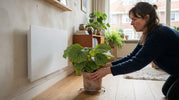
Influence of infrared heat on houseplants: heat and dehydration
, by Warmteshop, 17 min read
, by Warmteshop, 17 min read
Infrared heat heats surfaces and objects first, not the air. The influence of infrared heat on houseplants therefore depends primarily on how much heat the leaves and potting soil receive, the humidity, and…
Infrared heat heats surfaces and objects first, not the air. The influence of infrared heat on houseplants therefore depends primarily on how much heat the leaves and potting soil receive, the humidity, and the location. Excessive light, a high plant temperature, and dry air can combined disrupt photosynthesis and ultimately cause damage.
It is logical to wonder whether an infrared panel dries out plants. Infrared heating does not dry out the air in the same way as heating that blows warm air through the room. However, plants can lose moisture if they are kept too warm or receive a lot of direct radiant heat.
In this article, you will read how infrared radiation works, when heat and dry air can be stressful for houseplants, and how to help prevent dehydration. This way, you can consciously manage the placement of your plants and the heat in your home, without having to separate comfort from greenery.
Keep plants out of the direct path of an infrared panel and follow the manual for placement and use. Do not cover the panel and prevent leaves from touching the heated surface. This limits direct heat load and ensures you adhere to the device's safety instructions.
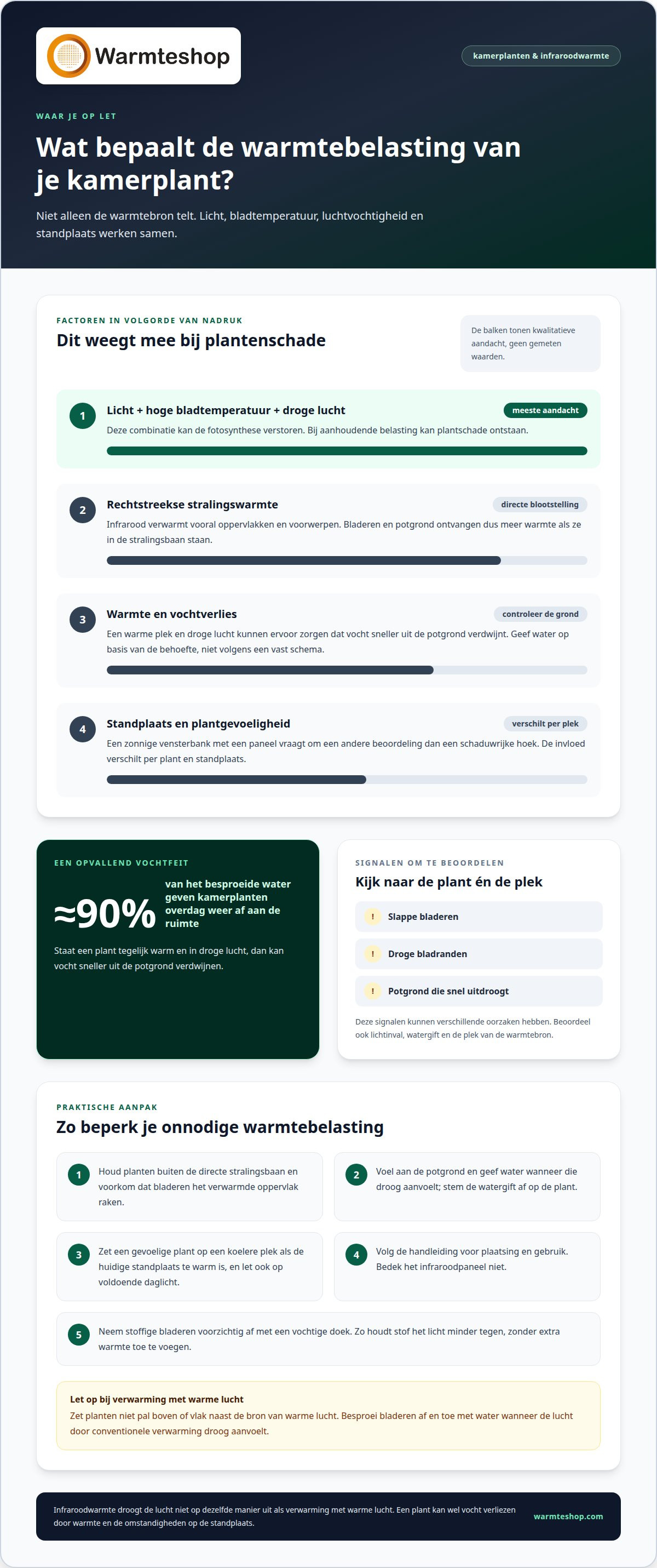
Photosynthesis can come under pressure when high light levels are combined with high plant temperatures and low humidity. The plant is then less able to photosynthesize; damage can occur with prolonged stress. The influence of infrared heat on houseplants therefore depends not only on the heat source, but also on light and moisture around the leaves.
A sunny windowsill clearly demonstrates this combination. Leaves receive plenty of light there, while a panel facing the same direction can provide additional radiant heat. As a result, a plant in the middle of the windowsill receives a different heat load than a plant further from the window and outside the direct path of radiation. The influence of infrared heat on houseplants therefore varies depending on their location.
Moisture loss also plays a role. Houseplants release approximately 90 percent of the water they are sprayed with back into the room during the day. If a plant is placed in both warm and dry air, moisture can disappear from the potting soil more quickly. Therefore, check the soil and adjust watering to the plant's needs, not to a fixed schedule.
Leaves can collect dust in winter. Gently wipe them with a damp cloth so that dust blocks less light. This does not replace a suitable location, but it helps the plant absorb light without adding extra heat.
Watch out for limp leaves, dry edges, or potting soil that dries out quickly. Such signs can have various causes. Therefore, also assess the light exposure, watering, and location of the heat source. For example, move a sensitive plant to a cooler room or out of direct sunlight during the winter.
The effects vary by plant and location. A plant next to a sunny window requires a different approach than a plant in a shady corner. By avoiding direct sunlight, checking the potting soil, and keeping the leaves clean, you limit unnecessary stress and take your plants' needs into account.
High light, high plant temperature, and low humidity can combinedly disrupt photosynthesis and ultimately cause plant damage. Therefore, looking only at the amount of light does not provide a complete picture of the load. Also pay attention to how warm the leaves become and how dry the air around the plant is. When these factors are unfavorable simultaneously, the plant may function less effectively before damage becomes visible.
Assess the location as a whole. Check if the plant receives direct heat while being exposed to plenty of light. If you see signs of strain, move the plant out of the direct line of radiation and observe the conditions around the leaves again. Do not automatically change watering based on a single signal: also check the potting soil and the location of the heat source. This way, you take light, heat, and dry air into account when choosing a more suitable location.
In winter, houseplants require attention for both the potting soil and the leaves. When using warm air heating, keep the potting soil moist and occasionally mist the leaves with water. Feel the soil first: if it remains moist, extra water is not automatically necessary. A fixed watering day does not suit every plant, as light, location, and water requirements vary.
Infrared heating does not dry out the air in the same way as heating with warm air. However, this does not mean that every plant automatically receives enough moisture. Humidity varies by room and time, while a plant in a warm spot still loses water. Therefore, check the potting soil and leaves and watch for changes when you use the heating more frequently. Tailor the care to the conditions in your home.
With this simple approach, you monitor the health of your plants:
The location makes a difference. A plant directly next to a heater faces different conditions than a plant on a cabinet on the other side of the room. Therefore, do not place plants directly above or right next to a source of warm air. A shelf or cabinet can help avoid direct exposure. At the same time, ensure sufficient daylight: a cooler spot is only suitable if the plant receives enough light there.
With infrared heating, the point of attention differs from that of warm air heating. The conditions around a plant can change when the heating is on, so pay attention to the position and the condition of the leaves. Arrange the room so that the leaves do not touch a panel and are not exposed to direct radiation for extended periods. The distance and position determine how much heat the plant receives. Moving the plant to a spot outside the direct path of the heat can be a practical solution.
If you want to properly match the heat source and the plants in the same room, check which indoor infrared heater suits the space. Additionally, keep an eye on the potting soil and leaf condition when using the heater. This way, you will notice more quickly when a plant needs extra water or would be better placed elsewhere.
Infrared radiation heats people, objects, and surfaces in a room first. That makes a difference for houseplants: leaves and potting soil can absorb heat without all the surrounding air heating up first.
Infrared is radiation with a wavelength above 700 nm; the wavelength partly determines how energy affects a plant. Infrared radiation can heat plants, especially above 1200 nm. Therefore, not only the settings of a heat source are important, but also the location and duration of exposure of a plant.
Near-infrared covers the range from 700 to 2500 nm. Far-red light lies between 700 and 800 nm and affects growth differently than heat-generating radiation. A temperature limit is not the same for all houseplants. In an example for a grow room, 10 degrees is considered the minimum indoor temperature and 30 degrees the maximum desired temperature. Those are values from that example, not universal advice for every plant.
Plenty of light can increase the load when the plant temperature rises simultaneously and the humidity is low. Consider a plant behind glass in a sunny spot, with a heat lamp aimed at the same leaves. Therefore, pay attention to the combination of sunlight, leaf heat, and location, not just the room air temperature.
There is no general distance that applies to every infrared panel and every houseplant. The required space depends on the direction of the radiation, the placement of the panel, and the position of leaves and potting soil. Follow the panel's mounting and operating instructions and place plants out of the direct path of radiation.
Infrared heat is not automatically better or worse for plants than convection heating. Convection heats the air, while infrared heats surfaces first. The effect depends on how much heat the plant receives and how humid the air is. Therefore, a plant directly in front of a panel may react differently than a plant further away.
Consider, for example, a panel on the wall and a plant on a low cabinet in front of it. If the leaves are facing directly in the direction of the radiation, move the plant out of that path. Also ensure that the leaves do not touch the panel. Use the device's prescribed clearance as a guideline, as installation instructions vary by panel.
A thermostat control can help manage the room temperature, but it does not automatically measure the temperature of every leaf. A sunny windowsill can be warmer than the rest of the room. Therefore, assess the location yourself and observe changes in the leaves and potting soil when the heating is on.
Infrared radiation is electromagnetic radiation outside the visible light spectrum that can transfer heat. You notice it, for example, as radiant heat from the sun on your skin or from a heated surface in your home. Infrared heating converts electricity into radiant heat. The radiation first heats the surfaces and objects it reaches.
The infrared spectrum is divided into bands based on wavelength. Short-wave infrared, also called IR-A or near-infrared, ranges from 0.7 to 1.4 micrometers. Medium-wave infrared, IR-B or middle infrared, covers 1.4 to 3 micrometers. Long-wave infrared, IR-C or far-infrared, ranges from 3 micrometers to 1 mm.
This classification helps explain why not every infrared source has the same effect. Wavelength is one property; the temperature of the irradiated surface and the distance to the source also play a role. A plant in front of a radiation source receives heat differently than a plant standing alone in the heated room. The direction of the radiation also makes a difference.
For plants, the distinction between infrared and visible light is also important. Red and far-red light are involved in growth responses, such as a plant's tendency to remain compact or to grow taller. This is different from heat transfer by infrared radiation. Therefore, when looking at a plant under a grow light, do not just look at the word 'infrared', but also at the purpose and wavelength of the light source.
The sun is a recognizable example of combined radiation: plants receive light and heat simultaneously. Indoors, a heating panel can heat surfaces without first bringing all the room air up to temperature. As a result, a leaf that catches the radiation can become warmer than a leaf outside the direction of radiation. The plant responds to those local conditions, not just to the set room temperature.
In horticulture, a greenhouse coating can block infrared radiation and thus limit the warming of plants. This approach also has a downside: in the spring, heat protection can delay the morning warming of the crop. This example shows that radiant heat is not simply good or bad. The effect depends on the plant, the angle of light, and the way in which heat reaches the leaves.
For houseplants, this means that an infrared source and a light source do not automatically have the same function. A heating panel provides heat; a grow light supports the lighting. Keep these functions separate when arranging the placement of plants and heating sources. This allows you to specifically assess which radiation reaches the leaves.
There is no infrared wavelength or temperature that is suitable for all houseplants. The right conditions depend on the plant species, the amount of light, and the heat the leaves actually receive. Therefore, do not use a temperature example as a universal guideline. A plant on a sunny windowsill experiences different conditions than the same plant in a spot without direct sunlight.
The wavelength indicates which part of the infrared spectrum a source emits. Near-infrared ranges from 700 to 2500 nm; far-red light lies between 700 and 800 nm. Infrared radiation above 1200 nm, in particular, can heat plants. This does not mean that every houseplant requires such a wavelength. A heating source serves to transfer heat to a room or surface, not to replace a plant's light requirements.
Distinguish between a grow light and a heat source. Red and far-red light influence how a plant grows: it can remain compact or grow taller. An infrared panel has a different function and heats surfaces that absorb the radiation. Therefore, when placing a plant under a grow light, look at the light color and position a heat source so that the plant is not unintentionally heated unnecessarily.
An example for a grow room mentions 10 degrees as the minimum indoor temperature and 30 degrees as the maximum desired temperature. These are limits from that specific example, not general values for all houseplants. The desired temperature varies by species and growth phase. Therefore, do not use these values as a setting for your entire home, but assess the needs of the plant and the conditions at its location.
Do not just measure the room air. A leaf in direct sunlight or in the direction of a panel's radiation can become warmer than the surroundings. For example, compare a plant by the window with one further away in the room. If the temperature setting changes, also observe the leaves and potting soil. This way, you will notice whether the chosen spot is receiving extra heat.
Adjust the heat to the room, not to a perceived fixed plant temperature. A heating thermostat allows you to regulate the heating in the room; however, this control does not automatically tell you how warm each leaf gets. Therefore, take sunlight, the direction of the panel, and the plant species into account. This way, you choose a heating setting that suits both your living comfort and the conditions of your plants.
Warmteshop offers industrial infrared heaters for workspaces where targeted radiant heat suits the heating needs. For houseplants, the most important consideration remains the placement: keep leaves out of the direct path of radiation and follow the heater's instructions for use.
If you are looking for heating for a home, you can also opt for infrared heating or an infrared panel. An infrared mirror is another form of heating for a specific spot in the house. Which solution fits depends on the room and where you want to experience warmth. Industrial heaters are not automatically the right choice for a room with plants.
Do you want to tailor the heat source to your space and take the placement of your plants into account? Contact Warmteshop to discuss your situation.
Base your next heating choice on how you use the room. The influence of infrared heat on houseplants only becomes meaningful within the specific layout: where do you want to experience warmth, where are your plants located, and which parts of the room do you use daily? Considering these points together creates a more practical starting point than simply choosing a heat source.
Map out the areas you want to heat and whether plants are located close to the heat source in those places. Also consider the layout of the room and the role that pleasant living comfort plays in it. This will help you determine whether a different location for the plants will suffice or if a different heating choice better suits your needs.
Do you want to translate that consideration into a suitable solution for your home? Submit your heating question to Warmteshop. With a conscious choice, you leave room for both pleasant warmth and a green, personal living environment.
Infrared radiation transfers energy to surfaces that absorb the radiation. Think of how you feel the sun's heat on your skin, even when the surrounding air is less warm. In a room, furniture, walls, and plants can absorb that energy. How much heat a leaf receives depends, among other things, on the direction of the source and any obstacles, such as a cabinet between the panel and the plant.
Infrared heat can affect growth if leaves or potting soil become too hot. For example, a plant next to a panel may experience different conditions than a plant of the same species on the other side of the room. Therefore, look not only at new growth, but also at the position and light exposure. If a plant changes after you have used the heating, move it temporarily and see if the growing conditions improve.
Dry leaf edges, limp leaves, and potting soil that feels dry quickly can indicate that a plant is experiencing heat or moisture stress. These signals do not, in themselves, prove that infrared radiation is the cause. Also check whether the plant is in direct sunlight and how often you water it. If necessary, move it out of the direct heat direction and then observe changes to the leaves and potting soil.
Infrared heating does not dry out the air in the same way as heating that distributes warm air throughout the room. However, a plant's water requirements can change due to the heat at its location. Feel the potting soil before watering; do not add extra water just because the heating is on. With conventional heating, you can occasionally mist the leaves with water and keep the soil moist.
Heat alone does not automatically promote photosynthesis or flowering. The plant requires appropriate lighting conditions; too much heat combined with bright light and dry air can actually be stressful. The ratio of red to far-red light plays a role in plant shape and flowering induction. A heating panel is not a grow light: use it for heat and adjust the lighting to suit the plant.
Sensitivity varies by plant and location. Plants that receive a lot of light and radiant heat while humidity is low can be subjected to extra stress. Move sensitive plants to a cooler spot out of the direct path of radiation.
There is no fixed exposure duration or frequency. Prevent plants from being directly irradiated for extended periods. Place them outside the radiation path, keep leaves away from the panel, and follow the device's operating instructions.


