

A minimalist interior without unsightly radiators
, by Warmteshop, 16 min read
, by Warmteshop, 16 min read
A radiator doesn't have to dictate the tranquility of your interior. For a minimalist interior without unsightly radiators, you can conceal existing radiators with matching covers, let them blend into the color…
A radiator doesn't have to dictate the tranquility of your interior. For a minimalist interior without unsightly radiators, you can conceal existing radiators with matching covers, integrate them into the room's colors, or opt for heating that takes up less wall space. This creates more freedom to place furniture and curtains, while the warmth remains comfortable.
A sleek look therefore does not necessarily start with removing all radiators. However, heat must still be able to flow into the room: openings in an enclosure allow air to circulate, while another heating solution distributes heat in its own way. Which approach suits depends on the space, the existing heating system, and the desired layout.
In this article, you will learn how to keep radiators and convector trenches out of sight, integrate them into the interior, and take heat distribution into account. This allows you to balance aesthetics against living comfort and opt for a calm layout with more space for furniture.
The way heat moves through a room affects both comfort and appearance. A traditional radiator heats the surrounding air, whereas underfloor heating distributes heat over a large part of the floor surface. As a result, the heat enters the room more gradually, rather than coming from a single point. With radiator heating, the heated air rises and cooler air moves back towards the radiator. Underfloor heating emits radiant heat and causes less air movement. You notice this difference, for example, when sitting in one spot for an extended period: the heat does not come solely from the direction of a radiator.
With water-based underfloor heating, hot water pipes run beneath the floor. The heat enters the room through the floor finish. The system operates at lower temperatures than traditional radiators and can therefore consume less energy. It can also be combined with a heat pump or solar water heater. According to the Municipality of Meppel, a larger surface area of the heat distribution system is required at a lower water temperature to provide sufficient heat. The floor offers a broad base for this. The comparison therefore revolves not only around visibility, but also around the operation and distribution of heat.
The floor finish partly determines how well heat is transferred. Tiles conduct heat well and are therefore often suitable for underfloor heating in a kitchen or bathroom. Thin PVC can also be suitable if it conducts heat well. PVC and laminate can be combined if both the floor and the subfloor are suitable. Multilayer parquet or engineered parquet is often designed to limit the movement of wood. However, not every type or thickness of wood is suitable for underfloor heating. Moreover, a thick wool rug blocks some of the heat; a thinner rug provides less protection.
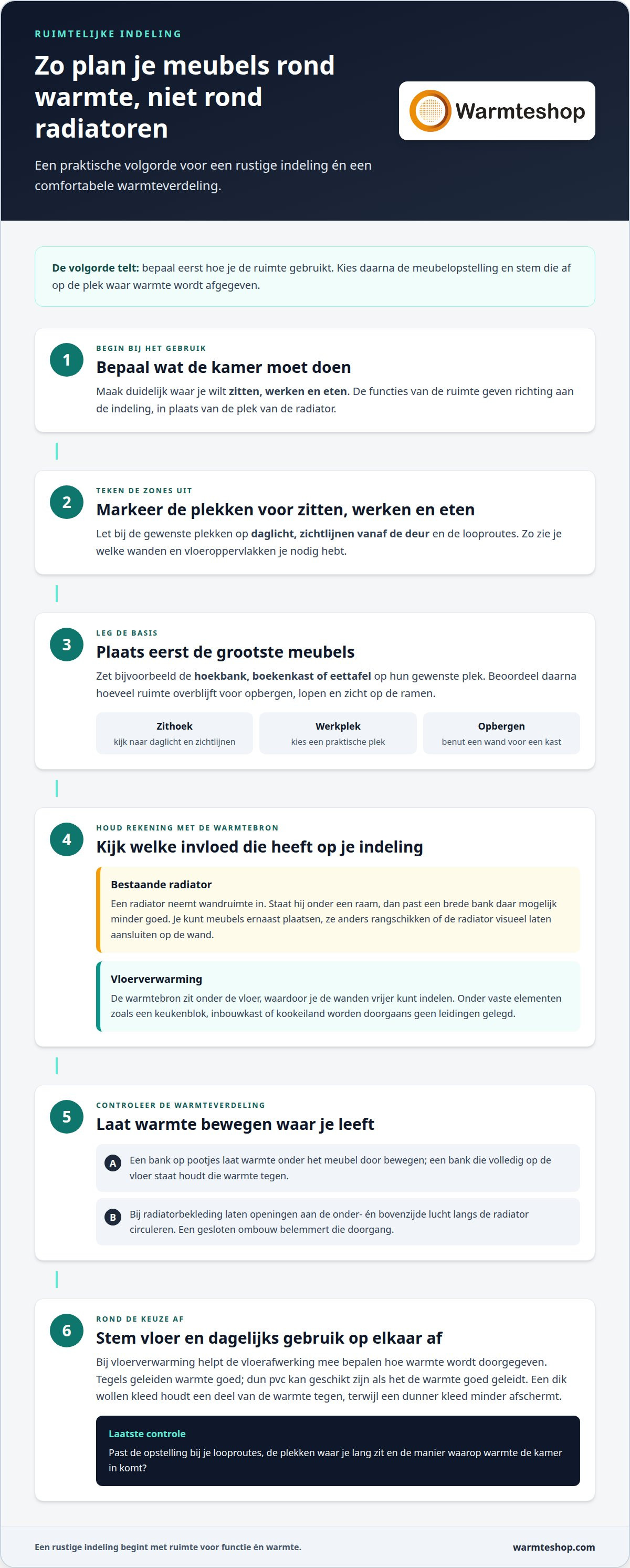
Furniture also influences the distribution of heat across the floor. A sofa on legs allows heat to move underneath the furniture, whereas a sofa standing entirely on the floor blocks that heat. Therefore, take large pieces of furniture and fixed elements into account when planning the layout. With underfloor heating, pipes are generally not laid under, for example, a kitchen unit, built-in cupboard, or kitchen island. These zones require a different assessment than an open walking space. This way, you tailor the heat distribution to the areas where you live and sit.
Radiator covers can make an existing radiator less conspicuous, but the heat must still be able to enter the room. Ventilation openings allow air to circulate; a closed enclosure obstructs this passage. Choose openings at the top and bottom so that air can move past the radiator. A vertical radiator can actually be a deliberate design accent if the color matches the wall or another interior element. Both solutions change the appearance but not the heat source. The choice depends on the desired look, the available space, and how the room is heated.
A radiator takes up wall space and thus influences the layout. If it is positioned under the window, a wide sofa might not fit as well there. A desk or low cabinet may need to be moved, even if that wall seems logical from a design perspective. Without that fixed heat source, you can tailor furniture more to usage and sightlines. Think of a reading chair in daylight, a dining table close to the kitchen, or art on a quiet wall. In a minimalist interior without disruptive radiators, the furniture arrangement thus has more influence on the atmosphere than the location of the heat source.
Distinguish between a room that is already heated and a redesign where the heating changes. In the first case, the existing radiator remains part of your floor plan. You can place the sofa next to it, visually align the radiator with the wall, or rearrange the furniture. With a new layout featuring underfloor heating, you no longer need to coordinate the furniture with radiators. The heat source is located beneath the floor, allowing the walls to offer more possibilities. For instance, a minimalist interior without unsightly radiators can accommodate a different seating area or workspace.
First, determine the functions the room needs to fulfill. Mark, for example, where you want to sit, work, and eat. Then, place the largest pieces of furniture, such as a corner sofa, bookcase, or dining table. This will show you how much wall space is needed for walking routes, storage, and a view of the windows. A minimalist layout often works better if furniture does not have to be arranged around a heating element. The desired arrangement then helps determine which heating solution is suitable.
With underfloor heating, the layout remains relevant. Fixed elements such as a kitchen unit, built-in cupboard, or kitchen island typically do not have pipes underneath. As a result, the heated zone differs from an open floor where you can rearrange furniture later. Moreover, a sofa, table, or cupboard is not a fixed structural element. Therefore, consider the daily use of the space, not just the initial furniture arrangement. Underfloor heating for a flexible layout can be suitable if you want to be less dependent on radiator positions.
More freedom does not automatically mean that every arrangement is comfortable. The heating and the place where you spend long periods of time influence each other. A stylish layout therefore takes walking routes, furniture, and the desired temperature into account. This makes the room look calmer without losing the practical function of a desk, sofa, or dining table.
A radiator under the window can determine where your curtains end and which furniture fits. With underfloor heating, that fixed position is no longer a starting point. Long curtains reaching to the floor then suit a seating area without the fabric hanging against a radiator or obstructing heat output. This allows you to more easily let the window function as a tranquil focal point of the living room. The layout then follows the daylight and the use of the space more closely.
Start with the functions your living room needs to fulfill. A sofa can be oriented towards the window, a television, or a fireplace; an armchair can stand next to a reading lamp. If there is a radiator under the window, that choice may conflict with the available wall space. Without a radiator in that spot, you can rotate the seating area or place a low cabinet. The heat source is located under the floor, so the wall layout imposes fewer restrictions.
Colors and materials also play a role. A visible radiator draws attention, especially if the color differs from the wall. In an interior with soft tones, natural fabrics, and little contrast, this can disrupt the calm overall look. If the heating is not a visible element on the wall, curtains, artwork, and furniture have more room to determine the atmosphere together. This does not mean that everything has to be the same color. A dark accent on a light wall can actually be a deliberate choice, without the radiator unintentionally becoming the most striking detail.
A flexible layout also requires attention to the heated zones. With underfloor heating, pipes are typically not laid under fixed elements such as a kitchen unit, built-in cupboard, or kitchen island. In a living room with an open kitchen, this difference can be significant. The position of a fixed kitchen unit is usually already fixed, whereas a sofa or dining table can be moved later. Therefore, when designing, consider the boundary between fixed elements and the space where you want to move furniture.
This is how you practically coordinate heating, window coverings, and furniture arrangement. Long curtains, a dining table in daylight, and a sofa in the desired spot can go together perfectly. The living room looks calmer because the wall is no longer designed around a radiator. At the same time, the layout remains tailored to daily use.
You can conceal a radiator with a cover that matches the wall, while allowing the heat to circulate freely. Choose a design with openings at the top and bottom. These ventilation openings allow air to move past the radiator and help prevent a closed enclosure from trapping the heat. This gives the radiator a sleek finish without completely sealing it off
A custom-made surround can meet the windowsill or extend into a low cabinet. Leave sufficient space around the radiator and keep the openings free of decorations, books, and plants. A solid panel in front of the heat-emitting surface obstructs air circulation. A professional can help ensure the cladding fits properly and prevent heat loss. This is especially practical if pipes or radiator valves need to remain accessible behind the surround.
A convector trench can also appear visually calmer if you treat the surrounding floor and the grille as a single unit. For example, choose a grille that matches the floor finish so that it contrasts less. Keep the openings clear: a rug, toys, or a furniture leg above the trench can obstruct the airflow. A seamless appearance therefore does not mean closing off the trench. Air must be able to move through the grille to bring heat into the room.
If you do not want to install a casing, you can let a radiator subtly blend into the background. Paint it in a shade that matches the wall to reduce the contrast. A vertical radiator can also form a deliberate line in the interior, for example next to a door or on a narrow wall. The shape remains visible but finds a place within the design. When making your choice, take into account the pipes, valves, and the space required for operation.
Many radiator covers are easy to install yourself and often require no drilling. When designing, however, ensure that the radiator remains accessible for operation and maintenance. Furthermore, a cover can prevent children from directly touching the hot radiator surface, but it does not eliminate the need to keep an eye on the heat source. With open ventilation, unobstructed access, and a suitable finish, the solution remains practical and aesthetically pleasing.
An alternative without visible radiators is underfloor heating. It distributes heat evenly and leaves the walls free. Underfloor heating works with radiant heat and causes less air circulation than convection-based radiator heating. This difference can be a factor when choosing between heating without visible radiators and incorporating existing radiators into the interior.
Panel radiators emit heat through convection and radiation. Therefore, when choosing such a radiator, visibility is not the only factor to consider: the heat output consists of both forms. When weighing up underfloor heating against panel radiators, you can also consider the even heat distribution of underfloor heating and the lower air circulation compared to convection-based radiator heating. In this way, the heating method aligns with the desired ambiance of the room.
A radiator can be a consciously chosen element, not merely a technical object. In a classic interior, for example, wooden radiator cladding complements wooden furniture, a parquet floor, or a windowsill. Wood can also add warmth to a modern interior, provided the texture matches other materials. Consider a light oak finish next to a wooden coffee table. This gives the radiator a cohesive place without demanding all the attention.
The shape also determines how visible a radiator is. A single-panel radiator consists of one panel, a double-panel radiator of two parallel panels, and a triple radiator of three. Multiple panels have a larger surface area and therefore emit more heat, but can also expose more mass. A flat panel radiator can look calmer than a model with pronounced shapes. Therefore, do not look only at the color, but also at the proportion between the radiator, the wall, and the furniture.
You can also use the radiator as an artistic accent. A striking color can work against a calm wall, for example, if that shade is repeated in an armchair, vase, or artwork. Connect the radiator with existing accents instead of adding isolated colors. This makes the choice purposeful. A contrasting color works if you want to showcase the radiator as part of the design; in an understated room, a tone-on-tone approach might be a better fit.
In multi-functional spaces, a radiator can combine aesthetics with practical use. Some designer radiators feature integrated towel racks or mirrors. For example, a towel radiator in the bathroom can allow towels to dry while simultaneously emitting heat. The shape and placement determine whether it blends seamlessly with the tiles, vanity unit, and mirror. Choose a spot that is practical for daily use so that the design does not compromise the layout.
A popular choice is not automatically the best for every room. A wooden surround, for example, requires openings to allow heat to circulate. With a visible radiator, on the other hand, material, shape, and color play the leading role. Do you want a radiator that combines heating and daily use? Check out towel radiators for a practical, stylish bathroom.
For a radiator, the finish determines its presence in the room. Wooden radiator cladding provides a warm, classic look. Use this finish consciously as part of the interior, so that the radiator complements the atmosphere you wish to create. In this way, the wood grain can influence the choice of cladding without the radiator itself drawing all the attention.
Even a radiator in a striking color can be an artistic element in the interior. Ensure the color complements the rest of the decor. This way, the accent feels like a deliberate choice within the whole, rather than a standalone element. Therefore, do not just look at the radiator itself, but also at the colors and materials you combine it with.
Warmteshop helps you align your heating choice with a calm interior and desired living comfort. If a radiator wall restricts your furniture layout, infrared heating is an alternative to consider. For specific rooms, there are also infrared mirrors, infrared glass heating, and infrared towel dryers. Which solution fits depends on the room, the desired location of the heat, and the use of the room. This way, you view aesthetics and heating in conjunction, without losing sight of the interior.
Would you like to discuss your space and heating requirements? Contact Warmteshop.
A minimalist interior without unsightly radiators starts with a choice that suits how you use your home. Think not only about the location of the heating, but also about changes you want to make later. A different seating area, a new wall color, or a workspace by the window calls for a layout that is not unnecessarily fixed. This way, comfort becomes part of the design, rather than a limitation.
Warmteshop offers various options to tailor heating to the look and function of a room, including infrared heating, infrared panels, and infrared mirrors. Which solution suits you depends on your space and living preferences. Discuss your situation with Warmteshop and discover which option aligns with the interior you have in mind.
Contact Warmteshop and take the first step towards an interior that looks calm and feels pleasant.


