

Industrial short-wave heating: the complete buying guide for 2026
, by Warmteshop, 17 min read
, by Warmteshop, 17 min read
Heating with air in a large industrial hall is simply a costly mistake. While traditional systems spend minutes trying to bring thousands of cubic meters of air up to temperature, industrial short gh…
Heating with air in a large industrial hall is simply a costly mistake. While traditional systems spend minutes trying to bring thousands of cubic meters of air up to temperature, industrial short-wave heating offers an immediate solution that wastes not a second. You probably recognize the frustration: a high energy bill while your employees are still working with cold hands because the heat dissipates instantly as soon as an overhead door opens. It feels like trying to mop up water with the tap still running.
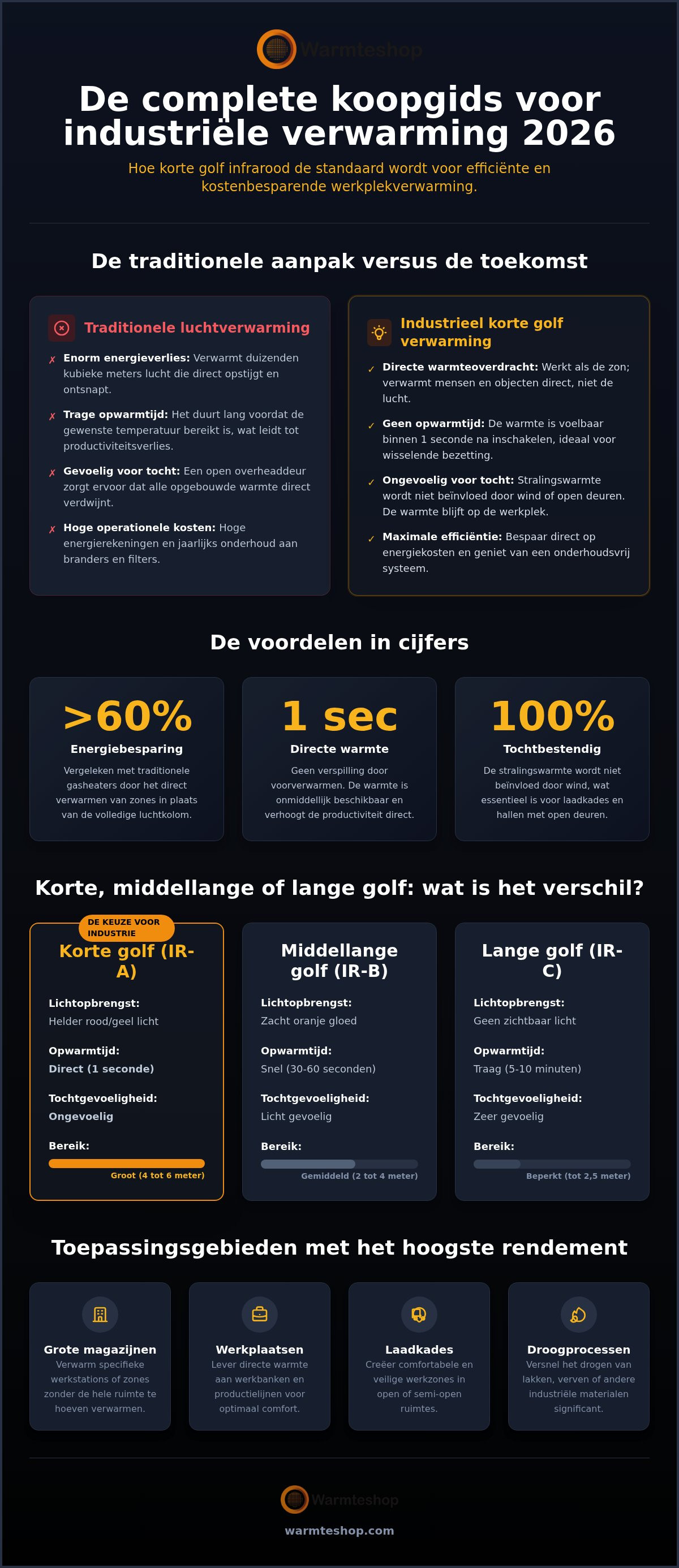
This technology works just as efficiently as the sun's natural radiant heat. Instead of heating the air, these powerful heaters direct their energy directly at people and objects in the room, which experts say can lead to energy savings of more than 60% compared to traditional methods. In this comprehensive buying guide for 2026, you will discover how to maximize the efficiency of your business space and ensure a comfortable workplace without unnecessary energy loss. We discuss the latest technological developments, compare robust systems that last for years, and show how you can immediately reduce your operating costs with smart zone heating.
Industrial short-wave heating, also known as IR-A radiation, is the most powerful form of infrared technology currently available. In the commercial market of 2026, this will be the standard for heating large volumes and poorly insulated buildings. While old-fashioned systems need to heat the air before you notice anything, a short-wave heater works immediately. What exactly is an infrared heater? Basically, it is a device that converts energy into electromagnetic waves that only emit heat once they strike a solid object.
You can compare this principle to the natural warmth of the sun on a cold winter day. As soon as you step into the sun, you feel the warmth on your skin, even if the ambient temperature is low. This is crucial for warehouses and workshops. In these spaces, traditional air heating is often inefficient because warm air rises directly to the ceiling. Short-wave radiation does not. The waves cut through the air without heating it up, ensuring the energy stays exactly where you need it: on the work floor.
A major advantage is its insensitivity to drafts. With convector heating, warm air from an open overhead door blows directly outside, but the radiant heat from a short-wave system remains directed at the employees. Gusts of wind have no effect on the radiation path. This makes it the only logical choice for loading docks and halls where doors are constantly opening and closing.
Speed is the biggest advantage. As soon as your employee flips the switch, the heat is there. This significantly increases productivity. People who are cold work less accurately and more slowly. Thanks to direct heat transfer, you create a comfortable zone without having to preheat the entire hall for hours. This is ideal for shift work or specific workstations in an otherwise unused warehouse. For larger projects, you can look at our infrared heating solutions specifically designed for these zones.
Switching to industrial short-wave heating is a smart financial move. Because you heat people rather than the air, recent market figures show you can save up to 60% on energy costs compared to traditional gas heaters. In an era where carbon-neutral business operations are the norm, this electric solution helps you immediately make your business operations more sustainable. The system is virtually maintenance-free. There are no filters to replace or complex burners requiring annual inspections. It is a robust investment that quickly pays for itself through lower operating costs and a healthier working environment.
Not every infrared beam is the same. The success of your heating plan depends entirely on the right wavelength for your specific space. In the industry, we distinguish between three types, where the intensity and range differ drastically. Incidentally, infrared radiation is not only used for heating but is also widely employed in various industrial processes, such as drying paints or hardening materials.
| Feature | Short wave (IR-A) | Medium wave (IR-B) | Long wave (IR-C) |
|---|---|---|---|
| Light output | Bright red/yellow light | Soft orange glow | No visible light |
| Reach | Large (4 to 6 meters) | Average (2 to 4 meters) | Limited (up to 2.5 meters) |
| Warm-up time | Instant (1 second) | Fast (30 to 60 seconds) | Slow (5 to 10 minutes) |
| Draft sensitivity | Insensitive | Light sensitive | Very sensitive |
Short wave (IR-A) is the undisputed powerhouse for large halls. Due to the extremely high surface temperature of the lamp, the beams cut effortlessly through the air, even over distances of six meters. This is essential for high factory halls where ceiling mounting is often the only option. When choosing industrial short wave heating, you opt for a system that is not affected by air movement. While medium wave heaters partially lose their heat with a slight breeze, IR-A radiation remains focused on the target. The visible light is a direct indicator of the enormous energy being emitted. It tells you exactly where the heat ends up, which is useful when setting up specific work zones.
Although short wave is superior in open spaces, there are situations where you would prefer medium wave (IR-B). Consider smaller, fully enclosed workshops with lower ceilings where the intense heat of IR-A can be too overwhelming. Medium wave also offers a softer alternative in environments where bright red ambient light is disruptive to work. Long wave (IR-C), on the other hand, is almost never suitable for industrial halls. These panels are designed for offices or well-insulated homes. They heat the air indirectly and lose their effectiveness as soon as a door opens. For situations where you specifically want to move the entire air mass, you are better off looking at our industrial air heaters. Curious which heater suits your hall? View our collection of electric patio heaters for powerful solutions that also perform excellently in semi-open locations.
Selecting the right installation is not a matter of 'the more wattage, the better'. It is about the strategic balance between the mounting height and the specific needs of the workplace. A wrong choice often leads to hotspots where it is too hot, or conversely to cold zones where the radiation does not reach the floor powerfully enough. When choosing industrial short-wave heating, you must therefore consider the complete configuration of your space.
For effective zone heating in a poorly insulated hall, you can rely on a concrete guideline for the required power. Contrary to popular belief, this depends heavily on the distance to the working floor. Use the following rules of thumb for optimal results:
The radiation angle determines how widely the heat spreads. Preferably, aim the heaters at a 45-degree angle at the workspace. It is essential that the radiation beams from multiple units overlap to create an even blanket of heat without cold spots. For an exact, tailored plan, we always recommend a professional heat calculation by the experts at Warmteshop. View our collection of infrared heating for the most robust models that meet these requirements.
In an industrial environment, equipment is subjected to heavy stress from vibrations and dust. IP certification is your most important indicator of durability in this regard. An IP20 rating is sufficient for dry warehouses, but in workshops where liquids are handled or where a lot of fine dust is released, an IP25 or even IP66 rating is necessary. Our collection of 15 industrial models has been specifically selected for this robustness.
The housing must withstand the daily dynamics of a factory hall. Choose heaters with an extruded aluminium housing; this material is not only vibration-resistant but also dissipates internal heat optimally. This prevents the components from overheating during prolonged use. Additionally, check whether the heater features a sturdy safety grille and fully complies with current European industrial standards for electrical safety.
The maximum efficiency of a heating system depends not only on the technology, but above all on its smart application within your business processes. Industrial short-wave heating is, in fact, a precision instrument. Whereas traditional systems attempt to influence the entire air mass in a hall, this technique allows you to deploy heat as a targeted beam. This is crucial in large warehouses where overhead doors are open more often than closed.
In a distribution center spanning thousands of square meters, it is illogical to maintain the entire space at 18 degrees, especially if employees are located in fixed positions such as packing stations or loading docks. The concept of 'island heating' offers the solution here. By strategically placing heaters above these workstations, you create a comfortable bubble for your staff without wasting energy on heating unused storage racks.
In the modern industrial environment of 2026, this goes beyond a simple on-off switch. Through integration with smart home Wi-Fi modules and advanced thermostats, you can link the heating to motion sensors or schedules. As soon as an employee leaves a zone, the system switches off immediately or dims to a lower power level. This automation ensures that you never pay for unused heat, which is essential for healthy business operations.
In addition to employee comfort, short-wave infrared plays a vital role in optimizing production lines. The constant and intense heat output is ideal for accelerating the drying processes of paints, coatings, or adhesives. Because the radiation penetrates deep into the material, the product dries from the inside out. This prevents cracking or air bubbles in the top layer and significantly shortens your production lead time.
Even for chemical reactions requiring a specific, constant temperature, this form of heating offers a stability unattainable with air heating. This is because you are not affected by cold air currents that can disrupt the process. Whether it involves preheating molds or keeping materials supple during processing, direct control over heat transfer makes your processes more predictable and efficient. Curious which specific configuration can increase your yield? View our collection of electric patio heaters and industrial radiant heaters for a solution that seamlessly aligns with your business operations.
At loading docks and transshipment points, the technology truly proves its value. Because wind and drafts do not affect the radiation path, employees remain warm while loading trucks, even in freezing temperatures. This reduces absenteeism and increases workplace safety, as employees do not need to wear thick, restrictive clothing to perform their work comfortably.
At Warmteshop, we understand that no two factory halls are the same. That is why our collection consists of 15 carefully selected models, each solving a specific industrial challenge. Whether you are looking for a compact unit for an individual packing station or a series of powerful industrial panels for a gigantic distribution center, the right choice determines your ultimate return. Investing in high-quality industrial short-wave heating is a conscious choice for business continuity. Cheaper alternatives often lead to unexpected downtime due to defective lamps or housings that simply cannot withstand the vibrations of heavy machinery or the dust load in a workshop.
Integrating these heaters into your existing building is surprisingly simple. Thanks to the flexible mounting brackets, you can position the units exactly so they deliver heat where your employees need it most. This modular nature also means that your system can seamlessly grow with your business operations. You start with the most critical zones and expand the installation as needs change.
Our most robust heaters for 2026 are designed to perform under the toughest conditions. They feature extruded aluminum housings that not only remain dust-free but also protect the internal electronics from the thermal stress of constant use. The short-wave lamps in this selection have an operational lifespan many times longer than that of standard infrared lamps. As a result, you won't have to worry about replacement or technical maintenance for years. Furthermore, we offer models with various beam angles, allowing you to heat both wide zones and very specific workstations from great heights without heat loss.
A professional installation does not stop at the heater itself. To ensure the stability of your electrical circuit, the use of soft starters is essential. Powerful industrial heaters require a brief voltage spike when switched on, which can overload your power grid. A soft starter absorbs this peak current, preventing your fuses from blowing and reducing mechanical stress on the lamps.
Additionally, you maximize savings by combining the system with smart control. Motion sensors ensure that the heating is only active when someone is actually working in the zone. This type of automation is the key to the lowest possible operating costs in a modern factory. You can configure and order your system directly via our infrared heating collection. Unsure about the ideal positioning? Our experts are ready to perform a detailed heat calculation for you, ensuring you choose the most efficient solution for your specific hall.
With the right technology, the transition to a gas-free and energy-efficient business environment is not an obligation, but an opportunity for greater comfort and lower costs. In this guide, you have discovered how industrial short-wave heating completely bypasses the inefficient heating of air. By directing heat directly at people and objects, you create a pleasant workplace even in the most drafty halls. This not only ensures a healthier indoor climate but also directly reduces operational costs through significant energy savings compared to traditional methods.
Warmteshop acts as your innovative guide in this energy transition. Our robust systems are specifically designed for intensive use and are backed by a long warranty, ensuring you have an installation that will last for years. With our fast delivery for business customers and expert, tailored advice, we ensure that your business processes never come to a standstill. We invite you to experience the power of targeted radiant heat for yourself and give your business premises a smart upgrade that is ready for the future.
View our complete collection of industrial short-wave heating and order directly
The biggest advantage is the immediate heat output without any warm-up time. In a large warehouse, it is impossible to heat all the air; short-wave radiation directly heats the employees and objects on the floor. This means you do not waste energy on the enormous amount of air near the ceiling. As soon as you flip the switch, you experience comfort, which immediately increases productivity in your company.
Most industrial short-wave heaters emit a characteristic reddish or yellow glow. In a workshop or warehouse, this is rarely perceived as bothersome. In fact, the light often serves as a handy visual indicator of the active heating zone. Should residual light be a problem in your specific situation, we will look together at models with filters or medium-wave alternatives from our collection of 15 industrial models.
According to recent market figures, switching to industrial short-wave heating can save you up to 60% on your energy costs compared to traditional gas heaters. This enormous saving stems from the fact that you only heat the zones where people are actually working. You simply switch off the heaters in unused parts of the hall, ensuring you never pay unnecessarily for heat that would otherwise dissipate immediately.
Absolutely, short-wave infrared is the only technology that remains truly effective outdoors or at open loading docks. Because IR-A radiation does not heat the air, wind or drafts have no effect on heat transfer. Your employees remain comfortably warm while loading trucks, even when the doors are wide open. It is the perfect solution for locations where traditional air heating would fail immediately due to constant drafts.
The ideal mounting height depends entirely on the wattage of the heater. Units of 1500W to 2000W are usually mounted at a height of 2.5 to 3 meters. For more powerful models of 4000W or 6000W, a height of 4 to even 6 meters is no problem at all. It is crucial to find the right balance; our experts are happy to perform an accurate heat calculation to determine the optimal position in your hall.
These systems are virtually maintenance-free because they have no moving parts or filters. No annual inspection is required, as is the case with gas boilers. The robust aluminium housing and high-quality lamps are designed for a long operational lifespan in harsh conditions. Occasionally removing dust from the reflector is usually sufficient to maintain the maximum radiant efficiency of your installation for many years.
Yes, provided you choose heaters with the correct IP certification. For a dusty production environment, we recommend models with at least an IP25 or IP66 rating, which are excellently protected against dust and moisture ingress. The housing of our industrial models is made of vibration-resistant material. As a result, the heaters function safely and reliably, even in the most dynamic and challenging factory environments we encounter in 2026.
Although physical mounting to a wall or ceiling is often simple, we recommend hiring a professional for the electrical connection. Especially with powerful systems, correct connection to the distribution board and the use of soft starters are essential to handle peak currents. Warmteshop has certified technicians who can take care of the entire installation and mounting, ensuring that your system operates safely and optimally.


