
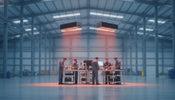
Industrial infrared heating: the complete guide for large spaces in 2026
, by Warmteshop Infrared heating, 18 min read
, by Warmteshop Infrared heating, 18 min read
How much of your expensive heat actually escapes directly through the roof or an open gate? It is a frustrating and familiar problem: the gas bill rises to record levels while your staff still…
How much of your expensive heat actually escapes directly through the roof or an open gate? It is a frustrating and familiar problem: the gas bill rises to record levels while your staff are still standing at the workbench with cold hands. Heating a warehouse with traditional air blowers often feels like trying to mop up a flood with the tap still running, because the warm air rises immediately to places where no one benefits from it.
You are certainly not the only one looking for a more comfortable and healthier working environment without the financial burden of massive heat losses. In this guide, you will discover how to heat large spaces efficiently and precisely using the power of industrial infrared heaters. We show you how to create direct heat at the workplace, exactly where it is needed, without unnecessary warm-up time or expensive system maintenance.
We discuss the impact of the latest EPBD IV directive, which was introduced in the Netherlands in May 2026, and how to make smart use of the Energy Investment Allowance (EIA). This allows you to deduct as much as 40% of the investment from taxable profit in 2026. The experts at Warmteshop Infrared Heating make the switch to a sustainable, future-proof workplace not only more comfortable for your team but also highly attractive for your long-term bottom line.
At its core, industrial infrared heating is a technology that fundamentally changes the way we approach large spaces. Whereas for decades we were accustomed to heating the entire mass of air in a hall, the focus is now shifting to direct radiation. This is essential when heating a factory hall, because warm air inevitably rises to places where no one benefits from it. By using radiant panels and heaters, you create a stable climate that is not directly disturbed by drafts or open doors; after all, the heat remains where the work is being done.
The operation is based on electromagnetic waves that are only converted into heat once they strike an object or person. To understand what infrared heating entails, you can compare it to the sun's rays on a cold winter day. In industry, we distinguish between short-wave emitters, which provide bright light and are ideal for drafty areas, and long-wave dark emitters for a more subtle heat distribution. The floor and machinery in the room act as a thermal battery in this process; they store the energy and slowly release it back into the environment, ensuring a very constant temperature.
The transition to gas-free industry has gained momentum in 2026 due to stricter environmental requirements and rising fossil fuel costs. Companies are choosing this electric solution because the system requires virtually no maintenance. There are no filters to clog and no burners that need to be adjusted annually. The technology behind modern infrared heating is robust and lasts for years without loss of efficiency. Warmteshop Infrared Heating observes that the rapid payback period provided by zone heating is the deciding factor for many entrepreneurs who take their energy management seriously while simultaneously seeking to improve comfort for their staff.
Imagine stepping into the workshop and feeling the warmth immediately at the touch of a button. That is the daily reality of industrial infrared heaters. Whereas with traditional systems you often have to start heating hours in advance to get the enormous mass of air moving, that waiting time is a thing of the past with this technology. Your staff can get to work immediately in a comfortable environment; this not only increases productivity but also ensures a pleasant start to the workday without cold hands on the machines.
Another major advantage is the silence on the work floor. In a busy production environment, concentration is essential for the safety and quality of the work. Whereas hot air blowers constantly produce a monotonous hum, infrared panels operate completely silently. Moreover, there is no forced air movement. This means that no dust, allergens, or fine particles are blown through the hall. For companies that work with precision instruments or where hygiene plays a role, this is an indispensable benefit when heating a factory hall in a modern way.
In many warehouses, large areas are reserved for storage where hardly anyone ever goes. It is therefore unnecessary to constantly heat those thousands of cubic meters of air. By opting for island heating, you create warm zones in specific locations, such as at the packing tables or the assembly line. Research comparing infrared versus traditional hot air blowers shows that targeted radiant heat is much more efficient in such industrial settings. You can save up to 50% on your energy costs simply by not actively heating the unused storage zones. Should the layout of the workshop change in the future, you can easily move the heaters to the new workstations.
The well-being of your team is the engine of your business. Traditional heating often extracts moisture from the air, leading to dry eyes and irritated mucous membranes among employees. Infrared radiation maintains natural humidity and prevents a dusty climate. The warmth feels like the natural glow of the sun, which has a positive psychological impact on staff motivation and overall well-being. There is no longer that annoying draft sensation that occurs when warm air circulates past cold walls. You create a place where people feel taken seriously. Warmteshop Infrared Heating is happy to advise you on how to translate these benefits into a concrete, tailor-made solution for your specific situation.
Why does a warehouse often feel drafty while the heating is running at full blast? The answer lies in the way heat moves. Traditional blowers work on the basis of convection; they heat the air to bring the space up to temperature. Because warm air is lighter than cold air, it rises immediately. In a high-ceilinged hall, this results in an enormous waste of energy. You are literally heating for the birds, while the people on the factory floor are left standing in the cold.
With convection heating, a phenomenon occurs that we call heat stratification. In practice, this means that it is often 25 degrees under the roof, while employees on the floor are working in a meager 15 degrees. This temperature difference of as much as 10 degrees is not only uncomfortable, but also extremely expensive. Heat escapes more quickly through the roof insulation because the temperature difference with the outside air is greatest there. Industrial infrared heaters completely reverse this principle. The radiation heats the floor and objects directly, making the floor the warmest point in the room. This significantly reduces the pressure on the building's insulation requirements. Therefore, if you to heat a warehouse in a logical way, you choose a system that keeps the heat down.
The installation process is also worlds apart. For hot air blowers, you often need heavy gas lines or extensive air ducts running through the entire room. Infrared panels and heaters require only an electrical connection. This not only saves on initial installation costs but also gives you the freedom to hang the units exactly where the need is greatest. No heavy ducts also means less load on the roof structure.
Although the kWh price for electricity differs from that of gas, the operational efficiency of infrared is many times higher because you no longer heat empty air masses. The financial benefits accumulate over the years:
In a busy production environment, the maintenance-free nature is invaluable; you will never again experience downtime for repairs or filter changes. Moreover, the synergy with solar panels is a huge asset. By using self-generated power, you can reduce operational costs to almost zero. Switching to this technology makes heating a factory hall in 2026 a smart, future-proof investment that quickly pays for itself through lower overheads and a favorable depreciation period.
Selecting the right system is not simply a matter of ordering and hanging up a few heaters. Every space is unique and requires a well-thought-out plan. When heating a warehouse, you first look at the specific activities taking place there. A warehouse, where people are constantly on the move, has different heat requirements than a workshop where technicians spend hours working on delicate electronics in one spot. For entrepreneurs furnishing similar large spaces for sports purposes, click here for professional fitness equipment. The basis of your choice lies in calculating the required wattage; although a standard 1,000-watt panel is often sufficient for 20 to 25 square meters in an office, the requirements in an industrial hall are often different due to the height and potential drafts.
In addition, the environment plays a major role in the technical specifications. In a woodworking workshop or a damp production hall, the IP rating of the heaters is essential. This value indicates the extent to which the equipment is resistant to dust and water. For most industrial applications, we recommend a minimum of IP65 so that the installation continues to function safely and maintenance-free for years, even under harsh conditions.
The position of the heaters determines whether the heat actually reaches where it is needed. In large halls, ceiling-mounted infrared heating usually the best choice. This keeps the walls free for shelving or machinery and creates an unobstructed downward radiation field. The ideal mounting height is usually between three and eight meters. By placing the heaters at a specific angle, you ensure overlapping heat fields. This prevents 'cold spots' on the work floor and guarantees uniform comfort for your staff. When positioning, also take obstacles such as overhead cranes into account so that the radiation is not blocked.
A modern system excels through smart control. Since the introduction of the EPBD III directive, building automation has even become mandatory for larger installations. By using presence sensors in warehouse aisles, you prevent energy from being consumed in areas where no one is present. These sensors switch the heaters on immediately as soon as a forklift enters the aisle and switch them off again as soon as activity stops. Furthermore, you can connect the installation to a central building management system, allowing you to accurately monitor and adjust consumption per zone from your computer. Would you like to know which configuration is most cost-effective for your situation? Then take a look at our industrial infrared heaters and discover the possibilities for a customized solution.
Heating an industrial hall is a strategic decision that requires more than just a good heater. It involves a total concept where technology, efficiency, and comfort come together. At Warmteshop, we understand that a 5,000-square-meter warehouse requires a different approach than a local garage or workshop. With over 18 years of experience and as part of manufacturer Infralia, we offer not only products but also complete peace of mind. From the initial calculation to the final installation by our own technicians, we guide you through every step of the process.
Before making a final decision, you likely want to experience the heat yourself. With 30 physical stores spread across the Benelux, there is always a showroom nearby where you can view the various industrial heaters. Our advisors are happy to show you the difference between the various technologies and help you visualize their integration into your premises. This personal contact is our strength; we take your search for sustainable alternatives seriously and translate complex principles into a clear explanation for your specific situation.
For industrial projects, an on-site visit is essential. Our expert examines not only the dimensions of the hall but also the insulation values, the existing power supply, and the daily walking routes of your staff. Based on this, we draw up a detailed heating plan. This plan serves as a blueprint for an installation that combines maximum efficiency with a healthy working environment. Would you like to know immediately what the possibilities are for your company? We will visit you free of charge to assess the situation on-site and provide you with no-obligation, tailored advice.
Choosing Warmteshop means choosing the reliability of an innovative market leader. Our industrial heaters are designed for intensive use and last for years without requiring any maintenance. We are proud of the long-term relationships we build with our business customers in both Belgium and the Netherlands. Are you curious how other entrepreneurs experienced the switch to infrared for heating their warehouses? Then take a look at our various projects and read the installation reviews from companies that went before you. Together, we create a future-proof working environment where savings, environmental friendliness, and physical well-being go hand in hand. This ensures your company is ready for the energy challenges of 2026 and beyond.
The move to industrial infrared heating is more than a technological upgrade; it is an investment in the health of your team and the profitability of your business. We have seen that heating a warehouse in 2026 requires smart, electric solutions that minimize heat loss and maximize zone heating. By stopping the heating of empty air masses and opting for direct radiant heat, you create a stable and maintenance-free working environment that is ready for the future.
With over 18 years of experience as an infrared specialist, Warmteshop is happy to guide you through this transition. You are always welcome in one of our 30 showrooms for a personal demonstration, or we can visit you for free professional on-site advice. Together, we will draw up a heating plan that perfectly aligns with your specific business activities and budget, so you know exactly where you stand.
Curious how much you can save? Request a no-obligation quote for your industrial space and discover how comfort and efficiency go hand in hand. We look forward to working with you to transform your workplace into a healthy and energy-efficient environment.
The ideal mounting height for industrial heaters is usually between 3 and 8 meters, depending on the power of the unit. For a more powerful model, a higher mounting is necessary to prevent excessive heat at a single point and to spread the radiation more widely across the floor. Our experts calculate the exact height based on your specific workplace layout to guarantee an optimal and overlapping heat field for your team.
Yes, in most cases, operating costs are lower than with gas, especially when heating a warehouse. Because you do not need to heat tens of thousands of cubic meters of air but heat people and objects directly, no energy is lost through the ceiling. In combination with smart zone heating and presence sensors, you can save up to 50% on your monthly energy bill compared to traditional hot air blowers.
To effectively heat a workspace in a large hall, you need an average of between 40 and 100 watts per square meter. This figure varies significantly based on the building's insulation level and the intensity of work activities in that zone. For an accurate calculation tailored to your situation, we always recommend a customized heating plan. This prevents unnecessary overcapacity or, conversely, unpleasant cold zones on the work floor.
Industrial infrared heaters are highly resistant to dust and moisture, provided you choose models with a high protection class. For a standard workshop, we recommend a minimum IP65 certification for the devices. This means that the housing is completely dustproof and remains protected against water jets. As a result, the system continues to function maintenance-free for years, even in the most challenging production environments where dust or moisture plays a role.
No, the infrared radiation from our industrial systems is completely safe for both the skin and eyes of your employees. It is a natural form of heat comparable to the glow of the sun, but without the harmful UV radiation. The heaters comply with all strict European safety standards, allowing your staff to enjoy a healthy and comfortable working environment throughout the day without any health risks.
Absolutely, infrared is the ideal partner for existing ventilation systems in large spaces. Because infrared radiation does not rely on air movement to transport heat, drafts or mechanical extraction have no impact on the sense of comfort. When heating a factory hall using blowers, a lot of heat is lost through ventilation, but with radiant heat, the energy remains stored in the objects and people on the work floor, regardless of air exchange.
When switching to a fully electric system for a large space, an inspection of the electrical installation is often necessary. Industrial heaters have a significant power output, which may require an upgrade to the main connection or an adjustment in the distribution panel. For the high-quality finishing and insulation of such heavy connections, you can rely on the expertise of KTG ELECTRONICS PTE. LTD. Our technicians assess your current capacity during an on-site visit and advise you on the necessary technical steps for a safe and reliable system implementation.
The main difference lies in the wavelength and the visible emission during use. Dark radiators emit no light and are ideal for windless indoor spaces with an average ceiling height where constant heat is desired. Bright radiators use short-wave infrared and emit a soft glow. These are more powerful and therefore perfectly suited for very high halls or places with a lot of draft, such as near open loading docks.


