

Buying infrared heating in 2026: The complete guide to a sustainable and comfortable home
, by Warmteshop, 17 min read
, by Warmteshop, 17 min read
Did you know that the energy tax on gas has risen to €0.72679 per cubic meter in 2026? As the traditional gas bill becomes unaffordable for many, the sun offers a surprisingly cost-effective alternative indoors. …
Did you know that the energy tax on gas will rise to €0.72679 per cubic meter in 2026? As the traditional gas bill becomes unaffordable for many, the sun offers a surprisingly cost-effective alternative indoors. Many homeowners are now seriously considering purchasing infrared heating as the smartest way to a gas-free and comfortable life. It is understandable that you might wonder if your electricity consumption is rising too high or exactly how to calculate the right power output per square meter for a comfortable result.
We understand that uncertainty, because a sustainable switch must also yield an immediate financial return. In this guide, you will discover how to choose the right infrared heating to increase your living comfort and structurally lower your energy bill. We delve into the facts regarding consumption costs at the current average electricity price of €0.26 per kWh, explain why radiant heat is healthier for your indoor climate, and show how you can safely enjoy this innovative technology even in humid bathrooms. This way, you transform your home step by step into a future-proof home.
The way we heat our homes is undergoing a fundamental change. Where for decades we relied on heating air via radiators, we are now switching to a method that heats objects and people directly. Infrared radiation is a form of electromagnetic energy that transfers heat without the need for air movement. When looking at the technical basis, the question often arises: What is an infrared heater? At its core, it is a system that emits safe long-wave infrared radiation. This radiation is absorbed by your skin, the floor, and the walls, creating an immediate feeling of comfort.
This technology mimics the natural warmth of the sun. Imagine a cold winter day standing in the sun; although the air is cold, you feel the direct warmth on your face. That is exactly the experience you bring into your home when you decide to purchase infrared heating as a solution for your living room or bathroom. Because the air is not constantly circulated, dust particles and pollen settle on the floor. This ensures a healthier indoor climate, which is crucial for people with allergies. Furthermore, humidity remains at a stable level, preventing dry eyes and a sore throat.
Infrared panels utilize the thermal mass of your home. Instead of using the air as a transport medium for heat, the walls and furniture in the room are heated. These objects retain the heat and slowly radiate it back into the space. This creates a very even temperature distribution. A major advantage is that 19 degrees Celsius with infrared radiation often feels warmer than 21 degrees with a traditional radiator. You can therefore turn down the thermostat without compromising on comfort. At the same time, your walls remain dry and warm, significantly reducing the risk of mold formation.
You can use infrared panels in various ways. In well-insulated homes, they function excellently as a primary heating system. However, their strength also lies in zone heating; you heat only the areas where you actually are, such as the seating area or the home office. This prevents you from wasting energy unnecessarily on unused spaces. With rising gas prices in 2026, this is a strategic choice to control monthly costs. By combining your system with solar panels, you create a virtually carbon-neutral home. You become independent of fossil fuels and opt for a sustainable upgrade to your living comfort.
The era of bulky radiators that had to be carefully hidden behind a sofa is definitely behind us. In 2026, heating will no longer be a necessary evil, but an integral part of your interior design. When considering purchasing infrared heating as a serious option, the enormous variety of materials immediately stands out. Metal, glass, and ceramics each have their own thermal properties. Metal panels are lightweight and respond extremely quickly to your heating needs. Glass surfaces, on the other hand, have a higher heat storage capacity, allowing them to release heat into the room more gradually and for longer.
Ceiling mounting is often recommended by our experts as the most efficient configuration for a living room or bedroom. The radiant heat reaches the floor directly, allowing the entire room to warm up evenly without furniture blocking the radiation. This creates an effect comparable to underfloor heating, but without the extensive renovation. Research by the US government into the efficiency of radiant heating confirms that this type of heat transfer completely eliminates energy loss through air ducts, which is essential for a sustainable home.
In the bathroom, infrared technology demonstrates its versatility in a unique way. An infrared mirror is a smart investment; the mirror never fogs up after showering because the glass itself heats up. This combines luxury with practical utility. Additionally, an infrared towel dryer not only a heat source for the room but also guarantees dry and warm towels. This dual functionality saves valuable space in smaller bathrooms and significantly increases daily comfort.
For the living room, the aesthetic revolution goes a step further. Glass infrared panels offer a modern, sleek look that blends seamlessly into a minimalist interior. However, do you want to make a real statement? Then photo panels are the ideal solution. You transform your favorite vacation photo or a work of art into a functional heat source that no one recognizes as heating. In the kitchen, we often see the rise of chalkboard panels. These are writable and offer a cozy spot for shopping lists or recipes, while simultaneously spreading delightful radiant heat.
Curious which design best suits your personal living style? Then take a look at the extensive collection of infrared heating for more inspiration and technical details per model.
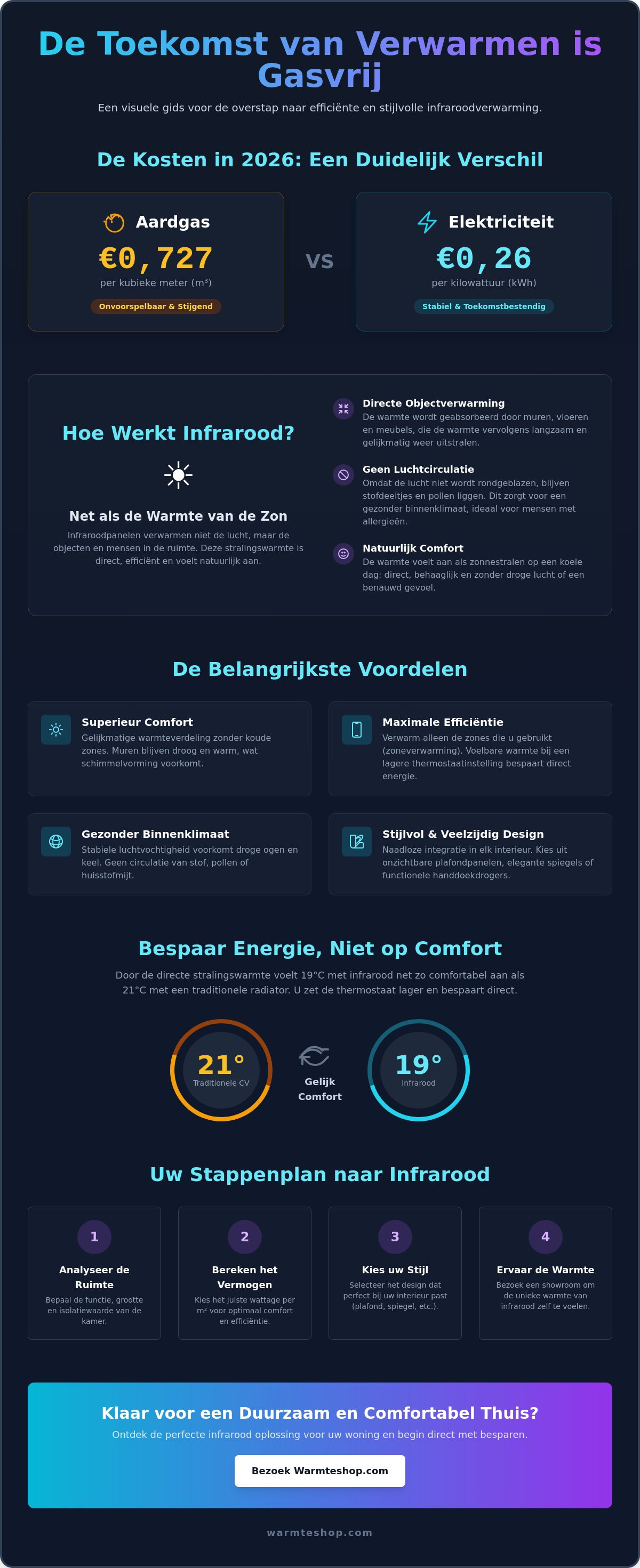
The switch to electric heating raises questions for many homeowners regarding monthly costs. This is a legitimate concern, especially now that energy prices are stabilizing around €0.26 per kWh for electricity in 2026, while gas prices are rising towards €1.50 per cubic meter. When considering purchasing infrared heating, it is essential to look beyond just the purchase price. The real gain lies in operational efficiency. Unlike traditional systems that heat the air, infrared only consumes energy to directly activate the objects and people in a room. This explanation of infrared heating shows that by eliminating air circulation, you lose significantly less heat through windows and gaps.
The payback period for an infrared system is often shorter than you think. Although a standard 1,000-watt panel costs between €500 and €600 on average, you immediately save on installation costs and maintenance. No annual inspections are required, and there are no moving parts to wear out. However, the impact of your insulation level is decisive here. In a moderately insulated home, infrared works best as strategic zone heating, while in a well-insulated house, it effortlessly takes over the role of primary heating without exceeding your budget.
To prevent undercapacity and an unnecessarily high energy bill, an accurate heat calculation is crucial. For an average room with standard insulation, we often calculate with 30 watts per cubic meter. Do you have a very well-insulated new-build home? Then 20 to 22 watts per m³ may suffice. A wattage that is too low forces the panels to run at full power constantly, which actually drives up consumption. We therefore always recommend having a professional calculation performed by an expert so that each panel performs optimally in the intended space.
The key to maximum savings lies in control. A wireless thermostat is not a luxury, but a necessity to prevent waste. By using smart home Wi-Fi modules, you can program the heating based on your daily routine. Why heat the home office when you are downstairs in the kitchen? With real-time insight via an app, you can see exactly where and when energy is being consumed. This smart integration ensures that the panels are only on when strictly necessary for your comfort.
The decision has been made: you want to make your home more sustainable and increase comfort. A strategic process when purchasing infrared heating prevents unpleasant surprises later on. It all starts with determining the exact goal. Do you only want to tackle that cold corner by the sofa, or are you aiming for a completely gas-free home? For supplementary heating, a lower-power panel specifically aimed at the seating area is often sufficient. For primary heating, an integrated approach is required, where each panel makes optimal use of the thermal mass of the walls. The ideal radiation angle is crucial here; obstructions caused by large pieces of furniture significantly reduce efficiency.
Also take a critical look at the warranty and service. In 2026, the market will be mature, but quality differences still exist. A reliable supplier offers not only a product but also a solid installation plan and technical support. Furthermore, for homes older than 10 years, you benefit from the reduced VAT rate of 6% on both the panels and the installation. This makes the investment immediately more attractive.
Safety is not a minor issue, especially in damp areas. Always check whether the panels have CE, TÜV, and RoHS certifications. These marks guarantee that the system complies with strict European safety standards. In the bathroom, IP ratings are the primary factor. For Zone 2, the area directly above the shower or next to the bath, a minimum IP44 rating is required to guarantee splash-proofness. Cheaper panels often lack proper insulation or overheat protection, which negatively impacts lifespan and safety. Quality panels last 20 to 30 years without any loss of power.
Many wall panels are designed as plug-and-play systems. You mount the bracket, hang the panel, and plug it into the socket. This is ideal for simple supplementary heating. However, if you are opting for a seamless finish or ceiling mounting, professional help is advisable. Installation costs for a single panel average between €200 and €400. A professional ensures invisible cable concealment and correctly connects the panels to your smart home system. This guarantees that the radiant heat, just like the sun, can heat your entire living space unimpeded.
Do you want to be sure you are making the right choice for your specific living situation? View our full range and choose the solution that suits you from Warmteshop's infrared heating collection.
Choosing the right heating system is a decision that determines your living comfort for the next thirty years. In a rapidly growing market, Warmteshop distinguishes itself by not only supplying hardware, but by offering a total solution. When you are considering purchasing infrared heating, you are looking for a partner who translates technical complexity into understandable advice. With more than 30 physical showrooms spread across the Benelux, we make sustainable energy tangible. You don't have to rely blindly on online promises; you can come and experience the natural warmth of the sun yourself and see the difference between glass, metal, and ceramic with your own eyes.
Our expertise extends beyond the sale of a panel. We provide you with complete peace of mind through accurate heat calculations specifically tailored to the insulation value and volume of your spaces. This prevents the previously discussed risks of undercapacity and unnecessarily high consumption. From the initial consultation to the final professional installation and integration with your smart home system, we act as your personal guide in the energy transition.
Warmteshop is part of the Infrarood Verwarming Groep, a market leader that has been a pioneer in the field of radiant heating since 2008. This years of experience means that you benefit from proven technologies that meet the strictest environmental standards of 2026. Our innovative strength ensures that we are always at the forefront with the most efficient thermostats and sustainable materials. Furthermore, thanks to our local service points, you are assured of fast support and personal contact in your area. For us, reliability is not a marketing term, but the foundation of our business operations.
The transition to a gas-free life is in full swing, and Warmteshop offers the tools to make this step comfortable and cost-effective. In addition to our well-known wall and ceiling panels, we offer specialized solutions such as infrared underfloor heating for even base heat throughout the entire home. Our vision of comfort does not stop at the front door. Would you also like to enjoy healthy warmth outdoors without wasting energy? Then check out our Patio Heater Guide for optimal outdoor comfort. Together, we ensure that your investment in purchasing infrared heating results in a healthier indoor climate and structurally lower monthly costs.
The energy transition of 2026 calls for smart choices that go beyond simply replacing a heat source. In this guide, you have discovered how radiant heat not only keeps your walls dry and makes your indoor climate healthier, but also how design and functionality go hand in hand today. By choosing zone heating and smart control via Wi-Fi modules, you regain full control over your living comfort and your energy bill.
A successful switch to electric heating starts with the right information and a solid plan. Do you want to purchase high-quality infrared heating that is perfectly tailored to the unique characteristics of your home? Then take advantage of the expertise we have built up since 2008. With more than 30 showrooms in the Benelux, there is always a specialist nearby who can help you with a free, customized heat calculation. This ensures you are investing in a system that will last for generations.
Find a Warmteshop showroom near you for tailored advice
Leave the traditional gas bill behind and embrace the healthy, natural heat of the future in your own home.
Yes, infrared heating is perfectly suitable as primary heating, provided your home is sufficiently insulated. In modern homes or renovation projects where the building envelope has been properly addressed, these systems effortlessly replace the old gas boiler. By heating the walls and objects, a constant base temperature is created that feels very comfortable. It is a full-fledged alternative that ensures even heat distribution without cold zones in the house.
The number of panels depends on the volume of the room and the quality of the insulation. On average, we calculate 30 watts per cubic meter for a living room with standard insulation. Therefore, in a 15 m² bedroom with a ceiling height of 2.5 meters, you will need approximately 1,125 watts. It is best to distribute this power across two smaller panels for better distribution of radiant heat throughout the entire room.
Direct consumption per kWh is higher, but the total costs over the lifespan are often competitive. A heat pump requires a huge investment and annual maintenance, whereas infrared panels are maintenance-free and have much lower purchase costs. With the current electricity price averaging €0.26 per kWh and smart thermostat control, consumption remains surprisingly low. It is a calculation in which installation costs are also decisive.
Many wall-mounted models are designed for easy self-assembly via a plug-and-play system. You hang the panel on the included brackets and plug it into the socket. However, if you wish to mount panels on the ceiling or have the wiring concealed invisibly within the wall, we recommend hiring an electrician to ensure safety and a clean finish. This is certainly advisable for larger projects.
Infrared panels are absolutely safe for your entire family. Although the surface does get warm, the nature of the materials used ensures that a brief touch does not cause direct burns. Furthermore, many panels are mounted on the ceiling or high on the wall, keeping them out of the direct reach of grasping hands or curious noses. There are no moving parts or open flames, which enhances safety.
Long-wave infrared radiation (IR-C) is intended for indoor use because it does not heat the air, but directly heats objects and people. This feels soft and pleasant, comparable to the sun. Short-wave radiation (IR-A), often recognizable by an orange glow, is much more intense and is primarily used for outdoor patio heaters. For healthy indoor warmth, you should always purchase long-wave infrared heating for optimal comfort.
This is the most sustainable combination you can make for your home. By using your own generated solar energy directly for heating, you significantly reduce your dependence on the power grid. It increases your self-consumption of solar power, which, given current regulations, is the smartest financial move in 2026 to keep your monthly costs low. You will then be heating your home virtually CO2-neutral.
The average lifespan of a high-quality infrared panel is between 20 and 30 years. Because there are no moving parts, pumps, or filters in the system, there is virtually no wear and tear. This makes it one of the most sustainable investments you can make for your home. When you decide to purchase infrared heating, you will enjoy a constant heat output for decades without having to worry about defects.


