

Choosing a hybrid infrared panel: practical buying guide for 2026
, by Warmteshop, 17 min read
, by Warmteshop, 17 min read
A panel with more power is not automatically the best choice for your space. With a hybrid infrared panel, heat output and how you use the room also matter. Are you primarily looking for direct heat on your…
A panel with more power is not automatically the best choice for your space. With a hybrid infrared panel, heat output and how you use the room also matter. Are you primarily looking for direct heat at your workspace, or do you want to heat a room that feels cold quickly? Then the difference between radiant heat and convection heat makes a big difference.
Hybrid and standard infrared panels look similar, but they do not emit heat in the same way. A standard panel primarily emits radiant heat, which directly warms people and objects. A hybrid version adds convection heat to this, which heats the air in the room. Which option suits you therefore depends not only on the wattage, but also on the insulation, the size, and your heating needs.
In this buying guide, you will learn how hybrid panels work and when they might be suitable for your situation. You will discover what to look for regarding power output, design, and operation, and the role a thermostat plays. This allows you to compare features based on your space and make a choice that suits your intended use.
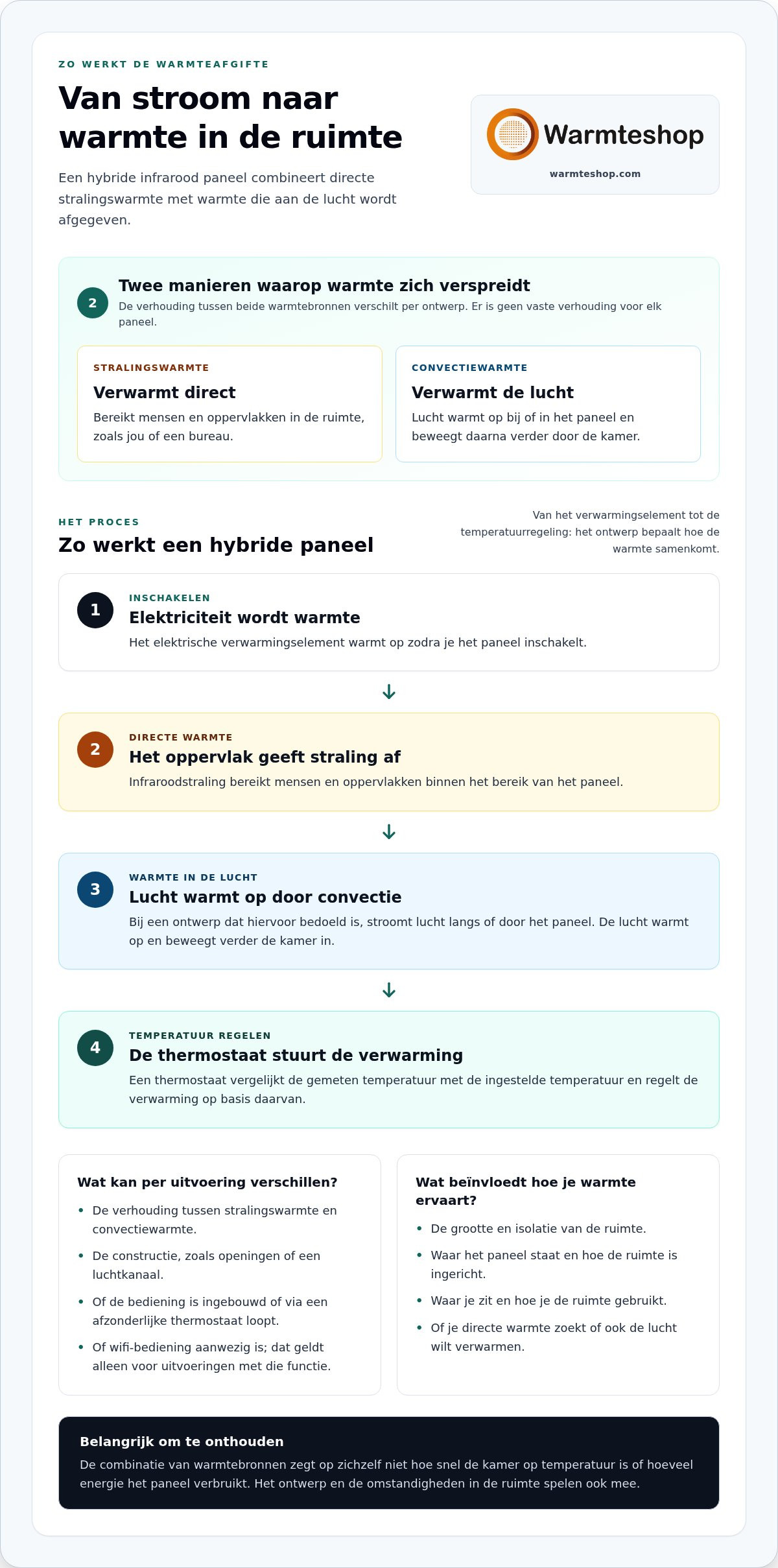
Hybrid heating combines two ways of emitting heat: infrared radiation and convection. A hybrid infrared panel heats people and surfaces directly and also releases heat into the air. The ratio between these heat sources varies by design. There is no fixed ratio that applies to every panel.
That distinction helps when comparing heating panels. With a standard infrared panel, the emphasis is on radiant heat. A hybrid version adds convection heat to that. This combination may be suitable if you value both direct heat and heating the air. Hybrid does not automatically mean more economical or better: the right choice depends, among other things, on the room, the insulation, and how you use it.
Infrared radiation heats people and surfaces directly; convection heat heats the air. That difference helps you understand the double heat output. For more background on infrared heating, also read: What is an infrared panel?
With standard infrared heating, radiation is central. The heat reaches you or a desk, for example, without the air first forming the main intermediate step. A hybrid panel adds convection: the air near the panel heats up and begins to circulate. As a result, the heat can spread through the room differently. This does not mean that a hybrid panel is more comfortable for everyone.
Suppose you mainly sit in one fixed spot. In that case, direct radiant heat may meet your needs. If you use the room as a whole, heating the air can also be a factor. Therefore, do not just look at the type of panel, but also at where you sit, the size of the room, and the temperature experience you are seeking.
Radiant heat reaches you directly and releases heat to surfaces in the room. This can feel like sunbeams warming your skin, even when the air around you does not yet feel warm. Convection heat works differently: the panel heats the air, which then moves through the room. The two heat sources therefore operate according to different principles.
The distribution that feels comfortable varies depending on the situation. Consider a home office you use for part of the day, a living room where you spend longer periods, or a room that is less well insulated. The placement of the panel and the interior design also influence how you experience the heat. Therefore, view the combination as a choice regarding heat output, not as a promise regarding heating time or energy consumption.
Operation begins as soon as the panel receives power. An electric heating element converts electricity into heat. The panel distributes that heat in two ways: the surface emits infrared radiation, and the structure can also heat the air. How these processes combine depends on the design of the panel.
The two heat paths are not the same. Radiation releases heat to whatever is within its range, while convection heats the air and circulates it. This combination influences how heat spreads throughout the room, but does not in itself indicate how quickly the room reaches the desired temperature. The panel design and room conditions also play a role. In Research into infrared heating, you will find additional information about infrared heating and experiences with its use.
In versions with openings or an air duct, air can move along or through designated parts of the panel. The air absorbs heat and subsequently rises, after which cooler air can take its place. Meanwhile, the panel surface plays a role in radiant heat. The construction varies by model. Therefore, compare the openings, airflow, and surface of the specific version, but do not deduce a fixed warm-up time from this.
A thermostat compares the measured temperature with the set temperature and regulates the heating based on that. In this way, the thermostat helps adjust the room temperature to your desired setting. Thermostat control adjusts the operation of the heating based on the measured temperature.
The controls can be integrated into the panel or operated via a separate thermostat. A built-in Wi-Fi thermostat is only available on models with this feature. With a separate thermostat, you control the heating independently. Check how the temperature control is configured on the model you are considering. Also compare the options for thermostats for electric heating to choose a control system that suits your needs.
A hybrid infrared panel therefore does not regulate itself completely. A thermostat helps control the temperature, but the placement and characteristics of the room remain important. By considering heat output and control together, you get a more realistic picture of how the heating fits into your daily routine.
The choice depends on how you heat the room and what level of warmth you find comfortable. A hybrid infrared panel combines radiant heat with convection. With a standard infrared panel, radiant heat is the primary function. This difference can be important if you often sit in one spot or prefer to experience the warmth throughout the entire room. Neither type is automatically the best option for every home or room.
Use this comparison as a starting point. The experience also depends on the placement, insulation, and layout of the room.
| Point of comparison | Standard infrared panel | Hybrid panel |
|---|---|---|
| Heat principle | Especially radiant heat | Radiant heat and convection |
| User experience | Targeted heat on people and surfaces | Direct radiation, supplemented by heating of air |
| Point of attention | Suitable for a targeted heat demand | The combination must suit the space and use |
Power output is important, but it does not in itself indicate whether a panel is suitable. Two rooms with similar dimensions can differ in insulation, ceiling height, usage, and desired heating experience. Therefore, look at the overall picture and not just the wattage. Hybrid heat distribution also does not guarantee fixed energy savings. Consumption depends partly on the control system and how long you heat.
The combination may be suitable for a space where you appreciate both direct heat on a seating or workspace and heating of the air. Think of a room you use for extended periods, but where you want to make more than just the area directly in front of the panel comfortable. How much value you place on the additional air heating depends on your preference and the characteristics of the room.
Also consider your daily routine. Do you heat the room mainly for short periods, or do you spend hours in it at a time? The duration of use and your comfort preferences help determine which heating principle suits you best. A hybrid panel is not automatically suitable as primary heating. Factors such as heat demand and insulation must be taken into account for this.
A standard panel can be logical if you are primarily seeking targeted radiant heat, for example at a fixed workstation or seating area. If you want to make a single defined spot more comfortable, then an emphasis on radiation may suit that heating requirement. Additional convection is not automatically an advantage in that case, especially if you do not want to heat the entire room in the same way.
Compare the options based on your own usage: where do you spend time, which parts of the room do you want to heat, and how long is the heating on? Also, look at infrared heating for different rooms to compare the possibilities side by side. This way, you base your choice on the heating needs in your home, not on a general ranking of panel types.
Don't start with the product, but with the room and your heating method. First, map out the heat demand, and then compare power output, design, and operation. This prevents you from basing your choice on a single specification. Use these steps as a practical starting point.
Start with the dimensions and the function of the room. Measure the space and then consider insulation, windows, and lifespan. A room with a lot of glass can feel different from a comparable room with few exterior walls. Also consider where you want to experience warmth. With this data, a heat calculation can guide the choice of capacity, without applying a single fixed rule to every situation.
Metal and ceramic versions are both options, but the material alone does not indicate how a panel performs. Compare the features of the specific version. Also check whether the desired thermostat control or Wi-Fi operation is included. In damp rooms, such as a bathroom, there are additional considerations regarding electric heating and installation. Take these into account when making your choice.
A hybrid infrared panel is best suited when the heat output, power, and controls match your daily use. Do you want to compare heating options for different rooms? Then take a look at the infrared heating at Warmteshop.
Choosing the right heating system starts with understanding your space. How big is the room, how well is it insulated, and when do you use it? Your desired heating experience and how you want to operate the panel also play a role. Warmteshop helps you combine these factors with personalized advice and a heat calculation. This gives you more certainty when choosing power output than if you only looked at surface area or wattage.
Warmteshop offers infrared panels for walls and ceilings, alongside other heating solutions. Which model suits you depends on the product's features, operation, and installation options, as well as your specific situation. Compare these characteristics with how you use the space daily so that your choice doesn't just look right on paper.
Good advice starts with your heating needs. A room you use as a workspace daily requires a different assessment than a room you only spend time in occasionally. The heat demand, insulation, and desired heat distribution guide the execution and the required capacity.
Next, take practical preferences into account. Consider the materials and controls you find convenient. Some models feature a Wi-Fi thermostat, while others use separate controls. Discuss your wishes and the characteristics of the room so that the advice and heat calculations provide a concrete basis for your choice. Review the options for heat calculations and personal advice as the next step.
Warmteshop provides professional installation as an additional service. The approach is tailored to the chosen model and the room where the panel will be installed. The desired placement and the practical layout of the room are relevant starting points in this regard. Thus, installation is part of the total solution, alongside the choice of the panel and the power output matching.
Making the right choice therefore requires more than just a comparison of materials or specifications. By viewing advice, heat calculations, and installation as interconnected steps, you work towards a solution that aligns with your wishes. Infrared heat can evoke the feeling of sunbeams on your skin, while a hybrid version also emits convection heat. The comfort you experience depends on your situation and the chosen model.
Would you like to view infrared heating for your space? Discover the Warmteshop range and choose the next step with personal advice, a heat calculation, or professional installation.
A heating choice becomes concrete when you translate your comfort preferences into a solution for your home. Consider where heat makes a difference for you and which controls feel comfortable for daily use. With these starting points, you can make a targeted assessment of whether a hybrid infrared panel fits your plans for the space.
Warmteshop helps you with personal advice and a heat calculation to tailor the capacity to your situation. You can also view the options in a physical store or showroom. Professional installation is available as an additional service if you wish to have your choice installed.
This way, you don't make your choice based on a single specification, but tailor the heat to your living environment and what feels comfortable. Discover infrared heating and request customized advice. Discuss your space and wishes with Warmteshop and take the next step towards a suitable heating solution.
No, suitability depends on the function, dimensions, and insulation of the room, as well as the warmth you are seeking. You might use the panel differently in a small home office than in an open living space. Therefore, double heat output is not automatically the best solution. A heat calculation helps substantiate the required capacity. In damp rooms, such as a bathroom, the product specifications and installation instructions require extra attention.
This depends on the capacity, the operating time, and the thermostat control. You calculate the theoretical consumption by multiplying the capacity in kilowatts by the number of operating hours. The result is in kilowatt-hours. For example, a 0.5 kilowatt panel that is switched on continuously for one hour consumes 0.5 kilowatt-hours. In practice, the operating time varies with the insulation, the room, and the set temperature. Therefore, a fixed average consumption is not representative for every situation.
No, that varies by model. Some panels have an integrated Wi-Fi thermostat, while others use a separate thermostat. Compare the controls of the model you are considering: is the temperature control built-in or do you use a separate thermostat? With thermostat control, you set a desired temperature and the heating can be adjusted accordingly. This way, you know which controls suit your daily use.
That depends on the design, mounting, and electrical connection. Always follow the installation instructions for the chosen panel and consider the location where you need heat. A heat calculation can help determine the placement, ensuring you aren't just looking at an empty wall. If you wish to have the installation carried out, Warmteshop provides professional installation services as an additional service.
Not automatically. The combination of radiant heat and convection does not in itself guarantee fixed savings. Energy consumption depends on factors such as the power output, heating duration, insulation, and temperature control. Therefore, first compare the room's heat demand with its usage. A panel with more heating principles is not automatically the most economical choice; tailoring it to your specific situation is the determining factor.
This cannot be assessed in the same way for every home or room. The required capacity depends, among other things, on the size of the room, the insulation, and the heat loss. Have a heat calculation determine whether the chosen model can fulfill the desired role. Without this alignment, it is not advisable to consider a hybrid panel as universal primary heating. The same calculation also helps when assessing multiple rooms separately.
Switch off the panel and allow it to cool down before cleaning. Then follow the maintenance instructions for the specific version and do not use cleaning agents or methods that are not permitted therein. The advice may vary depending on the material and construction. Therefore, consult the documentation for your panel before starting maintenance. This will prevent a general cleaning method from being unsuitable for the surface or components of your version.


