

Buying a patio heater in 2026: the complete guide for your outdoor space
, by Warmteshop, 18 min read
, by Warmteshop, 18 min read
Did you know that gas-fired patio heaters are now a thing of the past in cities like Amsterdam, Utrecht, and Eindhoven? The transition to electric is no longer a choice, but the new standard for every…
Did you know that gas-fired patio heaters are now a thing of the past in cities like Amsterdam, Utrecht, and Eindhoven? The transition to electric is no longer a choice, but the new standard for anyone who wants to continue enjoying the outdoors comfortably in 2026. You probably want nothing more than to extend those sultry summer evenings indefinitely, but you might be worried about a rising energy bill or an unsightly device on your carefully styled facade.
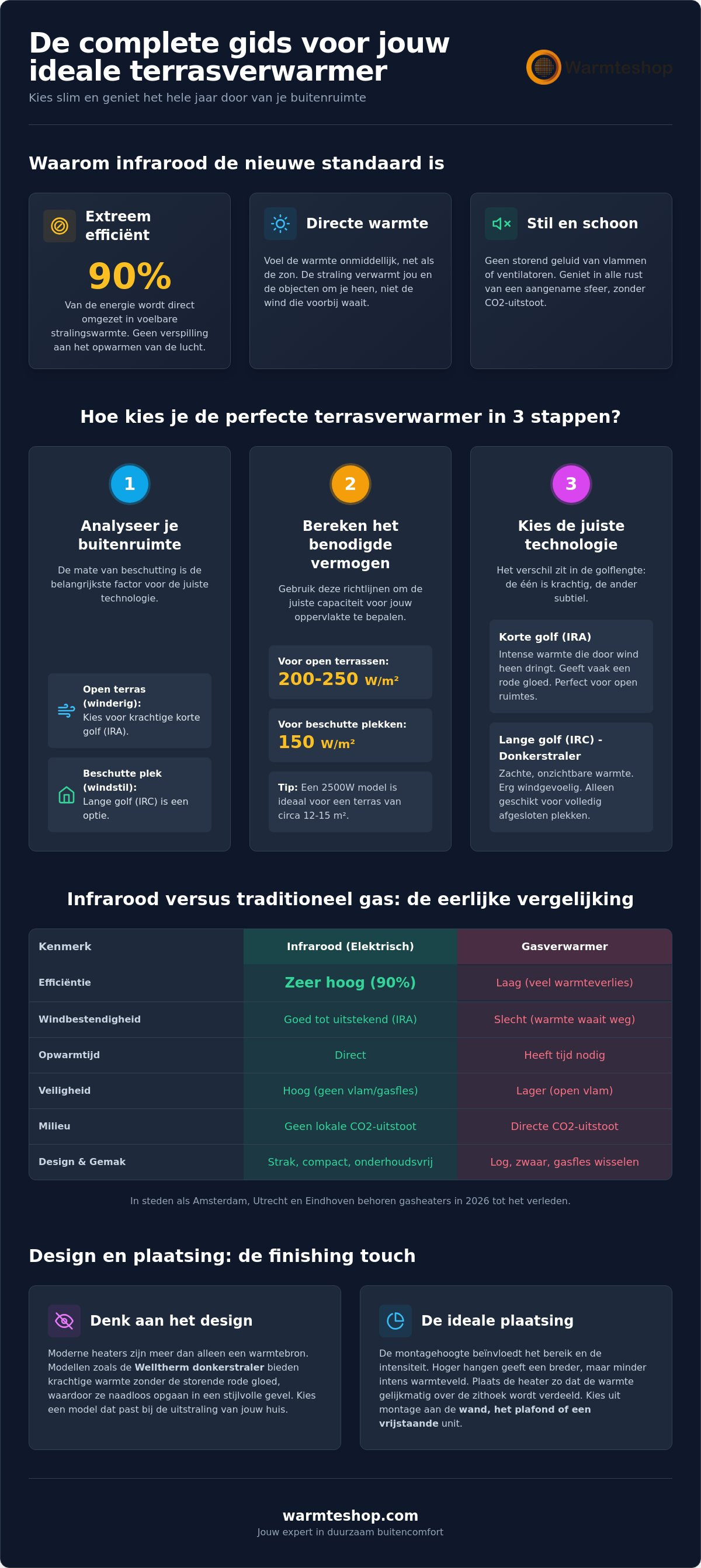
That feeling makes perfect sense, because an outdoor space should be a place of relaxation, not a source of uncertainty regarding running costs. In this comprehensive guide, you will discover how to choose the ideal patio heater that seamlessly complements your garden or balcony, so those thick blankets can stay indoors for good. We explain exactly how modern infrared technology converts up to 90 percent of the energy directly into heat and what capacity you really need for your specific situation. We dive into the world of energy-efficient short-wave radiation and show you how to create a stylish outdoor space that feels like the natural, healthy warmth of the sun all year round.
Your garden is no longer a separate space that you only visit during the hottest summer days. By 2026, we expect the boundary between indoors and outdoors to permanently blur. A high-quality patio heater serves as the indispensable link that transforms your terrace into a full-fledged extension of your living room. While we used to often settle for a thick sweater or a shaky gas heater, we are now opting for innovative technology that feels just as natural and healthy as the sun on your skin. It is a smart upgrade for your living comfort that combines sustainability with pure luxury.
The fundamental difference between older systems and the current generation lies in the heating method. While a traditional patio heater attempts to warm the air around you, infrared does something completely different. It directly heats the objects and people within the radiation zone. This is crucial for your comfort. After all, warm air blows away immediately with the slightest breeze, leaving you feeling cold. Radiant heat does not. It penetrates cold gusts of wind, ensuring you experience a constant and pleasant temperature even on a crisp autumn evening. Moreover, 2026 is the year in which we will definitively say goodbye to the cumbersome gas cylinder in many Dutch cities due to stricter local regulations and growing awareness regarding CO2 emissions.
Waiting for heat is a thing of the past. As soon as you flip the switch, you feel the radiation directly on your skin. Because no air movement is required, virtually no energy is lost to the outside air. This makes the system extremely energy-efficient; modern devices convert up to 90 percent of the electricity directly into tangible heat. Furthermore, you enjoy completely silent operation. There are no hissing flames or rattling parts to disturb the peace on your terrace, contributing to a relaxed atmosphere.
An investment in a patio heater is a direct investment in your quality of life. You expand your effective living space without having to add a costly extension. Whether it’s an early drink in the first spring sunshine or a cozy evening in late autumn, the outdoor space remains usable and inviting. For hospitality business owners, allowing guests to sit comfortably outside has become a business necessity, but for you as a private individual, it also significantly increases the value of your home. You create a place where memories are made, regardless of what the thermometer indicates.
Choosing the right outdoor heating is not simply a matter of grabbing the model with the highest wattage. Your specific situation determines which technology is most effective. Do you have a completely open terrace where the wind has free rein, or are you looking for warmth for a sheltered veranda? The environment dictates the type of radiation you need. While a patio heater in an open space has to exert brute force to defy the wind, a more subtle solution often suffices in an enclosed space.
A crucial aspect that is often overlooked is the difference between short-wave and long-wave infrared. Short-wave radiation (IRA) is the most powerful form. This radiation is hardly susceptible to gusts of wind and penetrates directly into the body, similar to the bright midday sun. This makes it the only good choice for exposed locations. Long-wave radiation (IRC), often found in so-called 'dark heaters', emits a gentler heat without emitting light. However, this technology is very sensitive to wind and is therefore only suitable for completely windless or enclosed canopies. Also pay attention to the mounting height during installation. The higher you hang the device, the greater the range, but the lower the intensity of the heat on your skin.
For a comfortable feeling on an average terrace, we often use a guideline of 200 to 250 watts per square meter for an open terrace. For a sheltered spot, 150 watts per square meter is often sufficient. In 2026, a 2500W model is often seen as the 'sweet spot'. It offers sufficient reserve to effectively heat an area of approximately 12 to 15 square meters, even on really chilly evenings. Furthermore, if you choose a model with a wide reflector, you distribute this heat more evenly across your seating area.
The way you position the heater affects both the aesthetic result and safety. Wall mounting is the most popular permanent solution because it keeps the cables neatly out of sight and guarantees a fixed beam angle. For modern patio covers, built-in options are available that blend completely into the ceiling for a minimalist look. Do you have multiple seating areas in the garden? Then a freestanding model offers the flexibility you are looking for. With every installation, always take into account the official safety guidelines for patio heaters to prevent fire hazards and overloading your power grid.
Do you want to know for sure which technology best suits your garden design? Then take a look at our extensive range of electric patio heaters and find the perfect match for your outdoor space.
When faced with the choice between a gas heater and an electric patio heater, the comparison will be quicker than ever before in 2026. The days of lugging around heavy, unwieldy gas cylinders that always run out at the wrong moment are definitely behind us. In addition to sheer ease of use, safety plays a decisive role in this consideration. An electric solution is the only responsible option for use under a canopy, veranda, or awning. After all, gas heaters produce an open flame and emit combustion gases, which poses risks in semi-enclosed spaces that you simply want to avoid.
The lifespan of modern infrared lamps is impressive and contributes to a worry-free user experience. While a gas heater often shows signs of wear after a few years due to corrosion and soot formation, high-quality infrared lamps last for up to 10,000 operating hours. This means that with average use, you enjoy the same constant heat intensity for well over fifteen years without significant maintenance. A unique advantage of switching to electric is the synergy with your own energy generation. Do you have solar panels on your roof? Then you are essentially heating your terrace with your own generated green electricity. This makes the switch from gas to infrared not only comfortable but also a financially smart move.
Although the initial investment in a high-quality electric heater may sometimes seem higher, it pays for itself very quickly due to its superior efficiency. For a 2000-watt electric heater, you will pay an average of around €0.70 per hour in running costs in 2026. By comparison, a gas variant will easily cost you between €1.30 and €2.50 per hour for propane. This makes the technology just as cost-effective as the infrared heating we use indoors. You do not waste budget on heating the outside air, but instead direct the heat precisely to where you are sitting.
The transition to a gas-free Netherlands does not stop at your home's front door. Electric patio heating emits no CO2 at the point of use, which is essential for a healthy and pleasant outdoor space. Independent research shows that traditional gas heaters waste an enormous amount of energy because the heat simply rises and dissipates into the atmosphere. With infrared, you choose clean heat without the unpleasant smell of gas, soot formation, or disturbing noise. It is a future-proof solution that seamlessly aligns with a modern, environmentally conscious lifestyle.
In 2026, the choice of a patio heater is no longer solely about whether the device gets warm. The modern consumer seeks a balance between technological perfection and aesthetic integration. We have selected three models that each excel in performance and design in their own way. Whether you have an open rooftop terrace or an intimate, covered veranda, there is a specific solution that elevates your outdoor experience.
The absolute king of design is the Welltherm dark radiator HPGS. This model is a favorite for those who love an atmospheric ambiance without the disturbing red glow of traditional lamps. Thanks to innovative ceramic technology, this device emits powerful, invisible infrared heat that is perfect for long dinners at the garden table. Are you looking for brute force for an exposed terrace? Then the Heliosa 77 RC is still the flagship for 2026. With its robust housing and impressive range, this model effortlessly defies the wind. For smaller spaces, such as a city balcony, the Alkari I-Pipe offers a compact yet highly efficient solution that is barely noticeable on the wall.
A patio heater should not intrude on the architecture of your home. While older models often looked bulky and industrial, in 2026 we see a trend towards minimalist finishes. Ceramic heaters fitted with high-quality glass provide a luxurious look that blends seamlessly into a modern garden design. Moreover, you can choose from various color finishes, such as anthracite, white, or brushed aluminium, so that the unit perfectly matches the color of your window frames or the beams of your canopy.
Comfort also means you don't have to get up from your armchair to adjust the temperature. The latest generation of heaters is fully smart. You easily control the heat intensity via an app on your smartphone or with a compact remote control. Dimmable heaters are essential in this regard; they allow you to adjust the heat output to the outside temperature, which is also beneficial for your energy consumption. For those who want maximum control over multiple zones on the terrace, our advanced thermostats offer the ability to set up scenarios that suit your lifestyle.
Curious which model looks best in your garden? Visit one of our showrooms to experience the different models live, or view our complete collection of patio heaters online now.
You have chosen the perfect patio heater; now it is a matter of installing it so that you make optimal use of every gram of heat. Proper mounting determines whether your outdoor space feels like a chilly corner with a heater, or a natural oasis of comfort. Just as the sun heats the earth from a specific angle, your infrared heater must be strategically aimed to effectively reach people and the space. Expert installation is the foundation for healthy heat that does not simply move the air, but warms you directly.
The beauty of modern electric systems is that they are virtually maintenance-free. Unlike gas heaters, you do not need to clean burners or replace filters. Nevertheless, a small effort is advisable for maximum efficiency. The reflector behind the lamp is the heart of your device; it ensures that the radiation is reflected forward. By dusting this reflector once or twice a year with a soft cloth or compressed air, you maintain full reflection capacity. For technical installation, especially when new power outlets or separate circuits need to be installed, we always recommend engaging a professional. Our advisors in the 30 showrooms in the Benelux can tell you exactly which installer in your region has experience with the high-quality systems from Welltherm or Heliosa.
Prevent cold spots by not hanging your heater too high. An ideal mounting height is usually between 2.10 and 2.50 meters. If you hang it higher, you lose intensity; if you hang it lower, the heat becomes too concentrated. Adjust the heater at an angle of approximately 45 degrees so that the radiant cone covers your entire seating area. On an open terrace, it is smart to have the heater radiate with the wind so that the perceived temperature remains constant, even if a fresh breeze picks up.
Powerful heaters of 2500W or more place a heavy strain on your power grid. It is therefore essential to connect them to a separate circuit to prevent overloading. When purchasing, also pay close attention to the IP certification. For an exposed patio, you need at least IP65, which means the unit is splash-proof. Under a closed canopy, IP44 is often sufficient, offering protection against splashing water. Safety and comfort go hand in hand in a future-proof outdoor space. View all technical specifications and models on the patio heater collection page for an informed choice.
Extending the outdoor season in 2026 will be easier and more sustainable than ever before. By choosing a modern patio heater, you move away from inefficient gas cylinders and opt for the healthy, direct radiant heat of infrared. We have seen that the right balance between technology, such as the choice between short- or long-wave radiation, and stylish design makes the difference between a temporary solution and a permanent enhancement of your living comfort. Whether you fall for the invisible heat of a dark radiator or the brute force of a wind-resistant model, the transition to electric heating is a smart investment in your own garden enjoyment.
Do you want to experience the natural warmth of the sun yourself, or do you need help calculating the required capacity for your patio? Then visit one of our 30 showrooms in the Benelux for expert advice tailored to your situation. Our experts would be happy to show you high-quality models from top brands such as Welltherm and Heliosa, ensuring you make the right choice for your unique outdoor space. Discover the ideal patio heater for your garden at Warmteshop and enjoy a comfortable patio all year round without compromise.
A 2000-watt electric patio heater consumes exactly 2 kilowatt-hours (kWh) per hour when operating at maximum power. Based on average energy rates in 2026, this will cost you approximately €0.70 per hour. This is a significant saving compared to gas heaters, which often cost twice as much in fuel. You can reduce consumption even further by choosing a model with dimming settings, allowing you to adjust the intensity to the outdoor temperature.
Yes, you can safely install an electric heater under a wooden canopy provided you adhere to the prescribed safety distances. For most infrared models, a minimum distance of 20 to 30 centimeters from the ceiling applies to prevent heat buildup. Because electric systems do not involve an open flame, the fire risk is minimal compared to gas heaters. Our advisors in Warmteshop's 30 showrooms will be happy to help you determine the exact safe position for your situation.
The main difference lies in the wavelength of the heat and its sensitivity to wind. An infrared heater with a short-wave lamp provides direct, powerful heat that does not blow away, comparable to the bright midday sun. A ceramic heater works with long-wave radiation and emits no light. This is perfect for completely enclosed spaces, but less effective on open terraces because the heat dissipates more quickly there due to the wind.
For a 15-square-meter terrace, you typically need a total output of approximately 3,000 to 3,750 watts in an open setting. If the space is sheltered under a canopy, an output of 2,250 watts is often sufficient. It is smart to distribute this output across two smaller units instead of one large heater. This creates an even heat distribution across the entire seating area, ensuring everyone at the table enjoys the same level of comfort.
Most high-quality patio heaters are highly resistant to extreme weather conditions, provided they have the correct IP certification. A model with an IP65 rating is completely splash-proof and can remain outdoors all year round, even during heavy rainfall. Brands such as Heliosa design their housings specifically using corrosion-resistant materials for outdoor use. However, it is advisable to clean the reflector of dust occasionally to ensure continued optimal radiation efficiency.
No, a permanently mounted patio heater with a high IP rating does not need to be brought indoors in the winter. These devices are built to withstand the elements without compromising on quality. Especially during the cold winter months, a short-wave heater can provide healthy warmth for spending some time outdoors. For freestanding models, however, it may be wise to use a protective cover or store them in a shed to keep the housing looking good for longer.
A dark radiator is a heater that emits no visible light, creating a very peaceful ambiance on your terrace. These devices use long-wave infrared radiation that heats objects and people in the room more slowly but very pleasantly. They provide absolutely enough heat, but are only effective in windless or completely enclosed spaces. In an open garden, the heat would dissipate too quickly, preventing you from experiencing the desired comfort.
Yes, modern patio heating integrates perfectly into your smart home system via special Wi-Fi modules or wireless thermostats. This allows you to easily control the heater via an app on your smartphone or even with voice control. You can set schedules or dim the heat steplessly without getting out of your armchair. This not only increases your comfort but also helps save energy by only running the heater when it is truly necessary.


