

Buying an indoor infrared heater: the complete guide to a warm interior in 2026
, by Warmteshop, 18 min read
, by Warmteshop, 18 min read
By 2026, the transition to a natural gas-free life will no longer be a distant prospect, but a daily reality that calls for smart, aesthetic solutions. In this context, a high-quality indoor infrared heater is not so…
By 2026, the transition to a natural gas-free life will no longer be a distant prospect, but a daily reality that calls for smart, aesthetic solutions. In this context, a high-quality indoor infrared heater is not just an extra heater; it is a strategic design element that brings the natural warmth of the sun directly into your living room or home office. While central heating often blasts unnecessarily all day long to heat the air, infrared technology offers direct, healthy warmth that heats objects and people without stirring up dust.
You probably recognize the doubt: how much wattage do you really need, and won't that extra electric heating actually drive up your energy bill? It is perfectly logical that you seek a balance between a comfortably warm home and responsible electricity consumption, especially now that the rules surrounding renovation grants are constantly changing. In this article, you will discover how to choose the right indoor infrared heater for maximum efficiency and a healthy indoor climate. We take you step-by-step through the technical choices and show how modern panels blend seamlessly into your interior, so that from now on you can enjoy sustainable warmth that feels just right.
Imagine stepping into the sun on a cold winter day. You immediately feel the warmth on your skin, even though the air around you is fresh. That is exactly the experience an infrared heater creates indoors. Unlike traditional systems that attempt to heat the air in a room, a heater emits waves that directly warm objects, walls, and people. In 2026, now that the transition to fossil-free living is gaining momentum, this technology is one of the smartest ways to increase your comfort without wasting energy unnecessarily.
To fully understand how it works, it is useful to look at the technical basis. What exactly is an infrared heater ? It is a device that converts electricity into radiant energy. Whereas central heating works on the basis of convection, or the circulation of warm air, infrared bypasses the air as a medium. This makes it the ideal solution for challenging spaces with high ceilings or places where drafts play a role. After all, you are not heating the volatile air, but the solid mass in the room, which then slowly releases the heat back into the surroundings.
Although both systems use radiation, the main difference lies in intensity and range. Infrared panels are usually designed for constant, subtle basic warmth in rooms where you spend extended periods. An indoor infrared heater, on the other hand, often has a higher power density. You choose the power of a heater when you want to tackle a specific 'cold zone' or bring a room up to temperature quickly. Think of a seating area in a large living room or a desk in an otherwise cool office. The heat is more direct and powerful, meaning you do not need to heat the entire room for a comfortable feeling in one spot.
Radiators are inherently slow and inefficient. It takes a long time for air circulation to warm up the room, and even then, the warmest air often remains stagnant against the ceiling. This results in cold feet and a stuffy feeling due to swirling dust. With a radiant heater, you see results within minutes. Because the radiant heat acts directly on your body, a room at 19 degrees with infrared often feels just as comfortable as a room at 21 degrees with convection heating. According to current figures, you save approximately 7% on your energy consumption for every degree the thermostat can be turned down. It is a fast, healthy, and modern way of heating that perfectly aligns with current requirements for sustainable living.
The biggest advantage of an indoor infrared heater is undoubtedly speed. You no longer have to wait half an hour for the air in the room to finally reach a comfortable temperature. As soon as you switch on the heater, you feel the warmth directly on your skin. This makes the system extremely efficient for zone heating. Instead of heating the entire house, you focus the energy exactly where you are at that moment. Because you can turn down the thermostat in other rooms, you save significantly on your monthly costs. After all, every degree lower means a saving of approximately 7% on your energy consumption.
In addition, the system is completely maintenance-free. There are no filters to replace, no pipes to leak, and no moving parts to wear out. This ensures not only a long lifespan but also completely silent operation. In a home office or bedroom, that silence is essential for your concentration and a good night's sleep. Although the technology is very reliable, we recommend always following general safety guidelines for electrical appliances during installation, such as keeping the radiation zone clear of objects and flammable materials.
For people with allergies, this method of heating is a relief. Traditional radiators create a constant airflow that spreads dust, pollen, and dust mites throughout the room. Infrared radiation does not do this. The air remains calm and the humidity stable, which is better for your mucous membranes and prevents dry eyes. Moreover, the heater heats the walls directly instead of the air. This keeps the masonry dry and prevents the formation of mold, which directly contributes to a healthier living environment in the long run.
The heat from an indoor infrared heater feels fundamentally different from the 'dry' heat of a convector. It is a deep, penetrating heat comparable to the natural radiation of the sun on a clear day. This radiation penetrates deeper into your body, which has a relaxing effect on your muscles and promotes your overall well-being. It is a sensory experience that brings tranquility to your interior. You create a place where you can truly recharge after a busy day. Would you like to experience for yourself how this beneficial warmth feels? Then take a look at our extensive collection of infrared heating and discover the many possibilities for your specific living situation.
When purchasing an indoor infrared heater, you always start with the question: what is the main purpose? Do you want to heat an entire room as primary heating, or are you looking for a targeted solution for the seating area? For supplementary heating, a heater with lower power output is often sufficient, which you strategically aim at your favorite reading chair. Are you going to install the heater in the bathroom? Then pay close attention to the IP rating. This rating indicates the extent to which the device is protected against moisture and water. An IP44-certified heater, for example, is splash-proof and therefore safe for use in damp areas.
The quality of the housing determines how efficiently heat is released. Aluminum is an excellent choice because this material distributes heat very evenly and is lightweight. Glass or metal offers a more luxurious appearance but often has different heat conductivity. Do not forget the safety features either. A good indoor infrared heater is always equipped with overheating protection and, in the case of a portable model, tip-over protection that immediately switches off the power if the device is no longer stable.
For indoor use, the long-wave heater, also known as the dark heater, is the absolute favorite. These devices do not emit disturbing red light, making them perfect for the living room or bedroom. Medium-wave heaters are more often seen in large halls or rooms with drafts, because the radiation is slightly more powerful. Due to their bright light and intense heat, short-wave heaters are intended almost exclusively for outdoor use on the patio. Indoors, the light output would simply be too dominant for a cozy atmosphere.
A modern indoor infrared heater doesn't have to stand out to do its job. You can choose a minimalist matte white panel that blends in with a light wall, or a sleek black design element that makes a statement in your interior. A very practical and stylish solution is the infrared mirror. This functions as a full-fledged heater and simultaneously prevents the mirror from fogging up after showering. Thanks to the slim design of modern heaters, you can integrate them almost invisibly into your home's architecture, whether you mount them on the wall or the ceiling.
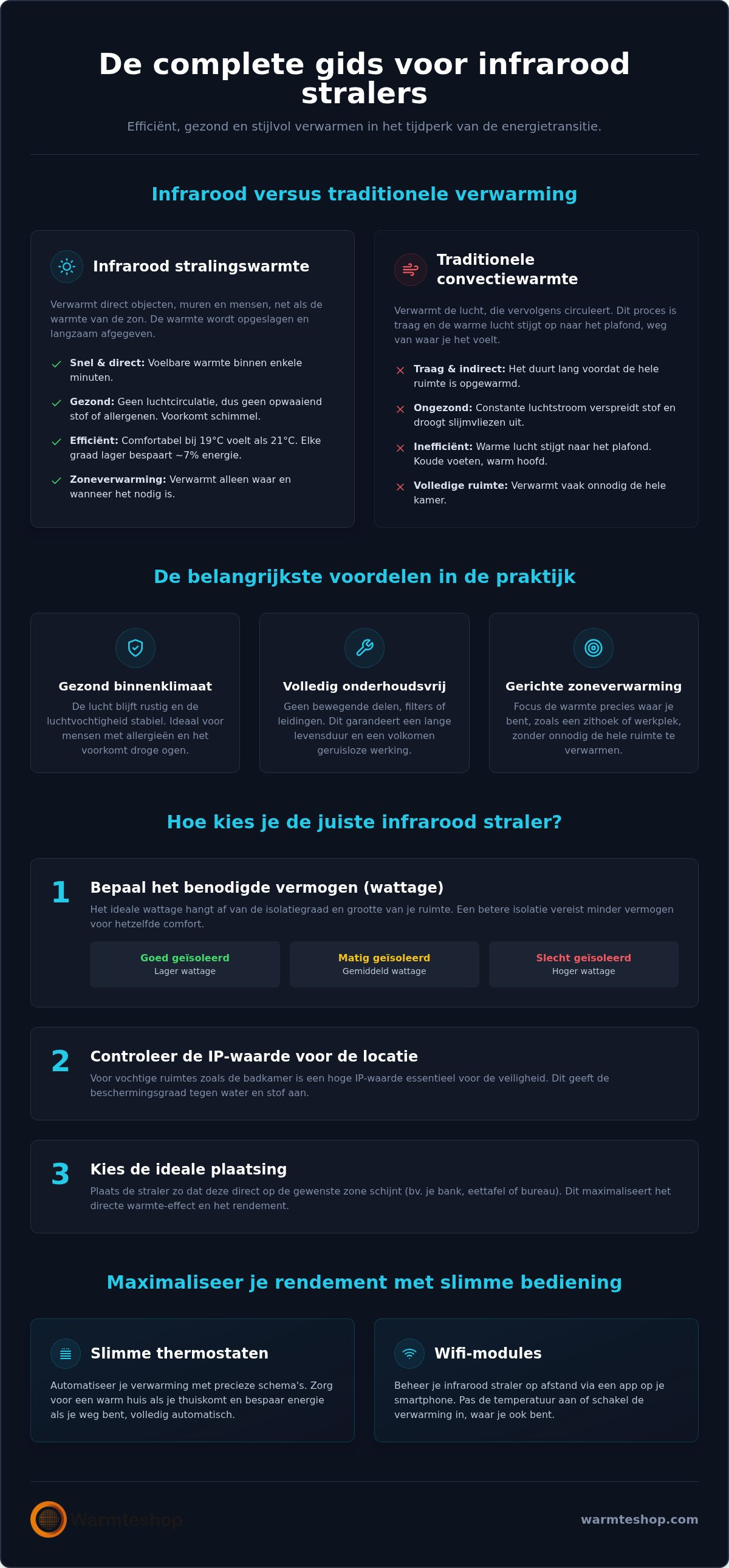
Determining the correct power output is the most important step in keeping your energy consumption under control. An indoor infrared heater operates most efficiently when the capacity is precisely matched to the room and the level of insulation. In a modern, well-insulated home, 20 to 30 watts per square meter is often sufficient for supplementary heating. Do you live in an older home with less insulation? Then that requirement can rise to 70 watts or more per square meter. The goal is to create a comfortable zone without the device having to run continuously at full power to maintain the desired temperature.
The mounting height is crucial for the radiation angle. If you hang the heater too high, the radiation loses intensity before it reaches you. If you hang it too low, the heat can feel too concentrated and unpleasant. Furthermore, always ensure that there are no obstacles between you and the heater. Infrared waves heat the mass they strike. Is a large cupboard or an armchair in the way? Then that object will get warm, but the beneficial radiation will not reach your body.
The function of the room partly determines the required wattage. In a bedroom, where the base temperature is often lower, a lighter heater suffices. The bathroom, however, is a different story. Here, you want a comfortable feeling on your bare skin within minutes, whereas cold tiles extract heat from the surroundings more quickly. For these specific challenges, you can read more in our guide on electric bathroom heating. By calculating the power intelligently, you avoid consuming unnecessary electricity or, conversely, being left in the cold.
Ceiling mounting is often the most efficient choice for an indoor infrared heater. Just like the sun, the heater warms the floor and objects in the room from above, which then release the heat evenly. This ensures warm feet and a stable indoor climate. Wall mounting, on the other hand, is ideal for targeted heat in a specific spot, such as directly at a desk or in the seating area. In the bathroom, a heater can be perfectly combined with a towel radiator. While the heater warms the room and you, the radiator ensures wonderfully warm towels after showering.
Do you want to be sure you are making the right choice for your home? View our full range of infrared solutions and find the heater that perfectly matches your power requirements and interior style.
An indoor infrared heater is a powerful tool for making your home more sustainable, but without proper control, you miss out on a large part of the savings potential. An intelligent thermostat is the absolute key here. Instead of manually guessing the right temperature, precise control ensures that the system switches off exactly when the desired warmth is reached. This prevents unnecessary power consumption and keeps your energy bill low. This is where the principle of zone heating truly comes into its own: you only heat the rooms where you actually spend time, while the rest of the house remains at a lower base temperature.
By using modern Wi-Fi modules and smartphone apps, you can fully personalize your heating system. Imagine turning on the heater in the living room via your phone while on your way home. By the time you step inside, you are welcomed by healthy, sun-drenched warmth. This technology translates complex energy settings into an understandable interface, giving you insight into your consumption at any time and allowing you to optimize your home's efficiency without technical knowledge.
Installing a wireless thermostat gives you the freedom to measure the temperature where you are sitting, rather than just at the device itself. This ensures a much more realistic sense of comfort and prevents overheating. By programming schedules, you fully automate your energy savings. The system learns your rhythm and ensures the heat is there when you need it, and turned off when you are away. This is not an obligation, but a smart upgrade for your daily living comfort and your wallet.
At Warmteshop, we understand that every interior and every heating need is unique. In our indoor infrared heater collection, you will find no fewer than 21 high-quality options that vary in design, power, and application. Whether you are looking for a robust heater for a high hallway or a subtle model for your home office, there is always a solution that suits you. Our technicians can take the professional installation completely off your hands, so you can be sure that everything functions safely and with the highest efficiency.
While online information provides a good foundation, nothing beats a live demonstration of radiant heat. In our thirty physical showrooms in the Benelux, you can experience the natural warmth of our systems for yourself and feel how it warms your body. Our expert advisors are ready to create a tailored plan for you, including a calculation of the required wattage for your specific situation. Visit us today and discover how we can transform your house into a future-proof and warm home.
Switching to an indoor infrared heater is more than just a choice for comfort; it is a smart investment in a healthier and more energy-efficient home. By opting for targeted radiant heat, you save immediately on energy costs and enjoy an indoor climate free from swirling dust. Whether you choose a stylish mirror in the bathroom or a powerful heater in the seating area, the combination of modern design and smart Wi-Fi control ensures that your interior is fully ready for the future in 2026.
Since 2006, Warmteshop has been the authority in infrared technology. With more than 30 showrooms in the Benelux, our experts are ready to provide you with personalized, tailored advice. Moreover, you don't have to worry about the technology, as our professional installation service takes care of everything down to the last detail. Are you ready to bring the soothing warmth of the sun into your home?
View our complete collection of indoor infrared heaters and discover the ideal solution for your home. We look forward to helping you create a comfortable and green interior that you will enjoy for years to come.
An indoor infrared heater typically has a higher intensity and a more powerful range than an infrared panel. While a panel is designed for constant, subtle basic heat via long-wave radiation, a heater is often used to quickly address specific cold zones. Heaters are ideal for rooms with high ceilings or places where you want to experience an immediate, powerful sensation of warmth, comparable to the direct radiation of the sun on a terrace.
Yes, this system is completely safe as long as you ensure proper placement. Because the housing can become hot, we recommend mounting it on the ceiling or high on the wall, out of reach of inquisitive little hands or curious pets. Unlike convection heaters, there are no exposed heating elements or moving parts. The radiation itself is harmless and actually creates a healthier indoor climate free from airborne dust or pollen.
The required wattage for your living room depends heavily on the level of insulation in your home. In a modern, well-insulated house, 20 to 30 watts per square meter is often sufficient for supplementary heating. For an average living room of 30 square meters, this amounts to approximately 600 to 900 watts. In older homes with less insulation, this requirement can rise to 70 watts per square meter to ensure a stable indoor climate.
That is certainly possible, provided the home is well insulated and the total capacity has been calculated correctly. In the current energy transition, we are seeing more and more households switching entirely to electric heating. By applying strategic zone heating, you only heat the rooms where you are actually present. This often makes the system more efficient and comfortable than traditional central heating, which keeps the entire house unnecessarily warm using gas.
The running costs of an indoor infrared heater are directly linked to the wattage and your personal usage. You can easily calculate this by multiplying the power in kilowatts by the number of operating hours and your current electricity rate. Because infrared heating often allows you to set the thermostat two degrees lower for the same level of comfort, you save significantly on your total energy needs. For every degree lower, your consumption drops by approximately 7 percent.
No, modern heaters do not always emit light. For use in the living room or bedroom, we recommend so-called dark heaters that work with long-wave infrared radiation. These devices are designed to deliver maximum heat without a disturbing red or orange glow. Only short-wave heaters, which are more often used outdoors on the terrace, emit that recognizable bright light. Indoors, you choose aesthetics and tranquility without visual distractions.
For a single heater, a separate electrical circuit is usually not required. A standard 16-amp circuit can power a maximum of 3600 watts of equipment. However, if you decide to use multiple powerful heaters simultaneously as your primary heating source, it is advisable to have a separate circuit installed. During a consultation, our installers can accurately calculate whether your current fuse box has sufficient capacity for your new, sustainable, and future-proof heating plan.
In principle, you can hang a heater yourself using the included brackets and plug connection. However, for a sleek and secure integration into your interior, we recommend our professional installation service. Our technicians ensure invisible cable concealment and connect the heaters directly to smart thermostats or Wi-Fi modules. This not only guarantees safe operation but also ensures that you get the maximum return on your investment.


