
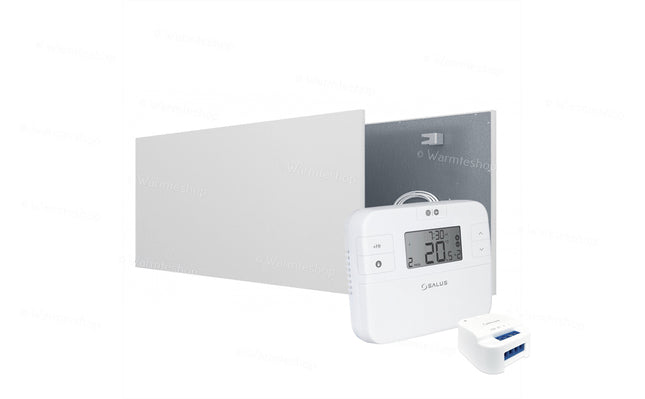
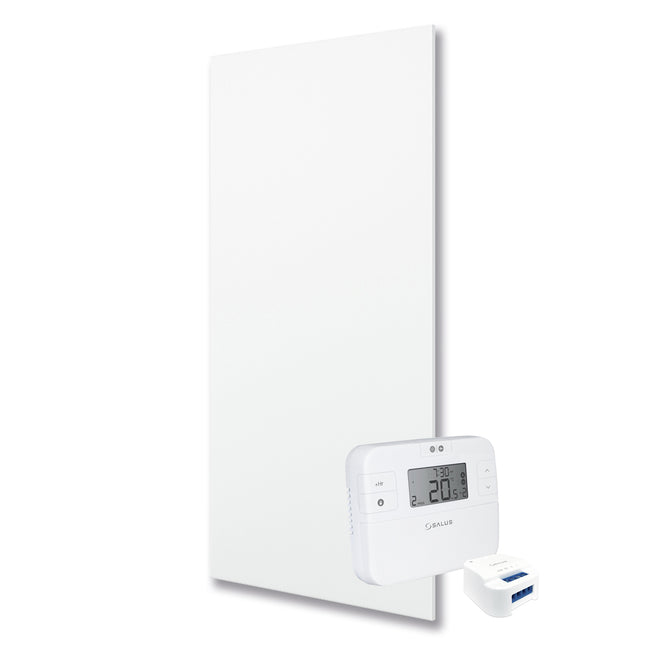
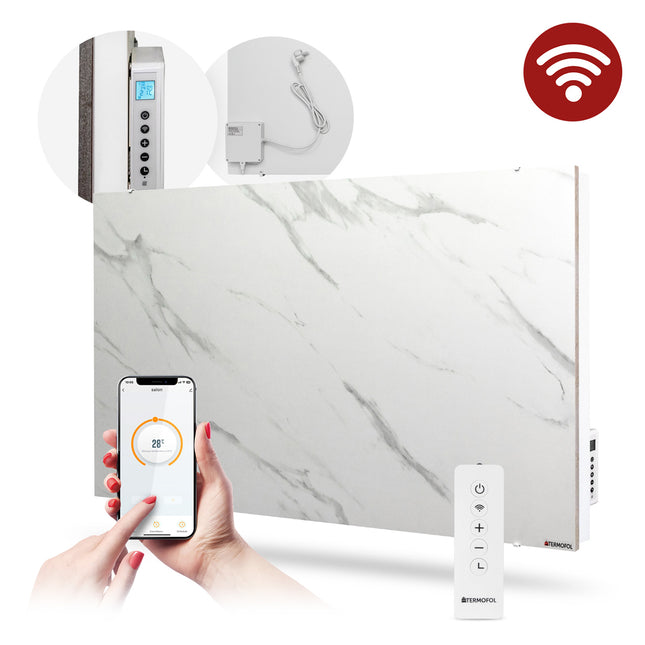



A 1000 W infrared panel delivers 1 kilowatt of electric heating power for primary, supplementary, or zone heating. Whether this power is suitable for your space depends on heat loss, the desired temperature, and the panel's placement. Material, installation, and thermostat control also determine comfort. Below, you will discover how to fairly compare models and choose the right 1000-watt panel for a home or business in Belgium or the Netherlands.

What is a 1000 W infrared panel?
An infrared panel converts electricity into heat and emits a significant portion of it as long-wave thermal radiation. People, walls, furniture, and other surfaces within its range then absorb this radiation. Subsequently, these surfaces gradually release a portion of the heat into the room.
Moreover, a panel does not require a fan. As a result, it operates quietly and no forced airflow is created. Nevertheless, placement is important. A cupboard, curtain, or open door in front of the panel blocks part of the radiation. Therefore, ensure a clear line of sight to the usage zone.
For how many m² is 1000 watts sufficient?
There is no universal number of square meters for every 1000 W infrared panel. The heat demand varies per building and room. Insulation, ceiling height, glazing, exterior walls, ventilation, year of construction, and desired temperature all play a role. Therefore, a good choice starts with the room, not with a fixed number of square meters.
However, you can illustrate the relationship between power and surface area with a formula:
Approximate surface area = 1000 watts ÷ specific heat demand in watts per m².
| Assumed heat demand | Calculation surface area at 1000 W | Possible situation |
|---|---|---|
| 50 W/m² | 20 m² | Very favorable, well-insulated space |
| 75 W/m² | Approximately 13.3 m² | Average heat demand |
| 100 W/m² | 10 m² | Higher heat demand |
| 125 W/m² | 8 m² | Very high heat demand |
However, this table is merely a calculation example and not universal sizing advice. Therefore, have a heat loss calculation performed for primary heating. This prevents the panel from running continuously without reaching the desired temperature.
1000 W infrared panel as primary heating
A 1000-watt panel can function as primary heating provided the calculated heat loss does not exceed the available power. In a larger room, multiple panels are often required. This also allows you to distribute the radiation more evenly than with a single remote heat source. Additionally, you can control different usage zones separately.
For a living room, it is not just the total wattage that matters. Also consider the seating area, dining table, windows, and cold exterior walls. Two well-placed panels can feel more pleasant than a single unit that only covers part of the living space.
Supplementary heating and zone heating
As supplementary heating, a 1000 W infrared panel supports an existing system during cold spells. With zone heating, you direct the radiation to the area where people are present. Think of a dining table, work zone, reception area, or treatment room. This way, you do not necessarily have to bring the entire room to the same temperature.
For a compact workspace, an infrared desk panel be more suitable. A 700 W model may also be a better fit if the calculated heat demand is lower. Therefore, do not automatically choose the highest power, but match capacity and radiation zone.
Actual consumption of an infrared panel 1000 W
At continuous full power, a 1000-watt panel consumes exactly 1 kWh of electricity per hour. The maximum hourly costs are therefore equal to your current price for 1 kWh. For example, if you pay €0.30 per kWh, one full hour of operation costs €0.30.
| Operating time at full power | Electricity consumption | Costs at €0.30/kWh |
|---|---|---|
| 1 hour | 1 kWh | €0,30 |
| 3 hours | 3 kWh | €0,90 |
| 5 hours | 5 kWh | €1,50 |
| 8 hours | 8 kWh | €2,40 |
These are merely examples. Electricity prices vary by supplier, contract, country, and time of day. Furthermore, a thermostat switches off the panel when the set temperature is reached. Consequently, average consumption may be lower than 1 kWh per clock hour. However, the actual operating time depends on insulation, outside temperature, ventilation, and settings.
Metal, glass, mirror, or illuminated panel?
A 1000 W infrared panel is available in various versions. Firstly, a metal model is often sleek, robust, and relatively easy to integrate into an interior. In contrast, a glass panel has a smooth design surface and can be heavier. Therefore, always check the weight and the permitted mounting method.
Additionally, a mirror panel combines heat with a reflective surface. This is practical in a bathroom or changing room, provided the IP rating and installation zone are suitable. If you want to combine ceiling heating with functional lighting, take a look at an infrared panel with lighting. Light output, light color, dimmability, and operation vary by model.
Wall mounting or ceiling mounting?
When wall-mounted, a panel provides focused radiation towards a seating area or workspace. You can compare models within the wall category. Next, check whether both horizontal and vertical mounting are permitted. Additionally, adhere to the minimum clearances specified in the manual.
In contrast, with an infrared ceiling panel, you keep the wall free and the heat can reach a larger floor area. However, not every panel can be mounted overhead. Therefore, verify the ceiling suitability, weight, mounting bracket, and load-bearing capacity of the structure.
Do you want to move the device between different locations? Then a floor-standing model be more suitable. In this case, too, observe the prescribed clearance and place the base on a flat, stable surface.
Select thermostat and control
A suitable control system prevents unnecessary running time. Some panels have a built-in thermostat or receiver. Other models require an external thermostat, a plug-in receiver, or a switched electrical connection. Therefore, a product-specific check is essential. Check what is included in the packaging before purchasing.
With a smart thermostat, you can often set schedules and zones. Place the temperature sensor in a prominent location in the room. Avoid direct sunlight, drafts, a cold exterior wall, and the warm radiant zone directly in front of the panel. This way, the thermostat controls based on the room temperature rather than a local heat source.
A 1000 W infrared panel in various rooms
| Room | Possible application | Important point of attention |
|---|---|---|
| Living room | Main, supplementary or zone heating | Unobstructed view to seating and dining area |
| Kitchen | Targeted heat at the dining table or work zone | Distance to cabinets, moisture, and cooking fumes |
| Office | Quiet heat for workplaces | Distribution across multiple desks |
| Bathroom | Comfortable supplementary heating | IP rating, electric zone and higher comfort temperature |
| Practice or waiting room | Zone heating without a fan | Sufficient power during opening hours |
For damp rooms, wattage is not sufficient as a selection criterion. Therefore, also check the IP rating and the permitted installation zone. Furthermore, if necessary, have the electrical connection assessed by a qualified installer in accordance with the regulations in Belgium or the Netherlands.
Why consider multiple smaller panels?
A single 1000 W infrared panel emits its heat from a single position. In an elongated room or space with multiple usage zones, this distribution can feel uneven. Two smaller panels on different sides can then provide better coverage, even when the total output remains the same.
Therefore, do not compare only 1000 watts. Also consider 400 W, 700 W , and 1500 W.The best combination depends on heat loss, panel position, and space utilization.
Buying checklist for a 1000 W infrared panel
- Heat loss: is 1000 watts sufficient for the calculated heat demand?
- Application: do you use the panel as primary, supplementary, or zone heating?
- Material: does metal, glass, a mirror, or a light panel suit the space?
- Installation: is the model suitable for wall, ceiling , or freestanding use?
- Control: are the thermostat and receiver integrated or required separately?
- Connection: check voltage, plug, cable length, and secure connection.
- IP class: is the panel suitable for the desired bathroom zone?
- Weight: can the wall or ceiling safely support the panel?
- Surface temperature: does the mounting site remain safe and out of direct reach?
- Warranty: compare conditions for panel and electrical components.
Safe installation and maintenance
Always follow the product-specific installation manual. Use fasteners suitable for concrete, stone, wood, plaster, or a suspended ceiling. Never cover the panel with textiles, paper, or decorations. Additionally, keep curtains and furniture outside the specified clearance.
First, switch off the panel and let it cool down completely. Then clean it with a soft cloth and a product suitable for the surface. Avoid abrasive sponges and harsh cleaners. Finally, regular inspection is important. Check the mounting, cable, and plug during this inspection.
Frequently asked questions about 1000 W infrared panel
Does a 1000-watt panel always consume 1 kWh per hour?
Only when it runs continuously at full power for a full hour. A thermostat can switch off intermittently. As a result, the average consumption depends on the actual operating time.
Is 1000 watts sufficient for 20 m²?
Only if the specific heat demand is approximately 50 W/m² or lower. With a higher heat demand, the suitable surface area is smaller. Therefore, have a heat loss calculation performed for primary heating.
Can any 1000 W infrared panel be mounted on the ceiling?
No. The manufacturer must explicitly permit ceiling mounting and supply a suitable mounting system. Additionally, check the weight and load capacity.
Is a thermostat necessary?
A suitable control system prevents unnecessary running time and monitors the desired room temperature. Check whether the thermostat is integrated, included, or available separately.
Can a 1000-watt panel be installed in the bathroom?
That depends on the IP rating and the permitted electrical zone. If in doubt, have the position and connection assessed by a qualified installer.
Buy 1000 W infrared panel at Warmteshop
Compare the models above based on material, dimensions, controls, protection rating, and installation. Warmteshop helps customers in Belgium and the Netherlands match capacity and position to their actual heat demand. You can read independent reviews of Warmteshop via Trustprofile.