
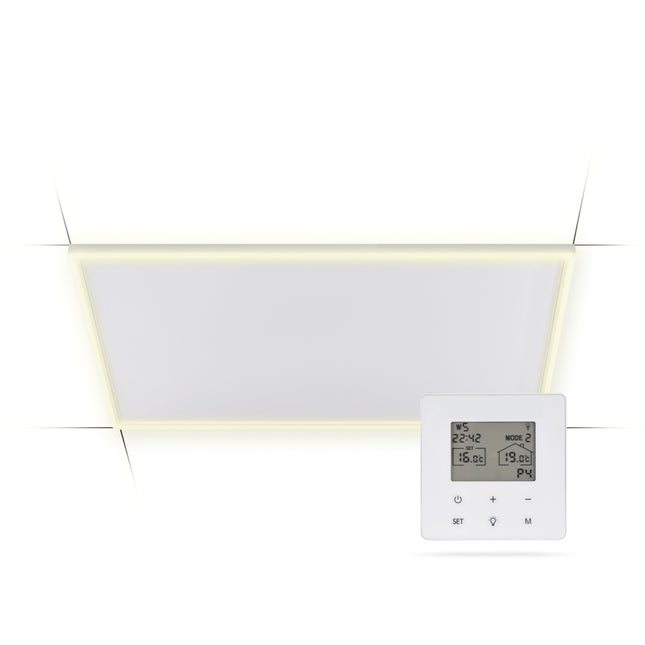
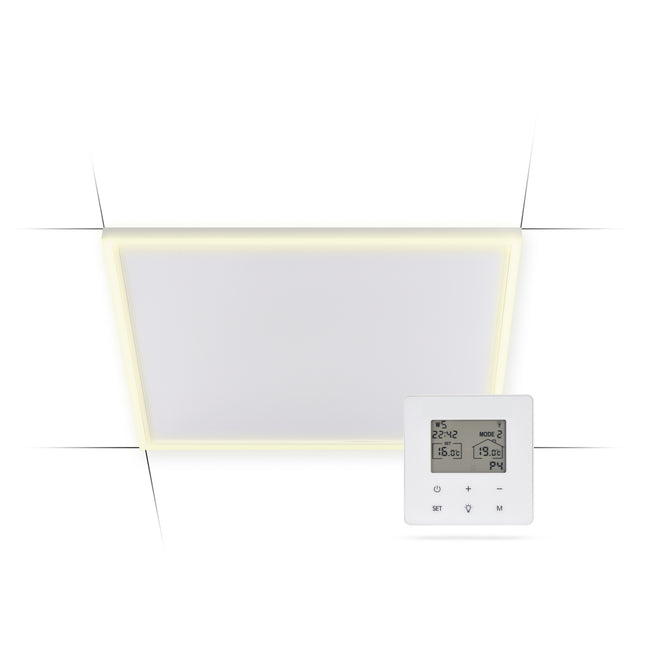
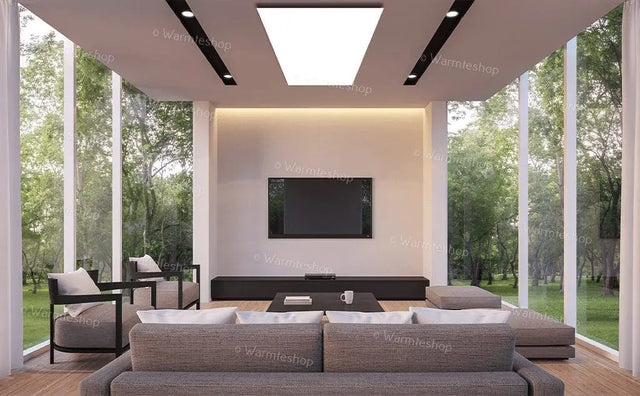

An infrared panel with lighting combines electric radiant heat and LED light in one sleek system. As a result, you do not need a separate radiator and ceiling lamp in the same location. The panel primarily heats people and objects within the radiation range. At the same time, the integrated lighting or LED frame provides functional light and atmosphere.
Not every model offers the same features. Power, light output, color temperature, dimmability, thermostat, Wi-Fi, and IP rating vary by series. The permitted mounting position is also important. Therefore, read below how to carefully compare heat, lighting, and controls.
Why choose an infrared panel with lighting?
The combination primarily saves space. This is useful in a bathroom, kitchen, bedroom, office, or compact living space. Moreover, the ceiling looks calmer when a single device fulfills two functions. Many models can switch heating and lighting separately. This allows you to use the light without heat or heat without the lamp remaining on.
An LED heating panel operates quietly and does not require a fan. As a result, there is hardly any additional air circulation. The heat is quickly felt when you are within the radiation field. Nevertheless, the entire installation determines the comfort. Appropriate power, an unobstructed radiation path, and proper thermostat control remain essential.
Integrated LED or a separate light frame?
With an infrared panel with LED lighting, the lighting is integrated into or around the panel. Other systems combine a standard infrared panel with a matching LED frame. An integrated version forms one complete design. A separate frame, on the other hand, can be useful when you want to combine heat and lighting in a modular way.
Check in advance what is included with the product. A remote control, wireless console, receiver, or thermostat may be included, but this is not always the case. Also, check if the light frame fits the dimensions and mounting points of the panel exactly. This will prevent surprises during installation.
Dimmable LED light and adjustable color temperature
Many infrared heating systems with lighting offer dimmable LED light. This allows you to adjust the intensity to suit the time of day. Bright light is practical for cleaning or working, while softer light creates more atmosphere in the evening. Check the light output in lumens when the panel becomes the main lamp in the room.
Some models also allow the color temperature to be adjusted. Warm white is often around 3000 Kelvin and creates a cozy atmosphere. Neutral white around 4000 to 4500 Kelvin is suitable for everyday use. Cool white around 6000 Kelvin looks bright and functional. These settings are examples; the exact values vary per product.
Use in the bathroom
An infrared panel with lighting is an attractive option for the bathroom. You combine quick, comfortable warmth with ceiling lighting without using extra floor or wall space. For this application, also compare our solutions for infrared heating in the bathroom.
Always check the IP rating and the permitted bathroom zone. Competitors offer IP44, IP52, and IP54, among others. This does not mean that every panel from this collection can be installed in every zone. Mounting height, distance to the shower or bath, and the manufacturer's instructions remain the guiding principles. If in doubt, have the electrical connection assessed by a qualified installer.
Ceiling mounting: space-saving and targeted
Many models are designed for mounting above the comfort zone. Therefore, also compare an infrared panel for the ceiling. From the ceiling, the radiation can be freely distributed downwards. Moreover, walls and floors remain available for furniture.
However, not every heating panel is suitable for ceiling installation. Check the permitted use, weight, and mounting method. Use suitable anchors for concrete, wood, plaster, or a suspended ceiling. Also, maintain the minimum distance from people, furniture, and flammable materials.
When is a vertical panel an alternative?
A ceiling model is permanent and does not occupy floor space. However, a portable solution is sometimes more practical, for example in a rental home or a changing workplace. In that case, compare it to a freestanding infrared panel. That provides targeted heat, but generally does not replace ceiling lighting.
Therefore, make the choice based on usage. If you want fixed basic lighting and heat from a single point, a ceiling model is a better fit. If you primarily want to be able to move heat locally, a freestanding panel might be more suitable.
Thermostat, remote control and Wi-Fi
A thermostat regulates the room temperature and prevents unnecessary overheating. Additionally, a remote control or wireless console can regulate the light intensity and color temperature. On some models, heat and light are operated via separate buttons. For this, also compare an infrared panel with a thermostat.
Wi-Fi enables remote control. Depending on the series, you can set a weekly program, timer, or heating schedule. Some consoles support multiple panels in the same room. However, such features do not apply to every product. Therefore, check compatibility, app, and network requirements before purchasing.
What heating capacity do you need?
For every LED heating panel, the required power depends on the volume and heat loss of the room. Insulation, ceiling height, outside temperature, glazing, and exterior walls all play a role. The purpose is also important. Primary heating usually requires more total power than local supplementary heating.
Preferably use a heat loss calculation. As a first indication, you can combine the room volume with an estimated loss per cubic meter. A well-insulated room generally requires fewer watts than an older, drafty room. Do not automatically choose the largest panel. An oversized model still requires a good thermostat.
Competitors offer a wide range of versions, for example from approximately 300 to 1800 watts. Compact models may be suitable for a small zone. Larger panels are intended for more surface area or higher heat loss. Check the recommended room, dimensions, and operating temperature for each product.
Heating capacity and light output are different
Wattage for heating and wattage for LED lighting do not mean the same thing. The heating power determines how much electrical energy is converted into heat. For the lamp, the light output in lumens is particularly relevant. Additionally, consider the dimming range, color temperature, and color rendering.
Do you want to use the panel as the only ceiling light? Then check whether the lumen value suits the room and activity. A bathroom, office, or kitchen often requires more functional light than a bedroom. For ambient lighting, a lower intensity may actually be more pleasant.
Connect to an existing light point
Some ceiling panels can be connected to an existing power point. However, a single existing lighting wire is not automatically sufficient for independent control of heating and lighting. The receiver, power supply, and switching vary by model. Therefore, please check the connection diagram first.
Also check the total load on the circuit. The heating element requires much more power than the LED lighting. Do not use an unsuitable extension cord or separate dimmer. A fixed connection must comply with the applicable electrical regulations.
Safety and surface temperature
An infrared panel can reach a high surface temperature. With certain high-temperature models, this is significantly higher than with standard low-temperature panels. Therefore, never cover the device. Keep curtains, furniture, and other flammable materials at the prescribed distance.
Do not touch the hot surface during use. Additionally, check whether the model has thermal protection. For ceiling mounting, fastening and load-bearing capacity are particularly important. This ensures that an infrared panel with lighting remains securely in place.
Calculate energy consumption of heat and LED
For an infrared panel with lighting, the consumption calculation is simple. Divide the total power in watts by 1,000 and multiply this by the hours of use. A 700-watt heater consumes a maximum of 0.7 kWh during one hour of continuous operation. Add to this the much lower power of the LED lighting when the light is also on.
In practice, a thermostat switches off the heating as soon as the set temperature is reached. The lighting can remain on in the meantime. Therefore, separate control is useful. You then use only the function that is needed at that moment.
Practical buying checklist
- Is the panel intended as primary heating or as supplementary heating?
- What power results from the heat loss calculation?
- Is the LED lighting integrated or part of a separate frame?
- How many lumens does the light produce and is it dimmable?
- What color temperatures can the model display?
- Can you control heating and lighting separately?
- Are the thermostat, console, receiver, and remote control included?
- Does the model support Wi-Fi and a weekly schedule?
- Is ceiling or wall mounting officially permitted?
- Does the IP rating match the room and bathroom zone?
- Are the power point, circuit load, and mounting surface suitable?
With this checklist, you compare LED infrared panels on more than just their appearance. This helps you avoid issues with lighting that is too dim, incorrect power output, or missing accessories. Furthermore, you know in advance how to connect the device.
Buy an infrared panel with lighting at Warmteshop
Warmteshop has specialized in infrared heating since 2006. Our advisors assess both your heating needs and desired lighting. This allows them to assist with power, light output, operation, and installation. You can check our reputation via Warmteshop's independent Trustprofile.
Would you like to compare other versions? Then view our complete collection of infrared panels. For a fixed position above the comfort zone, you can find more information under ceiling panels. If you want targeted radiation from the side, compare a wall panel. A free-standing model, on the other hand, offers flexibility. For localized workspace heating, you can take a look at a desk panel . With a thermostatically controlled panel, you then maintain control over temperature and operating times.
Frequently Asked Questions
Can the lights and heating be switched on separately?
With many models, yes, but check this per product. The included console or remote control often determines which functions can be controlled individually.
Is every infrared panel with lighting dimmable?
No. Some versions have fixed lighting. Other models offer dimming and multiple color temperatures. Therefore, check the lighting specifications and included controls.
Can the panel be installed in the bathroom?
Only if the IP rating, bathroom zone, and mounting instructions match the chosen location. If in doubt, have the connection checked by a qualified installer.
Can I hang the panel from the ceiling myself?
That depends on the weight, the substrate, and the electrical connection. Use the prescribed fastening material. Call in a professional for a permanent connection or an uncertain supporting structure.
Does the lighting work when the heating is off?
With models with independent controls, usually yes. Check the connection diagram and the functions of the receiver before ordering.
Which light color is the most pleasant?
Warm white is often suitable for living and sleeping areas. Neutral white is practical for the bathroom, kitchen, and office. An adjustable model offers the most flexibility.
Can one thermostat control multiple panels?
Some systems support multiple receivers or panels. Check the maximum switching capacity and compatibility. If necessary, distribute high power loads across suitable circuits.