

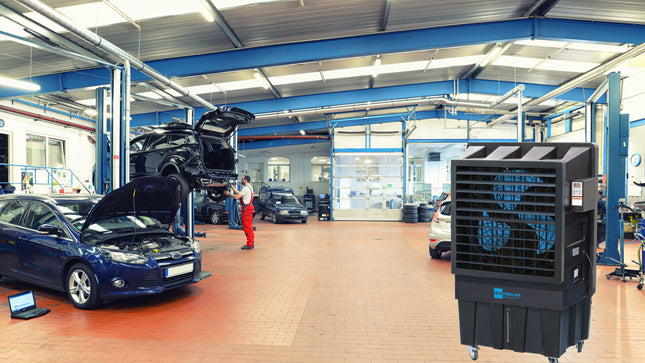
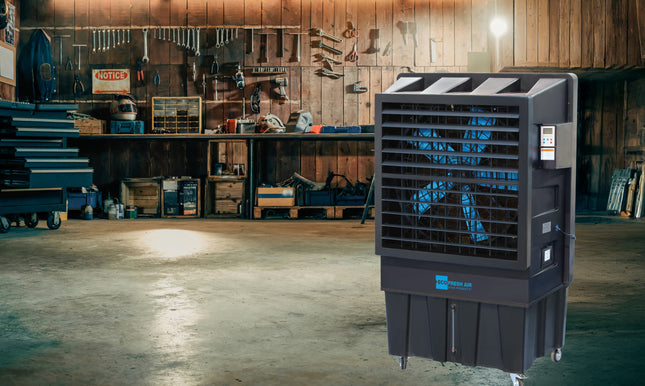



Industrial air conditioning is intended for professional environments where standard cooling offers insufficient capacity, range, or reliability. Examples include workshops, warehouses, production halls, server rooms, logistics zones, and temporary projects. The right solution not only lowers the air temperature but also removes absorbed heat in a controlled manner. Therefore, on this page, you will discover which system suits your space, how much cooling capacity is required, and which practical conditions you should check before purchasing.

When is an industrial air conditioner needed?
In a professional space, heat is generated by machines, lighting, computers, people, solar radiation, and frequently opened gates. A portable domestic air conditioner is often underpowered for such conditions or not designed for prolonged use. In contrast, an industrial air conditioner greater cooling capacity, a higher airflow, and a more robust design.
Industrial cooling can be useful for, among other things:
- workshops with welding equipment, compressors or other heat sources;
- warehouses, distribution centers and loading and unloading zones;
- production halls and assembly lines;
- server rooms, technical rooms and switch rooms;
- temporary workspaces, tents, events and rental projects;
- showrooms, sports halls, and public areas with peak loads.
If you wish to cool only a single workstation, full hall cooling is not always necessary. Targeted spot cooling may be more practical in such cases. However, for processes, stored goods, or electronics requiring a precise climate, a professional heat and moisture load calculation is more important than a general indication per square meter.
Which industrial air conditioner suits your application?
The term industrial air conditioning is used for various technologies. Therefore, compare not only cooling capacity or price, but also the way in which heat is dissipated.
| Type of cooling | Best application | Important advantage | Point of attention |
|---|---|---|---|
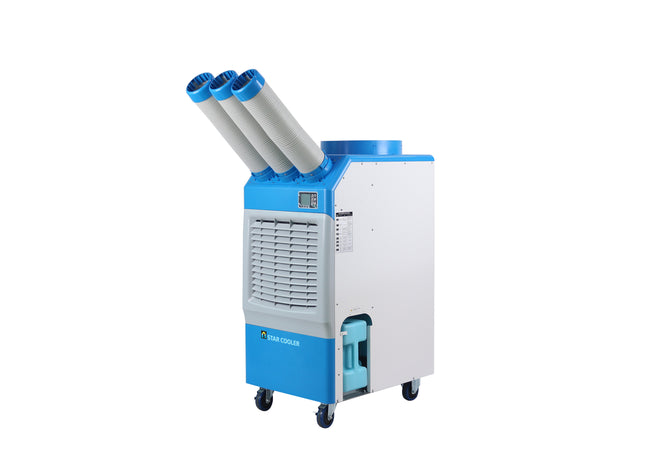
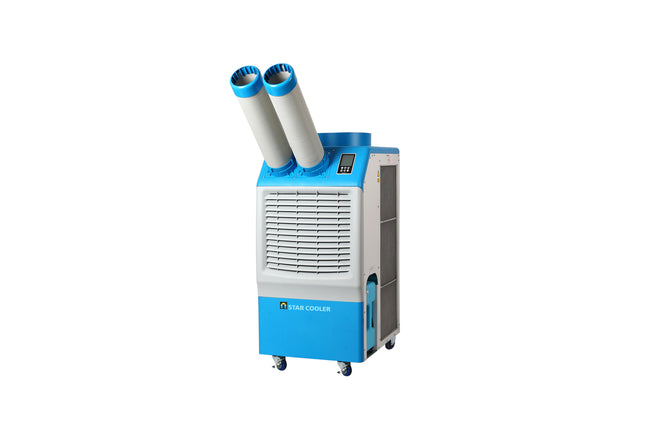
| Portable monoblock air conditioner | Temporary or local cooling | Quickly deployable and portable | Warm condenser air must be vented through a hose |
| Portable split air conditioner | Projects, server rooms and larger temporary zones | Warm and cold sides are separated | Space and secure placement required for the outdoor unit |
| Spot cooler | Machine, workstation or local process zone | Targeted cold air where needed | Without a vent, the total heat remains in the same room |
| Fixed split or duct installation | Structural cooling of a hall or multiple zones | Stable distribution and fixed arrangement | Design and professional installation required |
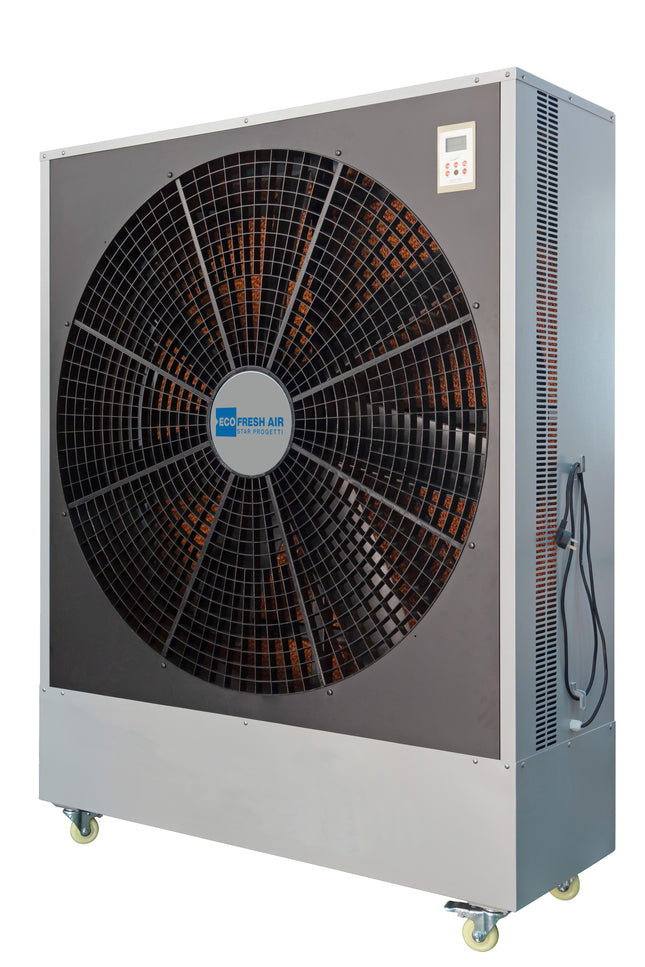
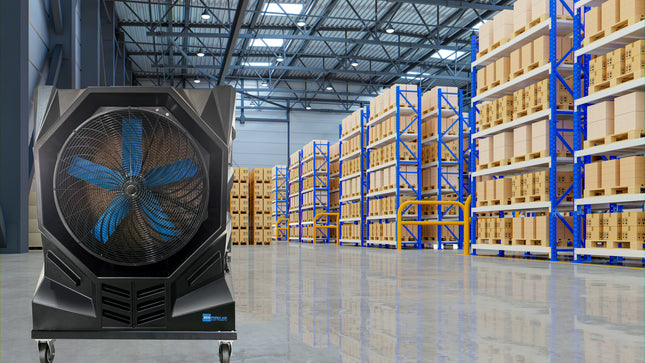
| Adiabatic air cooler | Large, well-ventilated or semi-open spaces | High air displacement at relatively low electrical power | Works with water evaporation and is not a compressor air conditioner |
Industrial air conditioning or industrial portable air conditioning?
When flexibility is important, a portable industrial air conditioner a good fit. You move the unit to the zone with the highest heat load and do not need to install a permanent system for the entire space. This is beneficial for seasonal use, maintenance shutdowns, rentals, and temporary production lines.
For daily cooling of an entire hall, on the other hand, a fixed or mobile split solution may be more suitable. If you are primarily looking for a purchase-oriented selection, also check out buying industrial air conditioning. Always compare cooling capacity, airflow, exhaust options, power supply, condensate drainage, and noise level.
Air conditioning or adiabatic air cooler?
A compressor air conditioner extracts heat and moisture from the indoor air and dissipates the heat to the outside or to another zone. An adiabatic air cooler, on the other hand, evaporates water in a large airflow. This provides noticeable cooling but can increase humidity. This technology performs best with a sufficient supply of fresh air and relatively dry conditions.
Therefore, an air cooler is not automatically suitable for an enclosed server room, laboratory, or moisture-sensitive storage area. In a large, ventilated workshop or semi-open hall, however, it can move a large amount of air with lower power consumption. In short, choose based on the application and not just on the advertised number of square meters.
Calculate cooling capacity for workshop or warehouse
an industrial air conditioning system based solely on floor area is risky. Two halls of the same size can have completely different cooling demands. Ceiling height, insulation, roof and glass surface area, machinery, people, and open gates all combine to determine the heat load.
Data for a reliable capacity selection
- Dimensions: length, width, and clear height of the zone to be cooled.
- Building envelope: insulation, roof type, windows, solar load and exterior walls.
- Internal heat: electrical power and simultaneity of machines and equipment.
- Persons: average and maximum number of employees or visitors.
- Air exchange: ventilation, open ports, extraction and supply of outside air.
- Target temperature: comfort cooling, process cooling, or equipment protection.
- Operating time: occasional peak, day shift, or prolonged deployment.
A general square meter indication for a product is only useful as a guideline. Therefore, request a refrigeration calculation for large halls, high internal heat loads, or critical processes. An undersized unit may not reach the desired temperature and will run at maximum load for extended periods. Moreover, overdimensioning without a control strategy can also be detrimental.
Understanding kW, BTU, and airflow
Cooling capacity is expressed in kilowatts or BTU per hour. As a quick conversion, approximately 1 kW of cooling capacity corresponds to 3,412 BTU/h. Additionally, airflow rate in m³/h indicates how much air the unit moves, but this is not the same as cooling capacity. For example, a high airflow can be very useful for local cooling without the overall hall temperature dropping significantly.
Spot cooling: targeted cooling without conditioning the entire hall
With spot cooling, cold air is directed at an employee, machine, server rack, or production step. As a result, this approach can be more efficient than cooling thousands of cubic meters of hall volume. However, a spot cooler produces warm air on the condenser side. If that heat is not directed outwards or outside the target zone, the workstation cools locally, while the total space may become warmer on balance.
Therefore, check before purchasing:
- where the warm air can go;
- what length and diameter the drain hose may have;
- how condensation is collected or drained;
- whether the cold air hoses reach the desired working zone;
- whether the unit can stand safely without blocking transport routes.
Flow, condensation, noise and placement
A powerful industrial air conditioner requires more than just a free corner in the workshop. Therefore, check that the voltage, phase, plug, and available circuit match the unit. Have a fixed connection or heavier power supply assessed by a qualified installer. Furthermore, do not use just any extension cable with equipment that has a high power consumption.
Heat dissipation and condensate
A monoblock must vent its warm air through a correctly sized hose. Therefore, keep the hose as short and straight as possible, in accordance with the manufacturer's instructions. Additionally, consider the capacity of the condensate reservoir, any pump, and the possibility for continuous venting. Significantly more condensation can form during periods of high humidity.
Noise level in practice
Sound levels are usually specified in dB(A). Therefore, compare whether it concerns sound pressure or sound power and at what distance the measurement was taken. An increase of a few decibels can be clearly audible. After all, the considerations differ in a noisy production hall compared to a meeting room, control room, or showroom.
Air distribution
Do not place the exhaust against a wall, shelf, or tall machine. Furthermore, keep intake and exhaust grilles clear and prevent short circuits where cold air flows directly back to the intake. Industrial fans can then help to further distribute cooled air, but they do not replace missing cooling capacity.
Industrial air conditioning for specific sectors
Workshop and production hall
First, map out the heat sources per zone. For varying work activities, a mobile unit is practical; for a fixed production line, targeted duct or spot cooling may be more suitable. Additionally, take into account dust, oil, and metal particles, and follow an appropriate filtration and cleaning schedule.
Warehouse and logistics
Open doors cause a large, fluctuating heat load. Air curtains, sun shading, night ventilation, and zoning can therefore limit the required cooling capacity. Where possible, cool the occupied or temperature-sensitive zone instead of automatically cooling the entire building volume.
Server room and technical room
Server equipment generates heat continuously. Therefore, do not look solely at floor area, but primarily at the actual electrical power of the equipment, desired redundancy, and operating hours. Furthermore, for critical installations, alarming, monitoring, and a backup strategy are important.
Hospitality, events and terrace
Conventional air conditioning is usually not effective for open outdoor air. On a sheltered terrace, however, air movement or evaporative cooling can provide comfort, depending on wind and humidity. For such applications, also view terrace cooling.
Maintenance for stable cooling performance
Dust and dirt restrict airflow and heat transfer. Therefore, check filters, condenser, evaporator, hoses, and condensate drain according to the manual. Furthermore, maintenance is required more frequently in dusty workshops than in a clean office. Never clean a connected appliance and use only approved cleaning agents.
- check and clean filters at fixed intervals;
- keep grates, hoses and heat exchangers clear;
- Empty and clean condensate reservoirs when prescribed;
- inspect cable, plug, wheels and brakes;
- record malfunctions, maintenance, and unusual noises;
- Have work on the cooling circuit carried out by a qualified specialist.
Why view industrial air conditioning at Warmteshop?
Warmteshop has been a specialist in climate and heating solutions since 2006. You can compare available models online based on cooling capacity, airflow, consumption, noise level, and application. For personal advice, you can visit our 30+ showrooms in the Netherlands and Belgium. You can find independent reviews and experiences via Trustlocal.
If you want to view the range immediately, go to industrial air conditioning. For a portable solution, choose industrial mobile air conditioning. Those who wish to compare models specifically based on purchase intent will find additional options at buy industrial air conditioning.
Frequently asked questions about industrial air conditioning
What is the difference between an industrial air conditioner and an air cooler?
A compressor air conditioner removes heat via a refrigerant circuit and typically also reduces humidity. An air cooler cools by water evaporation, may increase humidity, and requires sufficient fresh air. The technologies are not directly comparable.
Can a portable industrial air conditioner cool an entire hall?
That depends on cooling capacity, hall volume, insulation, machinery, and air exchange. Often, a mobile unit is primarily suitable for a defined zone or temporary needs. For complete and permanent hall cooling, a calculation and system design are required.
Where does the warm air from a spot cooler go?
The heat leaves the unit on the condenser side. Vent this air to the outside or to a zone where the heat is not a problem. Without proper heat dissipation, only local cooling occurs, and the overall room temperature may rise.
How much cooling capacity do I need?
This cannot be reliably derived from the number of square meters alone. Gather room volume, insulation, solar load, occupants, ventilation, doors, and machine capacity. Have critical or large applications calculated from a refrigeration perspective.
Is an industrial air conditioner suitable for a server room?
Yes, provided the system is designed to handle the continuous IT heat load and the required availability. Also consider condensate drainage, monitoring, alarms, and potential redundancy. A general surface area claim is insufficient for a critical server room.
Does an industrial air conditioner always need to be installed?
Mobile monoblocks and spot coolers can often be installed immediately, but still require heat dissipation, condensate management, and a suitable electrical connection. Fixed split and duct systems require professional installation and commissioning.
Can industrial cooling be used outdoors?
Only if the exact unit is approved for this purpose. Check the IP rating, manual, and operating conditions. For an open outdoor space, targeted air movement or evaporative cooling is often more logical than conventional air conditioning.