

Future-proofing my house for resale value: The ultimate guide for 2026
, by Warmteshop, 17 min read
, by Warmteshop, 17 min read
From 2026, the final selling price of your home will no longer be determined solely by location, but primarily by energy efficiency. It is an understandable concern that changing legislation regarding gas connections and a ma…
From 2026, the final selling price of your home will no longer be determined solely by location, but primarily by energy efficiency. It is an understandable concern that changing legislation regarding gas connections and a poor EPC label make selling your house more difficult. You do not want your greatest asset to decline in value due to outdated technologies. Making my house future-proof for resale value is therefore a smart strategy to implement today to protect your wealth.
We recognize the doubts regarding the payback period of major investments and the uncertainty about the right course of action. In this guide, you will discover how to increase the market value of your home with sustainable upgrades and modern systems. We explain how healthy infrared radiant heat, which feels like the natural warmth of the sun, not only improves your comfort but also transforms your energy label. You will receive a concrete action plan for a gas-free future, allowing you to combine lower monthly costs with a home ready to meet the demands of the modern buyer.
In 2026, a home is more than just a roof over your head; it is a technical ecosystem that must perform under changing climate targets. A future-proof home is characterized by minimal dependence on fossil fuels and maximum energy efficiency. The question "how can I future-proof my house for resale value?" is answered by looking at the technical core of the building. Recent market analyses show that homes with an EPC label A now fetch up to 15% more than identical homes with a label D or lower. Buyers in 2026 will no longer view a gas connection as a basic necessity, but as a financial risk due to rising CO2 taxes and the transition to sustainable sources.
The psychological impact of a move-in ready, sustainable home is significant. Buyers experience a sense of peace knowing that major energy-saving interventions have already been carried out. This translates directly into a shorter time on the housing market and a higher willingness to bid above the asking price. Here, the transition to green energy is not viewed as a burden, but as a comfortable upgrade comparable to the natural warmth of the sun.
Whereas a new kitchen provided the most significant increase in value ten years ago, the focus is now on the insulation package and installation technology. Nowadays, appraisers weigh CO2 reduction more heavily than a luxury finish. Since the tightening of the renovation obligation in 2023, buyers of energy-guzzling properties must renovate to a better label within five years. This significantly drives down the price of inefficient homes. Investing in modern solutions such as infrared heating is a smart move. It contributes directly to a more favorable indoor climate and a modern image without the need for extensive demolition work.
The modern buyer calculates based on net monthly costs rather than just the mortgage amount. Low energy costs have become the most powerful selling point. People want to be unburdened; they have no need to arrange complex permits or search for scarce installers for an energy transition. Moreover, there is a great need for transparency and control. Homes that use smart technology and automation to provide insight into consumption data have an edge over the competition. With advanced thermostats and monitoring systems, you show exactly how efficiently the home performs, which strengthens the buyer's confidence.
Specialists in loft and floor insulation, such as ScotTherm Insulation, emphasize the importance of a well-insulated building envelope to minimize heat loss and protect home value.
Roof insulation typically offers the highest ROI, as up to 30% of heat escapes through an uninsulated roof. Floor insulation immediately increases comfort by raising the perceived temperature by an average of 2 degrees. For a complete overview of effective energy-saving measures for your home The central government offers detailed guidelines and information on current subsidies. Carefully document every upgrade with photos of the work and keep all invoices. This documentation package is invaluable during negotiations, as it provides the buyer with assurance regarding the quality of the invisible improvements.From 2026 onwards, the traditional central heating boiler will become a significant disadvantage in the housing market. Due to stricter regulations regarding the mandatory installation of hybrid heat pumps or electric alternatives upon replacement, buyers are scrutinizing outdated gas installations. A home that is still entirely dependent on gas is viewed as a financial burden in the near future. Those who choose to make their home future-proof now for resale valueare investing in systems that completely eliminate this uncertainty. Gas-free living is no longer a niche, but a hard requirement for a quick sale at an optimal price.
Infrared heating is a modern, flexible solution that can efficiently heat the entire home without the need for a gas connection. Instead of heating the air, which often leads to heat loss due to drafts and circulation, infrared directly heats the mass of the home. This creates a pleasant radiant heat comparable to the natural warmth of the sun. By using smart zone heating, energy is only consumed in the rooms that are actually in use. This significantly reduces monthly energy costs, a tangible benefit that every real estate agent can use during a viewing.
The use of infrared panels offers a unique combination of functional warmth and aesthetic added value. These panels are ideal for both primary and supplementary heating because they take up no floor space. Ceiling mounting ensures unobstructed heat radiation and keeps the walls free for cabinets or artwork, making the room feel larger and more modern. In damp rooms such as the bathroom, infrared mirrors the sense of luxury. They never fog up and immediately emit comfortable warmth after showering, contributing to a healthy indoor climate free from mold growth.
A warm floor is one of the most sought-after features in the higher end of the housing market. Therefore, electric underfloor heating should not be overlooked in the process of future-proofing my home to increase its resale value . It offers an invisible form of luxury that immediately impresses upon entry. Thanks to the availability of complete underfloor heating kits, installation in the bathroom or kitchen is often simpler than one might think. These systems combine perfectly with infrared panels or a heat pump, ensuring a home is fully prepared for a sustainable, gas-free future with an optimal energy label.
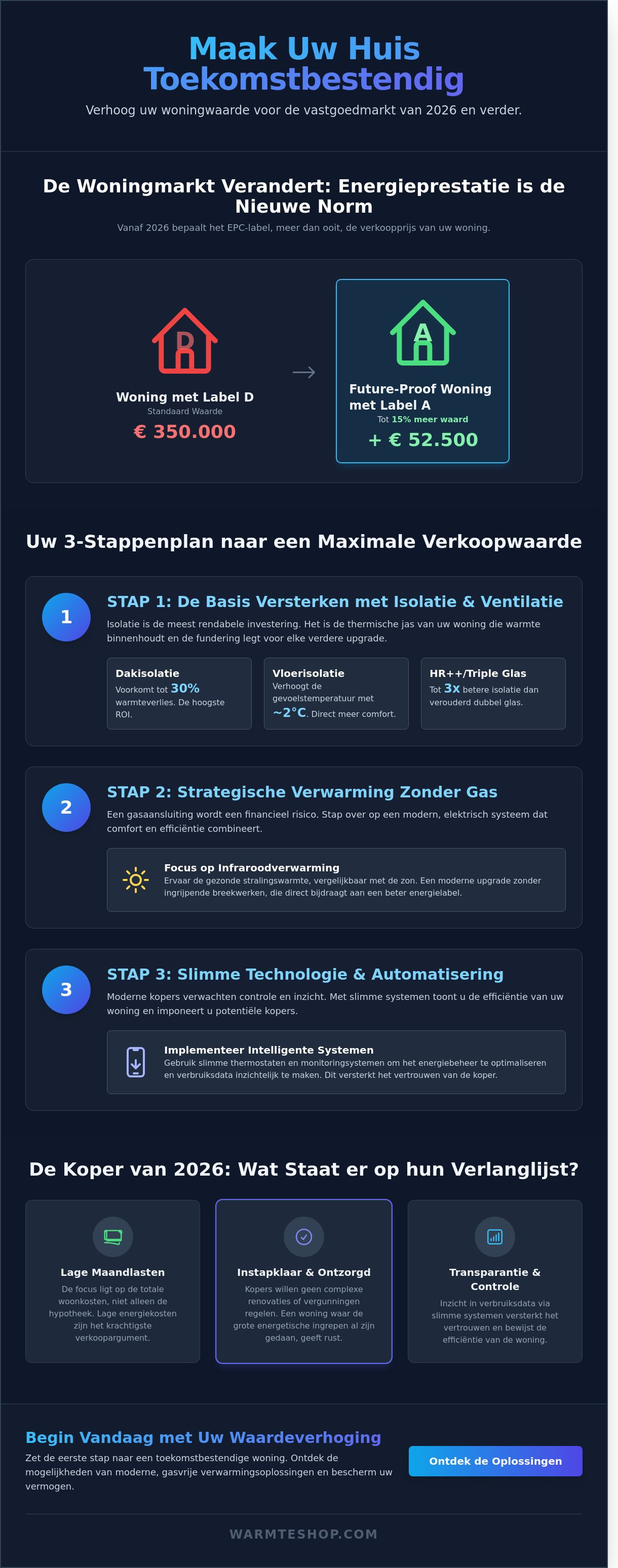
An 'intelligent' home makes an immediate impression on potential buyers. This is no longer just about technical gadgets, but primarily about measurable control and efficiency. When considering making your home future-proof for resale value, automation is the shortest route to a higher market value. Today, buyers seek certainty regarding their monthly expenses. By offering real-time insight into energy consumption via intuitive apps, you make future savings tangible during a viewing. This type of transparency builds trust.
Moreover, automation contributes directly to a better score on the energy report. Systems that intervene independently when no one is present in a room prevent active waste. This translates into a more favorable energy label, which, according to recent market figures, can increase the selling price of a home by an average of 2% to 5%. Implementing smart technology is therefore an investment that more than pays for itself at the time of transfer.
The heart of an energy-efficient home is indoor climate control. Modern thermostats allow you to precisely fine-tune the temperature in each room. This prevents you from heating the entire floor while you are only in a single office. Self-learning systems analyze your daily living patterns and adjust the heat demand accordingly. This often results in an immediate saving of 15% on heating costs. The major advantage for you as a seller is that many of these systems are wireless. No complicated demolition work is required, allowing you to upgrade the home to current standards without any mess.
The combination of PV panels and infrared heating forms the ultimate setup for a future-proof home. Infrared panels convert electricity directly into radiant heat. This technology does not heat the air, but rather the objects and people in the room, comparable to the natural warmth of the sun on a clear winter day. When you generate this power yourself with solar panels, energy costs drop to an absolute minimum.
Energy storage battery systems are set to become the new standard for 2025 and beyond. With these, you store solar energy generated during the day to use for your heating in the evening. A home that approaches the 'zero-energy' principle is a dream scenario for every buyer. You present a house that is independent of fluctuating gas prices, which is a rock-solid argument during price negotiations.
Do you want to immediately improve control over your energy consumption? Discover our selection of advanced thermostats for a smart and valuable home upgrade.
The process of future-proofing my home for resale value begins with setting the right priorities. The market is critical; buyers are looking for homes that meet the strictest environmental standards for the next thirty years. Therefore, always start with the building envelope. A well-insulated house forms the basis for an efficient infrared heating system. Once the insulation is in order, replace the outdated boiler with modern, electric solutions. This sequence prevents you from investing in overcapacity and ensures an immediately noticeable result in living comfort.
Professional installation and the associated certificates are indispensable in this process. A buyer wants the guarantee that the technology has been installed safely and according to the latest standards. Warmteshop supports you in this as an expert guide. We not only take care of the technical execution but also provide the evidence needed to justify the investment during price negotiations. Real estate styling in a modern home goes beyond a fresh coat of paint. It is about visualizing comfort. Show how an invisible heating panel fills the room with the natural warmth of the sun, without unsightly radiators getting in the way.
Gather all invoices, warranty certificates, and technical data sheets in an organized file. This serves as tangible proof of your investment. After the installation of infrared panels, it is essential to have a new EPC certificate drawn up. Recent research shows that a jump in the energy label can increase the property value by an average of 10% to 15%. Additionally, write a clear "energy story" for the sales brochure. Explain how the solar panels power the heating and what monthly savings this yields. Numbers convince where words fail.
Details determine the emotional value of a home during a viewing. A modernized bathroom immediately gets an upgrade with a stylish towel radiator. It offers the buyer the prospect of warm towels and a dry, mold-free space. For a true wellness feel, add a Sunshower to the shower cabin. This combines infrared heat with safe UV light, which is a powerful selling point for health-conscious buyers.
Do you want to create atmosphere in the living room without the emission of particulate matter or the need for a chimney? An electric fireplace offers the coziness of an open fire with the efficiency of modern technology. These elements ensure that making my home future-proof for resale value is not just a technical exercise, but a total package of luxury, sustainability, and future-proof living comfort. With the right choices, you transform your home from a standard property into a desirable, high-quality real estate investment.
The real estate market of 2026 places high demands on energy efficiency and sustainability. By focusing now on high-quality insulation and smart automation, you create a home that is ready for the future. Replacing traditional gas systems with innovative infrared heating is the most effective move in this regard. This technology mimics the healthy radiant heat of the sun, resulting in an optimal indoor climate without unnecessary energy loss.
Since 2008, Warmteshop has been the leading expert in this transition to energy-efficient living. With more than 30 showrooms spread across the Benelux, you will always find a specialist for personalized, tailored advice. Making my home future-proof for resale value becomes a straightforward process thanks to our professional heat calculations and full installation service. You are investing not only in a lower energy label, but also in tangible living comfort that will immediately appeal to potential buyers.
Discover how our infrared solutions increase your home value
Transforming your home into a sustainable flagship is a smart choice from which you are already reaping the benefits.
A home with a favorable EPC label increases in value by an average of 7% to 15% compared to energy-guzzling properties. Figures from real estate federations from 2023 show that a jump from label E to label B can increase the selling price by tens of thousands of euros. This makes investing in insulation and sustainable technologies a smart move when future-proofing my house for resale value, as buyers look directly at the monthly costs.
Infrared heating is an excellent and modern alternative to the traditional central heating boiler, provided the home has good basic insulation. Unlike classic radiators that heat the air, infrared works with radiant heat that warms objects and people directly, just like the natural warmth of the sun. This system is attractive to buyers due to its maintenance-free nature and healthy air quality without dust circulation.
In 2026, roof insulation and solar panels will remain the investments with the shortest payback period, averaging 5 to 8 years. Due to rising energy prices and the efficiency of new PV panels, you will recoup these costs faster than with a complete facade renovation. Sealing the building envelope is the most cost-effective first step to immediately improve your home's energy performance for the market.
It is not legally mandatory to make your home completely gas-free, but it significantly strengthens your position at the negotiating table. Since the introduction of the renovation obligation in 2023 for labels E and F, buyers have been looking more frequently for homes where the transition has already begun. A gas-free home with infrared panels or a heat pump relieves the new owner of the burden and justifies a higher asking price.
The total cost of future-proofing an average family home typically ranges between €30,000 and €50,000 for a complete package of measures. This amount often includes a combination of roof insulation, high-efficiency glazing, and a switch to electric heating or a heat pump. Although this is a substantial sum, appraisers confirm that this investment often increases the home's value by a greater amount than the initial cost.
Since 2024, buyers can count on increased borrowing capacity at most banks for homes with an A or B energy label. Banks view an energy-efficient home as a lower financial risk because residents spend less on fixed costs. This increases the group of potential bidders who consider making my house future-proof as a significant added value for resale value during their search.
Smart lighting has a limited impact on the appraised value, but increases the speed of sale due to its modern appearance. According to market research, homes equipped with smart home technology sell up to 3% faster than comparable homes without these features. It contributes to a sense of luxury and comfort, which has a positive emotional impact, especially on a younger audience.
Always start with a thorough analysis of the insulation values, giving the roof the highest priority as 30% of heat is lost there. Once the home's envelope is optimally insulated, you can look at efficient heating sources that do not require any demolition work. Infrared panels are an innovative solution in this regard; they are easy to install and immediately ensure a comfortable and CO2-neutral indoor climate.


