

Impact of infrared heating on your fire insurance: Everything you need to know
, by Warmteshop, 17 min read
, by Warmteshop, 17 min read
The notion that a modern heating system makes your home uninsurable or causes your monthly premium to skyrocket is a persistent myth that unnecessarily delays the transition to green energy. Since the tightening…
The notion that a modern heating system makes your home uninsurable or causes your monthly premium to skyrocket is a persistent myth that unnecessarily delays the transition to green energy. Since the tightening of the European Ecodesign directives in 2018, the impact of infrared heating on fire insurance has actually become a story of enhanced safety and technical perfection. You simply want to enjoy healthy radiant heat that feels like the natural warmth of the sun, without losing sleep over the fine print in your policy or unclear fire risks.
We understand that introducing new technology into your home comes with a need for confirmation regarding quality marks and your insurer's attitude. Discover in this guide why infrared heating is a safe choice for your home and how insurers view this innovative solution. We outline which certificates are crucial for your coverage and whether you actually need to inform your insurance intermediary after installation to ensure your peace of mind.
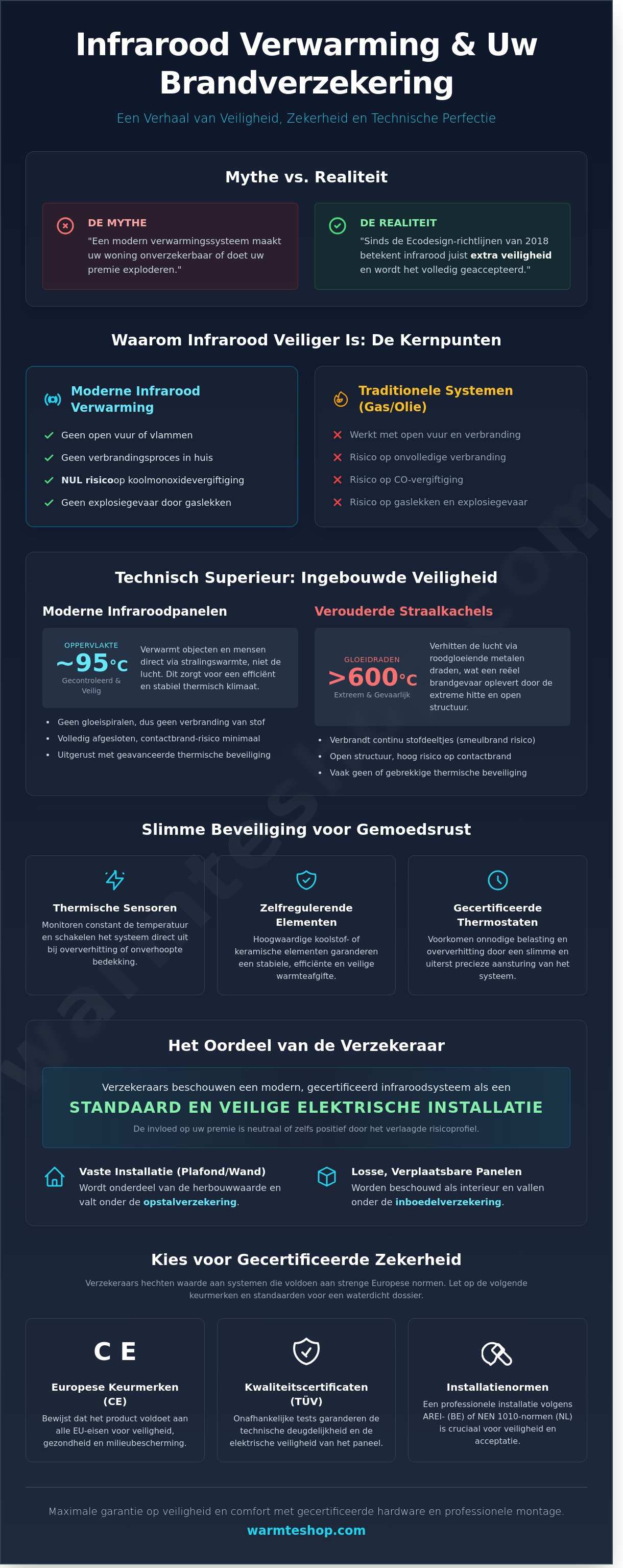
Safety is the cornerstone of a comfortable home. When choosing a new heating system, the impact of infrared heating on fire insurance an increasingly important role. Unlike traditional gas or oil systems, infrared heating operates as an indirect system without an open flame. No combustion takes place inside the home, completely eliminating the risk of carbon monoxide poisoning or explosion hazards caused by gas leaks. This significantly lowers your home's risk profile in the eyes of insurers.
The technical operation of infrared heaters is based on heating mass rather than air. While a traditional convector directs air past hot elements, an infrared panel reaches a controlled surface temperature of up to 100 degrees Celsius. This is a safety advantage compared to systems that reach internal temperatures of hundreds of degrees to maintain airflow. Given the transition to carbon-neutral homes by 2026, switching to this safe electrical technology is a logical step for any homeowner looking to the future.
Infrared radiant heat feels like the natural warmth of the sun on a crisp spring day. It heats walls and furniture directly, which is not only efficient but also minimizes the risk of overheating the ambient air. This stable thermal climate contributes to lower premiums with many insurance companies.
Old radiant heaters with red-hot wires pose a real fire hazard due to the extreme heat and open structure. Modern infrared heating is constructed completely differently from a technical perspective. Because there are no heating coils, no combustion of dust particles takes place. This eliminates the risk of smoldering fires, a common cause of fire in outdated electrical systems. The panels are completely enclosed, which minimizes the risk of contact fires with curtains or furniture.
High-quality infrared panels are equipped with advanced thermal sensors. These sensors constantly monitor the panel's temperature; in the event of an unexpected deviation or coverage, the system switches itself off immediately. The self-regulating properties of high-quality carbon or ceramic elements ensure that heat output remains stable. For optimal safety, it is essential to use certified thermostats. These controllers ensure constant monitoring of the room temperature and prevent the system from being unnecessarily overloaded, which further positively influences the impact of infrared heating on fire insurance .
Insurers in Belgium and the Netherlands currently view the rise of electric heating systems with confidence. The impact of infrared heating on fire insurance is in most cases neutral or even positive, because these systems do not use open flames, flammable liquids, or complex gas pipes. While old electric heaters with heating coils sometimes caused suspicion, companies consider a modern infrared system a standard and safe electrical installation. This is due to advanced technology in which radiant heat directly warms objects, just as the natural warmth of the sun does.
With a fixed installation on the ceiling or wall, the panels become part of the rebuilding value of your home. This means they are covered by building insurance, whereas freestanding panels are covered by contents insurance. This rarely has a major impact on your premium. Modern systems almost never lead to higher costs because the fire risk is minimal with correct installation. Although the US Consumer Product Safety Commission pointed out risks associated with outdated heating types in its official safety warnings in 2023, certified infrared panels are specifically designed to prevent overheating via built-in thermal sensors that immediately shut off the panel at abnormal temperatures.
It is advisable to inform your insurance broker when replacing your entire heating system. Switching from gas to infrared can be considered a change in the risk profile, even though the risk is often lower. Transparency prevents unpleasant disputes regarding potential future damage claims. Always document your choice of this type of heating in writing in your policy conditions to guarantee full coverage. A short email to your intermediary confirming the installation is often sufficient to fulfill your duty to disclose.
The quality of the electrical connection determines how an insurer views your installation. With self-installation, you run the risk of incorrect wiring or overloading of circuits, which can lead to a reduction in payout in the event of a fire. Insurers often require that the installation complies with AREI standards in Belgium or NEN 1010 in the Netherlands. Working with a professional offers the necessary assurance in this regard. By choosing the expertise and professional installation of Warmteshop, you are assured of a certificate of conformity and safe integration into your home. You can already start exploring the various options for infrared heating to see which aesthetic solution best suits your living situation.
Insurers base their risk analysis on tangible evidence of technical reliability. An infrared panel is an electrical device, and the quality of the internal components directly determines the fire risk in your home. The impact of infrared heating on fire insurance is positively influenced when you can demonstrate that your equipment meets strict, independent standards. A CE marking is mandatory in the European Union, but it is in fact merely a declaration by the manufacturer itself that the product meets the minimum requirements. For a discerning insurer, this is often no more than a basic requirement.
To guarantee complete peace of mind, insurance companies look for certificates from external testing bodies such as TÜV or KEMA. These bodies conduct destructive tests and verify whether a panel's temperature protection actually intervenes in the event of overheating. When selecting safe equipment, it is essential to look for international safety marks and guidelines that go beyond the legal minimum. This significantly lowers the risk profile of your home.
TÜV and the GS mark (Geprüfte Sicherheit) are leading German quality standards that are recognized worldwide. While a standard panel may sometimes contain questionable components, a GS-certified panel guarantees that the product has been extensively tested for electrical safety and fire resistance. Insurers often accept these certificates as the ultimate proof of "good stewardship." After all, you are choosing a product that has been deemed safe for long-term use by an independent expert. You will usually find these quality marks on a type plate on the back of the panel or in the accompanying technical documentation. It is advisable to keep these specifications for your policy records.
Specific regulations apply in the bathroom due to the combination of electricity and moisture. A towel radiator or an infrared mirror must have the correct IP rating to prevent short circuits. The impact of infrared heating on fire insurance is closely linked to the correct zone classification. An IP44 classification is the standard for most bathroom applications. This means that the device is protected against splashing water from all directions. For installations located closer to a water source, such as Zone 1, an IPX5 standard is often required. Compliance with these technical standards prevents an insurer from blaming incorrect installation in the event of water damage or a short circuit. Professional installation in accordance with AREI standards in Belgium or NEN 1010 in the Netherlands is essential in this regard.
A professional installation forms the foundation of your safety and peace of mind. The impact of infrared heating on fire insurance is directly related to how the technology is integrated into your home. In the event of damage, insurers scrutinize compliance with technical regulations. In Belgium, an AREI (General Regulations on Electrical Installations) inspection is legally required following any major modification to the electrical installation. For Dutch customers, the NEN 1010 inspection is the gold standard for a fire-safe environment. These inspections provide written proof that your system poses no risk due to short circuits or overheating.
Infrared panels are powerful heat sources that require a stable power supply. For installations exceeding a total power of 3680 Watts on a single circuit, it is necessary to provide a separate fuse group. This prevents the fuse from blowing when you switch on other devices simultaneously. Always use heat-resistant cabling, such as silicone or PTFE cables, for the connection directly behind the panels. The back of a panel can reach temperatures of up to 90 degrees Celsius. Standard PVC cables can become brittle over time due to this constant heat load, increasing the risk of failure. A professional installer ensures that the cables are installed stress-free and with sufficient ventilation space.
A well-documented file is your best defense during an inspection or claim. The impact of infrared heating on fire insurance is positive if you can demonstrate that prevention was a priority. Therefore, gather the following documents in a technical file:
During installation, take into account the specific regulations for wall or ceiling mounting. Use only the supplied brackets to ensure the necessary distance from the wall. This air gap is essential for heat dissipation and prevents heat from accumulating in your home's structure. By following these steps, you create a heating system that is just as safe as the natural heat of the sun.
Do you want to be sure that your system meets all safety requirements? View our range of certified infrared heating for a worry-free and sustainable installation.
When you invest in a sustainable heating system, you want it to seamlessly align with your home safety and your insurer's requirements. The impact of infrared heating on fire insurance is predominantly positive when you choose a professional partner. Warmteshop guarantees the highest safety standards through a strict combination of certified hardware and expert installation service. Insurers scrutinize the installation method and the materials used; therefore, our systems are equipped as standard with advanced thermal sensors that make overheating impossible. This limits the fire risk to an absolute minimum.
We offer not just hardware, but a total solution that provides peace of mind. Our long warranty periods of often 10 years or more on the panels serve as tangible proof of product reliability. Should an insurer or inspection body have technical questions regarding the installation, our team is ready with the necessary documentation and certificates. This proactive support accelerates the acceptance process for your fire insurance and ensures that you enjoy your home with peace of mind.
Our collection is broad and deep. It ranges from robust industrial air heaters for warehouses to sophisticated design panels for the living room. Every product undergoes rigorous quality control before leaving our showrooms. We continuously invest in innovation, such as sensors that immediately interrupt the power supply in the event of abnormal temperatures. By choosing a specialist, you significantly minimize risks regarding fire insurance. Insurers appreciate the transparency of our technical specifications and the proven safety of our hardware.
Safety begins with a correct calculation. Insufficient power forces panels into overload, while incorrect placement can cause heat buildup. Therefore, our consultants perform an exact heat calculation for every project. This prevents overheating and ensures an even heat distribution reminiscent of the sun's natural radiation. You can see this technology with your own eyes and feel the quality in our physical showrooms. We have been an established market leader since 2008; that experience translates directly into the safety of your installation.
The transition to green energy is a smart upgrade for your living comfort. With the right installation from Warmteshop, you combine this modernization with the highest degree of fire safety. This way, your home remains not only warm but also optimally protected.
Switching to modern heating technology requires a well-considered approach. The impact of infrared heating on fire insurance is positive when you choose tested quality and professional installation. Insurers place enormous value on TÜV and GS certified products that meet the strictest European safety standards. By having your system installed by experts, you build a rock-solid prevention file for your insurer.
Warmteshop supports you in this as the market leader, with more than 30 physical showrooms spread across the region. Our professional installation service operates throughout the Benelux and ensures that every panel functions perfectly from a technical perspective. This way, you benefit not only from a healthy indoor climate that feels like the natural warmth of the sun, but also from the assurance that your home is optimally secured. A transparent and professional installation prevents ambiguity in the event of potential claims and significantly increases your daily living comfort.
Request your free consultation now for a safe infrared installation
We look forward to realizing the transition to a sustainable and safe home together with you.
Infrared heating is not a fire hazard because the panels are equipped with built-in thermal protection devices that immediately switch off the power in the event of overheating. The surface temperature of a standard panel remains limited to a maximum of 95 degrees Celsius. This is significantly lower than the ignition temperature of common building materials such as plaster or wood. High-quality systems always comply with the strict IEC 60335-2-30 standard for electric heating devices.
You must always inform your insurer in writing about the installation, as the impact of infrared heating on fire insurance often requires an adjustment to the rebuilding value of your home. Although the fire risk generally decreases, Article 14 of the Belgian Insurance Act obliges you to report any relevant changes to the building. This prevents unpleasant disputes regarding underinsurance during any potential future claims.
Infrared panels are safer than a gas central heating boiler because no open flame or combustion process takes place in your home. As a result, the risk of carbon monoxide poisoning, which still claims hundreds of victims in Europe every year, is completely eliminated. Because there are no gas pipes running to the various rooms, the risk of gas leaks or explosions in the living areas of your home also disappears.
A safe installation requires at least the European CE marking and preferably a TÜV GS certification for tested safety. These marks confirm that the product complies with Directive 2014/35/EU for low-voltage equipment. For installations in damp areas such as the bathroom, an IP44 rating or higher is necessary. This rating guarantees that the panel is protected against splashing water from all directions.
Built-in sensors, also known as clixons, prevent an infrared panel from overheating by interrupting the power supply at 100 degrees Celsius. This safety feature intervenes immediately if heat dissipation is blocked, for example by a curtain accidentally hanging over the panel. The panel housing is specifically designed to withstand these temperatures without deforming or emitting toxic fumes.
Fire insurance covers damage caused by infrared panels, provided the electrical installation complies with the applicable AREI standards in Belgium or NEN 1010 in the Netherlands. If you have certified panels installed by a recognized installer, this is covered under the standard coverage of your policy. The impact of infrared heating on fire insurance is generally positive because insurers view modern electrical systems as a lower risk than old oil boilers.
In warehouses, the panels must hang at least 2.5 meters above the floor to avoid any contact with flammable goods. For the storage of highly flammable substances, special ATEX-certified devices are mandatory in accordance with European Directive 2014/34/EU. It is essential that the radiation intensity is precisely matched to the specific fire load of the materials present in the space.
The fire risk of infrared underfloor heating is virtually nil because the systems operate at a low temperature of a maximum of 30 degrees Celsius. The heating foils possess self-regulating properties that effectively prevent the formation of hotspots. Many modern systems use 24V or 48V low voltage. This significantly reduces the risk of short circuits and fire compared to traditional electric floor systems operating on mains voltage.


