

How do I convince my partner of infrared heating? A strategic step-by-step plan
, by Warmteshop, 17 min read
, by Warmteshop, 17 min read
Imagine this: it is a chilly Tuesday evening in November and you are dreaming of the healthy radiant heat of the sun in your own living room. The pressing question "how do I convince my partner of infrared heating" really remains…
Imagine this: it is a chilly Tuesday evening in November, and you are dreaming of the healthy radiant heat of the sun in your own living room. However, the pressing question of "how do I convince my partner of infrared heating" remains unanswered because the fear of an "ugly" panel or an unexpectedly high electricity bill dictates the atmosphere on the couch. We understand that this hesitation stems from years of habituation to traditional gas heating, a system we have considered the only standard in the Benelux for over 60 years. It is logical that your partner is skeptical about the switch to a fully electric solution that feels and looks different.
In this article, you will discover exactly how to dispel these doubts with objective facts about modern living comfort, aesthetics, and smart savings, including a concrete step-by-step plan for a warm agreement at the kitchen table. We explain how the transition to this green energy source is not an obligation, but a comfortable upgrade that directly converts up to 100% of the supplied energy into radiant heat. From invisible mirror panels to the impact on your monthly expenses, we offer you the expert insights for a convincing conversation about a healthy and future-proof home.
You probably recognize the situation immediately: you have delved into the benefits of sustainable living and are enthusiastic about the possibilities of radiant heating, but your partner reacts skeptically. The question of how to convince your partner of infrared heating is one of the most frequently heard issues in our showrooms. This resistance is understandable and often stems from a lack of up-to-date information. While one partner focuses on the innovation and sustainability, the other is often concerned about the practical implementation and the monthly costs.
Doubts usually center around three central fears: electricity costs, maintaining living comfort, and the aesthetic impact on the interior. To break through these barriers, it is essential to understand exactly what the technology entails. Infrared is not air heating, but direct radiant heat. How infrared heating worksis best compared to the sun: the rays do not heat the air, but directly the objects and people in the room. This fundamental difference creates a unique heating experience that simply cannot be matched by traditional radiators.
Achieving a shared vision for the home energy transition is crucial for a successful switch. It is not just about replacing a heater; it is about creating a future-proof home that is independent of fossil fuels. When both partners realize that this is a joint project for a healthier and more comfortable home, skepticism often vanishes like snow in the sun.
Unfamiliarity breeds contempt, and that certainly applies to our heating systems. Since the 1950s, we have become accustomed to the presence of radiators under the windowsills. Letting go of this familiar sight feels like a loss of homeliness to some. Furthermore, many people still base their opinions on outdated figures regarding electric heating from the 1980s. At the time, electric heaters were indeed inefficient, but the current generation of infrared heating uses advanced techniques that convert electricity into heat extremely effectively.
View the choice for infrared heating not as an obligation, but as a qualitative improvement to the home. Compare it to installing a new designer kitchen or a luxury bathroom. It is an investment in living comfort and a healthier indoor climate, as there is no dust circulation. By choosing this technology now, you prepare the house for a gas-free future. Given the current fluctuations in energy prices and stricter sustainability requirements for homes, it is a strategic choice that immediately increases the value of the property.
When you ask yourself, "how do I convince my partner of infrared heating?", experiencing pure comfort is often the deciding factor. Most homes are still heated via convection, where radiators heat the air. That warm air immediately rises to the ceiling, cools down near the windows, and sinks back to the floor as a cold draft. This causes the familiar discomfort: a burning head, but ice-cold feet. Infrared panels break with this inefficient cycle by directly heating objects and people.
The process is best compared to the sun on a clear winter day. Despite an outside temperature of, for example, -2 degrees, you feel the direct warmth of the sun's rays as soon as you step out of the shade. Infrared panels mimic this natural process indoors. The walls, furniture, and floor absorb the radiation and store this energy. As a result, the entire room acts as a buffer that releases heat evenly, resulting in a stable temperature without bothersome drafts.
The deep penetration of infrared radiation into the human body is unique. The rays penetrate a few millimeters into the skin, stimulating blood circulation and inducing deep relaxation. Whereas traditional central heating often takes 20 to 30 minutes to make a room comfortable, with infrared heating the first waves of warmth within just 5 to 10 minutes of switching it on. Because the floor retains the heat, the need for thick socks disappears. The thermostat can often be set 1 or 2 degrees lower without compromising the feeling of warmth, simply because the radiant heat is experienced more intensely.
Health forms an essential part of the question of how to convince my partner of infrared heating. Because infrared does not move air, dust, pollen, and dust mites settle on the floor instead of swirling through the living room. This is a direct benefit for family members with asthma or allergies. Furthermore, the relative humidity remains constant at around the ideal 50 percent, making dry eyes and irritated airways a thing of the past.
An official study into infrared heating by the British government underscores that users perceive the quality of this heat as superior. An additional benefit is that the radiation keeps the walls dry. This prevents mold formation and improves the insulation value of your home, as dry walls retain heat better than damp walls. The result is a healthy, fresh living environment that forms the basis for a sustainable home. Would you like to experience this comfort yourself? Then visit one of our showrooms for a personal demonstration.
Infrared panels are often unfairly compared to the energy-guzzling radiant heaters of the past. Those old models would glow red-hot and consume enormous amounts of electricity for mediocre results. Today's modern panels operate using far-infrared radiation. This is an advanced technology that emits the same healthy warmth as the sun on a clear winter day. The question of how to convince my partner of infrared heating therefore begins with dispelling this outdated image. The figures show that infrared is an extremely efficient method for keeping a home comfortable.
The major difference compared to traditional systems is the heating method. Whereas a central heating boiler heats the air, infrared heating directly heats the objects and people in a room. The Energy Saving Trust describes infrared heating as a much more targeted method, resulting in less energy being lost to circulating air masses that cool down again through windows or cracks. In a scenario where infrared is used as supplementary heating in the most frequently used rooms, the gas bill can drop by 20 to 30 percent. This is because the central thermostat in the rest of the house can remain set a few degrees lower.
It is a waste to heat 60 cubic meters of air throughout the entire home if you only spend time in the study or the sitting area. Infrared panels enable zone heating, allowing you to heat only where and when necessary. The impact of smart thermostats on consumption is crucial in this regard. These systems ensure that a panel automatically switches off as soon as the desired temperature is reached or when no one is present in the room. For example, specifically heating a bathroom during the morning routine costs only a fraction of the energy required to heat the entire house via the central heating system for the same period.
A financial aspect that is often overlooked is the absence of additional costs. Infrared panels have no moving parts, fluids, or pumps that can leak or break down. No annual inspections by a technician are required. This immediately saves on maintenance costs that recur every year with a central heating boiler or heat pump. Moreover, the initial investment is significantly lower than for more complex systems. For a clear price indication, you can view the complete collection of infrared heating . With a lifespan often extending to 25 years, this is one of the most cost-effective upgrades for a modern and sustainable household.
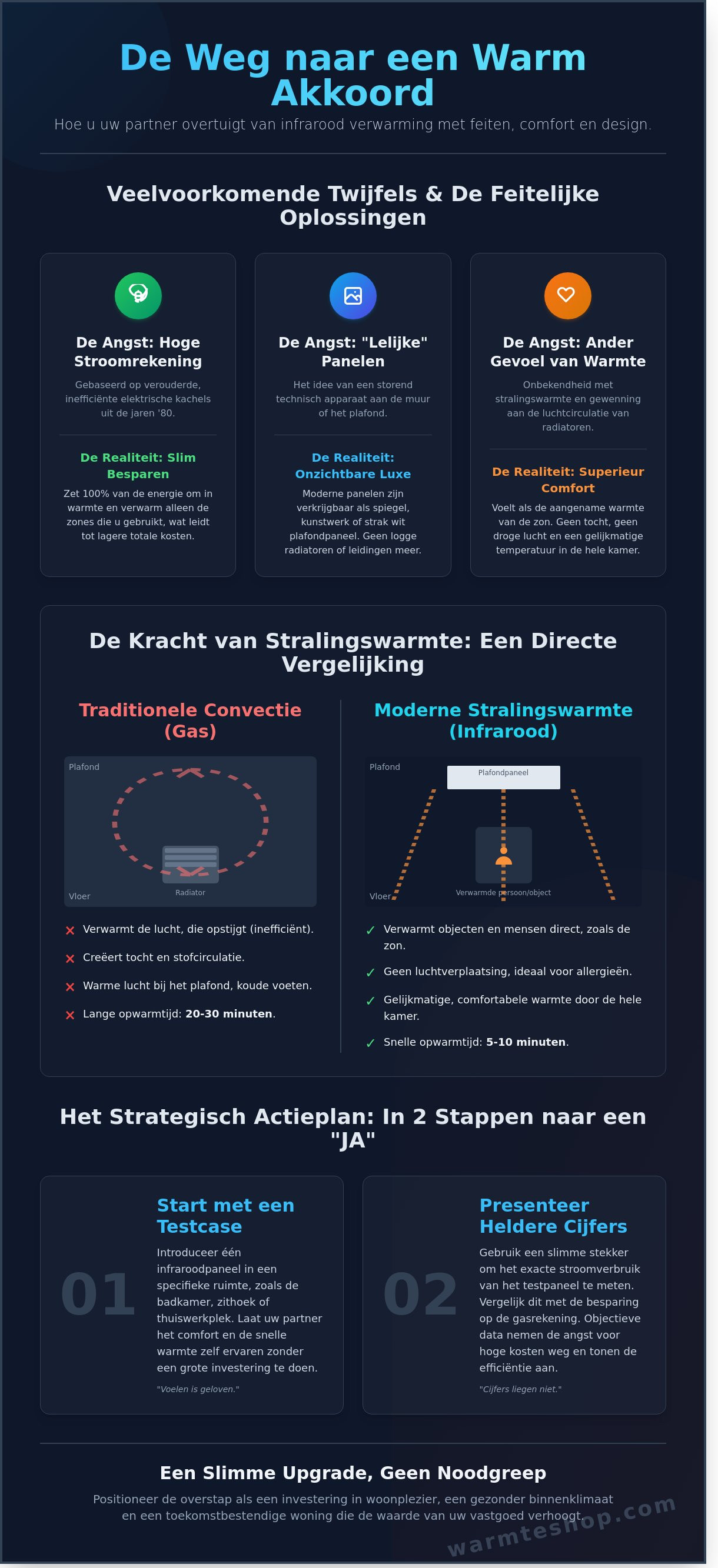
One of the biggest stumbling blocks with traditional heating is its appearance. Large, dusty radiators and unsightly pipes often dictate the layout of your interior. When the central question is how to convince my partner of infrared heating, the visual aspect is a decisive factor. Infrared panels offer an aesthetic freedom that is unthinkable with central heating. By opting for ceiling mounting, the heat source disappears completely from view. This immediately saves valuable square meters of living space; space that you can now use for an extra cupboard or a minimalist corner.
The panels are manufactured from high-quality materials such as tempered safety glass, powder-coated metal, or robust ceramic. This allows you to transform a previously purely functional object into a design element that seamlessly aligns with your personal living style. Instead of a disruptive factor that you try to hide behind a sofa, the heater becomes a subtle part of the home's architecture. The radiant heat emitted feels like the gentle touch of the sun on a clear spring day, while the technology itself remains virtually invisible.
In the bathroom, infrared technology proves its smart versatility in an area often smaller than 10 square meters. An infrared mirror is an absolute asset to the morning ritual. Because the glass surface is constantly heated, condensation stands no chance. The mirror remains 100% clear, even after a hot shower. For the ultimate wellness experience, combine this with a towel radiator. This system not only heats the room efficiently but also ensures that your towels always feel dry and comfortably warm.
The living room calls for a personal approach. Photo panels offer the ideal solution here. Your favorite vacation photo or a reproduction of a famous artwork acts as a discreet heat source on the wall. For a sleek, modern look, glass panels are available in various RAL colors that blend seamlessly into a minimalist design. It is the smartest way to integrate comfort without compromising the appearance of your home. When you explain how these panels blend completely into the interior, the answer to the question "how do I convince my partner of infrared heating" suddenly becomes much simpler.
Would you like to experience for yourself how design and warmth come together in a modern interior? Discover the extensive collection of infrared heating and choose the style that suits you.
You are convinced of the benefits yourself, but the question remains: how do I convince my partner of infrared heating? A radical change to the heating system can cause resistance, especially if one is accustomed to traditional convection heating. The secret to successful persuasion lies in a step-by-step approach that focuses on facts and experience. With this strategic action plan, you transform doubt into enthusiasm.
Infrared is a technology you must experience to understand its impact on living comfort. In our showrooms, you will immediately feel the similarity to the natural warmth of the sun on a clear winter day. Seeing the various finishes, from minimalist white to designer glass panels, eliminates aesthetic concerns. An expert advisor acts as a neutral third party, demonstrating exactly the best solution for your situation based on a heat loss calculation.
The transition to a sustainable home does not have to be an all-or-nothing decision. You can start with supplementary heating alongside your current central heating system to tackle specific cold corners. An excellent first introduction to the technology is purchasing a patio heater for the veranda or balcony. When your partner experiences the powerful, comfortable radiation there, the step indoors is much smaller. By spreading the investment and switching room by room, you build a future-proof and healthy indoor climate in a financially responsible way. This way, you discover together how to convince your partner of infrared heating by simply letting the results speak for themselves.
Switching to a sustainable interior is a smart investment in your daily well-being. You now have the necessary arguments to clearly explain the benefits of radiant heating, which feels exactly like the natural warmth of the sun, to your family. Since 2008, Warmteshop has served as the authority in the field of energy-efficient radiant heating, translating complex technology into tangible living comfort. The best way to answer the question "how do I convince my partner of infrared heating" is to let the facts regarding healthy air quality and invisible design speak for themselves. Furthermore, our certified on-site installation service guarantees a professional finish without extensive renovations.
Sometimes facts alone are not enough, and an innovation simply needs to be felt. The most effective way to dispel doubts is to experience the enveloping warmth together in a professional setting. With more than 30 showrooms spread across the Benelux, we offer you the opportunity to personally assess the aesthetics and efficiency of our systems under the guidance of an expert advisor.
Visit a Warmteshop showroom and experience the warmth together with your partner
Transform your home into a future-proof place where modern design and sustainable warmth come together seamlessly.
Yes, infrared panels heat a room completely by directly heating objects and walls, similar to the natural radiation of the sun. While traditional radiators heat air that cools down quickly, the thermal mass in your furniture and floors stores the heat. This ensures a constant temperature of, for example, 21 degrees without cold drafts. In well-insulated homes, these panels function excellently as the primary heating source for the entire house.
Infrared panels are completely safe for children and pets, especially when mounted on the ceiling or high on the wall. The surface temperature typically reaches 85 to 115 degrees Celsius, but the short contact time prevents immediate burns due to the nature of the material. Furthermore, our systems feature built-in sensors that switch off the power in case of overheating. This offers peace of mind in a busy household where safety comes first.
For an average living room, you usually need two to three strategically placed panels to ensure even heat distribution. The calculation is based on an average of 25 watts per cubic meter for well-insulated rooms. For a 40-square-meter living room with a standard ceiling height, this amounts to a total power output of approximately 2,500 watts. This is an essential point regarding the question: how do I convince my partner of infrared heating, since correct sizing is crucial for comfort.
You can easily install infrared panels yourself using the included brackets and a standard plug, but for a seamless finish, we recommend hiring a professional. Approximately 80 percent of our customers choose professional installation to conceal cables invisibly within walls or ceilings. A certified installer connects the panels directly to the thermostat control for maximum efficiency. This guarantees an aesthetic result that perfectly complements a modern and sleek interior.
Infrared radiation is actually beneficial to health because it utilizes long-wave C-radiation, which is also used in medical therapies. Unlike convection heating, this system does not cause air circulation, reducing the amount of airborne dust and pollen by 70 percent. This creates a healthier indoor climate for people with allergies or respiratory problems. Furthermore, the dry walls prevent mold formation, protecting the structural integrity of your home and your health.
Your electricity consumption increases when switching, but this is compensated by the complete elimination of the gas bill and the higher efficiency of radiant heat. Because you control rooms individually with smart thermostats, you save up to 20 percent on total energy demand compared to central heating. When it comes to the question of how to convince my partner of infrared heating, the combination with solar panels is a strong argument. This allows you to generate your own heat, which structurally reduces monthly costs.


