

Gas price alternatives in 2026: How to save structurally without gas
, by Warmteshop, 20 min read
, by Warmteshop, 20 min read
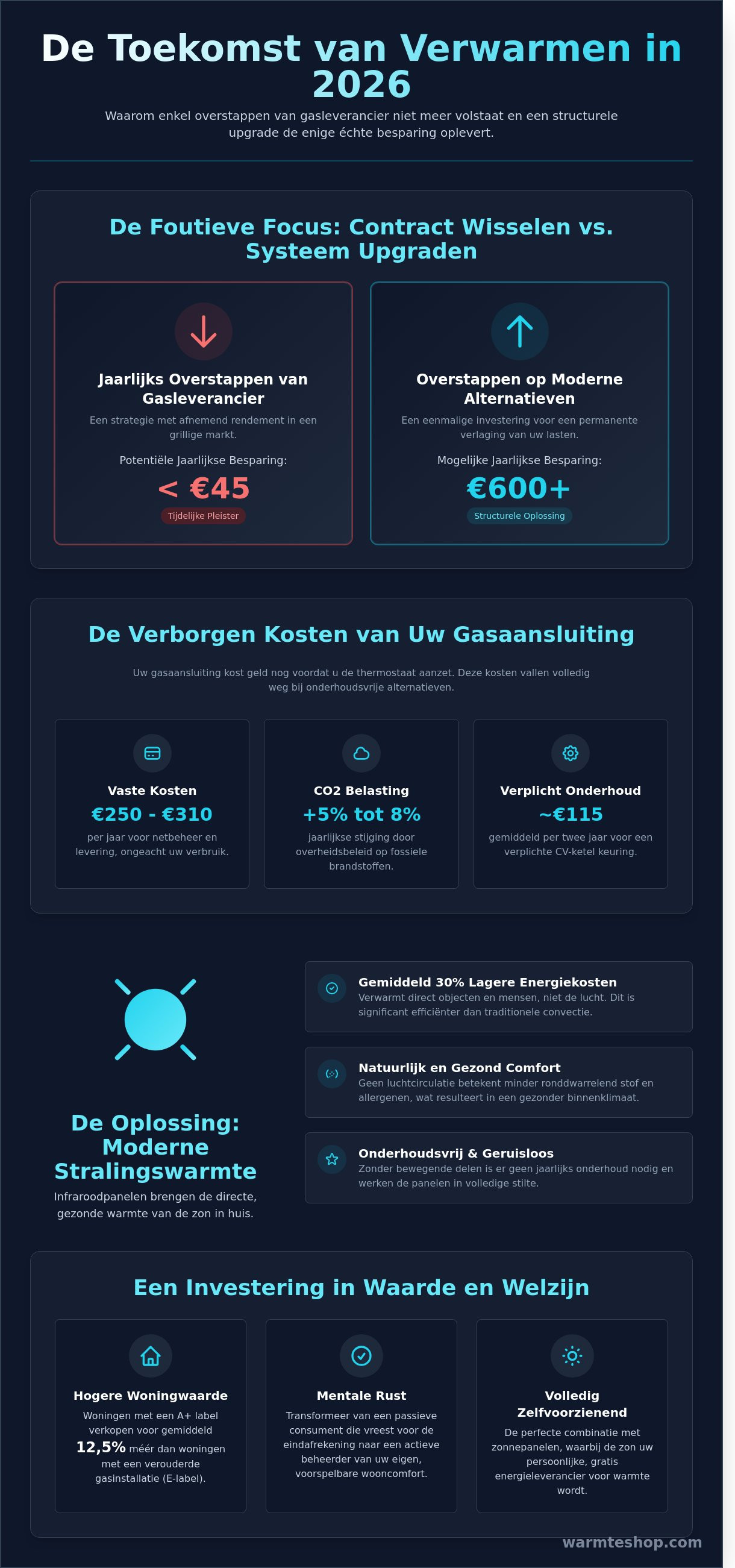
Switching to a different energy supplier annually will likely yield you less than 45 euros in actual savings in 2026, while geopolitical unrest keeps rates volatile. You probably notice…
Switching to a different energy supplier annually will likely yield you less than 45 euros in actual savings in 2026, while geopolitical unrest keeps rates volatile. You have probably noticed yourself that the familiar blue flame no longer offers the financial security you seek. The fear of a major renovation lasting weeks prevents many people from taking the step towards a sustainable home. Yet, the transition to smart gas pricing alternatives is not an obligation, but an opportunity for a significant upgrade to your daily living comfort.
In this article, you will discover why a new contract is merely a temporary fix and which physical solutions truly future-proof your home. We explain how innovative infrared panels bring the healthy, direct heat of the sun into your living room without noise or costly annual maintenance. You will receive a clear overview of the techniques required to reduce your monthly energy costs by an average of 30 percent simply by choosing modern radiant heating that warms the room and the people, rather than just the air.
The year 2026 marks a definitive turning point in how we view our energy bills. In the past, switching gas suppliers annually was an effective method to reduce costs. Today, that strategy is completely outdated by the new reality of the energy market. The gas market is grappling with structural scarcity and a tax system that penalizes fossil fuel consumption more heavily than ever before. Those who look solely at the price per cubic meter miss the bigger financial picture. You might save a few cents by signing a new contract, but you lose hundreds of euros by clinging to an outdated consumption pattern. The search for effective gas price alternatives is therefore no longer an optional choice, but a necessity for anyone who wants to keep their monthly expenses under control.
Gas prices have risen by an average of 35% since 2022 compared to the pre-crisis era. Comparison websites offer a false sense of security in this regard. They focus on marginal differences in supply rates, whereas the real gain lies in completely eliminating gas demand. An 'all-electric' home acts as a modern shield against geopolitical unrest and unpredictable price fluctuations on the global market. In practice, we see that households that remain stuck comparing rates often realize savings of a maximum of 60 to 90 euros per year. This stands in stark contrast to the savings of 600 euros or more that are immediately possible by switching to smart, electric heating systems.
Many homeowners focus solely on the variable consumption costs on their annual statement. The reality is that a gas connection costs you money even before you touch the thermostat. Consider the following items:
With modern gas price alternatives such as infrared heating, these recurring and hidden costs disappear almost completely, which immediately provides more breathing room in the budget.
The switch to gas-free living brings significant peace of mind. You transform from a passive consumer who dreads the final bill every winter into an active manager of your own living comfort. Investing in hardware, such as a system that understands how a heat pump works or the direct radiant heat from designer panels, permanently lowers your monthly costs. In combination with your own generation via solar panels, you become virtually self-sufficient, with the sun acting as your personal energy supplier.
Moreover, by 2026, a gas-free home will be the standard for value-retaining real estate. Homes with an A+ energy label are currently selling for an average of 12.5% more than homes with an outdated gas installation and an E label. It is an upgrade that pays for itself not only in lower bills but also in a healthy indoor climate and a future-proof investment. Warmteshop advises clients to view this transition as a switch to a natural form of heat that, just like the sun, heats objects and people rather than merely moving the air.
This holistic view of living comfort does not stop at the front door. Improving the outdoor space, such as the garden or terrace, also contributes to the value of your home and your daily enjoyment. For high-quality solutions for outdoor cooking and living, discover Tools & Grill.
The search for cost-effective gas price alternatives begins with a critical look at your current living situation. While a modern new-build apartment with an A+++ energy label can effortlessly switch to a fully electric installation, a monumental building from 1920 requires a more nuanced approach. The three most popular solutions differ fundamentally in operation, investment, and comfort experience. While a heat pump utilizes ambient temperature, infrared and convection operate directly on electricity, each with its own impact on your monthly energy bill.
When making a choice, the balance between purchase price and operating costs is crucial. A hybrid heat pump costs on average between 5,000 and 7,000 euros, while a complete system can exceed 15,000 euros. The lifespan is approximately 15 years. Infrared panels require a lower initial investment of around 500 to 1,000 euros per room, but last considerably longer, 25 to 30 years, without maintenance costs. Before you make a final decision, the Natural Gas-Free Living Step-by-Step Plan a clear overview of the necessary preparations per home type.
Infrared technology mimics the natural operation of the sun. Instead of heating the air in the room, these panels emit long-wave radiation that directly heats objects, walls, and bodies. This is the most aesthetic choice for modern interiors. You can effortlessly integrate the technology via elegant mirrors in the bathroom or minimalist glass panels on the ceiling. View our extensive range of infrared heating for the various design options. Because no air circulation takes place, humidity remains stable and no dust is stirred up, which directly contributes to a healthier indoor climate.
A heat pump is only truly cost-effective with excellent insulation. The Coefficient of Performance (COP) indicates efficiency; at a value of 4.0, the system delivers 4 kWh of heat for every 1 kWh of electricity. However, a major disadvantage is the loss of performance in extreme cold. As soon as the outside temperature drops below -5 degrees, efficiency plummets significantly. Additionally, you must take into account the outdoor unit, which produces approximately 45 to 55 decibels of noise and occupies considerable space in your garden or on the roof. For homes with a lower energy label, the hybrid variant is often the only realistic intermediate step.
Although convectors are inexpensive to purchase, they are often 30% to 50% more expensive to run than infrared panels. This system works by drawing in cold air, heating it, and blowing it out again. This constant airflow ensures rapid heating but also brings disadvantages such as dry air and dust displacement. It is an ideal quick emergency solution for a guest room or garage, but as primary heating, they fall short for those striving for a sustainable and healthy living environment.
Would you like to know exactly which system best suits your specific spaces? You can always request a no-obligation heat calculation for tailored advice that aligns with your budget and comfort preferences.
The calculation for energy costs in 2026 is determined by the shift in energy taxes. While a cubic meter of gas currently hovers around €1.30, the tax on fossil fuels is rising annually to accelerate the transition to alternative gas prices . One m³ of gas contains approximately 9.77 kWh of energy. At an electricity price of €0.25 per kWh, gas appears cheaper on paper, but that comparison is flawed due to efficiency losses. An average high-efficiency boiler loses 10% to 15% of heat through the exhaust, whereas electric infrared panels convert 100% of the consumed electricity into direct radiant heat.
Efficiency is not just about energy conversion, but primarily about its application. Infrared panels do not heat the air, but the objects and people in a room. This allows you to set the thermostat an average of 2 degrees lower for the same level of comfort. This technology results in energy savings of up to 30% compared to traditional radiators. Moreover, in 2026, you will benefit optimally from dynamic energy contracts. By heating smartly at times when the supply of wind and solar energy is high, costs per kWh sometimes drop to near zero or even negative amounts.
The biggest mistake in many Dutch households is heating the entire house while the residents are in just one room. Infrared zone heating solves this problem immediately. You place a panel specifically above the seating area or workspace, meaning the rest of the room does not need to be heated as intensively. By using smart thermostats per room, you prevent unnecessary energy loss on unused square meters. This significantly lowers your annual bill, as you only heat the place where you are actually staying.
Criticism of electric heating often ignores the total cost of ownership. A central heating boiler has a lifespan of approximately 15 years and requires annual maintenance costing an average of 150 euros. Infrared panels are completely maintenance-free and easily last 20 to 25 years without loss of performance. There are no moving parts to wear out and no water pipes to leak. This makes it one of the most reliable gas-cost alternatives on the market.
The real profit, however, arises from the combination with solar panels. While with gas you always remain dependent on the vagaries of the global market, electricity enables you to produce your own fuel. Even with the phasing out of the net metering scheme, directly using your own electricity for heating remains the most cost-effective method. Infrared heating is the only form of heating that fully pays for itself by directly converting the power of the sun into a healthy and comfortable indoor climate.
The switch to a sustainably heated home is a strategic process that requires calm and clarity. The search for effective gas price alternatives does not begin with the purchase of equipment, but with a thorough analysis of your current living situation. By following a structured path, you transform your house from a gas-guzzling environment into a future-proof, comfortable home.
Step 1: The insulation check and sealing gaps. Before investing in new heating technology, your home's envelope must be in order. An average home loses up to 15 percent of its heat through small cracks and gaps. Sealing these leaks with draft strips or sealant is a small investment that immediately increases the efficiency of infrared panels by 10 to 15 percent. Also check the insulation value of your glass and walls; radiant heat works most efficiently in a well-insulated envelope.
Step 2: Prioritizing living spaces. Map out which rooms you use intensively every day. The living room and kitchen often have different heating requirements than a guest room that is only used three days a month. By prioritizing the spaces where you spend 80 percent of your time, you can approach the transition in a targeted and budget-friendly manner.
Step 3: Specific solutions per room. Every room requires a unique approach. In damp rooms such as the bathroom, an towel radiator a smart choice. It not only ensures dry, warm towels but also prevents condensation and mold growth on the walls due to the direct radiation. This significantly improves the indoor climate compared to traditional convection heating.
Step 4: The professional heat loss calculation. Have an expert from Warmteshop perform a transmission calculation. We consider the room volume, the desired temperature, and the insulation value. A calculation prevents you from purchasing a system with insufficient capacity, which leads to an uncomfortable feeling, or conversely, one with too much capacity, which entails unnecessary costs.
Step 5: Phased installation. You do not have to renovate the entire home at once. By spreading the installation over, for example, two years, you spread the investment. Start with the rooms where the savings on gas price alternatives are greatest, such as the bathroom or the home office.
You can start increasing your living comfort today without major renovations. Start in the bathroom with an infrared mirror. This offers immediate comfort after showering and never fogs up. In the home office, you can replace the old radiator with an elegant ceiling panel. This panel heats you instantly, comparable to the healthy rays of the sun, allowing you to turn down the thermostat in the rest of the house while still working comfortably.
Although small panels are easy to install yourself, DIY installation of a complete main heating system entails risks. Incorrect positioning can lead to cold zones or inefficient power consumption. Warmteshop has over 30 showrooms where you can personally experience the warmth and receive technical advice tailored to your building plan. Our certified installers ensure a safe electrical connection and an invisible finish for the cabling. This guarantees a system that functions maintenance-free for decades.
Would you like to know exactly what savings are possible in your specific living situation? Request a no-obligation consultation with one of our experts.
The search for effective gas price alternatives ends with a partner that combines innovation with more than 15 years of practical experience. Since its founding, Warmteshop has developed into the undisputed market leader in the Benelux in the field of infrared technology. We have achieved this position not only by supplying high-quality products, but above all by taking our role as an advisor in the energy transition seriously. We understand that the switch to gas-free living is a big step for many households. That is why we offer a total solution that goes beyond just the sale of a panel.
Our expertise translates into a range that can provide every space in a building with the right heat. Whether it concerns a compact bathroom in an apartment or large commercial spaces, we offer custom solutions. For the business market and large warehouses, for example, we supply specialized industrial air heaters that combine efficiency with immense power. This diversity in our offering ensures that we can perform a calculation for every specific situation that minimizes energy costs.
A crucial aspect of our systems is the focus on a healthy indoor climate. Traditional convection heating moves air, and with it, dust, pollen, and bacteria. Our infrared panels work on the principle of the sun; they heat objects and bodies directly without air displacement. This results in stable humidity between 45% and 55%, which is essential for the respiratory system and the preservation of the building structure. With physical locations in Roeselare, Antwerp, Brussels, and various locations in the Netherlands, we guarantee service and support right in your area.
Heating without gas does not have to be a compromise on aesthetics. Our panels are designed to blend seamlessly into your interior or to make a statement. We supply photo panels with razor-sharp printing of your choice, as well as practical chalkboards for the kitchen. Every product is manufactured according to strict European production standards, guaranteeing an average lifespan of 20 to 25 years. This high-quality finish ensures that our systems come into their own perfectly in both modern lofts and classic townhouses.
The uncertainty surrounding fossil fuels makes the switch to electric infrared heating a smart investment. We are happy to help you become completely independent of fluctuating gas price alternatives by transforming your home into an energy-efficient beacon of comfort. Our experts are ready to perform a free, no-obligation heat calculation for your specific living situation. Visit one of our showrooms for a demonstration and experience for yourself the pleasant, natural warmth radiated by our systems. It is time to take back control of your own energy bill and living comfort.
The year 2026 marks a turning point for your energy bill. Simply switching suppliers no longer offers protection against rising network tariffs and the CO2 tax. The switch to gas-free living is a smart investment in your living comfort and your wallet. Infrared heating does not heat the air, but directly the objects and people in the room. This feels exactly like the natural radiant heat of the sun on a clear winter day. Since 2008, Warmteshop has been helping to make homes more sustainable with this innovative technology.
With more than 30 showrooms in the Benelux, we always offer a tangible solution near you. It is time to take back control of your energy costs. Various gas price alternatives make your home future-proof while you save immediately on your monthly expenses. Our advisors are ready to perform a free professional heat calculation for you. This way, you know exactly what your home needs for a healthy and aesthetically pleasing indoor climate.
Discover our energy-efficient infrared solutions
Infrared panels are currently the most cost-effective alternative in terms of purchase price, with prices starting from 250 euros per panel. While a heat pump requires an investment of 8,000 to 15,000 euros, you can equip an average living room with infrared for less than 1,500 euros. Infrared panels are among the most cost-effective alternatives to gas prices because they do not require annual maintenance of 150 euros and provide heat immediately.
Yes, you can comfortably heat your entire home with infrared, provided the insulation of the walls and glass meets energy label B or higher. For an average family home, we calculate with a capacity of 25 to 35 Watts per cubic meter to guarantee a constant temperature. By placing panels in every room, you create a zone-controlled system that only consumes energy in the places where you are actually present.
An average household saves between 30% and 50% on total energy costs by switching to infrared heating in combination with solar panels. With a historical consumption of 1,200 m³ of gas per year, this results in savings of approximately 850 euros per year at current rates. These gas price alternatives operate more efficiently because the thermostat can often be set 2 degrees lower, while the radiant heat provides the same sense of comfort as a warm summer day.
For most homes, a standard 3x25 amp connection is sufficient to switch completely to electric heating with infrared technology. A 600-watt panel consumes no more power than a modern coffee machine, keeping the load on your network limited. Only when you switch on more than 12 panels simultaneously at full power is a simple adjustment to the fuse box by a technician recommended.
A heat pump uses electricity to heat the air in the house via water pipes, while infrared panels emit direct radiant heat to objects and people. The installation of a heat pump typically takes 3 working days and requires an outdoor unit that produces noise. Infrared panels are mounted on your ceiling within 2 hours, are completely silent, and prevent dust circulation, resulting in a healthier indoor climate than traditional air heating.
In 2026, the ISDE subsidy remains in effect, allowing you to receive up to 30% of the investment costs back for insulation measures and hybrid systems. Although there is no national purchase subsidy for individual infrared panels, 140 Dutch municipalities offer specific sustainability loans at an interest rate of 0%. In 2026, some local authorities will issue vouchers of 500 euros to residents who demonstrably make their homes natural gas-free.
High-quality infrared panels have a lifespan of at least 25 to 30 years, which is more than double that of a traditional central heating boiler. A gas boiler contains moving parts that often fail after 12 or 15 years due to wear or limescale buildup. Because panels have no pumps or burners, the efficiency remains 100% consistent throughout the entire service life. By doing so, you are investing in a sustainable solution that remains maintenance-free for decades.
Yes, infrared heating is completely safe because the panels are equipped with thermal sensors that limit the temperature to 95 degrees Celsius. When mounted on the ceiling, the heat sources are out of reach of small children and pets such as dogs or cats. The technology mimics the healthy warmth of the sun without harmful UV radiation, which even stimulates blood circulation and prevents dry skin caused by heated air.


