

Carbon in Infrared Heating: The Technology Behind Sustainable Heating in 2026
, by Warmteshop, 18 min read
, by Warmteshop, 18 min read
What if the key to a lower energy bill in 2026 lies not in a more powerful heat pump, but in a wafer-thin layer of carbon atoms? Many homeowners are rightly concerned about rising electricity costs b…
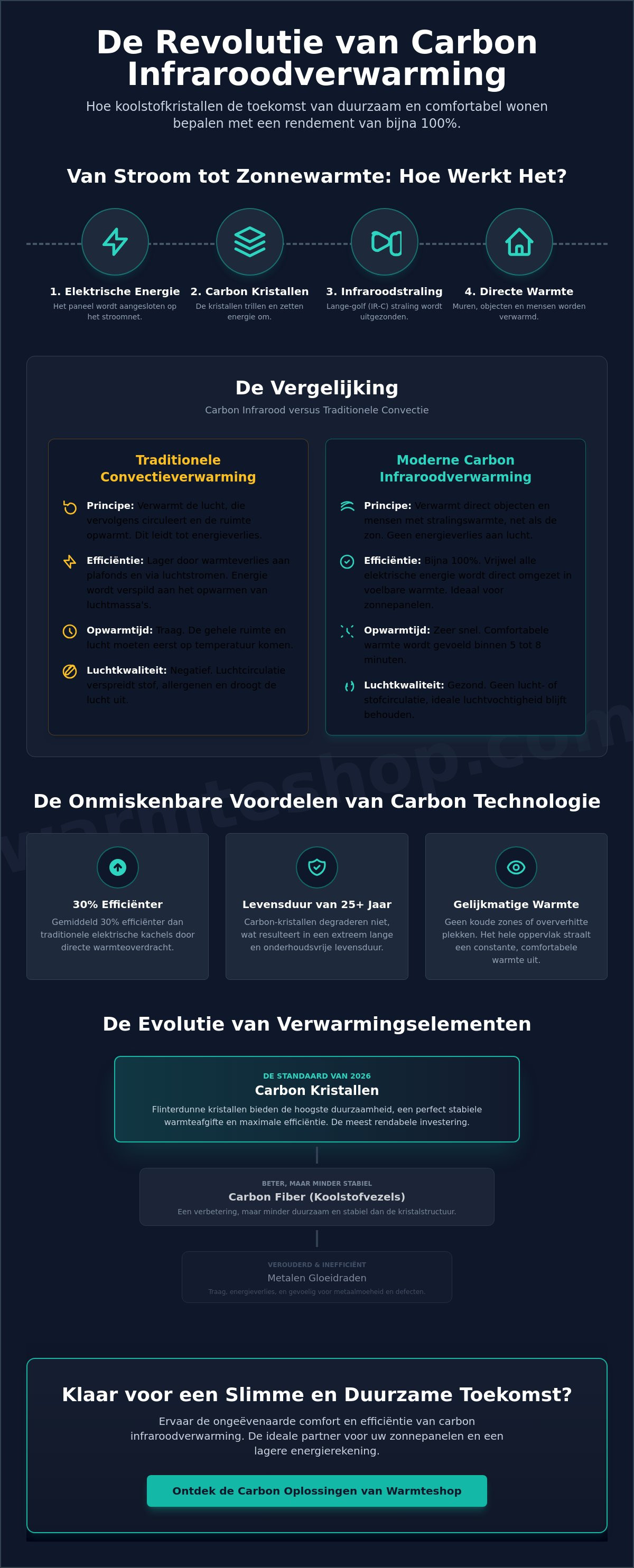
What if the key to a lower energy bill in 2026 lies not in a heavier heat pump, but in a wafer-thin layer of carbon atoms? Many homeowners are rightly concerned about rising electricity costs when switching to electric heating, while there is considerable confusion regarding various types of infrared panels. After all, you do not want to invest in a technology that turns out to be less sustainable than promised. The innovative use of carbon crystals completely changes the playing field by converting electrical energy into direct radiant heat with an efficiency of nearly 100 percent.
You are probably already convinced that gas-free living is the future, but you are looking for the most cost-effective way to get there. In this article, you will discover how carbon technology forms the core of the most efficient and healthy infrared heating for your home. We explain exactly how this technology works, why it lowers your energy consumption, and how to create an indoor climate without bothersome air movement. You will learn which type of panel achieves the highest sustainability score, so you can choose with peace of mind a warmth that feels like the beneficial, natural power of the sun.
Carbon, commonly known as carbon, forms the backbone of the most advanced heating technology of 2026. Whereas in the previous century we were still dependent on metal filaments that heated up slowly and lost a great deal of energy, the switch to carbon crystal elements marks a technological revolution. The molecular structure of carbon is, in fact, unique. It possesses the ability to convert electrical energy into heat with an efficiency of nearly 100%. This occurs via a process in which the atoms in the material begin to vibrate as soon as voltage is applied.
This vibration generates long-wave infrared radiation. This is exactly the same type of heat we experience when the sun shines through the glass on a cold winter day. It does not heat the air, but directly the objects and people in a room. To understand how this process fundamentally differs from traditional convection, it is useful to look at the basics: What is infrared heating? In essence, carbon ensures that a panel reacts faster and distributes heat more evenly than any other material. As a result, you enjoy a comfortable indoor climate within minutes without unnecessary energy consumption.
The transformation of raw carbon into a high-quality heating element is a complex process. Modern panels utilize carbon crystals applied in wafer-thin layers on an insulating plate. While older technologies often relied on carbon fiber, the crystal structure offers much higher durability and more stable heat output. By 2026, this technique will be the standard because the material does not degrade due to repeated heating and cooling. This results in a lifespan of more than 25 years, making carbon one of the most cost-effective investments for your home.
Carbon plays a key role in the current transition to a carbon-neutral built environment . The efficiency of infrared heating with carbon technology is on average 30% higher than that of traditional electric heaters. Because these panels respond directly to the thermostat, you do not waste energy preheating air masses. This makes them the ideal partner for solar panels. The electricity you generate during the day is directly converted by the carbon elements into healthy radiant heat, which is stored in the walls of your home. The result is a home that is not only heated smartly but also actively contributes to reducing your ecological footprint.
The core of modern infrared technology revolves around the unique molecular properties of carbon. When electric current flows through the carbon crystals in the panel, a specific vibration is created at the molecular level. This vibration generates long-wave infrared radiation, technically referred to as IR-C. It is a process directly comparable to the way the sun heats the earth; not by heating the air, but by directly transferring energy to objects and people in the room.
A major advantage of this technology is the speed with which a comfortable climate is created. Whereas traditional radiators must first circulate the entire air mass in a room, carbon elements react almost immediately. Within a timeframe of 5 to 8 minutes, the surface reaches the desired temperature. Because the heat is absorbed directly through the skin and the walls, the room feels comfortable more quickly, even if the air temperature is still relatively low. This not only increases comfort but also significantly reduces energy consumption.
The technical stability of carbon is another crucial aspect. Unlike metal heating wires, which expand and contract with every heating cycle, carbon exhibits hardly any thermal expansion. This prevents metal fatigue, a common cause of failure in cheaper electric heaters. Moreover, the heat distribution across the entire surface is completely uniform. There are no cold zones or overheated spots, which benefits the safety and efficiency of the panel.
The durability of a heating system is determined by the resistance of its components to oxidation and heat. Carbon is chemically extremely stable and does not corrode, even after years of intensive use at high temperatures. While a traditional convector often shows signs of wear after approximately 8,000 operating hours, high-quality infrared panels with carbon technology effortlessly last 100,000 hours. This is partly due to the absence of moving parts or wafer-thin wires that can break under tension. The result is a maintenance-free system that lasts for generations.
The effectiveness of radiant heat is measured by emissivity. Carbon has an emissivity of approximately 0.98, which means that 98% of the absorbed energy is actually converted into infrared radiation. This represents an unprecedentedly high efficiency compared to other materials. Thanks to the homogeneous structure of the carbon layers, "hot spots" are prevented. As a result, the surface temperature remains constant, leading to stable and steady heat output in the room. For those seeking this advanced form of climate control, the infrared heating various solutions that translate this science into everyday living comfort.
The switch to carbon infrared heating marks a fundamental shift in how we keep our homes comfortable. Traditional systems, such as the familiar central heating boiler with radiators, work on the basis of convection. This means that they heat the air, which then rises and cools down again. This process is slow and results in an uneven heat distribution. Carbon technology works differently. These panels convert electricity into direct radiant heat at an efficiency of almost 100 percent. You feel the heat directly on your skin, just as the natural rays of the sun warm you, even on a cold day.
The installation of these systems offers significant convenience compared to the complex laying of piping networks. Whereas a traditional renovation often takes days and requires hacking and breaking work, an infrared panel is often operational within 30 minutes via a standard power outlet. Moreover, in the long run, you save substantially on maintenance costs. Because a carbon panel contains no moving parts or fluids, there is no wear and tear, leaks, or the need for an annual inspection by a technician.
One of the most appreciated features of carbon heating is its positive impact on air quality. Because no air movement occurs, dust particles, pollen, and dust mites settle on the floor instead of floating through the room. This provides immediate relief for people with allergies or asthma. Furthermore, humidity remains stable between the ideal values of 45 and 55 percent, as the air is not dried out by hot metal surfaces.
In addition, the deep penetration of the infrared radiation has a therapeutic effect. The radiation penetrates the skin to a depth of approximately 2 to 3 millimeters. This stimulates blood circulation and helps relax stiff muscles and joints. The result is a healthy warmth that supports not only the room but also the body.
Thanks to the ultra-thin carbon layers, carbon panels are often only a few millimeters thick. This opens doors for aesthetic applications that were previously unthinkable. The panels do not take up valuable floor space and can be mounted virtually invisibly on the ceiling or high on the wall. This sleek appearance fits perfectly with the minimalist interior trends of 2026.
An innovative application of this technique is its integration into infrared mirrors. In this case, the mirror in the bathroom or hallway functions as a full-fledged heat source. The carbon technology ensures that the mirror never fogs up, while the room is heated efficiently. Whether you choose a striking design element or a discreet solution that blends into the plasterwork, this technology offers complete creative freedom without compromising on performance.
Switching to carbon heating is an investment in long-term living comfort and a lower energy bill. It all starts with an accurate wattage calculation. Insufficient power forces the system to constantly operate at maximum power, which negatively affects efficiency. For an average insulated home in 2026, we often calculate with 25 to 35 Watts per cubic meter. It is crucial to have this calculated for each specific room by an expert so that you never waste energy unnecessarily.
There are significant differences in quality on the market. Cheap imitations often use simple carbon fibers that lose strength after a few years. High-quality carbon crystals, on the other hand, retain their efficiency for decades. Pay attention to the following points when making your purchase:
Infrared radiation works via direct transfer, just like the natural heat of the sun. Therefore, we often recommend ceiling mounting for carbon panels. From the ceiling, the radiation reaches the floor and furniture without obstruction, allowing the entire room to store and release heat evenly. In large L-shaped rooms, one large panel is often less efficient than two smaller panels strategically distributed across the zones. Ensure that no large objects, such as cabinets, block the radiation path, otherwise effectiveness is immediately lost.
Home comfort increases significantly when you integrate various systems. A hybrid setup of wall panels and infrared underfloor heating based on ultra-thin carbon foil is a smart choice. The floor provides a constant base temperature, while the panels respond quickly to additional heat demand. The heart of such a system consists of smart thermostats. These allow you to create zones in your home, ensuring you only heat where you are at that moment. According to recent real-world figures, this type of zone heating saves up to 30 percent on energy costs compared to traditional systems.
Warmteshop has been acting as the driving force behind the adoption of infrared technology in the Benelux since 2008. The transition to a sustainable home by 2026 requires systems that are not only efficient but also last for decades without losing power. Our panels are rooted in high-quality German engineering, with a core consisting of an ultra-thin carbon mat. This technology converts 100 percent of the electricity consumed into direct radiant heat, making energy loss a thing of the past. We guide you through every step of the transition to gas-free living, supported by precise heat calculations tailored specifically to your living situation.
The versatility of our systems ensures that every room in the house benefits from an optimal climate. In the living room, our panels integrate seamlessly into the interior, while in humid spaces they create a dry, mold-free environment. A specific example of this innovation is the towel radiator. This system combines the powerful heating time of carbon elements with the functionality of a designer radiator. Here are three reasons why our panels are setting the standard for 2026:
Choosing the right heating is a sensory experience that you cannot have solely from a screen. You must feel the unique warmth of carbon crystals to understand the difference compared to traditional convection heating. In our 30 physical showrooms spread across Belgium and the Netherlands, we let you experience how our panels mimic the natural heat of the sun. Our advisors look beyond just the product; they analyze your insulation values and space usage to design a system that actually lowers your energy bill.
Warmteshop's reliability doesn't stop at the purchase. As a market leader, we offer a 10-year warranty on our panels and comprehensive after-sales service. You are not just investing in a device, but in a long-term partnership. Our experts ensure a smooth transition to a gas-free future, with the assurance of a warm home ready for tomorrow's energy standards. Visit us and discover how we elevate your living comfort with the most advanced infrared solutions on the market.
The transition to a sustainable indoor climate revolves around smart choices and the right technology. With the innovative power of carbon heating elements, you choose a system that already meets the strict sustainability standards of 2026. This technology converts electrical energy into direct radiant heat with unprecedented efficiency. As a result, you experience the same natural comfort in your home as the warm rays of the sun on a clear day. By doing so, you invest directly in a lower CO2 footprint and a healthier indoor climate without bothersome dust displacement.
Warmteshop has served as your reliable guide in the world of infrared technology for over 15 years. We combine top German quality with an extensive warranty, ensuring you enjoy your installation worry-free for decades. Our expert advisors are ready to assist you in over 30 showrooms to create a calculation that perfectly matches your specific living situation. With these modern solutions, the step towards a gas-free home is easier and more comfortable than ever before.
Discover our high-quality carbon infrared panels in the webshop
Prepare your home for the future and enjoy a comfortable and energy-efficient house every day.
A carbon panel distinguishes itself from a standard infrared panel by using an wafer-thin carbon mat instead of metal wires for more even heat distribution. This technology ensures that 98% of the energy is directly converted into radiant heat without energy loss at the rear. As a result, the surface reaches the optimal operating temperature within 5 to 10 minutes, which is faster than traditional panels with a metal core.
Although a heat pump delivers a higher technical efficiency per kilowatt-hour, carbon heating is often more cost-effective overall due to the absence of annual maintenance costs and a 70% lower purchase price. In well-insulated homes built after 2010, this system only consumes energy when you are actually present in the room. The University of Kaiserslautern demonstrated that this targeted heating method reduces energy consumption in specific living situations by over 12% compared to central systems.
A high-quality carbon-based heating element lasts an average of 25 to 30 years without any loss of efficiency. Because the system contains no moving parts or fluids, there is no mechanical wear or leaks. At Warmteshop, we see that the durability of this technology ensures that the panels often function twice as long as a traditional central heating boiler, which usually needs replacing after 15 years.
Carbon infrared panels are completely safe for every family member thanks to the built-in thermal sensors that limit the surface temperature to a maximum of 95 degrees Celsius. The heat feels like the natural rays of the sun and contains no harmful UV radiation. Due to the low thermal mass of the material, a brief touch does not cause immediate burns, which is a reassuring thought in a household with playing children or pets.
You can easily mount the panels to the wall or ceiling yourself using the included templates and the universal mounting system. For seamless integration into your smart home system, our experts in the 30 showrooms often recommend hiring a professional installer. These professionals ensure the cabling is concealed and place the thermostats in strategic locations for 100% optimal efficiency.
Carbon crystal technology is an innovative production method in which carbon molecules are pressed into an epoxy resin under high pressure to form an extremely stable plate. This structure prevents the panel from warping over time due to heat, which often occurs with cheaper alternatives. The result is a heating element that continues to emit constant and homogeneous infrared radiation towards the objects in the room throughout its entire 30-year lifespan.
Yes, this system is perfectly suitable as primary heating, provided the home has an insulation value that meets current post-2015 standards. With an average output of 25 to 30 Watts per cubic meter, you create a pleasant climate in every room. Because you control each room independently with its own thermostat, you avoid wasting energy unnecessarily on rooms you are not currently using.
Carbon heating significantly improves air quality by heating objects rather than air, reducing dust circulation by approximately 80%. This is a direct benefit for people with allergies or asthma, as pollen and dust mites no longer float through the room. Humidity remains stable between the ideal values of 40% and 60%, preventing dry eyes and ensuring a healthy indoor climate comparable to a crisp spring day.


