
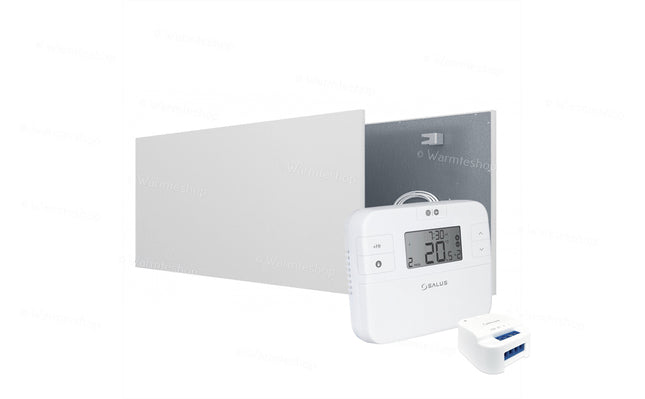
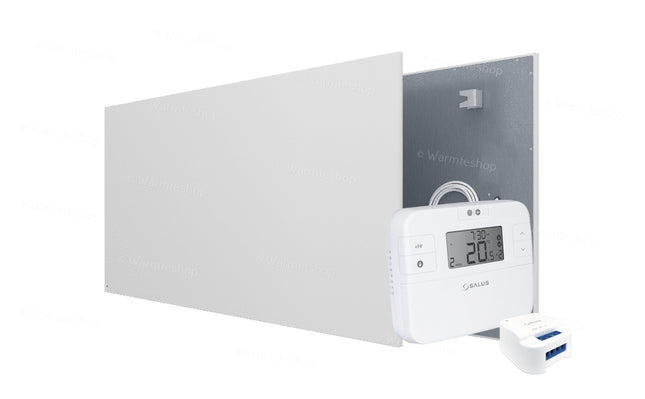
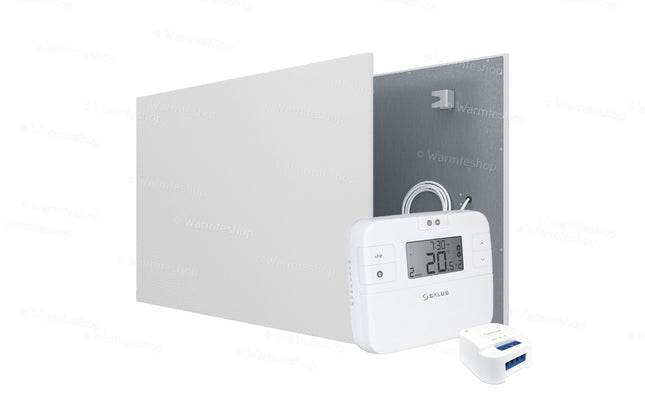
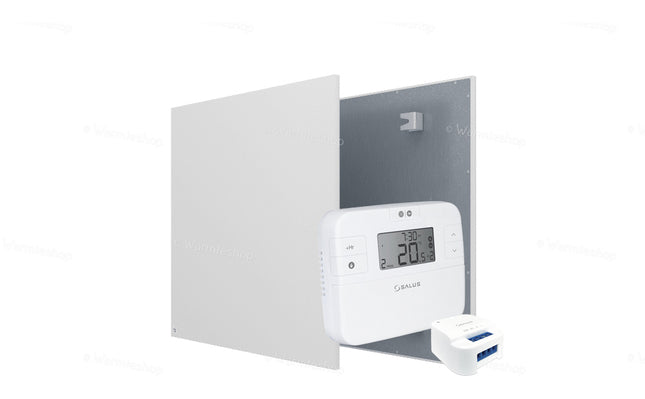
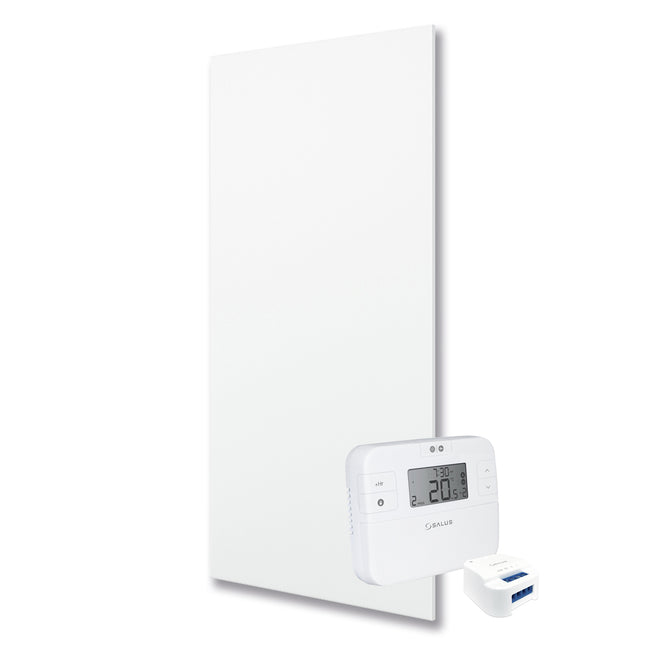
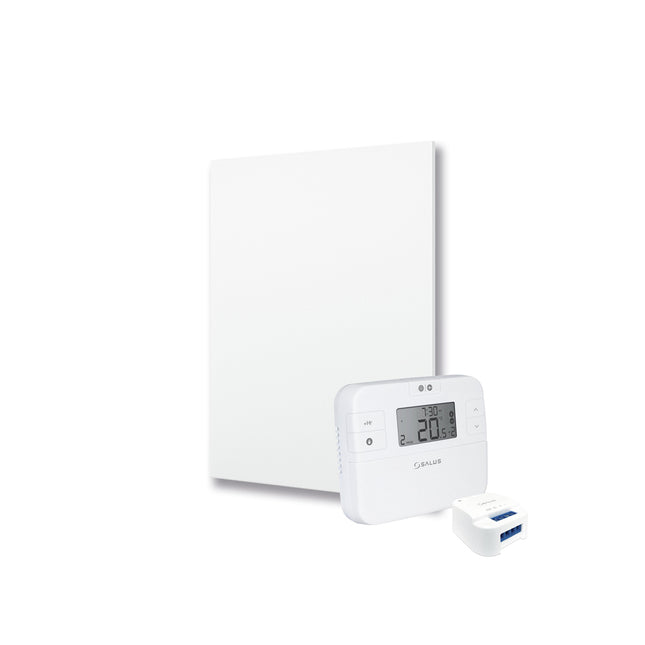
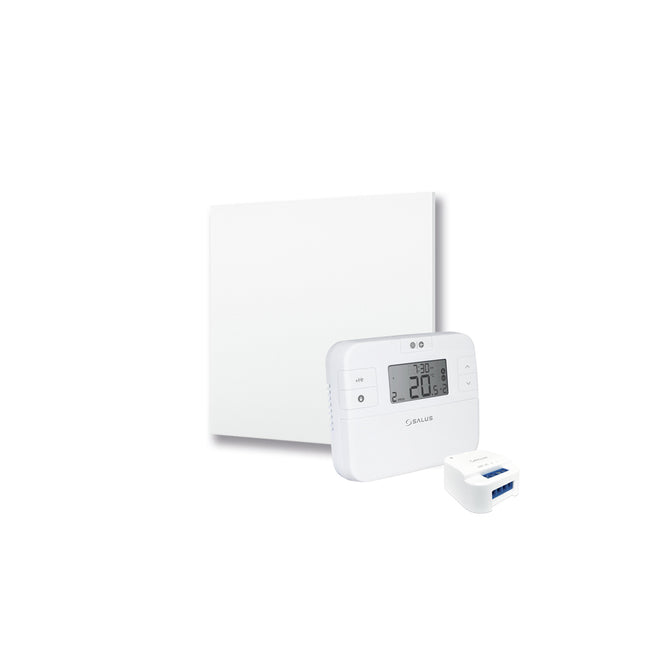

Infrared heating for the living room: efficient, quiet and stylish
An infrared panel in the living room directly heats the people and objects in the room via radiant heat, without air circulation or noise. The result is a pleasant, even feeling of warmth that lasts longer after the panel has switched off, because the heat is stored in the walls and furniture. At Warmteshop, you will find living room panels from Ecaros, Alkari, Welltherm, and Termofol: from compact 400 watts to powerful 2,000 watts, in metal, glass, and designer finishes. Always free shipping and personal advice in our 32 stores in the Netherlands and Belgium.
How many watts do you need for your living room?
For infrared heating in the living room, the rule of thumb is 35 watts per m³ of room volume for a well-insulated home. Calculate the volume of your living room by multiplying length x width x ceiling height. Some examples:
- Living room 20 m², ceiling 2.5 m = 50 m³ = approximately 1,750 watts required
- Living room 30 m², ceiling 2.5 m = 75 m³ = approximately 2,625 watts required
- Living room 40 m², ceiling 2.5 m = 100 m³ = approximately 3,500 watts required
For a poorly insulated home or open living room, increase this value by 30 to 50%. Multiple smaller panels provide better heat distribution than one large panel. The radiation range per power output is a useful guideline for placement: 500 watts reaches approximately 1 meter, 700 watts approximately 2 meters, and 1,000 watts approximately 3 meters. Our advisors will prepare a customized heat calculation free of charge.
Wall, ceiling, or freestanding: what works best in the living room?
Ceiling mounting
Ceiling mounting is the most efficient placement in the living room. The heat spreads evenly across the entire floor surface, and walls are heated from top to bottom. Ideal for larger living rooms and open floor plans. View our infrared panels for ceiling mounting.
Wall mounting
Wall mounting is ideal for targeted supplementary heating of a seating area or dining area. The panel hangs discreetly on the wall and heats the zone directly for you. Combine wall and ceiling mounting for a larger living room with multiple zones. View our wall models.
Freestanding or movable
Looking for flexible supplementary heating? You can easily place a freestanding infrared panel next to the sofa or in a reading nook. No drilling is required, and you can move the panel to any desired location. Ideal as a supplement to central heating or as a temporary solution.
Which type of panel suits your living room?
Metal infrared panels
The most popular and cost-effective choice. Scratch-resistant powder coating, available in white and black. Slim profile of 2 to 3 cm that is barely noticeable on the wall or ceiling. View our metal infrared panels.
Glass infrared panels
Glass infrared panels provide a sleek, modern look and are available in various colors. They fit well in a contemporary or Scandinavian interior and are easy to keep clean. Available with Wi-Fi control and remote control.
Design and photo print panels
Would you like your heating to have visual added value as well? Choose a photo-printed infrared panel with your own image, or a RAL color panel that perfectly matches your interior. Heat source and design element in one.
LED infrared panels
An LED infrared panel combines heating and lighting in a single device. Ideal for areas in the living room where you also want a lighting point, such as above a dining table or in a home office. The LED and heating can be operated independently of each other.
Hybrid infrared panels
Hybrid infrared panels combine infrared radiation with convection heat. As a result, the room heats up faster than with a pure infrared panel, making them ideally suited for less well-insulated living rooms or older homes. Equipped with a built-in WiFi thermostat.
Infrared as primary or supplementary heating in the living room
Infrared heating can be used as both primary and supplementary heating. For supplementary heating, combine a single panel above your seating area with your existing heating, allowing you to switch off the gas heating sooner. For primary heating, install multiple panels distributed throughout the room: one above the seating area, one by the dining table, and optionally one in the open kitchen. View our complete living room heating sets, pre-assembled based on room size.
Energy saving in the living room with infrared
An average 700-watt infrared panel costs approximately €0.21 per hour at an electricity rate of €0.30 per kWh. Because the heat is immediately noticeable and requires no warm-up time, the panel is switched on for shorter periods than a conventional radiator. Combine with a smart thermostat or Shelly home automation for automatic control based on presence and time. In combination with solar panels, you heat the living room completely CO2-neutral.
Buy infrared living room heating at Warmteshop
Warmteshop has been a specialist in infrared heating since 2006 and is the market leader in the Benelux. With 32 stores in the Netherlands and Belgium, thousands of panels in stock, and certified via Trustprofile, you are assured of quality and service. Always free shipping. Also check out our infrared heating for the bedroom or request a free heat calculation in one of our stores.
Frequently asked questions about infrared heating for the living room
Can I use an infrared panel as the sole heating in the living room?
Yes, provided you install sufficient capacity and the living room is reasonably insulated. As a rule of thumb, 35 watts per m³ applies with good insulation. For a living room of 30 m² with a ceiling of 2.5 meters, you need approximately 2,625 watts. Distribute this over two or three panels for even heat distribution. Our advisors will calculate the required number and capacity tailored to your specific needs free of charge.
Does an infrared panel make noise in the living room?
No. Infrared panels operate completely silently. There are no moving parts, no fan, and no running water. The panel also makes no ticking sound when heating up or cooling down, like a metal radiator sometimes does. This makes infrared heating particularly suitable for the living room, bedroom, or home office.
How long does it take for the living room to warm up?
Infrared panels emit palpable heat after just 5 to 10 minutes. The room temperature rises gradually as walls, floor, and furniture store and release heat. In a well-insulated living room, you typically reach the desired temperature within 20 to 40 minutes. Thanks to the thermostat, the panel switches off automatically as soon as the temperature is reached and only turns on when the temperature drops.
Can I use an infrared panel in an open living room with a kitchen?
Yes. In an open living room-kitchen, it is preferable to place multiple panels in strategic locations: one above the seating area, one above the dining area, and possibly one in the kitchen zone. Because infrared heat directly warms objects and people, and not the air, heat loss due to drafts or open doors is less than with convective heating. However, with an open floor plan, you generally require a higher total output.
Which infrared panel suits a modern or Scandinavian interior?
For modern interiors, glass infrared panels are the best fit: a sleek, reflective surface in various colors. For a Scandinavian or minimalist interior, white metal panels without a visible edge are the most popular choice. If you want the panel to blend completely into the interior, choose a RAL color panel that exactly matches the color of your wall or ceiling.