




Cooling a patio doesn't start with the most powerful device, but with the right combination of shade, air movement, and evaporative cooling. After all, an open garden requires a different approach than a sheltered patio or a busy restaurant terrace. In this guide, you compare fans, air coolers, misting systems, and patio air conditioning. Additionally, you will discover which solution suits the climate in Belgium and the Netherlands, where to safely install equipment, and which specifications are truly important.

Why does a terrace get hot so quickly?
The sun heats not only the air, but also paving, facades, glass, garden furniture, and canopies. These surfaces store heat and release it later. As a result, a terrace can still feel stuffy even at the end of the afternoon. Moreover, warm air lingers longer between walls or under a closed canopy.
The perceived temperature is mainly influenced by:
- direct sun and the amount of shade;
- wind and natural air circulation;
- humidity;
- heated paving, facades and roofs;
- the number of people on the terrace;
- kitchen heat, lighting and other heat sources;
- the degree to which the terrace is open or sheltered.
Therefore, a single device does not deliver the same result on every terrace. First, map out the sun, wind direction, seating, and available power and water supply. Then, you can cool the terrace without using excessive energy or water.
Cooling the patio: which solution works where?
Various techniques exist for outdoor cooling. They do not all lower the actual air temperature. A fan, for example, primarily provides a cooling sensation, while an air cooler or misting system evaporates water. A classic compressor air conditioner removes heat but only works effectively when the cooled zone is sufficiently enclosed. Therefore, cooling a terrace always requires a technique that suits the openness of the location.
| Solution | Effect | Fits especially well with | Point of attention |
|---|---|---|---|
| Sun protection | Prevents part of the heat radiation | Every terrace | Does not actively cool, but reduces the cooling demand |
| Fan | Increases air movement and sensation of cooling | Open and damp outdoor spaces | Does not lower the air temperature |
| Adiabatic air cooler | Cools the blown air through water evaporation | Ventilated terraces and semi-open spaces | Effectiveness decreases at high humidity |
| Misting fan | Combines airflow with fine water droplets | Hospitality, events and targeted seating | Check water quality, wind, and possible precipitation |
| High-pressure misting | Produces a very fine mist that can evaporate quickly | Fixed catering setup and larger terraces | Professional design and maintenance needed |
| Compressor air conditioning | Extracts heat and dissipates it elsewhere | Lockable veranda or interior space | Usually unsuitable for fully open outdoor use |
First shade, then active cooling
Sun protection prevents the terrace and facades from heating up to their maximum. Consider a parasol, awning, sunshade, or shade cloth. Light-colored materials generally absorb less solar heat than dark surfaces. Subsequently, combine shade with air circulation or evaporative cooling for a more noticeable comfort effect.
Fan for an open terrace
A fan moves air along the skin. This allows sweat to evaporate faster and makes it feel cooler, even though the measured air temperature hardly drops. This simple solution works particularly well when water misting is undesirable or when the air is already humid. Direct the airflow towards the living area and not exclusively over the heads of guests.
Air conditioning, air cooler, or nebulizer?
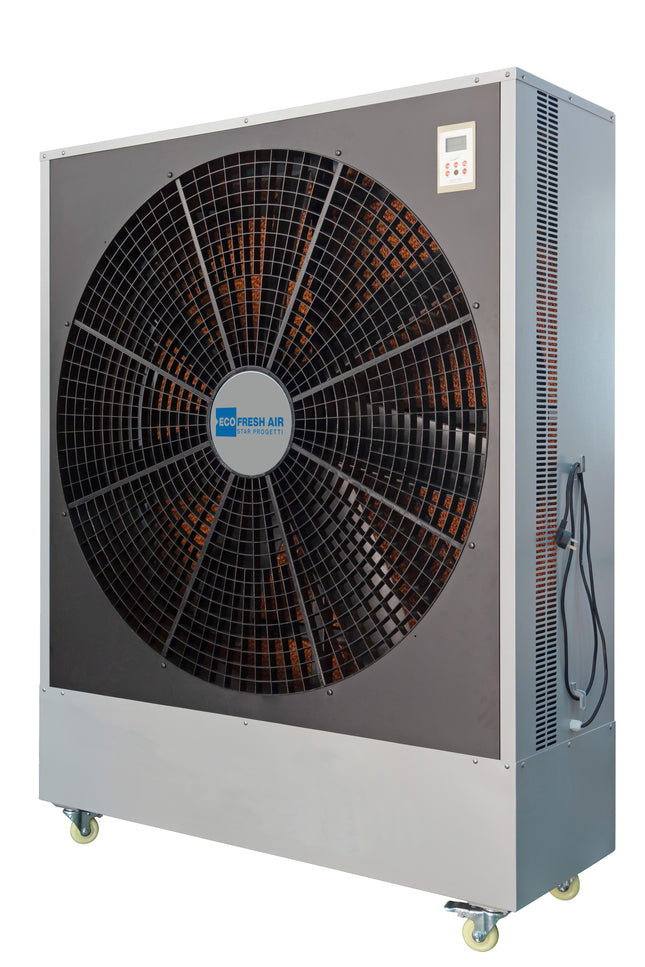
The term patio air conditioner is often used broadly. However, an adiabatic air cooler is not a classic air conditioner. The air cooler draws in warm air and directs it past moist cooling media. Through evaporation, the blown air becomes cooler, but also more humid. Therefore, this system requires sufficient fresh air and the removal of humid air.
A compressor air conditioner moves heat via a refrigerant circuit. In completely open outdoor air, the cooled air dissipates immediately while warm outside air continues to flow in. Therefore, use such a system only for an enclosed veranda, garden room, or other confined space. Additionally, for a broader search intent, you can also patio air conditioners .
When does evaporative cooling work well?
When cooling a terrace using water evaporation, warm, relatively dry air and sufficient ventilation determine the result. During evaporation, the water absorbs heat from the air. At high relative humidity, less water can evaporate, reducing the cooling effect. Therefore, on changeable days in Belgium and the Netherlands, performance varies by hour and location.
An air cooler generally pairs well with:
- a covered terrace with open sides;
- a patio or courtyard with sufficient ventilation;
- a restaurant terrace where the device can blow air directed at seating;
- an event, queue or temporary public area;
- a work terrace or semi-open professional space.
In a completely enclosed veranda, humidity can build up. This reduces efficiency and can make it feel clammy. In such a space, it is better to opt for ventilation or a proper air conditioner with correct heat dissipation. For a broad comparison of outdoor cooling options, you can also patio cooling .
Cool the terrace without getting guests or furniture wet
With properly adjusted evaporative cooling, the water evaporates as much as possible before reaching surfaces. However, the result depends on droplet size, water pressure, distance, wind, and humidity. A simple low-pressure mister often produces larger droplets than a professional high-pressure system.
Installation of an air cooler
Preferably place a portable air cooler at the edge of the terrace so that it can draw in fresh air and blow it towards the seating area. Do not place it in an enclosed corner where humid air continues to recirculate. Then, keep the intake and exhaust clear and use the brakes on the wheels if the unit has them.
Placement of misting system
Do not direct sprayers directly at food, electronics, slippery floors, or delicate materials. First, test how the wind disperses the mist. Additionally, check that no wet spots form that could cause slipping. In the hospitality industry, hygiene, water quality, and a fixed cleaning schedule deserve extra attention.
How do you choose the right capacity?
A stated number of square meters is only an initial indication. For terrace cooling , airflow, discharge range, and placement are at least as important. For example, a large unit behind a windbreak may be less effective than two targeted units near different seating areas.
Please note the following details before purchasing:
- surface area and shape of the terrace;
- open, semi-open or fully covered arrangement;
- sunshine hours and warmest moment of use;
- prevailing wind direction and shelter;
- average and maximum number of persons;
- available electrical power and water connection;
- desired mobility, noise level and operation;
- materials or products that must not get wet.
Air flow rate and discharge range
Air flow rate is usually expressed in m³/h. A higher value means that the unit moves more air, but it does not automatically indicate how comfortable every seat will be. Therefore, also consider the discharge angle, adjustable speeds, installation height, and the ability to control multiple zones.
Water and energy consumption
Compare the electrical power consumption and water usage per hour. Check the tank capacity, expected autonomy, and the possibility of a fixed water connection. Automatic refilling can be practical for a busy restaurant terrace. At home, a smaller, mobile device with a reservoir might actually be simpler.
Noise level
High air displacement produces noise. Compare dB(A) values only when the measurement method and distance are the same. Do not place a powerful unit unnecessarily close to a quiet table or conversation area. Use a lower fan setting during quieter moments if possible.
Cooling terraces in the hospitality industry
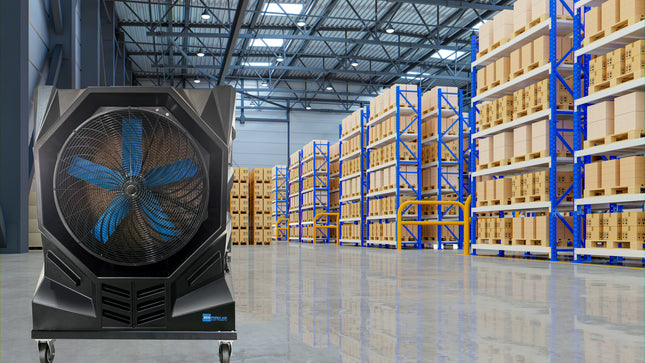
In the hospitality industry, outdoor comfort influences how long guests can remain seated comfortably. However, equipment must not block walkways, create loose cables, or hinder staff. Therefore, create a placement plan in advance that includes seating, escape routes and walkways, power outlets, water points, and storage after closing time.
For hospitality use, these points are particularly important:
- robust wheels and brakes for safe movement;
- sufficient tank capacity or a reliable water connection;
- service staff understand quickly;
- adjustable airflow for quiet and busy moments;
- easy access to filters and cooling media;
- off-season storage or protection options;
- a device that, according to the manufacturer, is suitable for the intended outdoor installation.
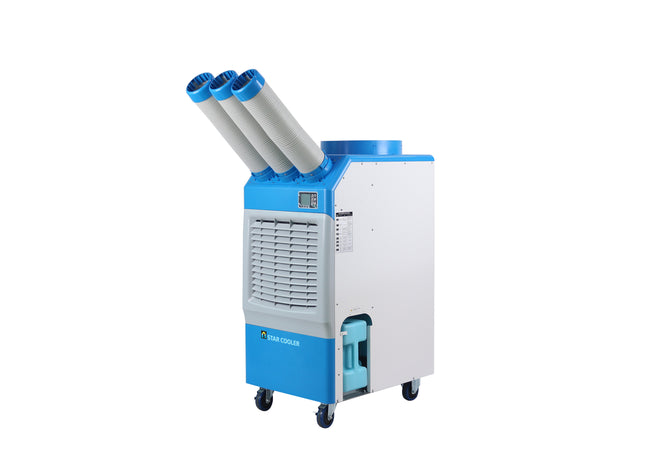
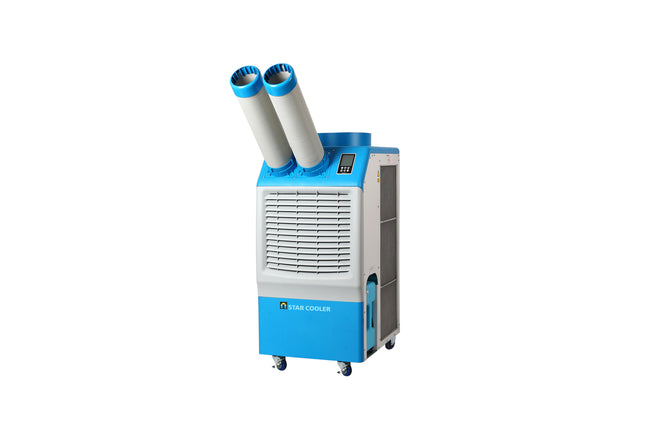
For very large terraces, events, or professional zones, heavier equipment may be required. In that case, also consider industrial air conditioning and portable industrial air conditioning. Please note: classic industrial air conditioning is not automatically suitable for open outdoor air. Choose the technology based on the actual application.
Safe outdoor placement
When cooling on a patio , not every electrical appliance may be left outdoors unprotected. Therefore, check the IP rating, permitted operating environment, and manual of the exact model. Furthermore, protect plugs and connections from water and use only suitable power supplies. Place mobile devices stably and prevent wind, a sloping surface, or passing guests from moving them.
Do not use an extension cable that is not suitable for the power output and outdoor environment. Unroll a cable reel completely when prescribed by the manufacturer. For a permanent installation, if you are unsure about the circuit breaker, or for use near water, have the connection assessed by a qualified installer.
Maintenance of patio cooling
Proper maintenance is part of responsible patio cooling, as water, heat, and stagnation can cause contamination. Therefore, empty and clean reservoirs according to the manual. Replace or clean filters and cooling media on time and do not leave old water in the unit for extended periods. Additionally, use only recommended cleaning agents and follow water quality regulations.
- check reservoir, hoses, and couplings for leaks;
- clean filters and evaporation media regularly;
- remove limescale according to the product instructions;
- clean the fan grilles of dust when the appliance is switched off;
- inspect cable, plug, wheels and brakes;
- Let the system dry and store it in a frost-free place out of season.
Why cool your terrace via Warmteshop?
Warmteshop has been a specialist in climate and heating solutions since 2006. You can compare the available models online based on airflow, recommended range, water consumption, tank capacity, noise level, and application. For personal advice, you can visit our 30+ showrooms in the Netherlands and Belgium. You can find independent reviews and experiences via Trustlocal.
If you want to view solutions for cooling a patio , go to patio cooling. For broader outdoor cooling, you will find additional models under patio cooling. If you are specifically looking for air conditioning for a patio or an enclosed outdoor room, also view patio air conditioning.
Frequently asked questions about cooling a patio
What is the best way to cool an open terrace?
Start with shade and then use targeted air movement. In relatively dry air, an air cooler or fine mist can provide extra comfort. A classic air conditioner is usually not effective in completely open outdoor air.
Does a fan lower the temperature?
No, a fan does not lower the air temperature. However, the airflow does help to dissipate body heat and allow sweat to evaporate. As a result, it feels cooler.
Does an air cooler make the patio wet?
An air cooler directs air past moist cooling media and should not spray a coarse mist onto furniture. Nevertheless, humidity may rise. Check the product's operation and always ensure adequate ventilation.
Does evaporative cooling work in high humidity?
The effect diminishes as the air becomes more humid, because less water can evaporate. A fan without water can then be a simpler choice. Take local weather conditions into account when making your selection.
Can I use a patio air conditioner under a canopy?
That depends on the type of unit. An air cooler requires fresh air and the removal of humid air. A compressor air conditioner only works effectively when the zone is sufficiently enclosed and the heat is properly dissipated.
How much airflow do I need?
That depends on the surface area, wind, shelter, airflow range, and number of seats. Use a manufacturer's m² claim as a guideline and also assess the actual air distribution on your terrace.
Are patio coolers suitable for the hospitality industry?
Many professional models do, provided they suit the intended lifespan, outdoor installation, walking routes, and available facilities. Check IP rating, noise, tank or water connection, maintenance, and safe electrical connection.