

What if the power goes out with electric heating? Everything about heat security in 2026
, by Warmteshop, 17 min read
, by Warmteshop, 17 min read
Imagine this: it is January 14, 2026, the outside temperature in the Netherlands plummets to -5 degrees, and suddenly the electricity goes out throughout the entire neighborhood. As the streetlights dim, the pressing question immediately arises: w…
Imagine this: it is January 14, 2026, the outdoor temperature in the Netherlands plummets to -5 degrees, and suddenly the electricity goes out throughout the entire neighborhood. As the streetlights dim, the pressing question immediately arises: what if the power goes out while using electric heating? It is a perfectly understandable concern for anyone who has made the switch to a gas-free home. After all, no one wants to spend the night in a house that cools down rapidly while the grid operator works on a recovery plan.
At Warmteshop, we fully understand this uncertainty regarding dependence on the power grid. That is why, in this article, we show you how your home remains surprisingly comfortable for a long time, even without an active power supply. You will discover why infrared panels have a unique advantage thanks to radiant heat, as they use objects and walls as a natural battery to buffer heat. We provide clear insight into the cooling figures of modern insulation and explain how smart systems safely restart themselves after a power outage. This way, you are fully prepared with a concrete emergency plan and can enjoy the sustainable warmth in your home with peace of mind.
As soon as the mains voltage drops, the direct energy supply to your heating system stops. This immediately raises the question: what happens if the power goes out with electric heating? The impact varies by technology. With a convector, the circulation of warm air stops almost immediately, causing the room temperature to drop more rapidly. Infrared heating offers a strategic advantage here. Because these panels heat objects and walls rather than the air, the home itself acts as a thermal battery. The stored radiant heat remains perceptible for some time, even without an active power supply. What is a power outage? At its core, it is an interruption of the electrical power supply that, in the Netherlands in 2023, lasted on average only 22 minutes per incident.
In addition to the physical heat, you will immediately notice that your system's intelligence pauses. Your thermostats lose connection to the Wi-Fi router and smart home hubs. Although most modern systems store their settings in flash memory, actual control and monitoring via apps stop immediately. You can often recognize an external fault by the fact that street lighting or your neighbors' equipment also goes out. If the problem remains limited to your own home, it is likely due to an overloaded circuit or a defective indoor appliance.
There is a persistent myth that a gas central heating boiler simply continues to operate during a blackout. This is incorrect. Virtually 100% of modern gas boilers require electricity for the electronic ignition, the safety sensors, and especially the circulation pump. Without power, the pump cannot force the hot water through the radiators, causing the boiler to shut down immediately for safety reasons. Whether you heat with gas or electricity, a power outage affects almost every modern household in the same way. Dependence on the power grid is a universal characteristic of our current living comfort.
When you notice that the heating stops, the first step is a visual inspection of the fuse box. Check if the RCD has tripped. This may indicate an internal fault. If the entire neighborhood is dark, the cause lies with the grid operator. It is advisable to physically switch off heavy consumers such as electric heaters or water heaters during the outage. This prevents a massive peak load on your internal network as soon as the power is switched back on. Your programmed schedules in the smart home app usually pick up where they left off automatically once the internet connection is restored, but a quick manual check of the targets is always recommended for your comfort.
When the electricity suddenly fails, your home transforms from an active heat source into a passive energy storage. The pressing question of what to do if the power goes out with electric heating calls for a quick, tactical approach to conserve the available thermal energy for as long as possible. The first step is to implement strict zoning. Select one central room in the house, preferably the room with the smallest glass surfaces or the best insulation values, and gather all household members there. An adult body generates approximately 100 watts of heat at rest. In a small, enclosed space, this collective body heat acts as a natural heater that significantly slows down the temperature drop.
For your safety during a power outage, it is essential to consistently keep doors to unheated areas, such as the hallway, storage room, or basement, closed. Every time a door opens, precious warm air escapes and cold air enters the living space. Make optimal use of natural insulation by closing curtains and blinds immediately as soon as daylight disappears. Thermally, glass is often the weakest link; a closed blind creates a layer of still air that can reduce heat loss through the windows by as much as 20 to 30 percent.
Small interventions have a big effect when active heating fails. Use draft strips or simply place a rolled-up towel in front of the gaps under the doors to block cold drafts. Although ventilation is normally crucial for a healthy indoor climate, you must limit it to the absolute minimum during an emergency. A well-insulated building envelope is the best ally of electric heating systems. In a modern, insulated home, core heat in the walls and furniture is often retained for 4 to 8 hours before the temperature drops below the comfort level.
An independent heat source offers extra security. A stylish fireplace or wood stove can provide excellent backup during such times without the need for a plug. Wearing multiple layers of clothing and using thermal blankets remains the most efficient method to guarantee personal comfort. Moreover, there is an important psychological aspect: radiant heat feels much more comfortable than stagnant, cold air. The realization that you remain in control of your microclimate—even what becomes a reality with electric heating if the power goes out —provides peace of mind and clarity during the outage.
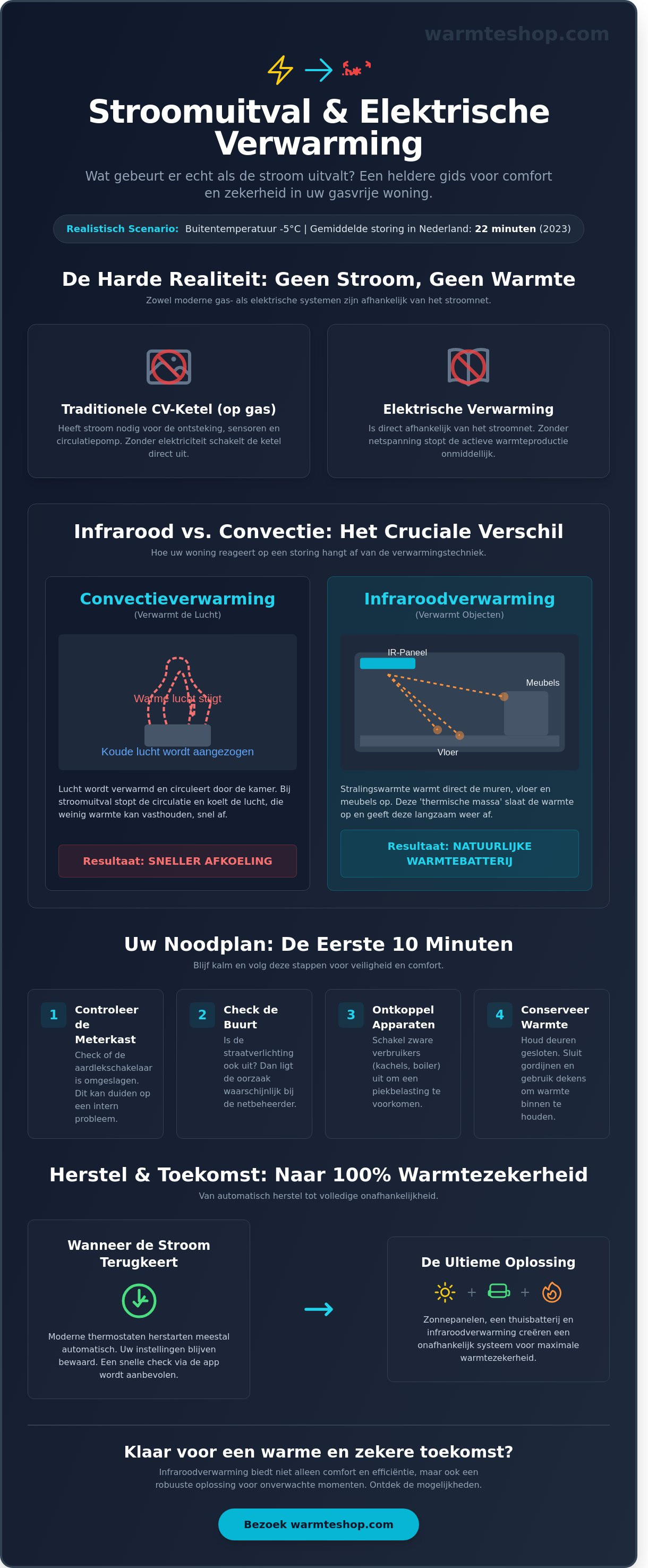
As soon as the grid operator has resolved the fault and the electricity is flowing again, the question arises as to how your system reacts. The question of what happens if the power goes out with electric heating only truly becomes meaningful the moment the power returns and everything needs to be restarted. Modern infrared panels are designed to ensure this transition is seamless. Unlike old analog systems, most Warmteshop panels feature an intelligent memory function. This means the panel knows exactly what setting it was on before the interruption occurred. Therefore, you do not have to walk through every room to manually turn on the heating.
A crucial aspect of the recovery is preventing peak loads on the power grid. When an entire neighborhood switches on all its equipment simultaneously, an enormous demand arises. Advanced thermostats and Wi-Fi-controlled systems often utilize a staggered start-up phase. This limits the load on your internal fuse box and allows the heating to start up safely without the fuses blowing again immediately. This is essential for preserving the sensitive electronics in your heating system.
In the event of a power outage, you might wonder: what if the power goes out with electric heating and all my carefully set schedules disappear? Fortunately, with 98% of modern smart systems, the data is securely stored in the cloud or on local flash memory. As soon as your router restarts, which usually happens within 180 seconds, the thermostats automatically synchronize with the server. Manual intervention is rarely necessary, unless the connection to the Wi-Fi module does not immediately restore due to an IP conflict. In that case, a simple press of the module's reset button will suffice.
Although the systems are robust, a brief check after a prolonged interruption is advisable. For digital displays, pay attention to specific error codes such as E1 or E2. These often indicate a sensor fault that may have been triggered by a power surge. Research by insurers shows that 12% of damage to household appliances after a blackout is caused by overvoltage at the moment the grid comes back online. The use of high-quality surge protection in the meter cabinet protects your investment in design panels against these invisible risks.
The question of what happens to electric heating if the power goes out will receive a reassuring answer in 2026 thanks to the rapid integration of smart storage technologies. The synergy between infrared panels and a home battery forms the backbone of a modern, independent energy system. While traditional convection systems immediately lose their heat as soon as air circulation stops, infrared radiation works by heating mass. Walls, floors, and furniture retain this thermal energy, keeping the perceived temperature stable even during a brief power outage.
A home battery with a capacity of 10 kWh can continuously power a strategically placed 400-watt infrared panel for over 25 hours. In practice, this number of hours is even higher, as a thermostat only switches the panel on periodically to maintain the temperature. Discover Zonnepanelen Brabant BV for expert advice on the installation of these storage systems. By using zone heating, you can prioritize essential rooms, such as the living room or an office, during a blackout. This significantly increases the efficiency of your emergency power.
A hybrid inverter is indispensable in this regard; this device ensures that your solar panels continue to charge the battery and power the heating during the day, independent of the electricity grid. However, pay attention to safety in emergency situations. Although a patio heater delivers powerful radiation, this type of device is not designed for prolonged indoor use. The intense heat and the lack of specific indoor safety make it unsuitable as a replacement indoor heating system during a power outage.
A future-proof heating plan stands or falls on meticulous preparation. The experts at Warmteshop perform professional heat calculations that take extreme scenarios into account. We look not only at daily consumption but also at the minimum power requirement to keep your home habitable in the event of a grid failure. This guarantees that your system continues to perform even under pressure.
In our showrooms, you can experience the unique effect of radiant heat for yourself. Our advisors will show you how the different panels react and how to connect them to modern storage systems. This transforms your home from a dependent end station into a self-sufficient energy hub. With this, you are not only prepared for the question of what happens if the power goes out with electric heating, but you also invest directly in a healthier and more comfortable indoor climate for the long term.
Do you want the assurance of a heating system that never leaves you out in the cold? Our specialists are ready to develop a tailor-made plan for you, including all technical specifications for emergency power supplies.
Request a no-obligation quote for your infrared project todayThe year 2026 calls for smart heating solutions that go beyond traditional systems. In this article, you have discovered that radiant heat directly warms objects and walls, causing the temperature in the home to drop significantly more slowly than with old-fashioned forced-air heating. When the power supply is restored after an outage, modern thermostats immediately resume the programmed settings without you having to intervene manually. This provides a reassuring answer to the question of what happens to electric heating if the power goes out ; your home acts as a thermal battery that retains comfortable warmth for hours.
Warmteshop has been an expert in infrared technology for 15 years and understands the need for a stable and healthy indoor climate. With more than 30 showrooms in the Benelux, our advisors are ready to provide personal advice on healthy radiant heat that feels like the natural warmth of the sun. Our specialists translate complex technology into an energy-efficient system that seamlessly aligns with your specific living requirements and architecture. Invest in a system that is not only efficient but also offers the necessary peace of mind during unforeseen situations on the power grid.
Discover our energy-efficient infrared panels and experience for yourself how you transform your home into a comfortable and future-proof sanctuary.
Your home remains comfortably warm for an average of 4 to 12 hours, depending on the insulation value and the thermal mass of your walls. In a well-insulated home with an EPC value below 100 kWh/m², the indoor temperature drops by only 1 to 2 degrees Celsius during the first 6 hours without power. Infrared panels heat the objects in the room, causing these materials to continue radiating heat into the surroundings for a considerable time.
Most modern thermostats automatically resume their program as soon as the power supply is restored. At Warmteshop, our digital control systems are equipped with internal memory that retains settings for up to 48 hours without mains power. You do not need to take any manual action to get your home back to the desired temperature; the system picks up where it left off immediately.
A standard power outage will not cause physical damage to your electric thermostat or the connected infrared panels. The electronics are designed to handle voltage fluctuations in accordance with the European EN 61000 standards for electromagnetic compatibility. However, we do recommend surge protection in the meter box that filters out spikes above 253 volts, so that your equipment remains safe during the power grid restart.
Your electric underfloor heating stops producing heat immediately during a blackout, as the resistance cables require a constant current. Nevertheless, you benefit from the thermal storage in the floor; a 5-centimeter-thick concrete screed releases residual heat into the room for another 3 to 5 hours. What if the power goes out with electric underfloor heating? Then the mass of your floor acts as a natural battery that temporarily keeps the cold out.
Home batteries with a capacity of 5 kWh or more offer an excellent solution for powering infrared panels during an outage. With a battery system based on lithium-ion storage, you can continue heating specific zones in your home for 4 to 8 hours without the help of the power grid. This makes your heating system independent of central power outages and significantly increases your autonomy.
Infrared radiation directly heats the objects and people in a room, which is exactly like the healthy rays of the sun on a cold day. With traditional air heating, the heat disappears almost immediately as soon as circulation stops, because the warm air cools down quickly. What happens if the power goes out with infrared electric heating? Then you are less likely to experience that chilly draft, because the walls and furniture continue to slowly release the absorbed energy.


