

What will heating without gas cost in 2026? The complete cost and savings guide
, by Warmteshop, 18 min read
, by Warmteshop, 18 min read
The transition to a gas-free home in 2026 is approaching, and with it, uncertainty is growing. Are you dreading the hefty investment of a traditional heat pump? Are you wondering what the impact on your electricity bill will be?
The transition to a gas-free home in 2026 is approaching, and with it, uncertainty is growing. Are you daunted by the sky-high investment required for a traditional heat pump? Do you wonder what the impact on your electricity bill will be? Or is the thought of a major renovation holding you back? You are not alone in asking yourself: what does heating without gas really cost , without hidden surprises and complex installations?
Fortunately, the reality is much warmer and more accessible than you might think. In this comprehensive guide, we'll take you step by step through the world of modern, gas-free heating. We'll break down the exact costs of the most efficient systems, from the initial purchase price to actual monthly consumption. You'll get a clear and honest overview of the investment versus the savings, so you can make the smartest choice for your wallet and your living comfort.
We look beyond the usual solutions and show you how to future-proof your home without major demolition work. Discover how a smart investment not only leads to lower energy bills but also to a healthier and more pleasant indoor climate. A guarantee for a wonderfully warm and comfortable home, now and in the future.
The question regarding the costs of gas-free living is no longer an abstract vision of the future, but a concrete and urgent reality for many homeowners. The year 2026 marks a crucial turning point. The combination of legal obligations, a changing energy price landscape, and the growing desire for independence forces us to think about sustainable alternatives now. This is not simply about replacing a central heating boiler. It requires a new vision of how we create comfort and warmth in the home, shifting the focus from uncertainty about gas prices to the certainty of a future-proof home. A wide range of renewable heat technologies, such as infrared heating, is becoming increasingly accessible and efficient, making the switch a sensible and logical choice.
By 2026, the energy market will look fundamentally different. The government is actively discouraging the use of natural gas through higher energy taxes and the phasing out of gas connections. This makes sticking with a gas-fired central heating boiler an increasingly financially unattractive option. At the same time, the rise of dynamic energy contracts offers smart opportunities for those who heat electrically. By heating your home when electricity is cheap and plentiful, for example, through solar or wind power, you gain immediate control over your monthly costs. Delaying the switch often means paying unnecessarily high gas prices for an extended period and missing out on potentially favorable subsidies.
A clear answer to the question of what heating without gas costs requires a shift in mindset: from a focus on the purchase price to the Total Cost of Ownership (TCO). A sustainable solution such as infrared heating has an initial investment, but at the same time eliminates a range of recurring and hidden costs associated with a gas installation:
Moreover, investing in a gas-free home with a better energy rating immediately increases the value of your house. So it's not an expense, but a valuable and future-oriented investment in your comfort and wealth.
Switching to a gas-free home is an important step, but which system best suits your situation and budget? There's no single answer to the question of how much does heating without gas cost ; the cost depends entirely on the chosen technology. We compare the three most frequently discussed options: heat pumps, infrared heating, and traditional electric heating.
An air-to-water heat pump is often considered the standard for a completely gas-free home. This system extracts heat from the outside air and uses it to heat the water for your central heating system. A hybrid system, which works with your existing boiler, can be a smart intermediate step. Its efficiency, expressed as a COP value, is high: for every kWh of electricity the system consumes, it delivers 3 to 5 kWh of heat.
The downside is the complexity and the high investment. A heat pump only functions optimally in a very well-insulated home with a low-temperature heating (LTH) system, such as underfloor heating or specialized radiators. Installation costs, including the outdoor unit and modifications to your pipework, can easily swallow up half of the total budget. Although long-term savings are substantial, as also shown in reports on The Future of Heat Pumps by the International Energy Agency (IEA), the initial investment of €10,000 to €25,000 represents a significant hurdle.
Infrared heating is an innovative alternative that works on a fundamentally different principle. Instead of heating the air in a room (convection), the panels emit healthy radiant heat that directly warms objects, walls, and people. This feels like the warmth of the sun and is experienced as very comfortable. Every kWh of electricity is converted into tangible heat with 100% efficiency, without energy wasted heating escaping air.
The biggest advantage is the low initial cost and the simple installation. No demolition work, piping, or an outdoor unit are required; a single electrical outlet is all it takes. This makes infrared an excellent solution for both renovations and specific spaces. Moreover, the panels integrate seamlessly into your interior. Think of a mirror in the bathroom, a sleek white panel on the ceiling, or even a panel disguised as a painting. Browse our infrared heating collection to discover the aesthetic possibilities.
Electric underfloor heating and convectors are also options, but often only cost-effective in specific situations. Consider a small, well-insulated bathroom where the underfloor heating is switched on for short periods. For heating an entire living room, these systems are generally less energy-efficient than infrared or a heat pump, which negatively impacts the question 'what does heating without gas cost' in the long run.
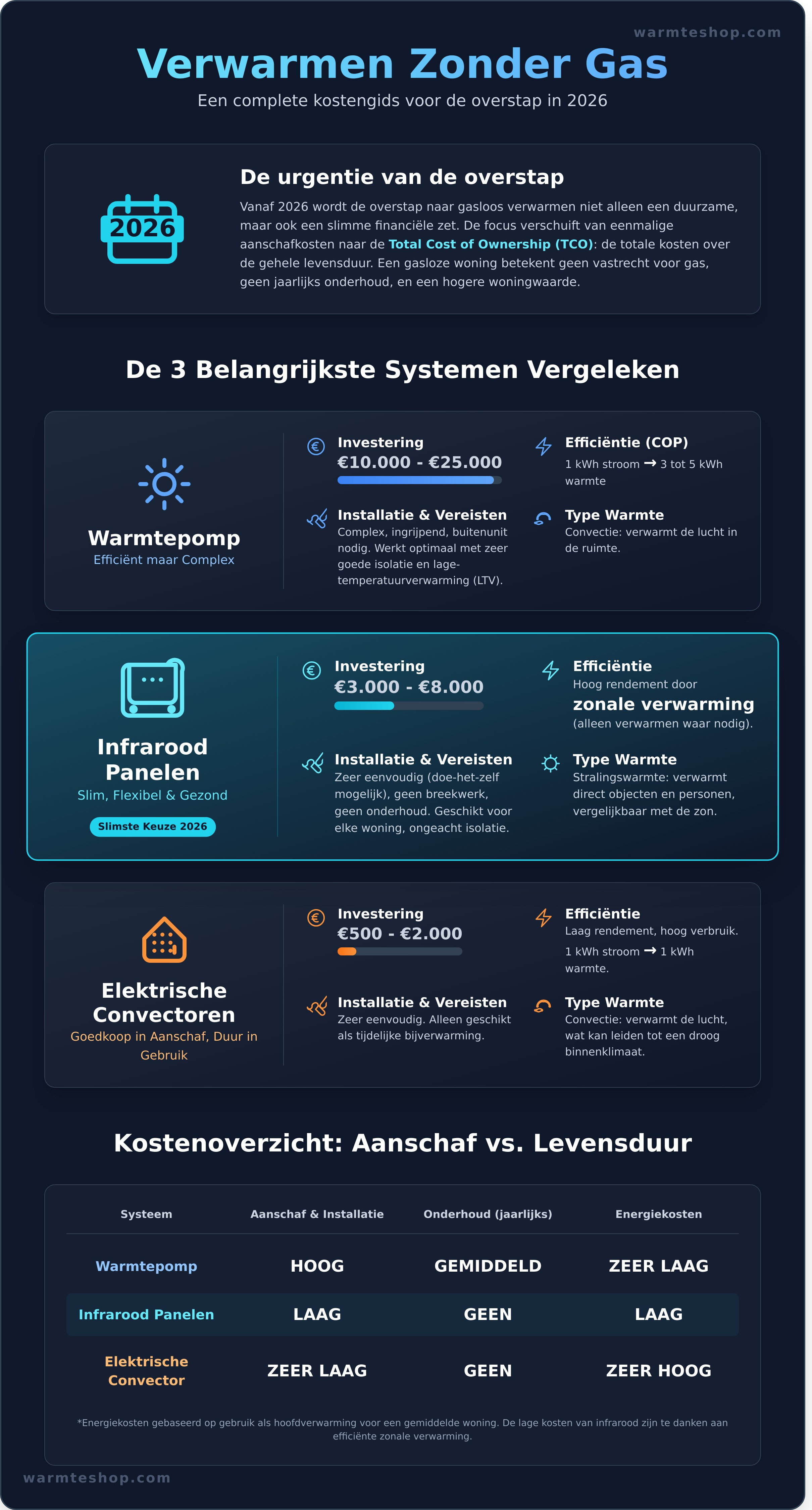
Switching to a gas-free home is an investment in the future, but what does heating without gas actually cost? The total cost is the sum of purchase, installation, maintenance, and lifespan. It's essential to carefully weigh these factors to get a clear picture of the financial impact in both the short and long term.
The initial investment varies greatly by solution:
Another approach, focusing on atmosphere and independence, is investing in a custom-made tiled stove or interior fireplace. This is not only a heat source but also a central design element in the home. For inspiration regarding the possibilities of modern craftsmanship in this area, one can look to specialists in countries with a rich tradition, such as the Czech HrejiciKrby kamnářství kominictví.
Suppose you have a 120m² terraced house with an annual gas consumption of 1,500 m³. Switching to a full infrared system means replacing this gas consumption with additional electricity. However, with a smart thermostat and zone heating, this consumption is perfectly manageable. Combined with solar panels, you generate a large portion of the required electricity yourself. This drastically shortens the payback period and you immediately benefit from a lower energy bill.
This is where the biggest difference between the systems lies. A heat pump is a complex mechanical device with moving parts and refrigerant. This requires an annual inspection by a specialist to ensure efficiency and prevent malfunctions, costing between €150 and €200 per year. Infrared panels, on the other hand, have no moving parts. This means literally €0 in annual maintenance. The question "What does heating without gas cost in the long run?" is therefore answered very favorably by the maintenance-free and future-proof nature of infrared technology.
Investing in a gas-free system is one thing, but the real gain lies in smart consumption. The ultimate question of 'what does heating without gas cost' is determined not only by the kWh price, but primarily by how efficiently you use that energy. Fortunately, you have complete control over this yourself. With a few strategic choices, you significantly reduce operational costs and maximize your comfort and well-being.
Why heat the entire home if you are mainly in the living room and kitchen? With zonal heating, a key advantage of infrared, you direct the heat exactly where it is needed, when it is needed. The bedroom does not need 21°C; a lower temperature is actually conducive to a good night's sleep. For those brief moments in the bathroom, an infrared panel is ideal. It provides instant, comfortable radiant heat without preheating the entire room for hours. A perfect example is a designer radiator that combines luxury and savings. Discover our towel radiators for targeted heat and optimal comfort.
Technology is your best friend in the fight against unnecessary energy consumption. Smart thermostats learn your lifestyle and, thanks to presence detection, can automatically turn off the heating when no one is home. Even smarter is the connection with your solar panels. The system can be configured to heat primarily when you generate free, green energy yourself. This optimizes your self-consumption and significantly reduces costs. Explore the possibilities with our smart infrared thermostats.
A gas-free system performs optimally in a well-insulated home, but that doesn't necessarily mean a large-scale renovation is necessary. Start with the quick wins that deliver immediate results:
Any heat you retain inside doesn't need to be re-generated. That's a clear saving on your energy bill.
The government encourages the transition to sustainable living. Although the schemes change, it is wise to keep an eye on the available subsidies and loans, especially with a view to 2026. The ISDE subsidy is often available for insulation measures and the purchase of a heat pump. This lowers the initial investment, making the question 'what does heating without gas cost?' even more favorable. Check with your municipality or the RVO for the most up-to-date options and make the switch even more accessible.
The question 'what does heating without gas cost' goes beyond just the purchase price. It is a sum of investment, maintenance, lifespan, and consumption. When we take all these factors into account, infrared heating emerges as an exceptionally smart choice for the future. The low entry barrier, combined with the complete lack of annual maintenance, ensures a predictable and manageable cost picture.
Besides the financial benefits, infrared offers superior comfort and a healthier indoor climate. Because the technology doesn't circulate air, the spread of dust and allergens is minimized. So you're not only investing in a lower energy bill, but also in your well-being. At Warmteshop, we understand this synergy like no other. With 18 years of experience and 30 showrooms, we are the experts who will guide you toward a comfortable, gas-free future.
A complete switch can sometimes feel like a big step, but it doesn't have to be. Start hybrid and tackle the spaces where targeted heat makes the biggest difference, such as the bathroom or your home office. An infrared mirror heater is a perfect first step: it is a mirror and an efficient heat source in one, without taking up extra space. Visit our stores in Roeselare or Oud Gastel for personalized advice tailored to your situation.
Choosing infrared means choosing certainty. You're installing a system that will last for decades without service calls, inspections, or unexpected repair costs. It's a one-time investment in sustainable comfort. Want to know exactly what the possibilities are for your home? Schedule a professional heat loss calculation. Our team will calculate exactly how much power you need for optimal efficiency.
Take the first step towards a warm and carefree home today. Request your free quote from Warmteshop now and discover the benefits of healthy, efficient radiant heat.
The transition to gas-free living by 2026 is no longer a distant prospect, but a concrete reality. As this guide has shown, many alternatives entail high investments and complex installations. However, the crucial question of what heating without gas costs leads us to a clear conclusion: infrared heating is the most cost-effective and comfortable choice for the future.
With infrared, you not only choose a significantly lower purchase price and a maintenance-free system, but also superior, healthy radiant heat that immediately enhances your home comfort. As a market leader with 18 years of experience, Warmteshop offers you the assurance of proven technology with a warranty of up to 10 years. Our experts are ready to provide honest advice in more than 30 physical showrooms.
Are you ready to take control of your energy bill and enjoy a comfortable and healthy indoor climate at the same time? Take the step toward a warm, carefree, and sustainable future today. Calculate your savings and discover our infrared solutions.
This depends on several factors. Purchasing and installing infrared panels is considerably cheaper than a new central heating system or heat pump. Consumption costs depend on the current electricity price. If you combine infrared heating with your own solar panels, operating costs drop dramatically and it often becomes more affordable than gas. The question of "what does heating without gas cost?" is therefore primarily determined by how you generate the required electricity and the level of insulation in your home.
The government encourages the transition to sustainable heating, but the specific regulations can change annually. Currently, the ISDE subsidy is primarily focused on heat pumps, solar water heaters, and insulation measures. Infrared panels are often excluded, unless they are part of a larger renovation project. It is advisable to consult the latest information from the Netherlands Enterprise Agency (RVO.nl) for the most accurate details and conditions applicable in 2026.
In most cases, a heavier connection isn't necessary. Infrared panels can usually be connected directly to a standard 230V socket. However, if you're equipping an entire house with infrared heating, it's wise to have an electrician check the total load on your meter box. A standard single-phase or three-phase connection is often sufficient, depending on the size of the system and the house, without the need for expensive reinforcement.
Yes, it's perfectly possible to comfortably heat your entire home using only infrared panels. However, the prerequisite is that your home is well-insulated and that a thorough heating plan is developed. This calculates the required power for each room to provide comfortable and efficient heat. The major advantage is the option for zone heating: you only heat the rooms you're currently in, resulting in significant energy savings.
Infrared heating is the most cost-effective and least invasive way to transition completely off gas. The investment in the panels themselves is relatively low, and installation is simple: no pipes need to be laid or floors need to be dug up. The panels are simply mounted to the wall or ceiling and connected to the electricity grid. This makes it the ideal solution for those looking for a quick, affordable, and renovation-free transition to gas-free living.
Infrared panels have an exceptionally long lifespan. Because they contain no moving parts, there's virtually no wear and tear. High-quality panels last an average of 25 to 30 years and are completely maintenance-free. A heat pump, on the other hand, has an average lifespan of 15 to 20 years and requires annual maintenance to remain efficient. In the long run, infrared heating is therefore a very sustainable and reliable investment in your comfort.
Yes, infrared heating can be more effective than traditional convection heating in a less well-insulated home. Infrared radiation directly warms the objects, walls, and people in the room, not the air. This means heat is less likely to be lost through cracks or drafts. While insulation is always the first and best step toward energy savings, infrared provides a directly noticeable and focused warmth that also creates a comfortable feeling in older homes.
Installation costs are remarkably low. Many panels are designed for easy DIY mounting on the wall or ceiling. If you opt for professional installation by an electrician, the costs are limited. Expect to pay between €100 and €250 per panel, depending on the complexity, such as installing a new power point. Compared to installing radiators or underfloor heating, this is a fraction of the price, making the total investment very attractive.


