

Warehouse heating: The complete guide to efficient heating in 2026
, by Warmteshop, 19 min read
, by Warmteshop, 19 min read
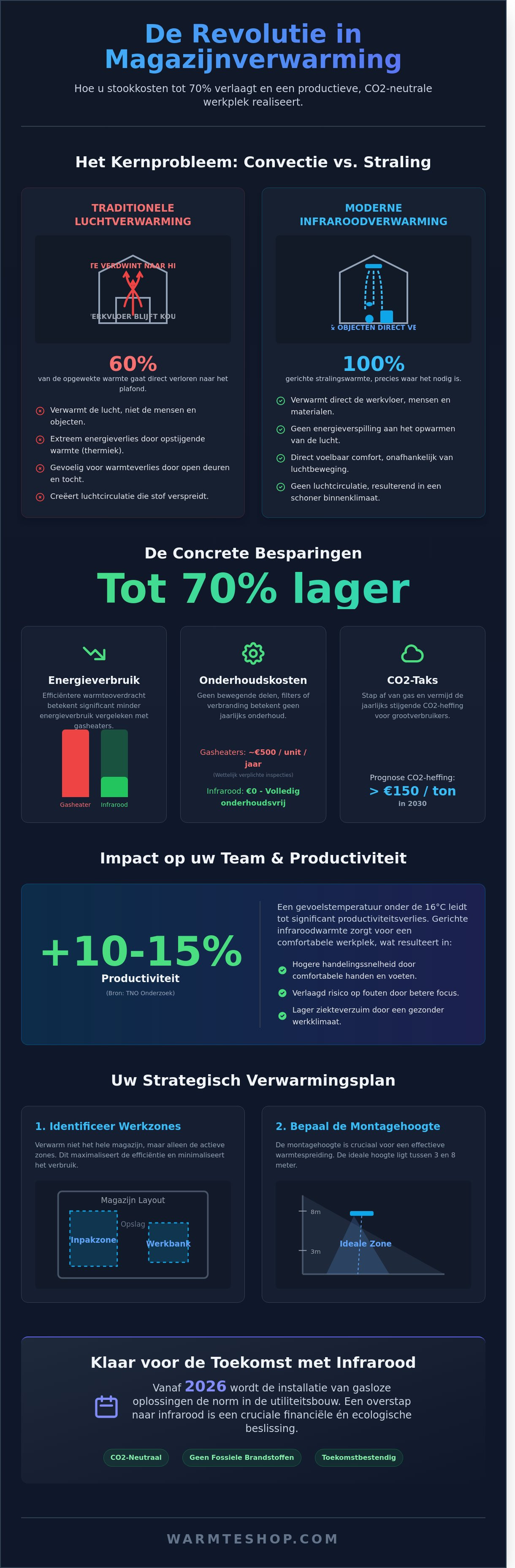
Did you know that in many conventionally heated warehouses, up to 60% of the generated heat rises directly to the roof? This means that more than half of your heating costs literally go up in smoke, without your staff ever…
Did you know that in many conventionally heated warehouses, up to 60% of the generated heat rises directly to the roof? This means that more than half of your heating costs literally go up in smoke, without ever reaching your staff on the work floor. It is a costly waste that severely undermines productivity and comfort.
Those sky-high gas bills, complaining employees in cold workplaces, and constant heat loss through open loading doors are a recognizable frustration. Fortunately, there is a fundamentally smarter approach to warehouse heating that heats the people and objects, rather than the air. In this comprehensive guide for 2026, you will discover how targeted infrared technology can reduce your operational costs by up to 70% and create a comfortable, CO2-neutral working environment. We dive into the operation, the concrete savings, and the steps towards a future-proof warehouse.
A warehouse is more than four walls and a roof; it is a dynamic environment where thousands of cubic meters of air are constantly in motion. Creating a productive and safe climate within such a volume is the core of effective warehouse heating. Many companies still rely on traditional heating systems, such as gas-fired air heaters. However, these systems encounter a fundamental physical problem: thermals. Warm air is lighter than cold air and immediately rises to the highest point of the building. Consequently, you are paying to heat an enormous mass of air accumulating under the roof, while your employees on the factory floor are literally left out in the cold.
This energy-consuming effect is exacerbated by the daily reality of logistics operations. Large loading doors that continuously open and close cause a constant influx of cold outside air. As a result, a conventional convection system must run nonstop to compensate for the costly, heated air that escapes. The result is a sky-high energy bill and an uncomfortable workplace. Moreover, the energy transition forces us to look ahead. From 2026, the installation of gas-free solutions in non-residential buildings will become the norm, a clear step towards sustainable and future-proof business operations.
The core problem with conventional systems is that they work via convection: heating air. In a 2,000 m² warehouse with a height of 8 meters, this means attempting to heat 16,000 cubic meters of air. An almost impossible and very costly undertaking. Infrared heating tackles this radically differently. Just like the sun, it does not heat the air, but radiates heat directly onto the objects, the floor, and the people in the room. This radiant heat provides pleasant and immediately palpable comfort exactly where it is needed, without wasting energy on unnecessarily heating the air under the ceiling. An important additional benefit is that no air circulation is created, meaning dust and particles are not blown through the room. This contributes to a healthier and cleaner indoor climate.
Inefficient heating costs significantly more than just the energy consumed. The impact on your bottom line is often greater than you think. These hidden costs manifest themselves in multiple areas and seriously impede your operational efficiency.
The challenges surrounding warehouse heating are therefore significant, but the solution lies in a smarter approach. It is time not to heat more, but to heat more targeted and efficiently.
Traditional heating systems struggle with the immense volumes of warehouses. Heating thousands of cubic meters of air, which subsequently escapes through the roof, is a costly and inefficient undertaking. Space heating is therefore often the largest energy consumer in warehouses, a fact that underscores the need for a smarter approach. Industrial infrared technology tackles this fundamentally differently by heating not the air, but the people and objects on the work floor directly.
The secret lies in the type of radiation. For industrial applications, short-wave infrared (IR-A) is used. This powerful radiation penetrates the air without losing energy and is only converted into heat when it strikes a surface, such as an employee, a workbench, or the concrete floor. Compare it to the sun on a cold winter day: the air is cold, but the sunbeams on your skin feel instantly warm. This principle makes infrared warehouse heating extremely effective
The implementation is just as intelligent as the technology itself:
A warehouse is a demanding environment. That is why our systems are built to perform under harsh conditions. The housing is manufactured from anodized aluminium, a material that is not only corrosion-resistant but can also withstand and dissipate maximum heat. The IP rating is essential; an IP65 rating, for example, guarantees that the heater is completely dust- and splash-proof, an absolute must in warehouses where dust and moisture are present. View our range of industrial infrared heaters for specific models that meet these stringent requirements.
Workplace safety is non-negotiable. Electric infrared heaters offer a significant advantage over open flame systems, such as gas heaters. There is no fire hazard, no CO2 emissions, and no need for fuel storage. Furthermore, this form of warehouse heating with occupational health and safety standards for a healthy indoor climate, as there is no air circulation that spreads dust and allergens. An additional benefit is the completely silent operation, which improves concentration and communication in the workplace.
The choice of a heating system is a strategic business decision that extends beyond the initial purchase price. A proper analysis of the Total Cost of Ownership (TCO) over a 10-year period reveals the true financial impact. While traditional gas heaters often have a lower entry price, the long-term benefits of infrared heating become clearly visible in the operating costs and minimal maintenance.
Switching to electric warehouse heating is not only a sustainable choice but, above all, an economically sound investment. The key to the significant savings lies in its fundamentally different operation. A gas heater heats the air, which then rises and escapes through the roof or open doors. Infrared heaters, on the other hand, directly heat objects, floors, and employees in specific zones. This direct radiant heat, comparable to the warmth of the sun, prevents waste and leads to a realistically lower energy consumption of up to 70%. By combining this with smart thermostats, which activate the heating only during working hours or upon detecting movement, unnecessary consumption is completely eliminated.
Moreover, the government encourages the transition to sustainable solutions. Companies that invest in energy-efficient technologies such as infrared heating can often claim subsidies such as the Energy Investment Allowance (EIA), which significantly reduces the initial investment.
The greatest financial benefit of infrared is realized through zone heating. In an average warehouse, 80% of the activity takes place on only 20% of the surface area. Why heat the entire 1,000 m² if your employees only need comfort at the packing table or the shipping counter? With infrared, you create warm comfort zones exactly where they are needed, while storage zones where no one is working remain unheated. This is a core component of modern energy efficiency strategies, ensuring energy is no longer wasted on unused spaces. By integrating motion sensors, the panels switch on and off automatically, resulting in maximum efficiency.
The payback period for an investment in infrared is surprisingly short. Let's take a calculation example for a 1,000 m² warehouse with two work zones:
This 50% saving on daily energy costs, combined with the absence of maintenance costs, results in a payback period of typically 3 to 5 years. If you already have solar panels, the ROI becomes even more spectacular. The self-generated electricity makes the operational costs for your warehouse heating virtually nil, meaning the investment is often recouped within just 2 years. Add to this the savings on maintenance contracts: a gas installation requires a costly annual inspection (€250-€400), whereas infrared panels are completely maintenance-free. Over 10 years, this yields additional savings of thousands of euros.
Effective and energy-efficient warehouse heating is no matter of chance. It requires a well-thought-out approach that goes beyond simply hanging a few heaters. Large, open spaces with high ceilings and varying activity levels call for a custom solution. A strategic plan, based on the unique characteristics of your premises, is the key to maximum comfort and minimum operating costs. We build this plan in four clear steps.
The basis for an efficient system is an accurate analysis of your operational processes. The success of infrared heating lies in its precision; we do not heat unused air, but the specific zones where your employees are active. This leads to significant energy savings, which, according to TNO research, can amount to as much as 65% compared to traditional hot air blowers.
A standard infrared panel designed for a living room is insufficient for the challenges of an industrial building. The intensity of the radiation decreases with distance. Therefore, a professional heat calculation is essential. In this calculation, we analyze not only the height but also factors such as the R-value of the insulation and the location of large roller doors that cause cold air currents. By managing each zone separately with wireless thermostats, you create a flexible and highly efficient system.
For optimal performance, ceiling mounting is almost always superior in warehouses. The heaters hang above the workstations and distribute their heat directly downwards, similar to the sun. This prevents shelving or machinery from blocking the heat radiation. To avoid "shadow spots," we install the heaters in an overlapping pattern. By connecting the installation to smart home Wi-Fi modules, the facility manager can operate the system remotely, set heating schedules, and monitor energy consumption in real-time.
Drawing up a solid plan is the first step towards a sustainable and comfortable working environment. The precision of custom-made warehouse heating translates directly into lower energy bills and higher productivity. Request a no-obligation heat calculation today and discover how much your company can save.
An efficient and comfortable working environment in your warehouse starts with a well-thought-out heating strategy. Simply installing standard heaters is rarely the solution. Large volumes, high ceilings, and fluctuating occupancy require a specialized approach. At Warmteshop, we understand that every square meter counts and that energy costs are a crucial factor in your operational budget. That is why we do not supply products, but complete, custom-made heating solutions that perfectly match the unique requirements of your company.
Our approach is based on four pillars that guarantee your investment:
Since 2008, we have been translating the ingenious efficiency of the sun into technological solutions for businesses. Our infrared panels do not generate expensive hot air, but rather direct radiant heat that warms objects and people, just like the sun's rays on a clear spring day. We apply this energy-efficient principle in every sector. Discover our complete infrared collection and see the versatility of our solutions.
Experience the power of infrared for yourself in one of our showrooms in Antwerp, Brussels, Roeselare, or Oud-Gastel. Here you can test the intensity of our industrial heaters and feel the direct impact on your comfort. A consultation with our advisor will give you immediate insight into the possibilities for your premises. Request a no-obligation quote for your warehouse today and take the first step towards a future-proof heating solution.
Efficiently heating a large warehouse is no longer an impossible task. Industrial infrared heating offers direct, targeted heat that warms objects and people rather than the air, ensuring no energy is wasted at the ceiling. This results not only in a significantly more comfortable working environment but also in a drastic reduction in your energy costs. A strategic plan is the key to maximum efficiency, and the right solution for your warehouse heating is closer than you think.
As the market leader in the Benelux since 2008, Warmteshop has the expertise to develop a tailor-made plan for you. Our specialists would be happy to visit you for a free on-site heat calculation. You can also experience the heat yourself and receive expert advice in one of our 30+ physical showrooms. Are you ready to make the switch to a sustainable and cost-efficient solution?
Discover our industrial infrared solutions and save on your energy costs. Invest in a sustainable future for your business today.
Absolutely, infrared is an extremely powerful and efficient solution for warehouse heating, especially in large and drafty spaces. Unlike air heaters, which distribute warm air that escapes immediately, infrared radiation heats objects and people. This radiant heat is unaffected by drafts. Even when the large doors open, your employees experience constant and pleasant warmth at their workplace.
The required power depends on the insulation and ceiling height, but as a guideline, you can count on 50 to 80 Watts per square meter for zone heating. For a specific workspace of 15 m² with a ceiling of 6 meters high, a radiator of approximately 1200 Watts would be an effective solution. Our experts always perform a free, customized heat calculation to guarantee the perfect configuration for your situation.
Absolutely, the combination of infrared heaters and solar panels is a perfect match for a sustainable future. You use the free, self-generated electricity to heat your warehouse in a CO2-neutral way. This significantly reduces your operating costs and maximizes the return on your solar panel installation. It is the most direct way to utilize your own green energy for a comfortable working environment.
An air heater heats the air, which then rises and circulates. This leads to energy loss, especially in high spaces, and causes dust displacement. An infrared heater, on the other hand, heats objects, floors, and people directly via radiant heat, similar to the sun. This is up to 65% more efficient, healthier because there is no air circulation, and provides a much more pleasant heating experience.
You do not need to heat the entire warehouse; that is the major advantage of infrared. You can opt for zone heating, where you heat only specific workstations, packing stations, or offices. This results in direct energy savings that can amount to up to 70% compared to heating the entire air mass. In this way, you create comfortable 'heat islands' exactly where your employees need them.
Our infrared heaters are completely safe for use in storage areas and comply with the strictest European standards, such as the CE marking and TÜV certification. The devices are designed with overheating protection and have no open flame or glowing parts. With correct installation according to the regulations, with sufficient clearance around the heater, the risk of fire is practically eliminated.
Yes, subsidies are often available for investments in sustainable electric warehouse heating. For Flemish companies, the Ecologiepremie+ via VLAIO is an important scheme that can cover up to 55% of the investment, depending on the size of the company. The conditions change regularly, so we advise you to check the current status or contact our advisors for guidance.
Infrared heating works almost immediately. Within 5 to 10 minutes of switching it on, you feel the direct radiant heat, comparable to the moment the sun emerges from behind the clouds. You therefore do not need to turn on the heating hours in advance. This 'on-demand' heating ensures maximum comfort and prevents unnecessary energy consumption, which is perfectly suited to a dynamic work environment.


