

The Payback Period of Infrared Heating in 2026: A Complete Guide
, by Warmteshop, 20 min read
, by Warmteshop, 20 min read
While many fixate on complex heat pumps with installation costs that often exceed 12,000 euros, the smartest way to a lower energy bill often lies simply on your ceiling or wall. You will notice…
While many fixate on complex heat pumps with installation costs often exceeding 12,000 euros, the smartest way to a lower energy bill often lies simply in your ceiling or on the wall. You have probably also noticed that unpredictable energy prices and uncertainty regarding actual consumption cause significant doubts when making your home more sustainable. It is perfectly logical that you want to see hard figures regarding the actual payback period for infrared heating before choosing a new way of heating.
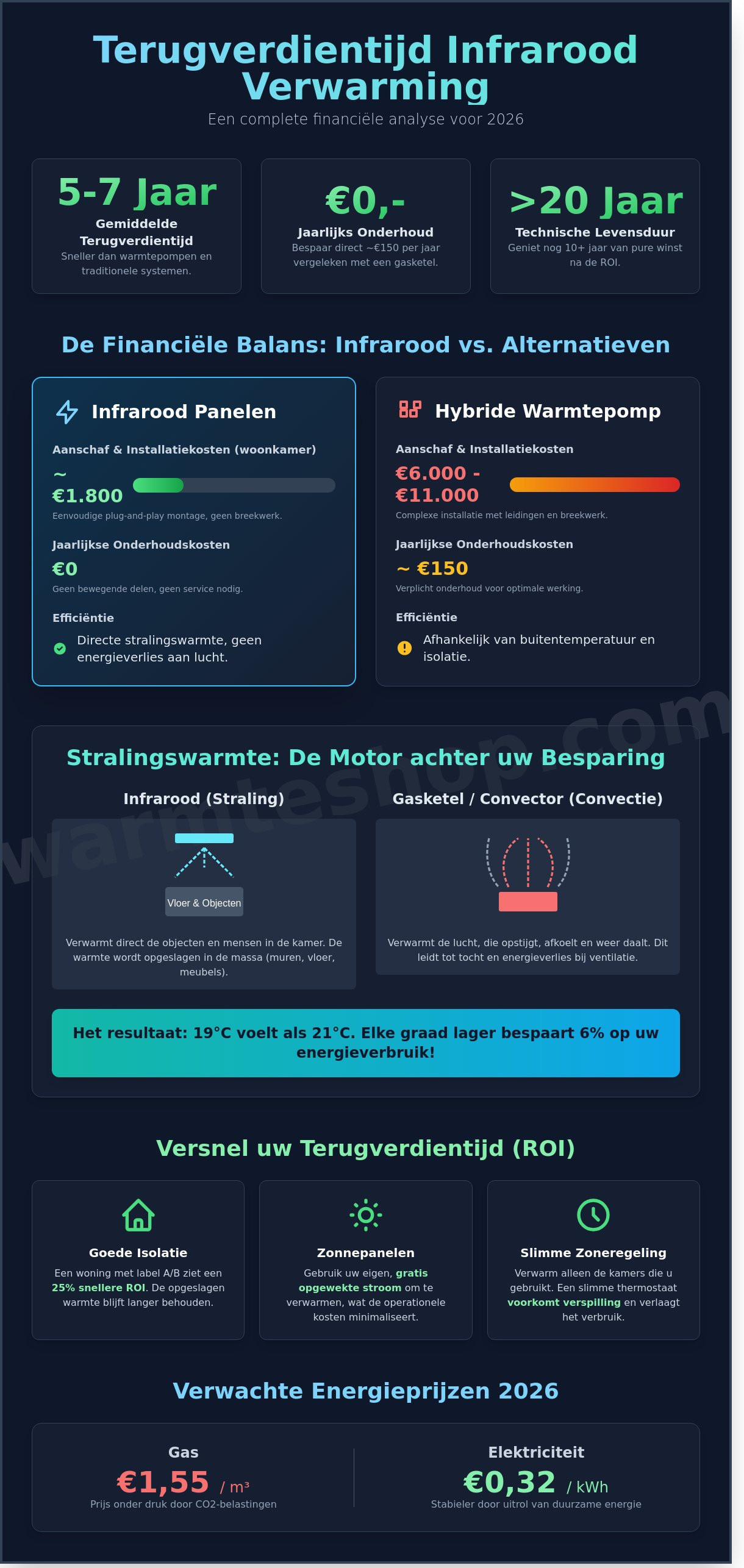
In this complete guide for 2026, you will discover exactly how to fully recoup your investment in infrared panels within an average of 5 to 7 years. Thanks to the complete elimination of annual maintenance costs and the use of smart zone control, you significantly reduce your monthly expenses from day one. We offer you an honest ROI calculation and show how this healthy radiant heat, which feels just as natural as the warm glow of the sun, transforms your home into a comfortable and future-proof place without unnecessary waste.
The return on investment (ROI) of an investment in infrared panels is the point at which the accumulated savings on your energy bill fully cover the initial costs of purchase and installation. For the infrared heating payback period, we use a realistic horizon of 7 to 12 years on average. This figure depends heavily on your current energy source, such as gas or fuel oil, and current electricity prices. Because high-quality panels have a technical lifespan of more than 20 years, you will enjoy at least another decade of pure financial gain in terms of living comfort after the payback period.
Three fundamental pillars form the basis of every calculation: acquisition costs, operating costs, and direct savings. To understand how this technology differs from traditional systems, it is essential to know what infrared heating is and how radiant heat directly heats objects without using the air as a transport medium. This direct transfer ensures that less energy is lost, which accelerates the path to a positive return. The profit is tangible and directly measurable in your monthly expenses.
A well-insulated home with an energy label A or B often sees a return on investment 25% faster than a poorly insulated property from the 1970s. This is because radiant heat remains stored in the walls and floors for longer in an efficient building envelope. This means that the panels need to switch on less frequently to maintain the desired temperature. Infrared panels are therefore not just a technological upgrade, but a strategic choice for anyone taking the transition to a gas-free future seriously.
The initial investment in infrared is significantly lower than that of a heat pump or a new central heating boiler. While a hybrid heat pump, including installation, often costs between €6,000 and €11,000, you can equip an average living room with high-quality panels for just around €1,800. You save immediately on installation costs thanks to the simple plug-and-play mounting on the ceiling or wall. Infrared panels do not require expensive piping or extensive demolition work in your floors and walls, which reduces start-up costs by 70% compared to traditional systems. Moreover, the annual maintenance costs of approximately €150 that you incur with a gas boiler are eliminated.
Heating the thermal mass in a room is the secret engine behind the short payback period of infrared heating. Instead of circulating the air, the panels charge the walls and furniture with heat. These objects act as a battery that slowly releases the heat back into the environment. This prevents the classic heat loss associated with ventilation; when you open a door, the warm air does not escape immediately because the heat is stored within the structure. Thanks to this sunlight effect, you experience the same comfort at an air temperature of 19 degrees Celsius as you would at 21 degrees under a radiator. Every degree you can lower the thermostat results directly in a 6% saving on your energy consumption.
The choice between traditional gas heating and modern infrared panels is about more than just comfort. It is a strategic decision that determines your monthly costs for the next thirty years. When we look at energy prices in 2026, we see a clear shift. The gas price remains under pressure due to rising CO2 taxes, with an expected price of approximately €1.55 per m³. Electricity, on the other hand, stabilizes at around €0.32 per kWh thanks to the massive rollout of wind and solar parks. This price difference works directly to the advantage of the payback period for infrared heating.
A traditional convector operates on the basis of air circulation. The air is heated, rises to the ceiling, and cools down near the windows, resulting in a constant draft and energy loss. Infrared works fundamentally differently. It heats objects and people directly, without the intervention of air. The US Department of Energy confirms that the efficiency of radiant heating is often higher than that of ducted systems, simply because there are no transport losses. You consume less energy to achieve the same feeling of warmth, which can lower your annual energy bill by an average of 22% compared to electric convectors.
When calculating total costs, many homeowners ignore the recurring expenses for a central heating boiler. An annual maintenance service, including call-out charges and minor repairs, costs you an average of €150. Over a period of fifteen years, we are therefore talking about €2,250 in pure maintenance. Infrared panels have zero moving parts. There is no pump that can seize up, no burner that gets dirty, and no expansion vessel that can leak. The economic lifespan of a high-quality panel exceeds 25 years, whereas a modern central heating boiler is often due for replacement after just 12 to 15 years. These saved replacement costs halve the theoretical payback period for infrared heating in practice.
The biggest financial drain in Dutch households is the unnecessary heating of empty spaces. A central gas heating system often heats the entire house to make just one room comfortable. Infrared panels excel in zone heating. You direct the heat exactly where you are. In the bathroom, for example, an infrared mirror a smart investment. Instead of turning on the central heating an hour in advance for a warm bathroom, you experience comfortable radiation within minutes while the rest of the house remains cool.
This principle also applies to the home office. A 400-watt panel above your desk consumes only a fraction of the energy needed to keep the entire ground floor at 21 degrees via the thermostat in the living room. Through this targeted approach, an average family saves up to 350 m³ of gas per year. Would you like to know what this saving means specifically for your home? You can easily request a personal consultation to have your exact savings potential calculated by our experts.
Installing infrared panels is a smart first step towards a sustainable home, but the full potential is only unlocked by an integrated energy system. When considering the payback period for infrared heating, we see that this period is often shortened by 50% when combined with self-generated power. Instead of purchasing electricity at market rates, your roof acts as your own power plant, feeding the panels with free solar energy. This transforms the investment from an expense into a profitable asset that pays for itself faster than traditional convection systems.
This principle of smart investing for a higher return applies not only to housing but also to the business world. Companies that invest in the development of their teams see a similar transformation. For inspiration on how training can strengthen a team, youcompany.eu valuable insights.
The market will change drastically in 2026 due to expected adjustments to the net metering scheme and the rise of dynamic energy contracts. As a result, directly consuming your own electricity becomes crucial. Infrared panels react within 5 to 10 minutes, allowing them to perfectly align with peaks in your solar production. According to UK government research on infrared heating, this technology offers the same thermal comfort at a lower air temperature, fundamentally reducing energy requirements. This means that you achieve a more pleasant indoor climate with fewer kWh, comparable to the direct warmth of the sun on a crisp spring day.
Using surplus solar energy for direct heating is the most effective way to reduce operating costs to zero. On average, an installation of 12 solar panels in the Netherlands generates around 3,800 kWh per year. By converting this energy directly into radiant heat during the day, you create approximately 1,200 to 1,500 "free" heating hours annually. This is essential for the future-proofing of your home. As soon as the net metering scheme is phased out, feeding electricity back into the grid will be less profitable than using it directly in your own living room or home office.
Maximum savings are impossible without precision control. That is why advanced thermostats with AI control are not a luxury, but a necessity. These systems learn your living patterns and anticipate your presence. Presence sensors ensure that you never heat an empty office or an unused guest room again, which can immediately result in a 20% saving on your consumption. Wi-Fi modules make it possible to set up scenarios; think of a 'preheating mode' that only activates when the electricity price on your dynamic contract is at its lowest.
Home batteries form the final link in this ROI boost. They act as a buffer that holds onto cheap electricity for the evening hours, when the sun has set but heat demand rises. By powering infrared heat from a battery fully charged during the day, the payback period for infrared heating extremely attractive even during the winter months. The result is a smart home that not only consumes energy but does so at the most economically favorable moment, without compromising on the healthy and natural warmth characteristic of Warmteshop systems.
Calculating the payback period for infrared heating is an essential step for every homeowner striving for a lower energy bill and a healthier indoor climate. The sun-drenched warmth of infrared panels offers not only immediate comfort but also a measurable financial benefit compared to traditional convection heating. Follow this step-by-step plan to accurately map out your personal ROI.
In many homes, using infrared in the seating area yields the quickest returns. By strategically placing a panel above the sofa, the central thermostat can often be set 2 degrees lower without loss of comfort. Every degree lower on the main thermostat results in a 7% saving on your total gas consumption. With a targeted investment of €550, you will often see the payback period for infrared heating realized within just 4 years, while the perceived warmth immediately rises to a level comparable to a pleasant spring day.
For a well-insulated home with an energy label A or higher, a complete switch to electricity is highly cost-effective. You save not only on consumption but also on fixed costs. Completely disconnecting the gas supply results in an immediate saving of an average of €262 per year in standing charges. If you combine this with solar panels that generate 4,000 kWh annually, you transform your home into a future-proof bastion. This transition increases the property value by an average of 3.5% due to the improved energy label and the modern, maintenance-free installation.
Would you like to know exactly what savings are achievable in your specific living situation? Our advisors would be happy to create a customized calculation tailored to your insulation value and consumption pattern. Request a no-obligation consultation with Warmteshop here.
Choosing a heating system is an investment in the future of your home and your wallet. At Warmteshop, we understand that a low purchase price may seem tempting, but the real profit lies in the long-term operating costs. The efficiency of our systems is based on advanced German technology that achieves a radiant efficiency of no less than 95 percent. This means that virtually every watt of electricity is directly converted into comfortable radiant heat, making the payback period for infrared heating significantly shorter than with less efficient alternatives.
Our panels utilize high-quality carbon fiber elements and specially developed reflectors on the back. This technology prevents heat from escaping to the wall or ceiling and directs the energy directly into the room. Combined with a lifespan of 25 to 30 years and a 10-year manufacturer's warranty, we offer a level of reliability you won't find with budget providers. You are investing in a system that lasts for decades without sacrificing power.
A cheap panel from far-off lands may seem like a bargain at the time of purchase, but appearances are often deceiving. These panels often have a radiation range of only 1.5 meters, whereas Warmteshop's panels radiate up to 4 meters deep into the room. As a result, you need fewer panels to heat the same space. Moreover, cheap panels often lose part of their capacity after just 3 years due to degradation of the heating elements. Choose infrared heating that lasts for decades and whose performance remains consistent. Higher efficiency translates directly into a lower energy bill, which often shortens the payback period for infrared heating with our premium models by 20 to 30 percent compared to B-brands.
Accurate calculation is the foundation of every saving. With over 32 showrooms spread across the Benelux, we always offer an expert near you. Our advisors use specialized software to determine the heat requirements of your specific spaces, taking into account insulation values and glass surfaces. This precision prevents overcapacity and unnecessary consumption. Our professional installation service then ensures that every panel is positioned in the strategically best location for maximum heat coverage. This comprehensive service and technology package guarantees that your transition to gas-free heating is not only comfortable but also financially very attractive. Visit a Warmteshop showroom for a customized ROI calculation.
The transition to a sustainable home does not have to be a years-long investment. By smartly combining infrared panels with solar panels and a home battery, you transform your home into an energy-efficient powerhouse. The average payback period for infrared heating will drop to a historic low in 2026 thanks to the efficient radiant technology that heats objects directly rather than the air. This not only saves energy but also immediately increases your living comfort without the need for costly maintenance.
You choose certainty with our 15 years of expertise in the Benelux and the support of 30 physical showrooms for personalized, tailored advice. Our systems are manufactured according to the strictest German quality standards, resulting in maintenance-free heating with extensive warranties of up to 10 years. The result is a healthy indoor climate that mimics the natural warmth of the sun, while your monthly costs decrease structurally. This makes making your home more sustainable an investment from which you reap the benefits every day.
Discover our energy-efficient infrared panels and start saving
Your home is ready for the future; we would be happy to help you take that step today.
You save an average of 10% to 40% on your annual energy costs compared to a traditional gas-fired central heating system. For an average living room of 30 square meters, this translates to an annual saving of approximately 250 to 450 euros. This efficiency is achieved because infrared panels heat not the air, but directly the objects and people in the room, just like the natural heat of the sun.
As a result, the thermostat can often be set 2 degrees lower without loss of comfort. In homes where only the occupied rooms are heated, savings even amount to 50% of the original gas consumption.
The average payback period for infrared heating is between 5 and 10 years, depending on your current energy contract and usage pattern. Because the purchase costs of a panel are often 50% lower than those of a heat pump, you start saving on your initial investment immediately. With daily use of 6 hours during the winter months, you will see that the lower running costs quickly tip the balance in your favor.
Infrared heating is up to 70% cheaper to purchase than a complete air-to-water heat pump, which often costs 10,000 to 15,000 euros. Whereas a heat pump requires complex installation and annual maintenance of 150 euros, infrared panels are completely maintenance-free and can be installed within a few hours. For targeted zone heating or well-insulated homes, infrared therefore offers a much higher direct ROI than the substantial investment in a central heat pump system.
Good insulation shortens the payback period by an average of 20% to 30% because the stored radiant heat remains in the walls and floors longer. In a home with energy label A or B, the panels only need to radiate actively for 15 minutes per hour to maintain a constant temperature. In a moderately insulated home, heat escapes more quickly through the walls, causing the panels to run more often and increasing the payback period for infrared heating by several years.
You often recoup the investment in infrared panels within just 4 to 6 years when combined with your own solar panels. By using your own generated electricity directly for heating, you reduce operating costs to virtually zero euros per kilowatt-hour. This makes the switch to electric heating not only an environmentally conscious choice for a carbon-neutral home, but also a smart financial strategy to permanently eliminate your energy bill.
The maintenance costs for infrared heating amount to exactly 0 euros over a period of 10 years. Unlike central heating boilers or heat pumps, infrared panels contain no moving parts, filters, or fluids that wear out or need to be replaced. This saves you the usual 1,500 euros that you would spend on biennial maintenance and repairs to pumps or pipes for a traditional system over an entire decade.
Self-installation is certainly possible and immediately saves you between 200 and 500 euros in electrician installation costs. The panels come with a simple mounting bracket and a plug, allowing you to securely attach them to the wall or ceiling in 20 to 30 minutes. This DIY approach significantly reduces the initial investment, shortening the total payback period for the system by an average of 12 to 18 months.
Infrared heating is highly cost-effective in older homes when used as targeted zone heating for specific living spaces, such as the sitting area or home office. Instead of heating the entire home to 21 degrees with an inefficient gas radiator, you heat only the area where you are actually spending time for approximately €0.15 per hour. This prevents unnecessary energy loss through uninsulated walls and ensures a healthy indoor climate without air circulation, which often represents a significant improvement in comfort in homes built before 1980.


