
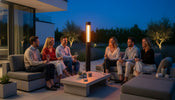
Standing patio heater: the complete guide to a comfortable patio in 2026
, by Warmteshop Infrared heating, 19 min read
, by Warmteshop Infrared heating, 19 min read
Imagine this: it is a beautiful evening in May 2026 and you are sitting on the terrace with friends. The sun has set, but no one is thinking about going inside. With a modern freestanding patio heater, you instantly create that…
Imagine this: it is a beautiful evening in May 2026 and you are sitting on the terrace with friends. The sun has set, but no one is thinking of going inside. With a modern freestanding patio heater, you instantly create the pleasant warmth you need to extend the evening without a care. We all recognize the frustration of heat blowing away or sky-high energy bills, but that no longer has to be the case.
In this guide, you will discover how to enjoy your garden all year round without unnecessary energy loss with the right freestanding patio heater. We dive into the latest infrared technologies, compare costs with traditional gas heaters, and provide practical advice for a stylish and sustainable outdoor space where coziness and comfort take center stage.
A freestanding patio heater is essentially a freestanding, mobile heat source specifically designed to extend your outdoor experience without being tied to one fixed spot. While traditional heating systems are often permanently mounted to a wall or ceiling, a freestanding model offers ultimate freedom. You simply place the heater wherever the coziness is at that moment, whether that is by the lounge set at the back of the garden or at the dining table where Holie Pizza prepares fresh pizzas on location. This flexibility makes it an indispensable element for anyone who views their patio as a full-fledged extension of their home.
The mobility of this type of heating is a huge plus. You do not have to worry about complex installations or structural changes to your home. This also makes a standing heater the perfect solution for residents of rental properties or for people who enjoy a dynamic garden layout. Because patio heaters are increasingly electric these days, they fit seamlessly with the broader transition to gas-free outdoor living. Especially now that gas-powered models are no longer permitted in cities such as Brussels since June 2026, switching to an electric variant is a smart and future-proof move.
The greatest convenience of a freestanding model lies in its simplicity. You do not need to drill holes in your valuable facade or canopy. This not only saves time but also prevents damage to the insulation or structure of your home. When the winter months arrive or if you need the space for something else, you can effortlessly store the unit in the garage or storage room. Furthermore, a high-quality patio heater is versatile enough for both large, open terraces and small, sheltered corners. You can easily adjust the position based on the wind direction or group size, ensuring that no one has to sit in the cold.
Modern heaters are no longer bulky devices you’d rather tuck away. Today, they function as true design objects that contribute to the aesthetics of your garden. High-quality materials such as anodized aluminum and stainless steel are frequently used. These materials not only look beautiful but are also extremely durable and resistant to the changing weather conditions in the Benelux. Furthermore, many models combine atmospheric lighting with powerful heat. This gives you a single stylish object that provides both light and a pleasant temperature during the late hours. The result is a patio that not only feels warm but also looks highly professional and well-maintained.
When you are sitting outside, you don't want to wait for the entire garden to warm up. That is exactly where the power of a standing patio heater lies. Unlike traditional systems that heat the air around you (convection), infrared uses direct radiant heat. Think of the effect of the sun on a clear winter day: even if the air is cold, you feel the warmth on your face as soon as the rays hit you. With convection, warm air rises and disappears at the slightest gust of wind, but infrared radiation works differently.
This technology is essential for a comfortable terrace, because infrared rays are unaffected by the wind. They travel through the air until they strike an object or person, where the energy is immediately converted into heat. This principle is supported by extensive government research on infrared heating, which shows that the direct transfer of radiant energy offers a much higher degree of thermal comfort with lower energy consumption than air heating. As a result, you enjoy a constant, pleasant temperature even on an open terrace without unnecessarily heating the air.
When choosing a standing heater, the wavelength of the radiation determines your comfort. Short-wave infrared, often recognizable by the bright halogen lamps, is the most powerful form. This radiation penetrates deeper into the skin and is virtually unaffected by wind, making it ideal for exposed spots. For more sheltered terraces, medium-wave radiation (often with carbon elements) is an excellent alternative. These lamps emit a softer, warmer glow that immediately creates a sense of security.
Furthermore, modern devices utilize high-quality reflectors. These mirrors behind the heating elements ensure that the radiation does not scatter in all directions, but is focused towards where you are sitting. This maximizes the radiation intensity and prevents precious energy from being lost to the back of the device. As a result, you experience a greater sense of luxury and warmth with less power.
Sustainability will be the standard for every conscious consumer in 2026. An electric standing patio heater converts nearly 100% of the electricity consumed into usable heat. Because no warm-up time is required, you experience immediate comfort as soon as you flip the switch. This prevents the device from remaining on unnecessarily while you are still indoors, which is immediately noticeable on the energy bill.
This efficient heating method fits perfectly with the vision of a modern, gas-free home and is easy to combine with solar panels for an even lower ecological footprint. Curious which model best suits your specific outdoor space? Our experts are happy to help you find the ideal patio heater that meets all your requirements in terms of both design and performance.
The choice between gas and electricity used to be a matter of personal preference. Today, it is a decision based on facts, costs, and regulations. While gas heaters are often praised for their atmospheric flame, they conceal low efficiency and high CO2 emissions. By 2026, the transition to gas-free outdoor living will no longer be a trend, but a necessity. A freestanding electric patio heater offers the ideal solution. You are no longer dependent on fossil fuels and you enjoy a system that is ready for the future.
The ease of use of an electric version is unsurpassed. You never have to lug around heavy, unwieldy gas cylinders again or worry about the heater turning off in the middle of a cozy evening. With modern smart home controllers or a simple remote control, you can regulate the heat with pinpoint accuracy. This ensures seamless integration into your daily life, where comfort and technology go hand in hand. For those who want to heat truly sustainably, connecting it to solar panels is the ultimate step. You generate your own energy and convert it directly into comfortable warmth on your patio.
When looking at operating costs, infrared outperforms gas in every respect. In May 2026, the average day-ahead price for electricity will be around €0.2375 per kWh. A standard 2000W patio heater therefore consumes approximately 2 kWh per hour, resulting in a cost of around €0.47 per hour of operation. With gas models, these costs are often significantly higher. This is because a large portion of the heat from gas simply rises and dissipates into the air before it reaches you. Infrared panels are therefore a sound investment; you only pay for the heat you actually feel.
Safety is a top priority for every family. Modern standing heaters are equipped with advanced tip-over protection. This system immediately switches off the device if it unexpectedly becomes unbalanced, which is reassuring when children or pets are playing. Additionally, with electric heating, you do not have to worry about:
In 2026, a terrace is much more than just a place to sit outside; it is a full-fledged extension of your interior. Therefore, when choosing a freestanding patio heater, it is not just about the technical specifications, but also about its visual integration into your outdoor space. A well-chosen model enhances the aesthetics of your garden furniture. Think of sleek lines of anodized aluminum that suit a modern lounge, or a heater with a matte finish that perfectly complements an industrial look. By approaching your heater as a design object, you create an atmosphere of luxury and comfort.
For optimal results, placement is crucial. A freestanding model offers you the freedom to place the heat source exactly where you need it. For even heat distribution on a larger terrace, a freestanding unit can be perfectly combined with other types of patio heaters, such as subtle ceiling panels above the dining table. This creates a synergy where the different heat zones complement each other without leaving any cold spots.
How much power do you actually need for a comfortable feeling? A general rule of thumb is that you need about 100 watts per square meter on a sheltered terrace. For an open terrace where the wind has free rein, this quickly rises to 250 watts per square meter. Models such as the Auronic, for example, are very effective for areas up to 16 m², while more compact variants such as the Eurom Comfy 1300 are ideal for smaller seating areas of approximately 10 m².
Preferably choose a dimmable heater. This allows you to easily adjust the intensity of the radiation based on the outside temperature. After all, you need less power on a mild spring evening than during a crisp autumn night. This not only increases your comfort but also ensures that your standing patio heater always operates as energy-efficiently as possible.
In the Belgian climate, weather resistance is not a luxury. Pay close attention to the IP rating when purchasing. While IPX4 offers protection against splashing water, an IPX5 rating (splash-proof) is the safer choice for an uncovered terrace exposed to heavy rain showers. A stable base is also essential. Many modern heaters are weighted at the bottom to guarantee wind resistance, but always ensure a flat surface for maximum safety.
Maintenance of an infrared device is minimal, but a few small actions significantly extend its lifespan. Regularly dust the reflectors behind the lamps with a soft cloth. Dust on the reflector reduces the radiation intensity and, consequently, your efficiency. Do you want to be sure which setup offers the best balance between design and efficiency for your specific situation? Our experts are happy to provide sustainable, tailored advice that perfectly matches your living preferences.
Choosing the right heating solution is an investment in years of living enjoyment. At Warmteshop, we understand that a freestanding patio heater is more than just a functional device; it is the key to a cozy and healthy outdoor climate. With our years of expertise as a market leader in infrared technology, we have seen the market change. We have therefore carefully curated our collection to meet the strictest requirements of 2026. Whether you choose the innovative power of an Ecaros infrared panel or the sophisticated technology of an Alkari infrared panel, you are assured of a sustainable solution that flawlessly combines aesthetics and efficiency.
Our approach is always advisory and solution-oriented. We look beyond just the product. We analyze your specific situation, from the level of shelter on your terrace to the integration with your existing energy supply. This personal approach is what sets us apart. You won't find standard solutions with us, but custom work that transforms your outdoor space into an oasis of security, even when the temperature drops outside. The result is stylish heating that not only provides warmth but also contributes to your physical well-being.
You have to feel the heat to truly understand it. That is why we have more than 30 showrooms spread across the Benelux. Here, you can experience the difference between the various short- and medium-wave heaters for yourself. Our expert advisors are ready to answer all your questions, whether regarding technical operation or visual integration into your exterior. In the showroom, you can immediately see how a freestanding patio heater can be an atmospheric design object that exudes tranquility and class in your garden design. It is the ideal place to find inspiration and view the quality of our materials up close.
No two terraces are the same. Wind conditions, surface area, and your personal preferences determine the best choice. That is why we offer you the option of a free home visit for tailored technical advice. Our experts will come to your location to assess the situation on-site. This allows us to make an accurate calculation of the required capacity and the optimal placement. You will then receive a no-obligation quote that perfectly matches your wishes and budget.
We conclude this guide with a clear promise: with the right guidance, you will enjoy instant warmth, a lower energy bill, and a timeless design. Are you ready to take your terrace to the next level and make the move to an energy-efficient outdoor space? Contact us today or visit one of our showrooms. We are happy to help you create that perfect, warm spot where you can relax in comfort all year round.
In 2026, creating a comfortable outdoor space revolves around the balance between technological innovation, sustainability, and aesthetics. You have discovered that a freestanding infrared patio heater is not only the most flexible solution but also the most efficient way to enjoy instant warmth without energy loss to the outside air. Moreover, by switching to electric heating, you are fully prepared for stricter regulations and save significantly on operating costs in the long run.
With over 18 years of experience and more than 30 physical stores in the Benelux, Warmteshop is ready to guide you through this transition to gas-free outdoor living. As a specialist in energy-efficient infrared solutions, we are happy to help you find a model that seamlessly matches your interior style and specific heating needs. Are you ready to fully enjoy your garden in a cozy atmosphere, even during cooler evenings?
Discover our range and request a no-obligation quote for a sustainable, custom solution. We look forward to working with you to create the ideal heating experience for your terrace.
A standing patio heater with a power of 2000 watts consumes exactly 2 kWh per hour when set to the highest setting. Based on the average Belgian electricity price of €0.2375 per kWh in May 2026, an hour of comfort will therefore cost you approximately €0.47. Because infrared radiation heats your body directly and not the air, you experience immediate results without precious energy being lost to the environment.
You can leave an electric heater outdoors provided the device has a suitable IP rating, such as IPX4 or IP65. Although materials such as aluminium and stainless steel are weather-resistant, we recommend storing the device indoors or using a protective cover during the winter months or stormy weather. This prevents dust from accumulating in the reflectors, ensuring optimal efficiency and a longer lifespan for the technology.
The main difference lies in the wavelength of the heat and the amount of light emitted by the device. Halogen lamps use short-wave infrared, which produces powerful heat that is unaffected by wind; ideal for open terraces. Carbon heaters use medium-wave radiation, which emits a softer, orange glow and creates a greater sense of security in sheltered areas. Therefore, you choose halogen in windy conditions and carbon for a covered terrace.
A 2000-watt model is generally powerful enough to comfortably heat an area of 12 to 16 square meters. The exact range depends on the ambient temperature and the wind direction on your terrace. For an average-sized seating area, this capacity offers more than sufficient comfort. For larger areas, you might consider strategically placing two units so that the heat overlaps and no cold spots are created.
Yes, modern heaters are very safe thanks to a built-in tip-over protection that immediately switches off the power if the device accidentally tips over. Furthermore, the stable, weighted base prevents the standing patio heater from simply falling over in the event of a gust of wind or an awkward movement. Although the housing gets hot, the glowing elements are safely protected behind a sturdy grate. However, it remains wise to always supervise small children when the device is in use.
For a single patio heater up to 3000 watts, you can usually use an existing socket, provided no other heavy appliances are connected to the same circuit. A standard Belgian 16-amp circuit can supply a maximum of 3680 watts of power. If you want to switch on multiple powerful heaters simultaneously, it is technically necessary to have an additional circuit installed. This prevents the fuse from blowing the moment you start enjoying the outdoors.
The lamp of a high-quality infrared heater has an impressive lifespan of an average of 5,000 to 10,000 burning hours. With normal use of a few hours per week, this means that the lamp often lasts more than ten years without losing power. Unlike old incandescent bulbs, these elements do not suffer from wear and tear caused by frequent switching. You therefore enjoy the same reliable heat year after year without having to worry about maintenance or replacement.
You can use a freestanding model perfectly under a canopy or awning because there is no open flame or harmful emissions involved. However, it is important to respect the minimum safety distance to the ceiling and side walls, which is usually around 30 to 50 centimeters. Because heat dissipates less quickly under a roof, you will find that you achieve a very comfortable result with a lower power output. This makes it an extremely energy-efficient solution for your veranda.


