

Presentation for the Contractor: Infrared Heating as a Future-Proof Solution
, by Warmteshop, 17 min read
, by Warmteshop, 17 min read
What if the most efficient route to a BENG-compliant home does not run through a forest of pipes and complex heat pumps, but simply through the ceiling? Since the tightening of energy performance requirements in Jan…
What if the most efficient route to a BENG-compliant home didn't lead through a forest of pipes and complex heat pumps, but simply via the ceiling? Since the tightening of energy performance requirements in January 2021, professionals in the construction sector have been looking for ways to control installation costs without compromising the EPB score. You likely recognize the frustration regarding the lack of space for thick pipe bundles and the high maintenance burden of mechanical systems after completion. This presentation for contractors on infrared heating offers you a concrete alternative that directly addresses these daily challenges on the construction site.
We agree that faster construction times and minimal service visits after the handover are crucial for your project profitability. With this article, you receive a ready-made technical and commercial dossier that allows you to sell infrared heating as a smart upgrade to your clients. We demonstrate how you reduce installation time by approximately 50 percent compared to traditional underfloor heating, explain the operation of healthy radiant heat, and prove why this technology is the most logical step towards gas-free living with the comfort of the sun.
The construction sector is in the midst of a fundamental shift. Where for decades we relied on the combustion of fossil fuels to heat air, the energy transition is now forcing us towards smarter, electric alternatives. In a compelling presentation for contractors on infrared heating, one fact is central: in an optimally insulated home, traditional convection heating is often superfluous and inefficient. The switch from heating air to directly heating mass via radiation is not a luxury, but a logical step in the evolution of residential construction.
The technical operation of infrared panels offers contractors a unique opportunity to reduce failure costs. Eliminating water-based systems means that the risk of leaks during construction or freezing of pipes during unoccupied periods disappears completely. This saves not only on installation time but also on long-term costs for maintenance and servicing. An infrared panel contains no moving parts and does not require an annual inspection by an installer.
The discussion regarding infrared as primary heating is often clouded by outdated assumptions. Scientific validation by the British Project Herschel and the German association IG Infrarood demonstrates that in homes with low heat demand, such as BENG homes, infrared performs excellently in terms of energy efficiency. Because objects retain heat and release it gradually, the perceived temperature rises by an average of 2 to 3 degrees compared to the actual air temperature. This phenomenon makes it possible to set the thermostat lower without compromising on comfort, which directly results in lower operating consumption.
Within current building regulations, infrared heating enormous benefits for modular construction and prefab projects. Installation is a matter of 'plug-and-play', which significantly reduces on-site construction time. When these panels are combined with PV panels and smart thermostat control, they contribute directly to a favorable energy label. Housing associations are increasingly opting for this strategy because it is an affordable way to reduce the carbon footprint of their real estate portfolio without extensive renovations to the piping network. The combination of healthy radiant heat, comparable to the natural warmth of the sun, and technical simplicity makes it a future-proof choice for any modern construction project.
Contractors who choose infrared today position themselves as pioneers in a market that demands sustainability and simplicity. The system offers the end user a healthy indoor climate without dust circulation, while the builder benefits from a streamlined process without the complexity of heat pumps or extensive underfloor heating systems in every room. This balance between ease of installation and occupant comfort forms the core of the modern business case.
A strong presentation to a contractor about infrared heating begins with the fundamental shift in heat transfer. Where traditional systems heat the air, infrared focuses on the objects and people in a room. This creates a living experience that residents often compare to the natural warmth of the sun on a windless spring day. It is a smart way to increase comfort while lowering energy bills.
Convection heating relies on the circulation of warm air. This process creates a temperature difference whereby the warmest air accumulates unnecessarily against the ceiling. Infrared panels work differently. They radiate energy that is directly absorbed by the thermal mass of the home, such as walls and floors. This results in an even heat distribution without cold spots underfoot. A recent government report on infrared heating shows that users perceive this form of heating as very comfortable due to the constant surface temperature. Moreover, the warm-up time is 15 to 20 minutes shorter than with traditional underfloor heating; a direct benefit for the dynamic lifestyle of the modern end user.
The indoor climate improves significantly because no active air movement takes place. This means that dust particles, pollen, and dust mites are not dispersed throughout the room. For the 1.2 million people in the Netherlands with a lung disease such as asthma, this offers a huge relief. In addition, humidity remains stable, and warm walls prevent condensation and mold growth. This protects the structure of the home in the long term. During a presentation to a contractor about infrared heating, it is essential to emphasize this technical superiority in terms of health.
The bathroom often serves as the ideal introduction to this technology. An infrared mirror combines functional lighting and a fog-free reflection with powerful radiant heat. This saves space and enhances the luxury experience for the client. In bedrooms and home offices, zone heating is the standard. Instead of heating the entire house, the resident activates only the heat where it is needed at that moment. Integrating a towel radiator in the bathroom ensures dry towels and a constant base temperature, which is essential for a healthy home. These aesthetic solutions eliminate the need for heavy radiators and give architects more creative freedom. Discover how these systems fit seamlessly into your next project by viewing our various design options
The transition to gas-free construction often entails complex technical challenges. During a presentation to contractors on infrared heating, it immediately becomes clear that this technology drastically shortens construction time. Whereas the installation of a traditional heat pump, including piping and underfloor heating, often takes three to five working days, a complete home equipped with infrared panels is delivered fully operational in an average of four to six hours. This time saving of over 75 percent enables contractors to complete projects faster and significantly reduce personnel costs per home.
The elimination of heavy infrastructure is another crucial advantage. There is no need for extensive technical rooms, buffer tanks, or kilometers of water-based piping. This not only eliminates the risk of leaks during construction but also simplifies coordination between various subcontractors. A UK Government report on infrared heating underscores that the simplicity of these systems minimizes the likelihood of installation errors, which directly results in lower failure costs and service visits after completion.
Post-completion, the contractor benefits from minimal maintenance obligations. Infrared systems contain no moving parts, filters, or pumps that require annual inspections. This means that the aftercare phase proceeds considerably more smoothly. Infrared proves its value particularly in renovation projects; panels are mounted directly to the ceiling or wall without the need for extensive demolition or breaking work in existing floors or walls.
The initial investment (CAPEX) for infrared is on average 50 percent lower than that of an air-to-water heat pump. Although operating costs (OPEX) depend on the insulation value, the savings on maintenance over a 20-year period offer a strong business case. Another major advantage is the space saved. Due to the absence of a technical room, the contractor gains up to 3 square meters of saleable floor space per home. Regarding peak load on the electricity grid, the fast response time of infrared, provided it is controlled intelligently, ensures a more consistent consumption profile than systems that constantly have to keep large quantities of water at temperature.
Infrared panels operate on a purely plug-and-play principle. Installation is done using standard brackets on the ceiling or wall, requiring only a standard power supply. For an average bedroom, a standard 16-amp circuit is more than sufficient to power multiple panels. For contractors seeking a hybrid solution, such as radiant ceiling heat combined with underfloor heating, complete underfloor heating kits available that integrate seamlessly with the electrical system. This modular design makes the presentation on infrared heating to the contractor a story of efficiency and modern simplicity.
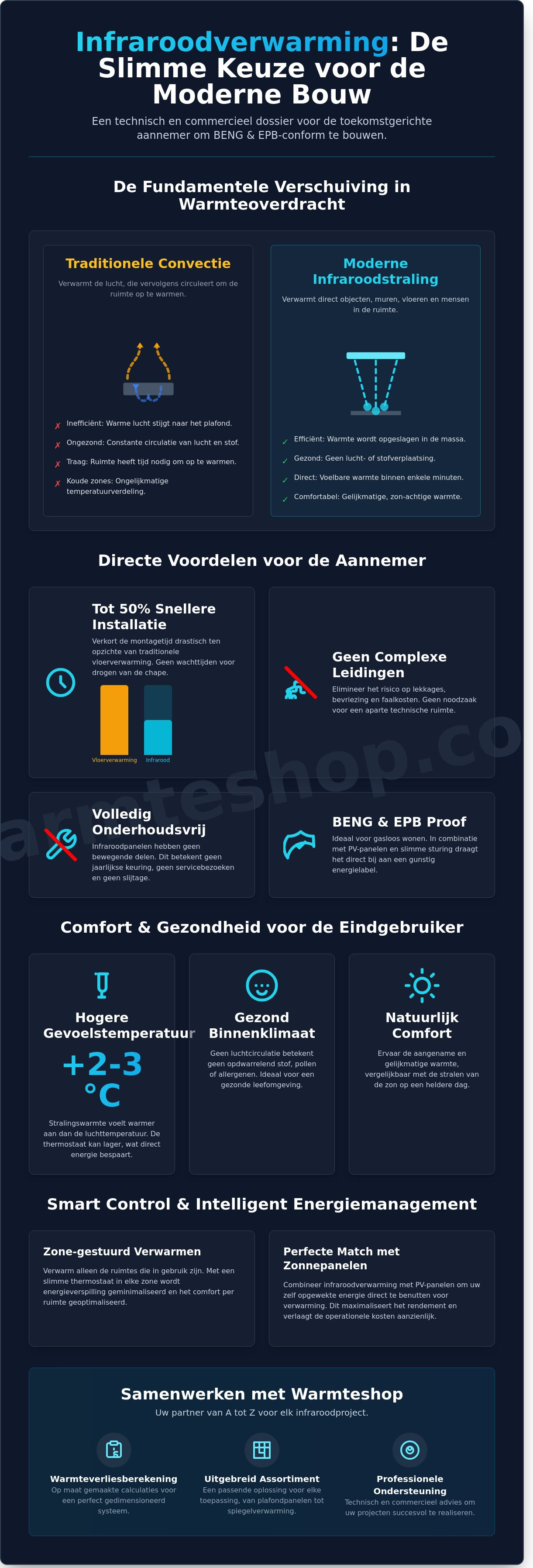
In an effective presentation to a contractor about infrared heating, the control system forms the backbone of the system. An infrared panel is a technical marvel in itself that converts nearly 100% of electrical energy into heat, but the actual efficiency is determined by how intelligently that heat is utilized. While traditional central heating systems often react slowly and heat entire zones unnecessarily, infrared technology enables extremely fine-grained control. By using intelligent thermostats, energy waste is kept to a minimum, resulting in energy cost savings that can amount to up to 30% compared to less advanced systems.
Zone-controlled heating is the key word here. With infrared heating, the resident heats only the rooms where they are actually located. Sensors in the thermostat detect the presence of people or respond to pre-set schedules. For large-scale projects, integration with a building management system (BMS) or modern Smart Home systems is essential. This offers not only comfort for the end user but also valuable data. This allows contractors to provide residents with written proof of their actual consumption, preventing potential disputes regarding energy bills in zero-energy homes.
Choosing a wireless thermostat offers a significant reduction in construction time. Because no physical connection is required between the thermostat and the panel, this saves the installer an average of 15% to 20% on the total installation time per room. This flexibility means that the layout of a room can still be changed even in the final phase of construction without extensive demolition work. Via Wi-Fi modules and smartphone apps, residents have complete control over their indoor climate, where the heat feels just as direct and natural as the sun's rays on a clear day.
In a presentation to a contractor about infrared heating, the connection with sustainable generation must be central. Infrared panels are the ideal buffer for excess solar energy. Instead of feeding electricity back into the grid at an unfavorable rate, the energy is directly converted into thermal mass in the walls and floors of the home. This paves the way for homes that meet the strictest BENG requirements (Nearly Zero Energy Buildings). In combination with battery storage, this system ensures a stable energy balance, making the home completely independent of fossil fuels and ready for a future without natural gas.
Would you like to discover how intelligent controls take your project to the next level? View our range of advanced thermostats and optimize every heating plan.
A successful transition to gas-free construction requires more than just the supply of panels. It demands technical precision and a partner who understands the intricacies of radiant heating. Warmteshop acts as that indispensable link for the modern contractor. In this presentation for contractors on infrared heating, we focus on how we strengthen your projects from start to finish with data and expertise.
We understand that, as a contractor, you are responsible for the performance of the building. Therefore, we offer professional heat loss calculations specifically tailored to the insulation values and volume of your project. Our specialists use advanced software to precisely determine the required wattages per room. This prevents under- or overcapacity, which is essential for achieving the desired energy performance coefficient. You gain access to a wide range of infrared heating, varying from aesthetic glass panels to robust units for intensive use.
For large volumes such as warehouses, workshops, or distribution centers, we offer specific solutions with industrial air heaters and powerful radiant heaters. In spaces with ceilings of 6 meters or higher, traditional heating is inefficient. Our systems directly heat the objects and people on the work floor, often resulting in energy savings of 30% to 45% compared to gas-fired systems. For offices and retail, we seamlessly integrate panels into suspended ceilings, working with project-based pricing that protects your margin.
Warmteshop is your external knowledge partner that eliminates technical risks for you. The Infrarood Verwarming Groep guarantees the highest quality, which is underscored by warranty conditions that often extend to 10 years on the heating elements. This reliability is crucial for your reputation as a builder. We support you not only with sales, but also with after-sales service and any questions from residents following completion.
Would you like to make your next project sustainable with proven technology? Contact us directly for a project-based quotation or a partner agreement. Together, we make construction future-proof.
The transition to gas-free homes requires heating solutions that are both technically superior and financially attractive. Infrared panels transform the way we think about comfort by heating objects directly, similar to the natural radiation of the sun. This presentation for contractors on infrared heating shows how you can significantly reduce installation time while simultaneously guaranteeing a healthy indoor climate without air circulation. It is a smart upgrade that immediately increases the value of your real estate projects.
As the market leader in the Benelux since 2008, Warmteshop offers the certainty you need as a professional. We provide certified heat calculations for every unique project, ensuring you always work with the right capacity and optimal efficiency. With more than 30 physical showrooms spread across the region, there is always a location nearby where your clients can experience the pleasant warmth for themselves. Together, we create homes ready for the future, with a focus on energy efficiency and unparalleled living comfort.
Download our technical brochure for contractors and discover the possibilities
We look forward to raising the standard for modern living together with you and taking your projects to the next level.
Yes, infrared heating is ideally suited as primary heating in new-build homes with an insulation value of RC 4.5 or higher. Because these homes experience minimal heat loss, the system responds extremely quickly and keeps the mass of the home at a constant temperature. This results in an energy efficiency of nearly 100 percent, where every kilowatt-hour of electricity is directly converted into healthy radiant heat comparable to the sun.
For an average new-build home, you should calculate with a capacity of 25 to 30 Watts per cubic meter to guarantee a comfortable indoor climate. In a standard bedroom of 12 square meters, one 600-Watt panel is often sufficient. When giving a presentation to a contractor about infrared heating, we always emphasize that an exact heat loss calculation according to the NEN-EN 12831 standard is crucial for determining the correct number of panels per room.
Infrared panels meet the BENG standards provided they are combined with self-generation via PV panels. Since the introduction of BENG on January 1, 2021, direct electric heating carries more weight in the energy requirement of BENG 1. By installing approximately 15 to 20 additional solar panels, you fully compensate for this consumption and the construction project achieves the required renewable energy share of 50 percent without complex piping routes.
A professional infrared panel has a technical lifespan of 25 to 30 years without any loss of efficiency. This is because the panels contain no moving parts that can wear out, such as pumps or valves in a heat pump. The high-quality carbon fiber elements retain their efficiency for three decades; this makes the total cost of ownership significantly lower than that of traditional systems, which often require replacement after 15 years.
Combining infrared panels with underfloor heating is a smart hybrid solution for spaces where you desire extra comfort quickly. While the underfloor heating provides the base load of 18 degrees, the panels kick in to raise the perceived temperature to 21 degrees within 5 to 10 minutes. This approach significantly increases living comfort in the seating area or bathroom without the slow underfloor heating having to run at a high temperature for hours.
Professional infrared panels are extremely fire-safe thanks to built-in thermal sensors that immediately cut off the power supply at temperatures above 120 degrees Celsius. The back of a high-quality panel typically remains around 40 degrees, ensuring that mounting on plasterboard or wooden ceilings poses no risk whatsoever. Every panel features an IP44 certification or higher, making them safe for use in damp areas as well.
The maintenance costs of an infrared system amount to zero euros over the entire lifespan of the product. There are no annual inspections, bleeding of pipes, or replacement of filters as is the case with heat pumps. For you as a contractor, this means a huge reduction in aftercare and service visits, since the system simply continues to operate as soon as the thermostat has connected to the panels.
Business projects in the Netherlands can benefit from the Energy Investment Allowance (EIA), which allows you to deduct up to 45.5 percent of the investment costs from taxable profit. In Belgium, grid operators sometimes offer specific premiums for control systems that optimize consumption. During a presentation for contractors on infrared heating, we demonstrate that these tax benefits often shorten the payback period of a business installation to less than 7 years.


