

Portable electric heating: which solution suits you?
, by Warmteshop, 17 min read
, by Warmteshop, 17 min read
The unit with the highest power output is not automatically the best choice. A portable electric heater only feels comfortable when the heat suits the room and the time you need it. In a …
The device with the highest power output is not automatically the best choice. A portable electric heater only feels comfortable if the heat suits the room and the time you need it. In a cold workspace, direct radiant heat can be pleasant, while convection heat warms the air in the room. What difference do you notice in practice?
It is only logical that you want to know whether a portable unit provides enough heat, how much power it consumes, and how to use it safely. The right choice depends not only on the power output but also on the size and use of the room. After all, a unit for targeted supplementary heating does not necessarily do the same thing as a unit that heats the entire room.
In this article, you will read how infrared heating and electric convectors emit heat, which type suits your situation, and what to look out for regarding operation and daily use. This allows you to determine more precisely what your space needs. A heat calculation can provide insight into the heat demand and help tailor comfort to the moment of use.
A portable electric heater is a device that you can use in various suitable locations, depending on where you need extra heat. Think of an electric convector in a home office that you later move to a hobby room. This way, you heat the room you are currently using specifically, instead of heating unused rooms as well.
Portable does not automatically mean lightweight, compact, or suitable for every room. Some units are designed to be moved regularly, whereas a freestanding unit tends to remain in one place due to its size or weight. Heat output, available space, and power connection also play a role. Therefore, always check the manual regarding placement and use. A location that seems practical is not necessarily suitable.
You can place a freestanding unit wherever you want temporary heat. This differs from fixed wall or ceiling heating, which is installed in one spot and is not intended to be moved repeatedly. Flexible use is convenient if you want to store the heater after use or switch it between rooms. Take into account the weight, the location of the unit, and the user manual. Portability is a feature, not a guarantee that every unit can be used everywhere.
The location also influences how you experience the heat. A convector heats the ambient air; infrared provides radiant heat that you can feel in a specific spot. Those who want to read more about the different forms of electric heatingwill find a general overview there. For a permanent solution, you could, for example, look at infrared heating for multiple rooms.
Supplementary heating is practical when you do not need to heat the entire home or workplace at the same time. If you use a home office only during working hours, warmth in that area can be more pleasant than constantly keeping an unused room at a constant temperature. The same applies to a hobby room that you use occasionally. On a cold morning, extra warmth can also be welcome in the place where you sit or work.
View a portable unit as a supplement to the existing heating, not automatically as a replacement. First, determine how long you use the room and what temperature feels comfortable for you. The required heat also depends on the size and insulation: a drafty room requires something different than a well-insulated room of comparable size. Consider the location where you want to feel the warmth. This way, you choose based on actual usage, not just because you can move the unit.
The way a device emits heat determines where you feel the heat and how it spreads through the room. With convection, the ambient air is heated. Radiant heat reaches people and surfaces directly, similar to the warmth of sunbeams on your skin. That difference is important for temporary heating: do you primarily want to warm the air in a room, or feel heat in a specific spot?
Convection heats the air moving through the room, while radiant heat directly heats people and surfaces.
A convector heats air at the unit. This air rises and spreads, after which cooler air moves towards the heater and is also heated. This creates air circulation. The distribution depends, among other things, on the layout: air moves differently in an open space than in a room with corners or obstacles. Drafts and the distance between the unit and the seating area also influence how evenly the heat feels. For example, take a look at the options for electric convectors if you want to compare this heating principle.
Infrared heat does not heat the air first, but reaches people and surfaces directly. As a result, you feel the heat primarily in areas within the reach of the heating surface. Placement matters: furniture and other obstacles can block the direct radiation. Therefore, consider where you sit or work and whether the device can freely reach that spot. Fixed applications of infrared heating for various rooms also demonstrate how targeted radiant heat can be deployed.
Comparison of heat principles
Neither principle is automatically the best choice in every situation. If you use a room briefly and always sit in the same spot, targeted heat can be pleasant. If you want to heat the air in the room, convection is the more obvious choice. Compare your desired heating experience with the layout and use of the space. This way, you choose not only a portable heater but also a heat output that suits your daily use.
Not every electric heater emits heat in the same way. Some devices primarily heat the air in the room, while others direct heat at people and surfaces. This difference helps you determine which type suits your needs: do you want to make a specific spot cozy or heat the room as a whole? Compare the heating principle, the location where you intend to use the device, and practical considerations. A universal ranking is less helpful, as the same type of heating can be pleasant in one situation and less suitable in another.
An infrared heater might be suitable if you primarily want to feel warmth in a specific spot, such as where you are sitting or standing. The radiation reaches people and surfaces directly. Your position relative to the heater therefore plays a role: if you turn away or something stands in between, the sensation of warmth can change. Consider in advance where you usually spend your time and whether the device can easily reach that spot. This way, you choose based on the desired sensation of warmth, without assuming that every device has the same range or performance.
A convector is an option when you want to heat the ambient air. The heated air spreads throughout the room, but how comfortable that feels also depends on the space. A high ceiling, an open layout, or limited insulation can affect heat distribution. Therefore, do not just look at the unit, but also at where you place it and the room in which you use it. Compare electric convectors based on their application and the features that are important for your situation.
A fan heater blows warm air into the room using a fan. The air movement is noticeable, and the noise can be a factor, for example, if you want to work or read quietly. Take these points into consideration. Oil-filled radiators are also a category of electric heating; the sensation of warmth and usage vary by device. Compare such options based on their features, and not just the model name.
The best choice depends on the combination of space and usage. For a workspace, direct heat can be pleasant if you sit in one spot for extended periods. However, if you want to heat the air in a room, convection might be a better fit. First, determine where you need heat and what you want to heat: the place where you are staying or the space around you.
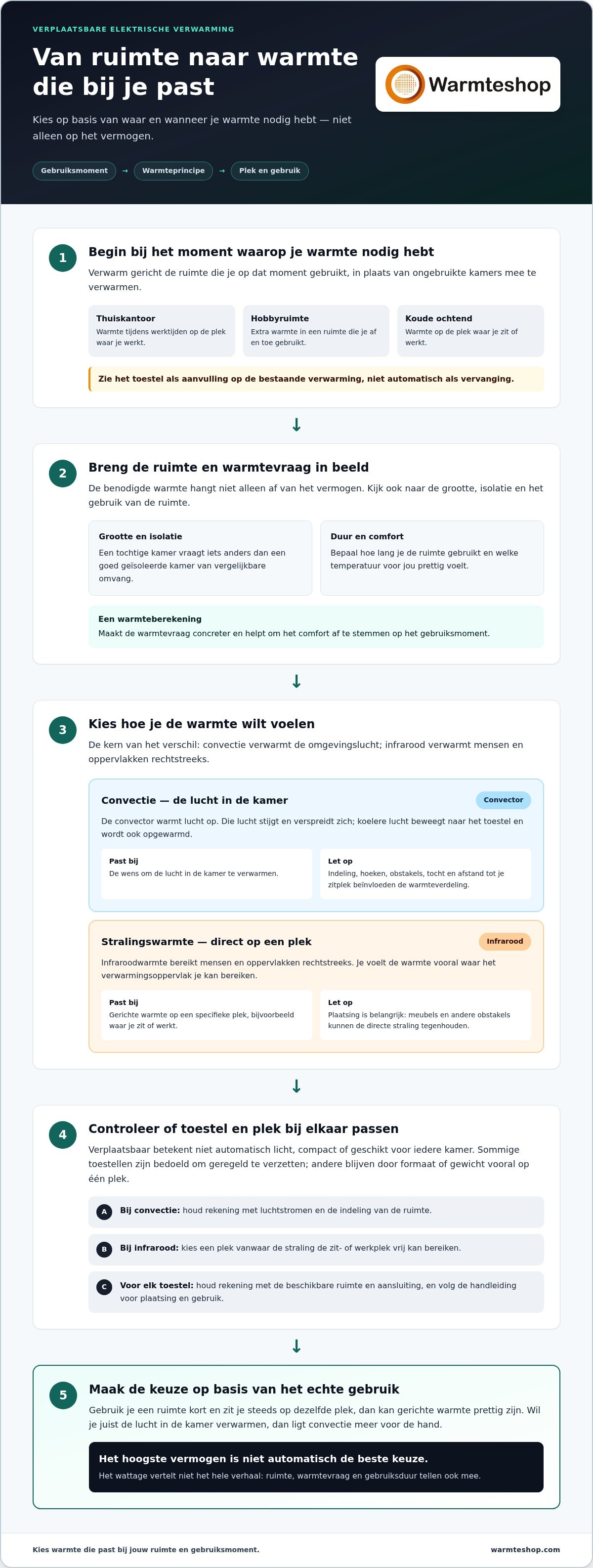
Making the right choice doesn't start with the wattage, but with how and where you need heat. A device may have sufficient power yet feel less comfortable if the heat doesn't match the room or your usage. Consider the time of use, heat demand, and heating principle step by step. This will help you make a more informed choice for portable electric heating.
The heat requirement is determined by the combination of room size, ceiling height, insulation, drafts, duration of use, and the temperature you find comfortable.
Follow these steps before choosing a device:
Surface area is only one part of the calculation. A high ceiling means more space to heat, while drafts and limited insulation can increase the heat demand. How warm you want the room to be and how long you stay there also play a role. Therefore, comparing only power output does not fully predict how comfortable or suitable an appliance is. A heat calculation combines the characteristics of the room and provides a more accurate picture than a rule of thumb.
Always follow the manual regarding the clearance around the appliance, the surface, and the distance to furniture, textiles, and other heat-sensitive materials. Place the heater stably and use only the prescribed connection. Also, observe the supervision instructions. This way, you make safe use part of your decision, rather than something you only think about after installation.
A thermostat control can help monitor the desired temperature. Adjust it according to room usage and prevent the heating from running unnecessarily when extra heat is not needed. A heat calculation provides insight into the heat demand. Discover the heating solutions that suit your situation.
The right choice starts with what you want to heat and how you use the space. Do you want to feel extra warmth in one spot, heat the air in a room, or temporarily make a larger space more comfortable? Also consider how long you use the heating and whether you want to move the unit regularly. Therefore, evaluate a solution based on how well it meets your daily needs, not just on the type of unit or the power output.
If you primarily want heat in the area where you sit or work, targeted radiant heat may suit that need. A convector is better suited to the desire to heat the ambient air. If you move the unit frequently, flexibility is important. If you consistently use the same zone, fixed placement may be more logical. With multiple zones or heat sources, professional advice helps to assess the situation as a whole.
A heat calculation makes the heat demand more concrete by taking the space and intended use into account. This prevents you from relying solely on a single number or a general rule of thumb. Warmteshop offers heat calculations, expert personal advice, and professional installation services. This guidance helps you assess how convectors and infrared heating align with your space and desired heating experience.
For a temporary need, portable electric heating can be practical; for a fixed location, a fixed solution may be a better fit. There is no single heating type that suits everyone. First, determine where you want heat, how long you need it, and whether you want to be able to move the unit. With these starting points, comparing becomes clearer, and you can make a choice that suits both comfort and usage.
Do you want to include infrared heating in your considerations? Discover electric heating solutions.
The most comfortable heating choice starts with a small observation: where do you miss warmth most often and at what time? Keep track for a few days of which spot feels cold and when you are there. This makes your needs more concrete before choosing a device. Portable electric heating can offer flexibility, but comfort ultimately depends on the match between the device, the space, and usage.
Take those insights into account when comparing heating solutions. Don't just think about today, but also about how you want to use the space in the future. Perhaps heat in one fixed spot is enough; perhaps you want a solution that you can use at different times. A conscious choice helps you work towards a more comfortable home step by step.
Explore the possibilities and discover electric heating solutions that suit your space and daily routine. With a clear picture of what you need, choosing becomes easier and the next cold day feels more pleasant.
Portable electric heating is usually primarily suitable as supplementary heating, for example for a home office that you do not use constantly. Heating a home entirely electrically with separate units can consume a lot of power, especially when they are on for extended periods. Whether a single unit can heat a room as the primary heating source depends, among other things, on the heat demand and the insulation. For structural heating of multiple rooms, a heat calculation is a sensible starting point.
Only operate a heater at night if the manual permits and the appliance is intended for this purpose. Place it on a stable surface, maintain the prescribed distance from bedding and curtains, and never cover it. Use a thermostat or timer only according to the operating instructions. If you have any doubts about unattended use, switch off the appliance before going to sleep and follow the manufacturer's safety instructions.
There is no single wattage that suits every room. The required capacity depends not only on the floor area but also on ceiling height, insulation, drafts, and the desired temperature. A small, well-insulated room requires something different than an open or drafty space. Therefore, do not use the watt-per-square-meter rule as the sole basis. A heat calculation helps determine the heat demand more concretely, so that you do not rely solely on the number on the appliance.
Preferably connect an electric heater directly to a suitable power outlet. Use an extension cord only if the manual explicitly permits this and the cord is suitable for the appliance's power rating. Unroll a cable reel completely when using it and position the cord so that it is not covered by a rug or at risk of damage. Always follow the connection instructions and do not use damaged cables or plugs.
Only if the manufacturer declares the appliance suitable for use in a bathroom. Moisture and splashing water make placement particularly important. Check the manual for the permitted operating environment and keep the appliance away from water, the sink, and the shower, unless the instructions indicate otherwise. A standard heater is not automatically suitable for a wet room. Switch off the appliance and unplug it only when it can be done safely and in a dry place.
Neither is automatically more economical in every situation. Power consumption depends primarily on the required heat, the duration of use, and how you deploy the device. A convector heats the ambient air, while infrared heat is directed directly at people and surfaces. If you sit in one spot all the time, targeted heat can be pleasant; if you want to heat the air in a room, convection may be a better fit. Compare the usage, not just the type.
That depends on the room and the appliance. A large room, a high ceiling, an open doorway, or limited insulation can increase the required heat. As a result, a single appliance may be insufficient to comfortably heat the entire room, even if the output seems high. First, determine whether you want to heat the entire room or only a part of it. For a larger or complex room, have the heat demand calculated.


