

Patio heater on a stand: what to look for when making your choice?
, by Warmteshop, 16 min read
, by Warmteshop, 16 min read
A more powerful patio heater is not automatically the best choice for your seating area. With a tripod-mounted patio heater, your seating position and the degree of shelter are the most important factors. Infrared heat works like solar radiation…
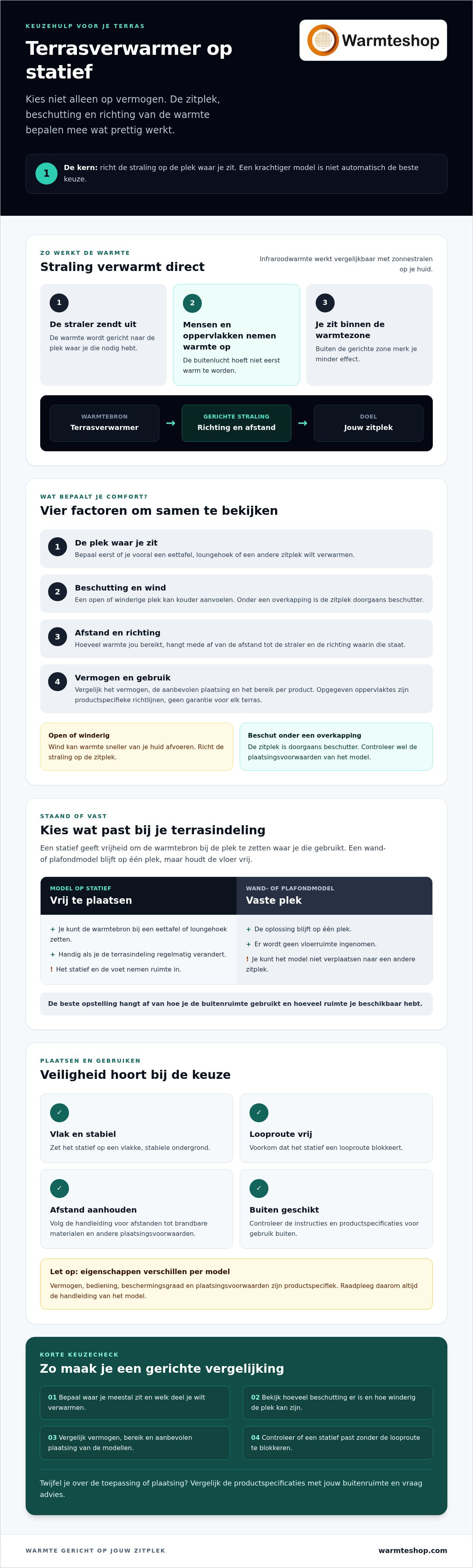
A more powerful patio heater is not automatically the best choice for your seating area. With a pedestal-mounted patio heater, your seating position and the degree of shelter are the most important factors. Infrared heat works like sunbeams: it heats people and surfaces directly, rather than first warming the outside air. Therefore, the direction and distance of the radiation make a difference to your comfort.
Are you undecided between a freestanding model and a wall- or ceiling heater? A tripod gives you the freedom to place the heat source near a dining table or in a lounge area. A fixed model takes up no floor space but remains in one place. When making your choice, also consider the required power, the stability of the tripod, and the safety instructions for outdoor use.
In this article, you will learn how outdoor radiant heat works and how to match a patio heater to your patio layout. We discuss what to look for regarding power and placement, and which safety aspects are important, such as a level surface and sufficient distance from flammable materials. This will allow you to determine more specifically which solution suits your outdoor space.
A patio heater on a stand is a freestanding heat source that you can place on the patio and, depending on the model, move to another spot. This allows you to direct the heat towards a dining table or seating area, for example, without attaching the heater to a wall or ceiling. However, the stand does take up space. Therefore, ensure that it stands firmly and does not block any walkways.
Radiant heat on a terrace directly heats people and surfaces within the range of the heater, rather than first warming up the outside air. The general operation of patio heaters and the various heat sources are also explained under How a patio heater works. With an infrared model, the heat is therefore often felt immediately when you are sitting within the radiation zone.
Infrared radiation can be compared to the warmth of the sun on your skin. The air around you does not need to warm up first before you feel the heat. The patio heater directs radiation to where it is needed; people and surfaces absorb that heat. That is why your sitting position is important: outside the targeted heating zone, you will notice less effect.
Wind does not alter the radiation itself in the same way that an airflow would move a layer of warm air. Nevertheless, an open, windy spot can feel colder because wind dissipates heat from your skin more quickly. The distance to the heater and the direction in which it is facing also determine how much heat reaches you. Therefore, direct the heat towards the seating area, not just the center of the terrace.
The practical advantage is that you can place the heat source wherever you are using it at that moment. This is convenient if you alternate between a dining table and a lounge area, or if you regularly change the layout of your terrace. A fixed wall or ceiling solution cannot be moved, but it does keep the floor clear. The best setup depends on how you use the outdoor space.
When choosing a freestanding model, consider the base and the surrounding space. Place the tripod on a flat, stable surface and avoid blocking foot traffic. Follow the manual for required distances and conditions for outdoor use. Power, operation, protection rating, and placement requirements vary by product model. Therefore, check these features before making a choice.
Would you like to view infrared patio heaters? You can find them in the range of patio heaters. Compare the product specifications with the spot where you actually want to sit. This way, you can assess not only whether a tripod-mounted patio heater fits on your patio, but also whether the heat reaches the right spot.
The correct capacity does not depend solely on the number of square meters. An open terrace requires a different assessment than a sheltered spot under a canopy. The distance between the heater and your seating area also matters. Therefore, first note where you usually sit, how many people sit there, and which part of the terrace you want to heat. This way, you compare models based on your own usage, rather than just on a general surface area claim.
Next, consider the setup. In an open or windy location, heat can be lost to the surroundings more quickly; under a canopy, the seating area is generally more sheltered. Higher power is not automatically better if the heater is positioned too far away or is not directed at the users. The heat you experience also depends on the distance, the wind, and the direction of the heater.
For each model, check the power output and information regarding recommended placement and range. Consider stated surface areas as product-specific guidelines, not as a universal guarantee for every patio. The lifespan also plays a role in the choice. House Digest discusses various factors regarding the energy consumption of patio heaters.
When choosing electric patio heating, it is useful to consider the type of infrared radiation and the conditions for which the manufacturer recommends the model. The comparison below provides guidance. The precise heat experience and installation conditions vary by product.
| Heating type | Experience of warmth | Appropriate placement | Point of attention |
|---|---|---|---|
| Shortwave infrared | Targeted heat that can be noticeable quickly | Can suit an open space where you direct the heat onto the seating area | Check recommended distance and radiation direction |
| Long-wave infrared | More even heat experience, usually without visible light | Is more often applied in sheltered or more enclosed places | Check if the conditions and assembly match the model |
Also compare the operation, protection rating, and conditions for outdoor use. These features indicate something different than the power output and are equally important for your setup. If you are looking for a tripod-mounted patio heater, base your choice on the seating area and not just on the stated wattage. Then view the range of patio heaters and compare the product specifications with your patio.
The choice between a freestanding, wall-mounted, or ceiling-mounted model depends primarily on your terrace layout. A freestanding model offers flexible deployment. A fixed heater heats from a single spot and takes up no floor space. Neither setup is automatically better. First, determine where you usually sit, how much space is available, and which zone you want to heat.
| Line-up | Flexibility | Space and focal point |
|---|---|---|
| On a tripod | To be moved to another seat | Occupies floor space and requires a suitable, stable subfloor |
| On the wall | Heats from a fixed position | Requires a suitable wall and a spot facing the seating area |
| On the ceiling | Stays in one fixed place | Keep the floor clear; check if the installation location matches the product instructions |
A tripod-mounted patio heater is suitable for a patio where you want to use the heat source in different places at different times. Think of a dining table that you only use during meals, or a lounge area where you sit later in the evening. You can adjust the setup without choosing a fixed mounting spot.
That freedom does require some planning. The stand takes up space and must stand firmly on a flat surface. Check in advance whether the base obstructs furniture or walkways and whether the heater can reach the desired seating area. Follow the manual for placement and prescribed distances. Move the device only in the manner indicated by the manufacturer.
A wall-mounted or ceiling-mounted model can be a good option if you consistently use the same seating area and can keep the heat source directed there permanently. You keep the floor clear and do not have to move the unit every time. However, this convenience depends on the installation location. It must suit the desired heating zone as well as the specifications of the chosen product.
Before making a choice, check the assembly instructions and installation conditions for the specific model. Do not assume a single general mounting height or distance; these can vary by product. If you are unsure which setup suits your patio, compare the situation with the broader guide to buying a patio heater in 2026. This allows you to weigh flexibility, available space, and the location where you want to feel the warmth in conjunction.
A good placement makes the difference between warmth on your seating area and a heater that primarily heats the surroundings. Therefore, take the time to check the setup before use. The manual for the specific model is the guiding document in this regard. Distances, connection requirements, and suitability for outdoor use may vary per patio heater.
Start at the spot where you are actually sitting. Aim the heater at that zone and take the wind direction into account: on an open terrace, wind can affect the perception of heat. Also check whether furniture, plants, or other obstacles are blocking the radiation. Keep walkways clear so that no one bumps into the stand or the heater.
Use this check before turning on the device:
This way, you will notice before or during the first use whether the heat source is positioned awkwardly or if the heat is not reaching the intended spot.
Always follow the manufacturer's assembly, connection, and operating instructions. Check whether the model is suitable for the outdoor environment where you intend to use it and how much clearance is required around it. Do not place the patio heater on an unstable surface or in a location where people can easily bump into it. Keep flammable materials at the prescribed distance.
Before use, check the cable, plug, and connections for visible damage, to the extent required by the manual. Do not use a damaged device. Consult the instructions or seek expert advice. Do not make any adjustments to the connection or the device yourself. If in doubt regarding proper placement or connection, consult an expert.
Do you want to compare models after this safety check? Then view the patio heaters and compare the product specifications to your patio. This way, you make a choice that suits both the seating area and the conditions for safe use.
The right choice starts with your patio, not with a single specification. Compare your usual seating area and the zone you want to heat with the model's features. Next, check if the setup fits practically and if the manual aligns with outdoor conditions. This way, you make an informed decision without assuming that every model provides the same heat or range.
Use this checklist to compare your options in a targeted way:
A tripod-mounted patio heater may seem suitable on paper, but in practice it can be awkward if the base has limited space or the heater cannot be properly aimed at the seating area. Therefore, always compare the product specifications and manual with the actual layout of your patio. Ask for advice if you are unsure about the relationship between power output, placement, and usage.
Personal advice can help take the conditions on your terrace into account when making your decision. Warmteshop also offers heat calculations to assess the heat requirement. Professional installation services are available for questions regarding installation. Discuss which support suits the chosen product and the intended setup.
You can visit Warmteshop at one of the stores and showrooms. When you are browsing, bring the dimensions of the seating area, the desired heated zone, and any questions regarding installation. Then, view the patio heaters and compare the available product specifications with your situation. This way, you can make a more informed choice and maintain realistic expectations regarding how the heat will be experienced on your patio.
A tripod-mounted patio heater works best when the heat is directed at your seating area. Therefore, do not choose based solely on power output. Shelter, distance from the heater, and desired heating zone also play a role. A freestanding model offers flexibility, while wall or ceiling mounting may be better suited to a fixed seating area.
Before making a decision, check the product specifications, the manual, and the conditions for outdoor use. Also, ensure stable placement and sufficient space around the unit. This way, you tailor your choice to the terrace and use the heater responsibly.
Unsure about the application or the right setup? Warmteshop offers personal advice, heat calculations, and professional installation services. You can also visit one of our stores and showrooms. View patio heaters and discover which solution suits your patio. With a well-coordinated choice, you make your outdoor space more inviting during cooler moments.
No, suitability depends on the available space, the surface, and the location where you want to feel the heat. A tripod takes up floor space and must be able to stand stably without blocking a passageway. On a small terrace, a fixed wall or ceiling solution might be more practical. Also, check whether the manufacturer declares the chosen model suitable for the conditions on your terrace.
There is no single power output that suits every patio. Check the product specifications and weigh the patio surface against the shelter, the distance to the seating area, and the zone you wish to heat. In an open area, wind can affect the perception of warmth. Furthermore, a tripod-mounted patio heater must be positioned so that the radiation reaches the users. Follow the manufacturer's guidelines for the specific model.
This is only possible if the manufacturer indicates that the model may remain outside on your patio under the conditions. Being suitable for outdoor use does not automatically mean that a device can remain unprotected for extended periods. Read the manual for information on weather conditions, storage, and protection when the device is not in use. Bring the device indoors or store it if the instructions require it. Check it for visible damage before use.
That depends on the regulations for the chosen model and the setup. Check the manual to see if the device may be used on that surface and how much clearance is required. Place the stand stably, away from flammable materials and out of walkways. Do not use the heater if it could tip over or if you cannot maintain the required distances. Always follow the manufacturer's instructions.
A freestanding model stands freely and can be moved to another seating area, if the manufacturer permits. However, it does take up floor space. A wall-mounted model remains in one place and requires a suitable mounting location, but keeps the floor clear. Which configuration is better depends on your terrace layout and usage. Compare the manuals and installation conditions of the models you are considering.
An infrared patio heater is primarily intended to heat people and surfaces directly, not to warm up the outside air first. You feel the radiation when you are sitting within the heated zone, similar to how sunbeams warm your skin. Wind can, however, affect the perception of heat. Therefore, direct the heater towards your seating area and check the product information to see how the model emits heat according to the manufacturer.
Place the device on a flat, stable surface and direct the heat towards the zone where you are sitting. Take wind, obstacles, and walkways into account so that the radiation is not blocked and people do not walk into the stand. Consult the manual for the required clearance and distances to materials. Also check whether the location and conditions meet the outdoor use requirements of the specific model.


