

Infrared heating experiences 2026: what you need to know before you buy
, by Warmteshop, 17 min read
, by Warmteshop, 17 min read
What if you turn the thermostat in the living room down three degrees, but feel warmer than ever before? Many homeowners are struggling with the question of whether electric heating will remain affordable, especially now that the average straw…
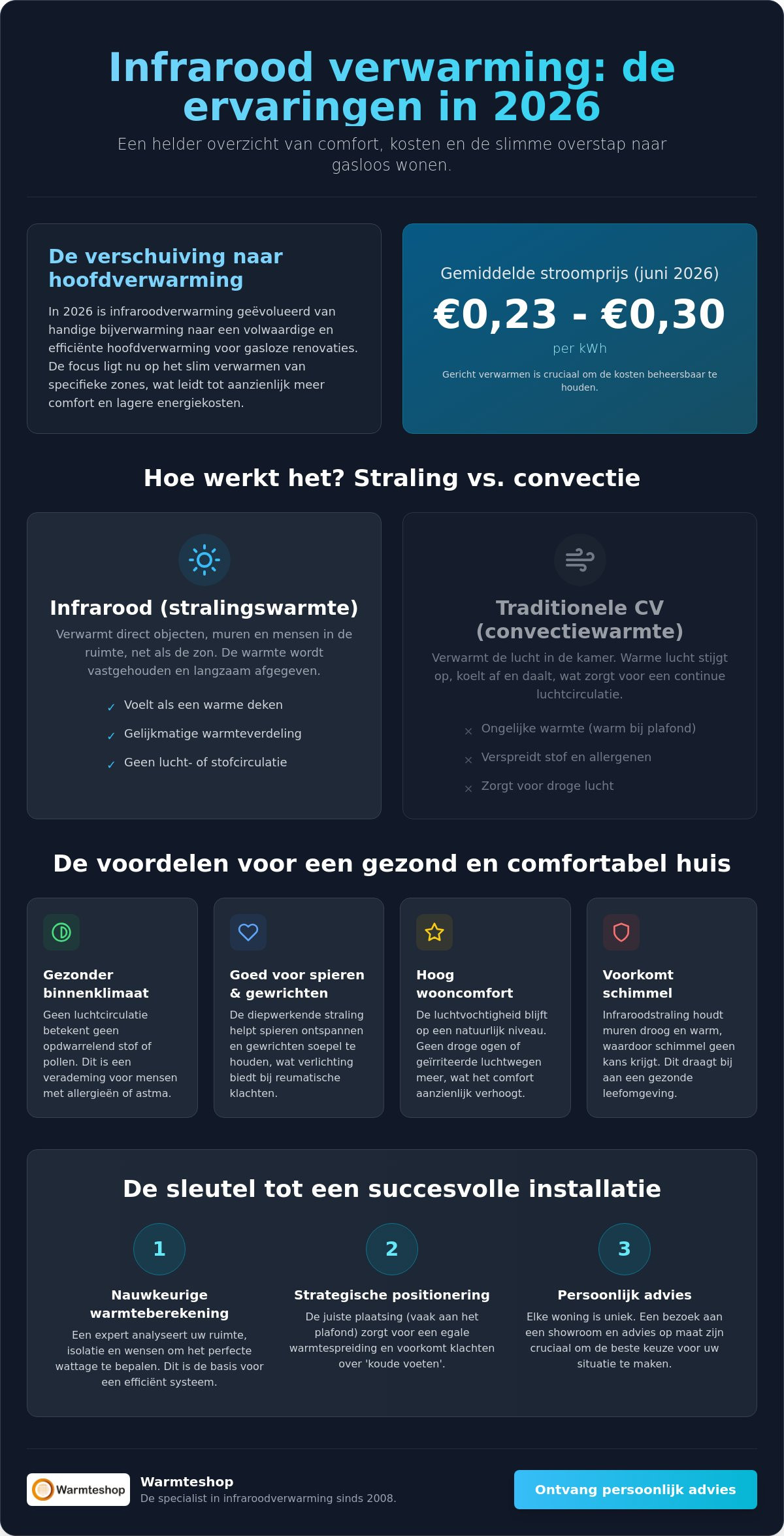
What if you turn the thermostat in the living room down by three degrees, but feel warmer than ever before? Many homeowners struggle with the question of whether electric heating will remain affordable, especially now that the average electricity price in June 2026 lies between €0.23 and €0.30 per kWh. The fear of cold corners in the house and the proliferation of conflicting reviews often cause unnecessary doubt. It is perfectly logical that you want certainty before investing in a new way of living.
In this article, we share the most up-to-date infrared heating experiences for 2026, so you know exactly what to expect from this sun-drenched warmth. We show how smart zone heating helps you keep energy costs manageable while simultaneously creating an aesthetic interior without unsightly radiators. You will get a clear overview of performance in modern, well-insulated homes and learn why switching to infrared is not mandatory, but a comfortable upgrade for a healthy indoor climate. We walk you through the facts and results so you can confidently make the right choice for your own home.
By 2026, the way we view our homes will have fundamentally changed. The transition to gas-free living is no longer a distant prospect, but a daily reality for thousands of Dutch people. While infrared panels were previously often seen as a convenient addition to the bathroom, infrared heating experiences in 2026 show that this technology is now the standard for complete home renovations. This shift is not a sudden development. Due to the focus on precision heating and the smart heating of zones rather than cubic meters of air, infrared has grown into a serious competitor to traditional systems.
Current energy prices, averaging between €0.23 and €0.30 per kWh in June 2026, force us to take a critical look at our consumption. The perception that electric heating is inherently expensive is giving way to the realization that targeted heating actually yields enormous savings. Warmteshop has played a pioneering role in this since 2008. By professionalizing the market and emphasizing scientifically substantiated heat calculations, we have transformed the transition to green energy from an obligation into a luxury upgrade to living comfort.
To understand why users are so enthusiastic, we need to go back to basics. What exactly is infrared heating? Unlike a central heating boiler that heats the air, an infrared panel works with radiant heat. This is exactly the same principle as the natural warmth of the sun on a cold winter day. The radiation directly heats the objects and people in the room, who then slowly release the heat back into the surroundings. For daily use in the home, we primarily focus on long-wave radiation (IR-C). These waves provide an even, gentle heat that users perceive as much more natural and pleasant than the dry, moving airflow of a traditional radiator.
The Dutch government is strongly pushing for an electric future. Although the net metering scheme for solar panels is changing, the combination with infrared heating highly cost-effective. It enables you to convert the generated solar energy directly into heat at the location where you need it at that moment. Instead of keeping an entire house at a constant 20 degrees, people in 2026 are increasingly opting for a system based on panels. It is a smart upgrade that not only enables CO2-neutral living but also improves the aesthetics of the home by eliminating bulky pipes and radiators. Infrared heating experiences in 2026 confirm that this transition goes hand in hand with an increased sense of well-being and coziness at home.
One of the most appreciated aspects of infrared heating experiences in 2026 is the direct nature of the heat. Users often describe the sensation as a warm blanket falling over them, comparable to the first rays of sunshine in spring. Because an infrared panel heats the people and objects in the room rather than the air, no bothersome air circulation occurs. This means that no dust or pollen is blown through the room. For people with allergies or asthma, this is a crucial advantage that makes daily life at home significantly more pleasant.
A healthy indoor climate is about more than just temperature. Infrared radiation keeps walls dry and warm, effectively preventing mold growth. This is a frequently cited benefit in the experiences of residents of older homes. Furthermore, dry walls have a higher insulation value than damp walls, allowing the home to retain heat better. Regarding the efficiency of targeted heating, the US Department of Energy reports that the proper application of radiant sources has a significant impact on the consumption and costs of infrared panels. Respiratory comfort is noticeably higher because humidity remains at a natural level and the air does not feel "tough."
In addition to comfort, aesthetics play a major role in the positive user feedback. By 2026, infrared panels will have evolved into true design objects. An infrared mirror in the bathroom is a favorite example; it saves space, prevents a foggy mirror after showering, and offers delightful warmth during the morning routine. The infrared photo panel is also gaining popularity, where a functional heater is camouflaged as a personal work of art on the wall. Thanks to the possibility of invisible ceiling mounting, modern interiors retain their clean lines without the visual interruption of pipes or radiators. Would you like to experience for yourself how this technology fits into your interior? You can always visit one of our showrooms for a customized demonstration.
The biggest uncertainty when switching to electric heating is often the monthly electricity bill. With an average electricity price of €0.28 per kWh in June 2026, it is logical that you take a critical look at the return on investment. The most positive infrared heating experiences in 2026 stem from a well-thought-out strategy: zone heating. Instead of keeping the entire house at a constant temperature, with infrared you only heat the areas where you actually spend time. This ensures that the total energy bill is often lower than with traditional systems that unnecessarily heat the air in unused rooms.
A professional heat calculation is the foundation of your success in this regard. Without this calculation, you run the risk of undercapacity, causing panels to work too hard and consumption to rise unnecessarily. High-quality panels can convert up to 93% of the electricity into direct radiant heat. This high efficiency truly comes into its own in well-insulated homes. Although infrared works excellently as supplementary heating in less insulated houses, experience in 2026 shows that a complete switch in such homes requires a smart approach to the building envelope. Scientific user experience with radiant heat confirms that the perception of comfort at a lower air temperature is the key to these savings.
An infrared panel is only truly efficient if it switches on and off at precisely the right moment. The era of simple on/off switches is behind us. In 2026, we expect users who choose wireless thermostats to score the highest satisfaction. These systems react lightning-fast to temperature changes and prevent energy from being wasted. Through the integration of smart home Wi-Fi modules, you can monitor exactly what each panel consumes via your smartphone. This insight into infrared heating experiences in 2026 helps you refine your heating habits and control costs down to the cent.
If you look beyond just the purchase price, you will see the true power of this technology. Infrared panels have no moving parts and require virtually no maintenance. There is no need for an annual inspection of a central heating boiler, and there are no pumps that can burn out. The lifespan of a high-quality panel significantly exceeds that of a traditional boiler. When you add these avoided maintenance costs to the savings from zone heating, a favorable financial picture emerges. The transition to infrared is therefore not an expense, but a smart investment in the value and comfort of your home.
When considering purchasing a home with such modern systems, a thorough inspection by an expert like A Premier Home Inspection provide you with the necessary peace of mind regarding the overall technical condition of the property.
Applying infrared technology requires a different way of thinking about heat. The most valuable infrared heating experiences of 2026 show that the success of the system depends on the specific function of a room. You are not simply heating a volume; you are creating a place where it needs to be comfortable at that specific moment. This customization makes it possible to enjoy a warm seating area in the living room, while the rest of the space remains a few degrees cooler without sacrificing comfort.
The transformation is most significant in the bathroom. An infrared mirror serves a dual purpose here. While the radiation directly warms your body, the heat in the glass ensures that the mirror never fogs up again. Experiences with the Sunshower in 2026 confirm that this is no longer a luxury extra, but an essential part of a healthy morning routine. The combination with an infrared towel dryer ensures that you always step into a warm towel, while the walls remain dry and mold-free.
Many users only truly discover the power of infrared in their home office. Often, this is a room in the attic that is difficult to heat with a standard central heating boiler. Instead of heating the entire home for a single workspace, a ceiling panel or a compact model under the desk offers a solution. The constant indoor climate without bothersome drafts significantly improves focus and productivity. You feel the warmth immediately as soon as you start the computer, making it the ideal solution for flexible working hours and a lower energy bill.
In the bedroom, a low-wattage panel is often sufficient, as you only need comfort here when getting up or getting dressed. For the living room, most people opt for strategic placement above the sofa, allowing the central thermostat to be turned down a few degrees without worry. And do you want to enjoy your garden on cooler evenings as well? Infrared heating experiences on the terrace in 2026 are unanimously positive; with a powerful patio heater, you extend the outdoor season by months without wasting energy on the outside air.
Curious which panel best suits your specific space? View our full range of infrared heating and discover the possibilities for your home.
Online reviews offer a valuable starting point, but the unique sensation of radiant heat is difficult to capture in text. The most convincing infrared heating experiences often originate on the floor of one of our 30 showrooms. Here, visitors discover that the heat not only fills the air but embraces them immediately. As part of the Infrared Heating Group, we have been building a reputation for reliability and expertise since 2008. Our in-house installation service takes all technical concerns off your hands, ensuring a seamless transition to a gas-free home.
A common source of disappointment with DIY installations is a mismatch between the panel capacity and the characteristics of the room. When a panel is too weak for the room, it must constantly operate at full power without achieving the desired comfort. Our experts prevent this by performing a detailed heat calculation. We consider the insulation level, window surface areas, and the specific positioning of the panels. We regularly hear stories from customers who bought a panel elsewhere that was correct 'on paper,' but only found true comfort with us through a correction in the setup and wattage. This precision is what positively distinguishes the infrared heating experiences at Warmteshop in 2026 .
No two homes are the same, and that calls for a wide range of solutions. In 2026, we foresee a strong need for aesthetic integration. Whether it concerns robust industrial heaters for a workshop or elegant glass heating for the living room, the technology must match the style of the residents. The option to have an infrared photo panel printed with your own image turns your heating into a unique interior piece. In combination with our advanced smart home Wi-Fi modules, you create a system that is not only beautiful but also responds intelligently to your presence.
Would you like to take the step towards a sustainable and comfortable future, but still have specific questions about your living situation? Our specialists are ready to guide you through the possibilities of modern radiant heating. You can visit our showroom for a free, tailored consultation. Experience for yourself how we translate the natural warmth of the sun into a smart solution for your home.
The collected infrared heating experiences from 2026 paint a clear picture: the future of living is electric, provided you choose precision. By switching to zone heating, you not only enjoy a healthier indoor climate without bothersome drafts, but you also maintain control over your energy consumption. It is a smart investment in comfort that pays for itself through lower maintenance costs and an aesthetic interior without bulky radiators.
At Warmteshop, we understand that every home requires a unique approach. With over 15 years of experience since 2008 and the largest network of showrooms in the Benelux, we are ready to guide you through this transition. Our own technicians ensure professional installation, so you can immediately benefit from natural heat in your own home. We take the time to analyze your situation and offer a solution that seamlessly aligns with your needs.
Discover our infrared collection and experience the warmth for yourself. We look forward to realizing your ideal living comfort together with you and welcoming you to the world of sustainable heating.
In 2026, infrared heating will be perfectly suitable as primary heating, provided your home is well insulated. In modern, well-insulated homes, the radiant heat ensures a constant base temperature, allowing you to heat specific rooms in a targeted manner using zone heating. This keeps energy consumption manageable and comfort optimal, as you no longer heat empty rooms unnecessarily, as is the case with a traditional system.
The most frequently mentioned disadvantages in infrared heating experiences in 2026 are the so-called radiation shadow and the limited range of approximately 3 meters. If there is an object between you and the panel, you feel the direct heat less intensely. Users in moderately insulated rooms also experience that the heat dissipates more quickly as soon as the panels are switched off, because the walls retain heat for a shorter time.
For a 30m² living room, you need an average of 2 to 3 panels to ensure good heat distribution. The exact power depends on the insulation value and ceiling height, but you should expect a total power between 2,100 and 3,000 watts. Good distribution prevents cold spots and ensures that objects in the room are heated evenly.
In principle, you can install infrared panels yourself using a simple plug-and-play system, but for professional integration, an expert is recommended. A professional ensures invisible wiring and proper connection with smart home thermostats for optimal efficiency. Moreover, when installed by our own technicians, you are assured of a full warranty and perfect positioning on the ceiling or wall.
Infrared heating can be significantly cheaper than gas, especially when using smart zone heating. With an average electricity price of €0.28 per kWh in June 2026, an efficiency of 93% is crucial. You save by heating only the zones where you actually spend time, often resulting in a lower total energy bill than constantly heating an entire home with gas.
In poorly insulated homes, infrared heating experiences from 2026 show that the panels are primarily effective as supplementary heating. Because the walls and objects in these houses lose heat to the outside air more quickly, using them as primary heating would lead to high power consumption. However, for a specific spot such as a seating area or a home office, it remains a very comfortable and fast solution.
For private homeowners, no national ISDE subsidy will be available in 2026 for the purchase of infrared panels. However, business users can benefit from significant tax advantages through the EIA (Energy Investment Allowance) and the KIA (Small-scale Investment Allowance). This makes the switch to this sustainable technology particularly financially attractive for companies in the context of the energy transition.
Customer experiences confirm that high-quality infrared panels have a very long lifespan of 20 to 30 years on average. Because the panels contain no moving parts, pumps, or fluids, there is hardly any mechanical wear. This makes the system significantly more sustainable and maintenance-free than a traditional central heating boiler, which often requires replacement after 12 to 15 years.


