

Disadvantages of infrared heating: An honest and in-depth overview for 2026
, by Warmteshop, 20 min read
, by Warmteshop, 20 min read
What if the switch to a gas-free home in 2026 reveals unexpected cracks in your daily living comfort? Although 87% of users perceive radiant heat as superior, concerns about cold spots remain…
What if the switch to a gas-free home in 2026 reveals unexpected cracks in your daily living comfort? Although 87% of users perceive radiant heat as superior, concerns about cold spots and rising electricity costs remain a point of doubt for many homeowners. It is essential that you gain a clear understanding of the specific disadvantages of infrared heating before investing in a system that transforms your entire living environment. After all, you are seeking that healthy warmth of the sun, but without the technical surprises sometimes hidden in the fine print.
We recognize the confusion caused by conflicting advice on the internet. In this in-depth overview, we lay our cards on the table and promise you an objective analysis of the limitations and the solutions to counter them. You will discover how to maximize your system's efficiency through proper sizing and smart thermostat control. We discuss the influence of insulation values and placement, so that by the end of this article, you can determine with complete certainty whether infrared heating is the right match for your specific living situation.
Infrared heating mimics the natural warmth of the sun by using direct radiation. Instead of heating the air in a room, the waves travel through the space until they strike an object or person. This provides an immediate sensation of comfort on the skin. To make a successful switch to electric heating, it is essential to understand the specific disadvantages of infrared heating . A sustainable transition in your home requires an honest analysis of the technology and its physical limitations.
Many people begin their search with the scientific basis: what exactly is infrared heating , and how does it differ from the systems we have been using for decades? Whereas a traditional central heating boiler circulates air, infrared does not. This fundamental difference means that the technology is not the ideal solution in every situation. The most frequently heard criticisms often focus on three areas: electricity consumption in poor insulation, the limited range of the radiation, and the need for highly strategic installation. Without the right expectations, a panel can feel like a local hotspot rather than a fully-fledged primary heating system.
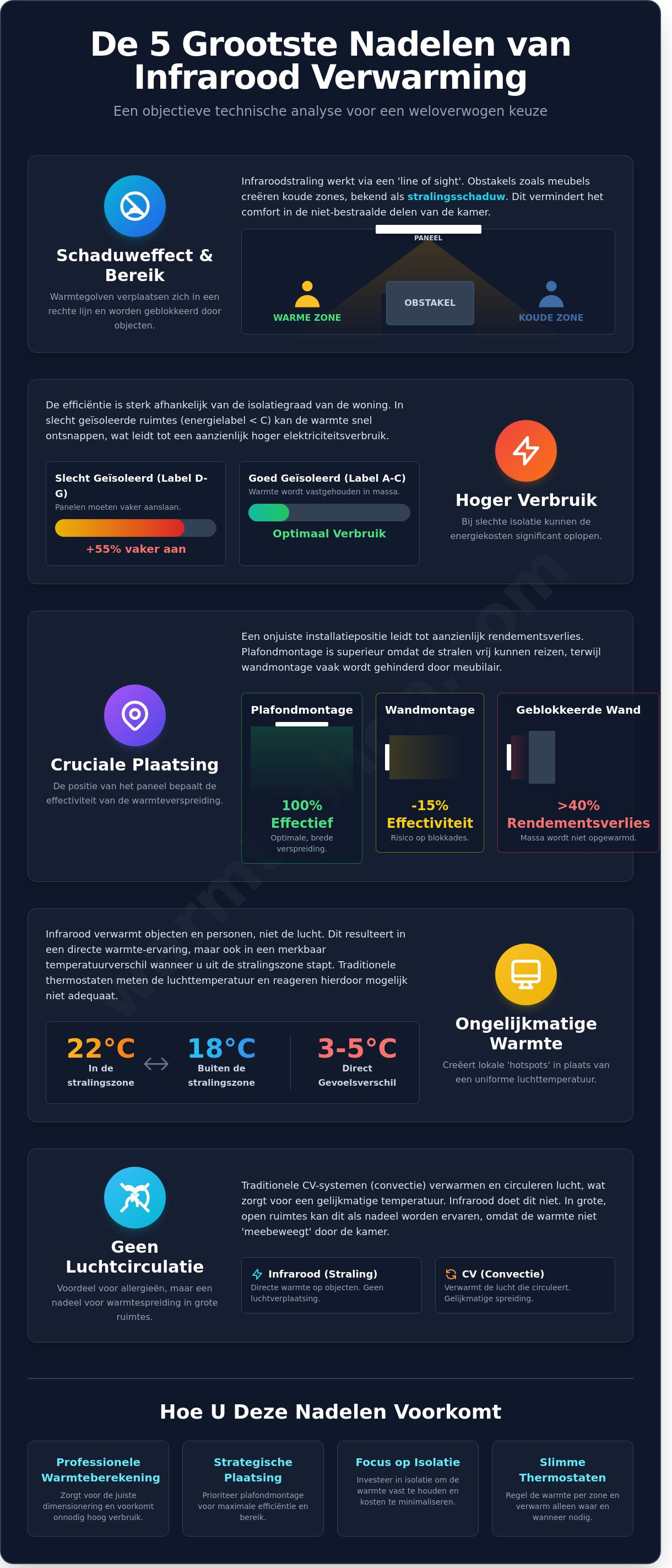
The lack of air circulation is a blessing for people with allergies, but it directly affects the perception of comfort in large spaces. With convection heating, warm air rises, ensuring a reasonably even temperature. Infrared works with zones. If you stand directly in the beam, you feel the warmth; take three steps to the side, the perceived temperature drops immediately by 3 to 5 degrees Celsius. Moreover, traditional thermostats only measure the air temperature. As a result, they do not always switch off at the right moment, which can increase the efficiency of infrared heating if specific radiation sensors are not present.
Infrared panels underperform in rooms with constant drafts or very poor insulation. In a drafty office from 1930, the heat stored in the walls escapes too quickly. Research shows that in such uninsulated spaces, the panels need to switch on up to 55% more often to maintain the desired temperature. It is also difficult to provide a constant level of comfort in large, open warehouses where employees are constantly on the move. The technology is likewise unsuitable for rooms where walls are completely blocked by furniture. If 75% of your wall surface is occupied by cabinets, the panel cannot load the mass of the home, causing efficiency to drop by more than 40%.
It is important to remember that infrared is not an air heater. The system requires an active approach to living, where you place the panels in the areas where you actually spend time. In a bathroom, a 600-watt panel is often effective within 10 minutes, but as the primary heating source in a poorly insulated 40-square-meter living room, energy costs can quickly add up without proper preparation.
In addition to the thermal aspects, there are technical installation challenges. The placement of the panels is critical for your living comfort. If you hang a panel in the wrong place, you will end up with cold feet. Because infrared must heat the floor to create a secondary heat source, an incorrect angle results in an unpleasant temperature distribution. The layer of air just above the floor remains chilly, while you do feel the radiation at head height.
Another technical disadvantage is the lack of thermal storage in the air. As soon as you turn off the panel, the sensation of warmth disappears almost immediately. There is no "buffer" like with a radiator that continues to radiate heat for thirty minutes. This makes the system very responsive, but also less forgiving in drafts or with poorly closing doors. You must also take into account the safety risks of infrared radiation in the event of improper installation. Consider surfaces that reach temperatures of up to 100 degrees Celsius, which can cause immediate burns upon contact.
Finally, there is the aesthetic aspect and the cabling. Each panel requires a power outlet. In existing buildings, this often means concealing cables in the wall or using cable trays, which can disrupt the sleek look of a design panel. Concealing these connections requires extra time and expertise during installation. Would you like to know how to avoid these technical challenges in your specific situation? Then visit one of our local showrooms for expert, tailored advice
To get a fair picture of the disadvantages of infrared heating, we must look at the alternatives. A traditional gas central heating system or a heat pump works via convection, heating the air. Infrared works differently; it heats objects and people directly, just like the radiant heat from the sun. This fundamental difference means that infrared almost always outperforms conventional systems as supplementary heating. After all, you do not need to heat the entire mass of air in a room to be comfortable. This saves directly on the energy bill because the thermostat can often remain 2 degrees lower.
The greatest advantage of infrared lies in the simplicity of the technology. While a gas boiler or heat pump contains complex moving parts such as pumps, fans, and compressors, an infrared panel has not a single moving component. This means that maintenance costs are literally zero. Whereas an average household spends 120 to 180 euros annually on maintenance for a central heating boiler, with infrared panels, this amount remains in the wallet for the entire lifespan. Regarding safety and exposure, it is worthwhile to look at a scientific analysis of health risks. Such research shows that the long-wave radiation from panels for home use is completely safe for the skin and eyes, provided the installation instructions are followed.
Gas heating often causes dry air and dust circulation due to the constant airflow. Infrared panels maintain natural humidity and prevent dust from swirling through the room. Flexibility is another strong point. With infrared, you regulate the heat per room using a precise thermostat. You heat the home office only during office hours, instead of maintaining the temperature of the entire house via a central boiler. This eliminates the inefficiency of heat loss through long pipe runs through walls and floors.
The purchase price of a complete heat pump installation for an average home ranges between 10,000 and 15,000 euros. A complete system with infrared panels is often 70% cheaper to purchase. Additionally, with infrared, you are not bothered by a noisy outdoor unit taking up space in the garden or on the balcony. Although a heat pump achieves a higher efficiency per kW of electricity, the low investment and lack of maintenance make infrared a very competitive strategy. In many cases, a hybrid solution, where infrared heats the bathroom and seating area, is the smartest choice for maximum comfort at minimal cost.
Many of the alleged disadvantages of infrared heating are, in practice, simply the result of incorrect installation or poor planning. When switching to this modern method of heating, a professional heat calculation is your most important foundation. An expert not only looks at the floor area but calculates exactly how many Watts per cubic meter are required based on the insulation value of your home. In a well-insulated home, 25 to 30 Watts per m³ is often sufficient, while an older home from 1970 can easily require 65 Watts per m³. Undersizing is the biggest cause of dissatisfaction; the panel then has to operate constantly at full power without reaching the desired temperature.
Strategic zone heating is the key to a low energy bill. Instead of heating the entire house to 21 degrees, you only heat the rooms where you actually spend time. This reduces energy consumption in unused rooms by as much as 50 percent. By combining infrared heating with a heat pump or existing central heating system, you create a hybrid system. The main heating maintains the base at 18 degrees, while the infrared panels rapidly raise the active living zones to a comfortable 21 degrees. This prevents you from having to compensate for the slowness of traditional systems by leaving them set unnecessarily high.
The position of your panel determines the efficiency. Never hang a panel directly opposite a window. Glass does not reflect long-wave radiation, causing the heat to literally escape outside. Ceiling mounting is often preferred over wall mounting. From the ceiling, the radiation reaches the floor directly. The floor absorbs this heat and releases it slowly, creating an effect comparable to natural underfloor heating. As a result, the floor temperature rises by an average of 2 to 3 degrees compared to heating via the air.
In damp spaces, technology offers an aesthetic solution. Installing an infrared mirror in the bathroom is a smart move to completely eliminate condensation. Because the mirror surface is warmer than the ambient temperature, water vapor has no chance to condense. This keeps your view clear and prevents mold formation in the grout in the long run, significantly extending the lifespan of your bathroom.
A simple on/off system is the shortest route to higher infrared heating disadvantages on your energy bill. Infrared works best with modulating thermostats that accurately meter the power supply. As soon as the desired temperature is reached within a margin of 0.1 degrees, the system switches back. This prevents large temperature fluctuations and saves up to 22 percent on operating costs compared to manual switches.
Modern app control allows you to set schedules per room. For spaces you use infrequently, such as a guest room or garage, motion sensors are indispensable. The panel switches on only when activity is detected and automatically switches off again after 15 minutes of absence. This automation ensures that comfort and sustainability go hand in hand without you having to worry about it.
Do you want to know exactly what power your home needs for optimal efficiency? Request a free heat calculation from Warmteshop for tailored advice.
Making the right choice for a heating system determines whether you experience the disadvantages of often-mentioned infrared heating or instead enjoy superior living comfort. At Warmteshop, we tackle technical challenges at the source. The quality of the housing and the technology used make the crucial difference here. We use exclusively long-wave infrared radiation (IR-C), the healthiest form of radiant heat that penetrates deep into objects and walls without unnecessarily drying out the air. Cheap panels often lose up to 30% of their heat at the back. Our panels are equipped with high-quality reflection and insulation layers, ensuring that 95% of the generated energy is directed directly into the room.
Since our start in 2008, we have continuously refined our systems to meet the strictest European safety standards. This translates into tangible assurance for you as a user. Our products come with a 10-year warranty period, which is unique in a market where technology is evolving rapidly. Whether it concerns an aesthetic photo panel in the living room or a robust industrial blaster for a 450-square-meter workshop, the core value remains flawless operation and minimal energy consumption. With this, we offer a stable anchor in today's, sometimes unpredictable, energy market.
A frequently cited disadvantage of infrared heating is uneven heat distribution. Our experts eliminate this risk by conducting an individual analysis for every project. We use advanced simulations to map radiation patterns. In doing so, we consider not only the surface area of the room but also the insulation value of the walls and the placement of large pieces of furniture. Preventing cold corners is an exact science that we have mastered down to the last detail. With more than 30 showrooms spread across the Benelux, there is always a location nearby where you can experience this sun-like warmth for yourself. There, you will receive a demonstration that translates the theory into the practical application in your own home.
When you have limited free wall space, our ceiling solutions offer the answer. These panels heat the floor in a way comparable to underfloor heating, but without the extensive demolition work. For the specific needs of the bathroom, we have developed a specialized towel radiator . This system solves two problems at once: it heats the room extremely quickly and ensures dry, warm towels, effectively preventing mold growth. The facts show that thoughtful placement immediately eliminates most of the disadvantages of infrared heating.
Request a free heat calculation from Warmteshop today and discover how our expertise can transform your home into a sustainable and comfortable environment.
Making a sustainable choice for your home in 2026 requires a fair assessment of all technical aspects. The disadvantages of infrared heating demonstrate that a successful transition hinges on an expert plan and the correct sizing of the panels. When you utilize the technology correctly, you transform these points into an efficient system that offers immediate comfort without wasting energy. The switch to radiant heat is not a complicated task, but a logical step towards a carbon-neutral future in which you enjoy the sun in your own home.
Warmteshop has been guiding you through this energy transition with tangible expertise for over 15 years. Thanks to our 30+ physical showrooms in Belgium and the Netherlands, you always receive personal advice tailored to your specific living situation. Our certified installation service takes all the worry off your hands, ensuring that your system performs optimally. Treat yourself to the luxury of a healthy indoor climate and a lower energy bill by choosing proven quality.
Discover the full range of infrared heating from Warmteshop
Your ideal living comfort is just one step away.
In many living situations, infrared heating is 10 to 20 percent cheaper to operate than gas, provided the home has basic insulation. Whereas a traditional central heating boiler often loses 15 percent of heat through pipes and the chimney, an infrared panel converts 100 percent of the electricity directly into usable radiant heat. In combination with solar panels, you can even reduce heating energy costs to zero euros.
You won't suffer from cold feet because the infrared radiation heats objects such as the floor and furniture directly. These objects retain the energy and release it gradually, causing the floor temperature to often be 2 to 3 degrees higher than with air heating. This prevents the annoying cold draft across the floor caused by the air circulation of standard radiators.
The radiation from infrared panels is completely safe and even healthy, as the panels use exclusively long-wave IR-C radiation. This technology mimics the natural warmth of the sun without the harmful UV radiation, which stimulates blood circulation and reduces muscle tension. Because no air is circulated, 80 percent less dust and pollen swirl through the room, which is a relief for people with allergies.
Yes, infrared heating is highly suitable as the primary heating system for your entire home or office space. When discussing the disadvantages of infrared heating, people often think that the output is insufficient, but with a calculation of 25 to 35 Watts per cubic meter, you create a stable and comfortable indoor climate. By equipping each room with its own thermostat, you save energy by only heating the spaces you actually use.
On average, for a standard living room of 25 square meters, you need two to three panels for even heat distribution. The exact requirement depends on the total volume of the room; for modern homes, we calculate with 30 Watts per cubic meter. In a compact bathroom of 6 square meters, one panel of 400 to 600 Watts is usually sufficient to quickly bring the room to the desired temperature.
Additional insulation is not strictly necessary, but a good insulation value significantly increases the efficiency of your new heating system. In a moderately insulated home, a panel needs to switch on 20 percent more often to maintain the temperature, which affects monthly electricity costs. We recommend at least double glazing and basic wall insulation so that the absorbed heat remains optimally within your home's structure.
A high-quality infrared panel lasts an average of 25 to 30 years without requiring interim technical maintenance. Because the system contains no moving parts, fluids, or pumps, wear and tear on the internal components is minimal. This makes the investment very sustainable compared to a heat pump or central heating boiler, which often require expensive repairs or complete replacement after 12 to 15 years.
You can easily mount infrared panels to the wall or ceiling yourself using the included brackets and a standard plug. However, for a sleek finish where the cables are concealed within the wall, the expertise of a certified installer offers significant added value. For larger projects, our professional ensures ideal positioning so that the radiation reaches every corner of the room for the highest level of comfort.


