

Infrared heating consumption: What will it really cost in 2026?
, by Warmteshop Infrared heating, 16 min read
, by Warmteshop Infrared heating, 16 min read
Are you worried about rising energy prices and wondering how you'll keep your home comfortably warm in 2026 without racking up a sky-high bill? You're not alone. The transition to a sustainable, gas-free future is…
Are you worried about rising energy prices and wondering how you'll keep your home comfortably warm in 2026 without a sky-high bill? You're not alone. Switching to a sustainable, gas-free future raises questions, especially when it comes to costs. Uncertainty about infrared heating's actual energy consumption and the confusion between wattage and actual costs can make the decision difficult. Is electric heating really more cost-effective than gas?
A strategic renovation can make all the difference here. If you are considering switching to a tiled floor that retains radiant heat better, having the carpet professionally removed an essential first step to prepare the subfloor.
The key to low consumption is precision in control. Choose advanced thermostats with self-learning functions that recognize your living patterns and adjust the heating accordingly. For the ultimate sustainable solution, combine your infrared heating with solar panels. The electricity you generate yourself is used directly, drastically reducing your energy costs and creating a CO2-neutral heat source. A reliable partner for the installation of this is, for example, Zonnepanelen Brabant BV.
In this article, we'll give you the clarity you're looking for. We'll debunk the myths and offer you an honest, transparent look at the costs. Discover what to expect with concrete calculation examples for different rooms. We'll compare the costs with a traditional gas system and provide you with smart, immediately applicable tips to keep your energy consumption as low as possible. This way, you can make an informed choice for a future full of healthy, efficient, and affordable heating.
The actual consumption of infrared heating is a dynamic figure determined by more than just the power output on the label. Whereas traditional convectors heat the air—a slow and often inefficient process—infrared panels work with direct radiant heat. This heat is comparable to the sun's rays: they do not heat the air, but directly the objects, walls, and people in the room. For those wishing to delve deeper into the technology, the page on what infrared heating is a comprehensive explanation. These objects (the so-called thermal mass) store the heat and release it gradually, ensuring a stable and pleasant indoor climate. The key factors influencing your consumption are the panel's power output, the insulation level of your home, and how you use the system.
A common misconception is that an 800-watt infrared panel actually consumes 0.8 kWh per hour. In practice, this is rarely the case. A smart thermostat ensures that the panel only switches on when the temperature drops below the desired level. In a well-insulated room, a panel is active for an average of only 20 to 30 minutes per hour to maintain the temperature. Paradoxically, a panel with a slightly higher output (oversized) can sometimes be more energy-efficient. It heats the room faster and therefore has a shorter total operating time, which benefits the energy consumption of your infrared heating.
Insulation is the most crucial factor for an energy-efficient system. In a passive house or a very well-insulated new building, energy consumption will be minimal because the generated heat has nowhere to escape. In an older, poorly insulated house, the panel will have to work harder. Thermal bridges, such as around windows or in corners, can significantly reduce efficiency. Therefore, panel placement is essential. Ceiling mounting is often the most efficient: the rays reach the floor and furniture unobstructed, allowing the entire room to act as a heat battery and optimally distribute the heat.
Estimating infrared heating consumption seems complex, but with the right formula, you'll quickly get a clear picture. Unlike traditional systems that heat the air, infrared provides direct radiant heat. This not only makes the calculation different but also much more predictable. Follow these steps for an accurate estimate of your future costs.
Suppose you have a 30 m² living room with average insulation. You need 2,100 Watts (2.1 kW) of panels. During the heating season (180 days), you use the heating for 8 hours a day, of which it is effectively switched on for 4 hours thanks to a smart thermostat. At an electricity rate of €0.35 per kWh, the calculation becomes: (2.1 kW x 4 hours x 180 days) x €0.35 = €529.20 per year. Unlike a high-efficiency boiler, which loses a lot of energy heating air that subsequently rises, the efficiency of radiant heat that direct heating of objects and people is much more targeted and economical.
In the bathroom, speed and comfort are essential. A infrared mirror is ideal here. It heats up instantly and prevents condensation. If you use the mirror for 30 minutes (0.5 hours) per day, the cost per shower is just: (0.6 kW x 0.5 hours) x €0.35 = €0.11. The major saving lies in the fact that you do not need to start up the central heating for a single short, comfortable heat requirement. This makes it an extremely efficient solution for zone heating.
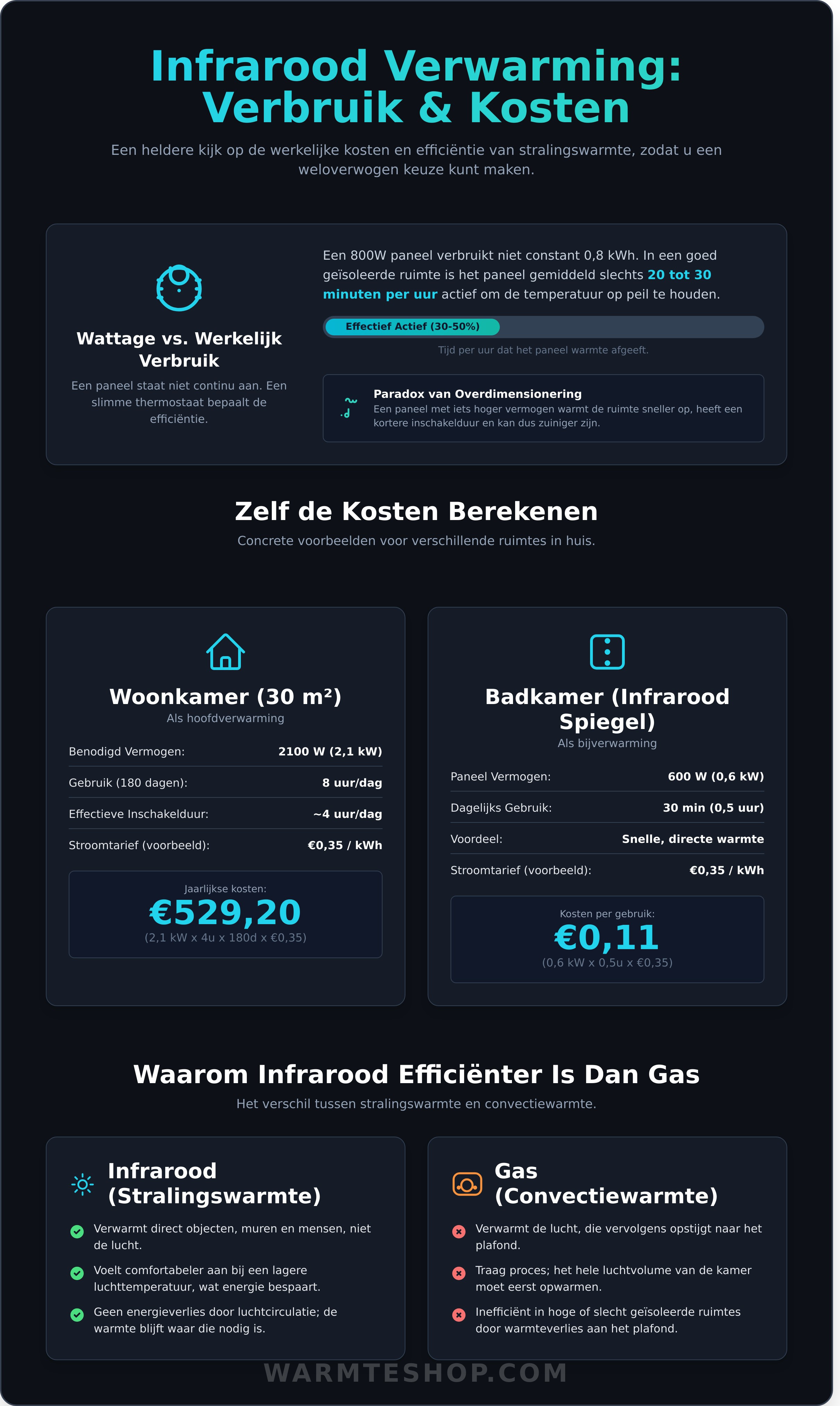
The comparison between infrared heating and a traditional gas-fired central heating system goes beyond just the energy source. The fundamental difference lies in the way heat is transferred. Whereas a central heating boiler heats the air (convection), infrared panels directly heat objects, walls, and people (radiant heat). This leads to more efficient and pleasant consumption of your infrared heating.
Convection heat rises, cools down, and descends again, leading to constant air circulation and significant heat loss through ceilings and cracks. Radiant heat, on the other hand, is stored in the mass of the room, such as your furniture and walls, which then release the heat evenly. This ensures a more stable and comfortable heating experience. As a result, a room temperature of 19°C with infrared feels just as comfortable as 21°C with convection heat. This comfort advantage, which directly leads to a lower thermostat setting and thus less energy consumption, is supported by various studies, including an in-depth UK government study on infrared heating that confirms positive user experiences with thermal comfort.
Moreover, the Total Cost of Ownership is significantly lower. Infrared panels are completely maintenance-free and have a much longer lifespan than a central heating boiler. In the transition to gas-free living, investing in infrared heating is therefore a smart, future-proof choice that immediately contributes to a lower energy bill.
The efficiency of infrared heating is unparalleled. The technology converts electricity directly into tangible radiant heat with nearly 100% efficiency. There are no transport losses through pipes and radiators, unlike with a central system. This makes infrared ideal for zone heating: you only heat the areas you are currently using, such as the living room or your home office, drastically reducing total energy consumption.
A healthier indoor climate indirectly contributes to lower energy consumption. Because infrared doesn't circulate the air, the spread of dust and allergens is minimized. Humidity remains stable, which makes you feel more comfortable. Because walls are heated directly, moisture and mold don't have a chance. A healthy, comfortable living environment means less frequent and intensive ventilation is needed, keeping valuable heat inside.
An infrared panel is inherently very energy-efficient, but the real savings are achieved through a smart approach. The way you install, control, and size the system has a direct impact on your energy bill. With the right strategy, you can further optimize the consumption of your infrared heating and enjoy maximum comfort at minimal cost.
The benefits often lie in the details. For example, strategically position your panels on surfaces with a high thermal mass, such as a tiled floor or a brick wall. These objects absorb the direct radiant heat, store it, and then slowly and evenly release it back into the room. This creates a pleasant warmth buffer that remains noticeable even after the panel is switched off.
The key to low consumption is precision in control. Choose advanced thermostats with self-learning functions that recognize your living patterns and adjust the heating accordingly. For the ultimate sustainable solution, combine your infrared heating with solar panels. The electricity you generate yourself is used directly, drastically reducing your energy costs and creating a CO2-neutral heat source.
Modern infrared systems offer unprecedented control. Use timer programs to set the bathroom to heat only in the morning and evening. Unexpectedly away for a longer period? Easily turn down the heat with Wi-Fi control via your smartphone. By integrating the panels into your smart home system, you can optimize your own solar energy consumption and perfectly tailor the heating to your lifestyle.
Choosing the right power is crucial. A panel with insufficient wattage for the room will have to operate continuously without reaching the desired temperature, which leads to unnecessarily high energy consumption. It's often more efficient to install two smaller panels than one large one for better heat distribution. Therefore, always have our experts perform a professional heat loss calculation. This ensures an optimally performing and energy-efficient system.
Switching to a sustainable heating solution is an important decision. With over 18 years of experience in energy efficiency, Warmteshop is your reliable guide in the energy transition. We understand that every home is unique and requires a personalized approach. That's why we translate our technical expertise into clear and practical advice, so you can make a well-informed choice for a comfortable, gas-free future.
Quality forms the basis of an efficient system. To infrared heating consumption as low as possible, we work exclusively with premium European brands such as Ecaros and Alkari. These manufacturers guarantee a long lifespan, maximum heat output, and flawless operation. However, a high-quality panel is only half the battle. Our professional installation service ensures perfect placement and adjustment. This guarantees optimal efficiency and prevents unnecessary energy loss, which is essential for your long-term savings.
Your ideal heating plan begins with a personal consultation. We start with a free quote and a detailed installation plan, created based on your specific living situation, insulation value, and wishes. Aesthetics and functionality go hand in hand. Whether you choose elegant towel radiators in the bathroom, a concealed ceiling panel, or a designer panel with your own photo, our solutions will become a seamless part of your interior. This way, we provide practical support in achieving a CO2-neutral and stylish home.
Experience the pleasant warmth for yourself and discover the possibilities for your home. You are welcome to visit one of our more than 30 showrooms in the Benelux for personalized advice.
Take the first step toward lower energy bills and a more comfortable home today. Request a free quote for your infrared project now and invest in the warmth of the future.
It is clear: infrared heating consumption is not a fixed figure, but the smart result of a well-thought-out approach. You have discovered that factors such as insulation, the right power output, and strategic placement are the key to maximum efficiency. Unlike traditional systems that heat air, direct radiant heat delivers a superior sense of comfort with significantly less energy, which translates directly into a lower bill.
Switching to this future-proof heat source is an important decision. That's why Warmteshop is your trusted guide with over 18 years of experience in the Benelux. In our 30+ physical stores, you'll receive personalized advice, and our certified installers guarantee professional installation for the highest efficiency.
Are you ready to take control of your energy bill and enjoy healthy, comfortable warmth? Discover how much you can save with infrared panels from Warmteshop and take the step toward a gas-free, stylish, and energy-efficient future today.
A direct comparison is complex because the systems operate differently. Gas heating warms the air throughout an entire house, while infrared heats objects and people in targeted zones. This eliminates the need to heat unused spaces, leading to more efficient energy use. This makes infrared often more cost-effective, especially as supplementary heating or in specific rooms, especially when combined with solar panels and rising gas prices.
The required power depends heavily on your home's insulation. As a rule of thumb, you can expect 50-75 watts per m² for a well-insulated space. For a moderately insulated home, this is approximately 75-100 watts per m², and in a poorly insulated space, this can be as much as 120 watts per m². For a precise calculation tailored to your unique situation, our experts are happy to provide personalized advice.
You can leave infrared panels on all day, but this isn't the most efficient way to use them. The strength of infrared lies in its rapid heat-up time; you'll feel the comfortable radiant heat within minutes. It's much smarter to only switch the panels on when you're in the room. A thermostat helps you automate this process, so you can enjoy personalized warmth without unnecessary energy consumption.
A smart thermostat can save you considerably. Depending on your usage patterns, savings can reach up to 30%. A smart thermostat ensures that the panels only heat when absolutely necessary, for example, through a timer program or presence detection. This prevents unnecessary energy consumption and optimizes the use of your infrared heating, while you always enjoy the perfect temperature at the right time.
With Warmteshop's high-quality infrared panels, the color or material, such as glass or metal, has no noticeable impact on energy consumption. Efficiency is determined by the quality of the internal heating element and the special coating that optimizes radiation. So you can confidently choose the design that perfectly complements your interior, without compromising the panel's performance or energy efficiency.
An infrared panel in the bathroom is very efficient because you use it for short periods. A 600-watt (0.6 kWh) mirror panel used for an hour a day—for example, 30 minutes in the morning and 30 in the evening—consumes only 0.6 kWh per day. At an electricity rate of €0.30 per kWh, this costs you just €0.18 per day. This way, you can enjoy a wonderfully warm bathroom at a very low cost.
The payback period for infrared panels typically ranges from 3 to 7 years. This depends on how you use the panels (as primary or supplementary heating), current energy prices, and your home's insulation. Because the panels are completely maintenance-free and have a lifespan of over 25 years, they are a highly profitable and future-proof investment in comfort and sustainability.
Yes, infrared heating can actually be a godsend in a less well-insulated house. Because the radiant heat directly warms you and the objects instead of the air, you experience comfort more quickly without heat escaping through cracks. However, objects will cool down faster, meaning the panels will need to switch on more often. As a result, the energy consumption of infrared heating will be higher. It is therefore always advisable to improve the insulation first for maximum efficiency.


